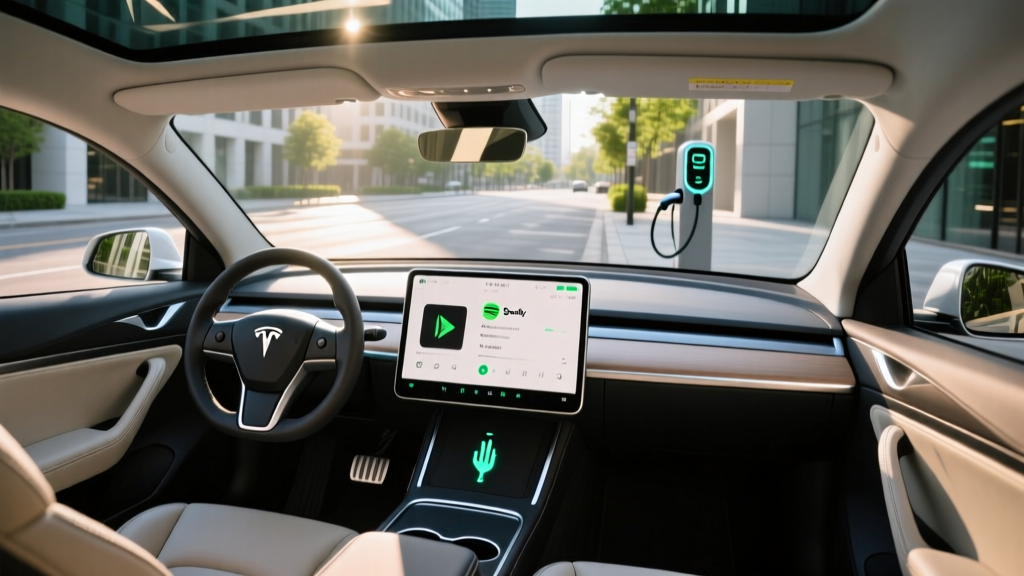
If you're searching for the Tesla Spotify experience, you're likely evaluating the Model 3 not just as a commuter EV but as a daily digital companion. Tesla's infotainment system — anchored by a 15.4-inch center touchscreen — integrates Spotify natively, allowing drivers to stream music, podcasts, and playlists directly through the car's 17-speaker premium audio system without relying on phone-based Bluetooth or Apple CarPlay (which Tesla still doesn't support in 2026). But the infotainment story is only part of the equation. This review covers the 2026 Tesla Model 3 Long Range AWD end to end: real-world range, DC fast-charge performance, battery chemistry, pricing after federal incentives, and whether it still holds up against a growing field of rivals.
2026 Tesla Model 3 Long Range AWD: Core Specifications
| Spec | 2026 Model 3 Long Range AWD |
|---|---|
| EPA Range | 363 miles |
| Real-World Range (highway 70 mph) | ~290–310 miles |
| Real-World Range (cold, 20°F) | ~240–270 miles |
| Battery Capacity (usable) | ~79 kWh (NMC chemistry) |
| Efficiency | 132 MPGe combined / 25 kWh/100 mi |
| Max DC Fast Charge | 250 kW (peak) |
| 10–80% DC Charge Time | ~25 minutes |
| Level 2 Home Charging | 11.5 kW (~44 mi/hr) |
| 0–60 mph | 4.2 seconds |
| Horsepower | ~384 hp (dual motor) |
| Drivetrain | Dual Motor AWD |
| Cargo Volume | 23 cu ft (trunk + frunk combined) |
| Rear Legroom | 35.2 inches |
| Base MSRP | $42,490 (before incentives) |
| Battery Warranty | 8 years / 120,000 miles |
Spotify & Infotainment: The Tesla Digital Cockpit Experience
Tesla's approach to infotainment is entirely proprietary. There is no Apple CarPlay, no Android Auto, and no physical instrument cluster — everything routes through the central 15.4-inch touchscreen running Tesla's in-house software. For many buyers, this is a dealbreaker; for others, it's the cleanest interface on the market.
Spotify integration is a first-class feature. Unlike Bluetooth streaming from your phone, the native Spotify app runs directly on the vehicle's computer, offering:
- Full playlist and album browsing on the touchscreen
- Voice-command playback ("Play my Discover Weekly")
- Seamless handoff — pause on your phone at home, resume in the car
- Playback over Tesla's built-in LTE connection (Premium Connectivity subscription required for streaming while driving, $9.99/month)
- Integration with Tesla's "Camp Mode" and "Dog Mode" for ambient listening while parked
The 17-speaker audio system (with dual subwoofers and immersive sound processing) is among the best in any vehicle under $60,000. It handles bass-heavy tracks cleanly and offers a genuine spatial audio experience. Spotify sounds noticeably better through the native integration than through Bluetooth, which compresses the audio stream.
Notable infotainment drawbacks: The absence of Apple CarPlay/Android Auto means you're locked into Tesla's app ecosystem. Navigation is Tesla-only (no Google Maps or Waze on-screen, though the Tesla nav is competent). Climate controls live entirely on the touchscreen — there are no physical knobs, which frustrates some drivers during spirited driving or when wearing gloves.
Charging Speed: Supercharger Network and Home Charging
Charging remains one of Tesla's strongest competitive advantages in 2026, primarily because of the Supercharger network — now exceeding 6,000 stations and 60,000+ stalls in North America. While competitors using CCS or NACS connectors from other networks have gained ground (many now access Superchargers via adapter), Tesla owners still enjoy the most seamless plug-and-charge experience.
| Charging Method | Power | Speed (Miles Added) | Notes |
|---|---|---|---|
| Level 1 (120V household) | ~1.4 kW | ~4–5 mi/hr | Emergency/trickle only |
| Level 2 (240V, 48A Wall Connector) | 11.5 kW | ~44 mi/hr | Full overnight charge in ~7–8 hours |
| DC Fast Charge (Supercharger V3/V4) | 250 kW peak | ~175 mi in 15 min | Peak rate at low SoC; tapers above 60% |
| DC Fast Charge (3rd-party NACS) | Varies (50–350 kW) | Varies | Now widely compatible at EA, ChargePoint stations |
Charging curve reality: The Model 3 Long Range peaks at 250 kW only when the battery is preconditioned and below ~30% State of Charge (SoC). Above 60% SoC, the charge rate drops significantly — typically to 100–120 kW by 70%, and below 50 kW above 85%. This is standard behavior for NMC lithium-ion packs to protect cell longevity. A 10–80% session takes roughly 25 minutes at a V3/V4 Supercharger. Plan to charge to 80% on road trips and move on rather than waiting for a full top-off.
Home charging setup: Tesla's Wall Connector ($420) is a solid Level 2 unit. Installation typically costs $500–$2,000 depending on your electrical panel's proximity to the garage and whether a panel upgrade (to 200A service) is needed. Most Model 3 owners charge overnight at home and arrive at a full battery every morning — the single biggest quality-of-life advantage of EV ownership.
Performance, Efficiency, and Driving Dynamics
The 2026 Model 3 Long Range AWD delivers 384 horsepower from its dual-motor setup, hitting 0–60 mph in 4.2 seconds. That's brisk enough to merge onto any highway with authority and pass without hesitation. The single-speed transmission means power delivery is instant and linear — no shift lag, no turbo spool.
Efficiency is where Tesla's engineering still leads the pack. At 132 MPGe combined (25 kWh per 100 miles), the Model 3 Long Range sips electrons more sparingly than nearly every competing EV sedan. For context, the Hyundai Ioniq 6 Long Range achieves 140 MPGe but with less power, while the BMW i4 xDrive40 sits at 97 MPGe with a heavier platform. Tesla's low drag coefficient (0.219 Cd), heat pump, and efficient powertrain contribute to this advantage.
Ride quality in the refreshed Model 3 (introduced for 2024 and carried forward) is markedly improved over earlier builds. The cabin is quieter thanks to acoustic glass, and the suspension absorbs road imperfections more competently. It's still a firm ride — sportier than a Camry, softer than a 3 Series — but the gap between Tesla and legacy luxury sedans has narrowed considerably.
Pricing, Tax Credits, and Total Cost
| Trim | MSRP | Est. Price After §30D Credit |
|---|---|---|
| Model 3 RWD | $38,990 | ~$31,490* |
| Model 3 Long Range AWD | $42,490 | ~$34,990* |
| Model 3 Performance | $52,990 | ~$45,490* |
*Federal tax credit eligibility under IRS §30D requires meeting multiple criteria. The $7,500 credit is not guaranteed for every buyer.
§30D Federal Tax Credit Eligibility Checklist (2026):
- MSRP Cap: Vehicle base price must be ≤ $55,000 for sedans (all Model 3 trims qualify)
- Buyer Income Cap: Modified AGI ≤ $150,000 (single) / $300,000 (joint filing)
- Battery Sourcing: Critical minerals and battery components must meet phased-in domestic/free-trade sourcing thresholds — Tesla has worked to comply, but confirm current-year status at purchase
- Point-of-Sale Transfer: As of 2024+, buyers can transfer the credit to the dealer for an immediate price reduction at purchase rather than waiting to claim on tax return
- Final Assembly: Must be assembled in North America (Model 3 is built in Fremont, CA and Austin, TX — qualifies)
Consult a tax professional and check fueleconomy.gov for the latest eligible VIN list before purchasing.
Warranty, Safety, and Long-Term Ownership
Tesla provides an 8-year/120,000-mile battery and drive unit warranty for the Model 3 Long Range AWD (the RWD trim gets 8 years/100,000 miles). The warranty guarantees the battery will retain at least 70% of its original capacity during the coverage period. Real-world degradation data from Tesla's fleet suggests most Model 3 packs retain 90%+ capacity at 100,000 miles — among the best in the industry.
The vehicle limited warranty is 4 years/50,000 miles, which is average for the segment but shorter than Hyundai's 5-year/60,000-mile bumper-to-bumper coverage. Tesla does not offer free scheduled maintenance because there is very little required — no oil changes, no spark plugs, no transmission fluid. Cabin air filter replacement and tire rotation are the primary service items.
Safety ratings remain excellent. The Model 3 earned a 5-star overall rating from NHTSA and was named an IIHS Top Safety Pick+. Standard active safety features include automatic emergency braking, blind-spot monitoring, lane-departure warning, and rear cross-traffic alert.
Autopilot and FSD (Supervised): Every Model 3 ships with basic Autopilot (traffic-aware cruise control and lane-centering). Full Self-Driving (Supervised) is an optional $8,000 add-on (or $99/month subscription) that adds features like automatic lane changes, traffic light recognition, and city street navigation. However, FSD remains an SAE Level 2 system — the driver must remain fully engaged, hands on or near the wheel, and eyes on the road at all times. It is not autonomous driving.
Pros and Cons: 2026 Tesla Model 3
Pros
- Class-leading 363-mile EPA range
- Supercharger network — most reliable DC charging in North America
- Native Spotify and premium 17-speaker audio
- 132 MPGe efficiency — lowest cost-per-mile in its class
- Over-the-air updates continuously add features
- Strong resale value relative to most EVs
- Minimal maintenance costs
Cons
- No Apple CarPlay or Android Auto
- No physical buttons or knobs for climate/audio
- Premium Connectivity required for in-car Spotify streaming ($9.99/mo)
- Rear seat space is tight for tall adults (35.2" legroom)
- FSD is expensive and still requires full driver supervision
- Service center availability varies by region — long wait times in some areas
- Turn signal stalks removed — signals on steering wheel buttons (controversial)
How It Compares: Model 3 vs. Key Competitors
The 2026 Model 3 Long Range AWD competes directly with the Hyundai Ioniq 6 ($42,500, 361-mi range), BMW i4 eDrive40 ($52,200, 307-mi range), and Polestar 2 Long Range ($49,900, 320-mi range). Here's how the decision breaks down:
Choose the Tesla Model 3 if: You prioritize maximum range, the lowest cost-per-mile, Supercharger access, native Spotify integration, and Tesla's software ecosystem. It's the data-driven efficiency pick.
Choose the Hyundai Ioniq 6 if: You want comparable range at a similar price but prefer physical buttons, Apple CarPlay/Android Auto, Hyundai's longer warranty (10-year/100,000-mile powertrain), and a more conventional interior layout.
Choose the BMW i4 if: You value brand prestige, a more luxurious interior, superior ride isolation, and don't mind paying a $10,000+ premium for a shorter-range vehicle.
Frequently Asked Questions
Does Tesla have Spotify built in?
Yes. Every Tesla vehicle (Model 3, Y, S, X) includes a native Spotify app that runs directly on the car's infotainment system. You can log in with your Spotify account, browse playlists, and stream over the car's LTE connection or Wi-Fi. Premium Connectivity ($9.99/month) is required to stream while driving without Wi-Fi.
Can I use Apple CarPlay or Android Auto with a Tesla?
No. Tesla does not support Apple CarPlay or Android Auto in any model as of 2026. The company's philosophy is to keep drivers within its own software ecosystem. If CarPlay is a must-have, consider the Hyundai Ioniq 6 or BMW i4 instead.
What is the real-world highway range of the Model 3 Long Range?
While the EPA rates it at 363 miles, real-world highway driving at 70–75 mph typically yields 290–310 miles. In cold weather (below 30°F), expect 240–270 miles. Tesla's heat pump and battery preconditioning help, but plan conservatively for road trips.
How long does it take to charge the Model 3 at a Supercharger?
At a V3/V4 Supercharger (250 kW peak), a 10–80% session takes approximately 25 minutes with a preconditioned battery. Peak charging speed only holds at low State of Charge — the rate tapers significantly above 60%. Plan to charge to 80% and move on rather than waiting for a full top-off.
Does the 2026 Tesla Model 3 qualify for the $7,500 federal tax credit?
The Model 3 is eligible for up to $7,500 under IRS §30D, provided the buyer meets income caps (≤$150K single / ≤$300K joint), the vehicle is assembled in North America (it is), and battery sourcing requirements are met for the specific model year. The credit can be transferred to the dealer at point of sale for an instant price reduction. Always verify eligibility on irs.gov and consult a tax professional before purchasing.
Is the Model 3 a good car for road trips?
Yes — it's one of the best EVs for road trips thanks to 363-mile range, the Supercharger network (fastest and most reliable in North America), and competent built-in navigation with automatic route planning around charging stops. The main limitation is rear seat comfort for adults on trips longer than 3–4 hours.
How much does it cost to charge a Model 3 at home?
At the US average electricity rate of ~$0.17/kWh, a full charge (79 kWh) costs approximately $13.43. That's roughly $0.04–$0.05 per mile — about one-third the fuel cost of a comparable gas sedan getting 30 MPG at $3.50/gallon. Actual costs vary by state and utility rate plan; time-of-use plans can lower costs further by charging overnight.