When shoppers ask "how fast is the Tesla," they are usually thinking about the Model 3 — the brand's volume seller and the most accessible entry point into the Tesla ecosystem. For the 2026 model year, the refreshed Model 3 (internally dubbed "Highland" and now in its second production year) offers three distinct trims, each with a very different answer to that question. Below, we dissect every performance, range, and charging metric with real-world context so you know exactly what you're getting before you configure one.
2026 Tesla Model 3 Quick-Reference Specs
| Spec | RWD Standard Range | Long Range AWD | Performance AWD |
|---|---|---|---|
| 0-60 mph | 5.8 sec | 4.2 sec | 2.9 sec |
| Horsepower | ~271 hp | ~346 hp | ~510 hp |
| Drivetrain | RWD (single motor) | Dual-motor AWD | Dual-motor AWD |
| Battery (usable) | ~57.5 kWh (LFP) | ~75 kWh (NMC) | ~75 kWh (NMC) |
| EPA Range | 272 mi | 341 mi | 315 mi |
| MPGe (combined) | 132 MPGe | 131 MPGe | 118 MPGe |
| Efficiency | 25 kWh/100mi | 25 kWh/100mi | 28 kWh/100mi |
| Top Speed | 125 mph | 125 mph | 163 mph |
| Base MSRP | $38,990 | $47,740 | $54,990 |
Sources: fueleconomy.gov, Tesla.com configurator (2026 MY).
How Fast Is the Tesla Model 3? 0-60 and Real-World Performance
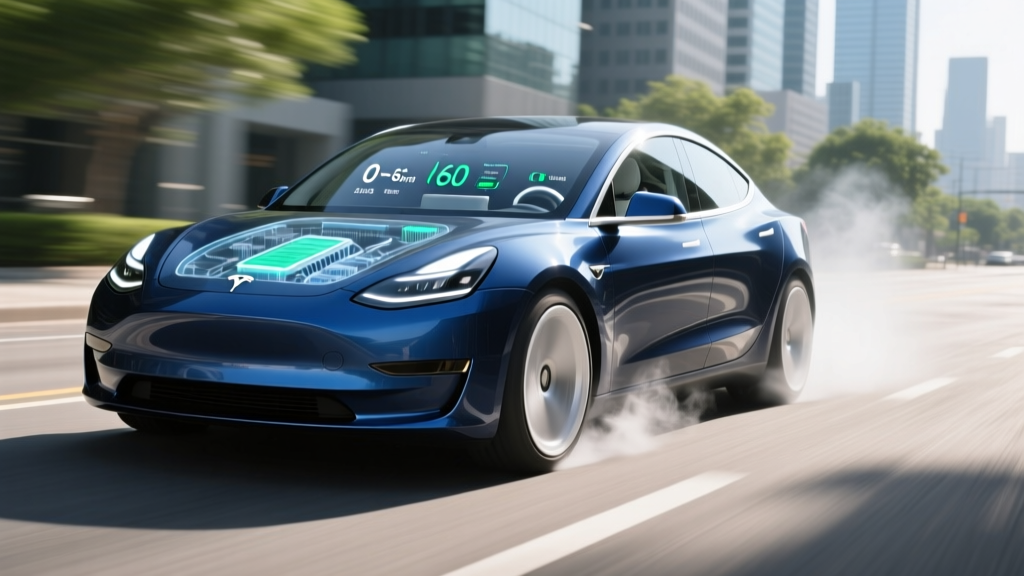
The short answer: anywhere from genuinely quick to supercar-rivaling, depending on trim. The RWD Standard Range model hits 60 mph in 5.8 seconds — brisk enough for confident highway merging and passing, though it won't pin you to the seat. The Long Range AWD drops that to 4.2 seconds, which is firmly in sports-sedan territory. The Performance trim, at 2.9 seconds, competes with a Porsche Taycan 4S or a BMW M3 Competition, but at a fraction of the price.
What the spec sheet doesn't convey is the instantaneous torque delivery. Unlike turbocharged gas engines that need a beat to build boost, the Model 3's electric motors respond in milliseconds. In real-world driving, this makes the RWD model feel faster around town than its 5.8-second time suggests. The Performance model's dual-motor torque vectoring also provides exceptional grip on wet or uneven surfaces — the car reads traction loss and redistributes torque before you notice a slip.
Track-package Performance models (with the optional $5,000 Track Package) include higher-performance brake pads, lightweight wheels, and a lowered adaptive suspension that sharpens cornering at the cost of some ride comfort. Without the package, the Performance trim still rides on adaptive dampers but with a more compliant default tune.
Real-World Range vs. EPA Estimates
- RWD (EPA 272 mi): Expect ~230-245 mi in mixed highway driving at 70-75 mph. In winter (below 32°F), plan for 190-210 mi due to cabin heating and battery resistance.
- Long Range AWD (EPA 341 mi): Expect ~285-305 mi highway. Winter reduces this to ~240-260 mi. City and suburban driving with regen braking can push close to 320 mi in mild weather.
- Performance AWD (EPA 315 mi): Expect ~255-275 mi highway. Aggressive driving and larger 20" wheels reduce efficiency. Winter range drops to ~220-240 mi.
The Model 3 Highland's improved thermal management and standard heat pump (on all trims) help mitigate cold-weather losses compared to the pre-refresh model, but physics still applies: cold batteries and cabin heating cost 15-25% of range.
Tesla's efficiency numbers remain among the best in the segment. The RWD and Long Range trims achieve 25 kWh per 100 miles, which translates to roughly 4 miles per kWh — meaning even modest battery sizes yield strong range. The Performance model's 28 kWh/100mi reflects its stickier tires, heavier motor output, and more aggressive aerodynamic drag from wider wheels.
Charging Speed: DC Fast Charge and Home Level 2
| Charging Level | RWD (LFP) | Long Range / Performance (NMC) |
|---|---|---|
| Level 1 (120V, 12A) | ~3 mi/hr | ~3 mi/hr |
| Level 2 (240V, 48A) | ~33 mi/hr (11.5 kW) | ~44 mi/hr (11.5 kW) |
| DC Fast Charge (peak) | 170 kW | 250 kW |
| DC 10-80% time | ~28 min | ~25 min |
| Sustained DC rate (avg 10-80%) | ~110 kW | ~165 kW |
| Connector | NACS (native) | NACS (native) |
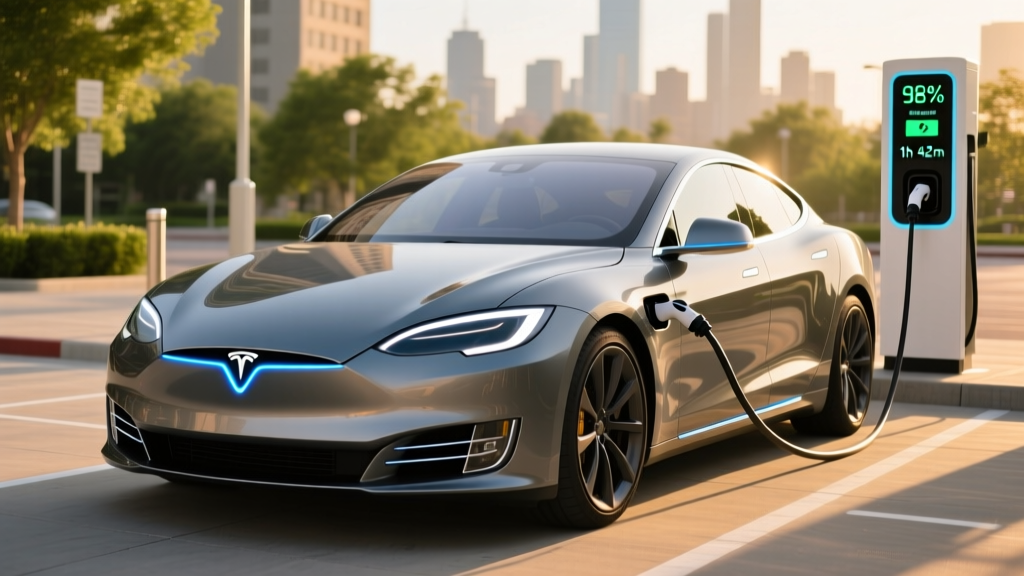
The Model 3 charges natively on the NACS connector, which is now the North American standard adopted by Ford, GM, Rivian, Volvo, and most major automakers as of 2025-2026. This gives you native access to the Tesla Supercharger network — over 22,000 stalls in North America — without an adapter, a significant practical advantage over CCS-equipped competitors still relying on adapters.
On a V3 Supercharger (250 kW), the Long Range and Performance trims peak at 250 kW but sustain roughly 165 kW on average between 10-80% SoC. The charge curve tapers significantly above 80% — a full 80-100% top-off can add another 20+ minutes. For road trips, plan stops around the 10-80% window for the best time efficiency.
The RWD trim's LFP (lithium iron phosphate) battery charges more slowly at a 170 kW peak. LFP chemistry trades peak charge speed for a key advantage: Tesla recommends charging LFP batteries to 100% regularly, effectively giving you the full 57.5 kWh usable capacity daily. NMC batteries (Long Range/Performance) are best kept between 20-80% for daily use to maximize longevity, reserving 100% charges for road trips.
For home Level 2 charging, a 48-amp Tesla Wall Connector on a 60-amp circuit delivers up to 11.5 kW. That's roughly 33-44 miles of range per hour of charging — more than enough to fully replenish any Model 3 overnight (7-10 hours from near-empty). Installation typically costs $800-$2,000 including the $475 Wall Connector, depending on your panel capacity and run distance. Homes with 100-amp panels may require a $1,500-$3,000 panel upgrade to 200 amps — get a quote from a licensed electrician before purchasing.
Pricing, Trims, and Federal Tax Credit Eligibility
| Trim | Base MSRP | As-Tested (typical config) | §30D Credit Eligible? |
|---|---|---|---|
| RWD Standard Range | $38,990 | $40,490 (with paint + FSD cap) | Likely — up to $7,500 |
| Long Range AWD | $47,740 | $50,240 (with paint + wheels) | Likely — up to $7,500 |
| Performance AWD | $54,990 | $58,990 (with Track Pkg) | Likely — up to $7,500 |
All three Model 3 trims fall under the $55,000 MSRP cap for sedans set by the IRS §30D clean vehicle credit. However, eligibility for the full $7,500 credit depends on several factors that change periodically:
- Buyer income caps: AGI must not exceed $150,000 (single), $225,000 (head of household), or $300,000 (joint filers).
- MSRP cap: Sedans must be at or below $55,000. All Model 3 trims qualify at base MSRP; loaded Performance models with the Track Package may push above the cap — verify your exact configuration.
- Battery sourcing requirements: A percentage of critical minerals and battery components must be sourced from the U.S. or free-trade-agreement countries. Tesla has progressively shifted sourcing, but the exact credit amount ($3,750 or $7,500) depends on current-year compliance thresholds. Check IRS.gov §30D guidance at time of purchase.
- Point-of-sale transfer: As of 2024+, you can transfer the credit to the dealer at purchase, reducing your out-of-pocket cost immediately rather than waiting for tax filing.
Tax rules change frequently. Consult a tax professional and verify current sourcing compliance on fueleconomy.gov before purchasing.
Interior, Cargo, and Daily Livability
The Model 3 Highland refresh brought meaningful interior improvements over the pre-2024 model. Cabin materials are noticeably upgraded — soft-touch surfaces, ventilated front seats (standard on Long Range and Performance), and ambient lighting that gives the minimalist interior more warmth.
Dimensions and space:
- Cargo volume (trunk): 23 cu ft (with rear seats up), expandable to ~43 cu ft with 60/40 rear seat fold
- Frunk (front trunk): 3.1 cu ft — useful for charging cables or a small bag
- Rear legroom: 35.2 inches — adequate for adults under 6'0" on shorter trips, tight for taller passengers
- Front headroom: 40.3 inches
- Curb weight: 3,862 lbs (RWD) to 4,034 lbs (Performance)
The Model 3 is a compact executive sedan, not a family hauler. Rear visibility is compromised by the sloping roofline (the backup camera is essential). If you regularly carry rear-seat adults or need more cargo volume, the Model Y crossover offers significantly more space at a ~$5,000-$8,000 premium.
Tech, Driver Assistance, and the FSD Conversation
Every Model 3 comes with a 15.4-inch center touchscreen running Tesla's proprietary infotainment OS. There is no instrument cluster — speed and navigation info display on the upper-left corner of the main screen. Rear-seat passengers get a dedicated 8-inch screen for climate and entertainment controls. Wireless phone charging, USB-C ports (front and rear), and a 17-speaker audio system (Long Range/Performance) are standard.
Basic Autopilot (included) and Full Self-Driving Supervised ($8,000 one-time or $99/month) are SAE Level 2 driver-assistance systems. This means the driver must remain fully engaged, hands on or near the wheel, eyes on the road, and ready to take over at any moment. The car does not drive itself. FSD Supervised can handle complex intersections, stop signs, and highway lane changes impressively well, but it is not autonomous — treat it as a highly capable co-pilot, not a chauffeur. Only Level 4 robotaxi services (Waymo, Zoox) operate without a human driver, and those are geofenced to specific cities.
Basic Autopilot includes traffic-aware cruise control and lane centering, which works well on highways. FSD Supervised adds navigation-guided lane changes, autosteer on city streets, traffic light and stop sign recognition, and Smart Summon (the car navigates a parking lot to you). The system has improved substantially through 2025-2026 neural-net updates, but it still makes occasional errors on construction zones, faded lane markings, and unprotected left turns. Plan to supervise actively.
Warranty and Long-Term Ownership
Tesla's warranty structure for the 2026 Model 3:
- Basic vehicle warranty: 4 years / 50,000 miles
- Battery and drive unit warranty: 8 years / 100,000 miles (RWD) or 8 years / 120,000 miles (Long Range and Performance), with a minimum 70% capacity retention guarantee
- Corrosion warranty: 12 years, unlimited miles
Real-world battery degradation data from Tesla's fleet shows most Model 3 batteries retain approximately 88-92% capacity at 100,000 miles. LFP batteries (RWD) tend to show slightly more initial degradation but flatten out; NMC batteries (Long Range/Performance) degrade more linearly but slowly. Out-of-warranty battery replacement costs range from $12,000-$16,000 depending on pack size — though replacements are rare within the first 150,000 miles based on current fleet data.
Pros, Cons, and Who Should Buy
- Best-in-class efficiency (25 kWh/100mi on RWD and LR)
- Native NACS — full Supercharger network access without an adapter
- Performance trim offers supercar acceleration at sedan pricing
- Over-the-air updates continuously add features
- High resale value relative to most EV competitors
- Excellent safety ratings (NHTSA 5-star, IIHS Top Safety Pick+)
- Rear-seat space is tight for taller adults
- No instrument cluster or physical controls — everything routes through the touchscreen
- FSD Supervised costs $8,000 and is still Level 2 (not autonomous)
- No Apple CarPlay or Android Auto
- Insurance costs run 15-30% higher than comparable gas sedans
- Ride quality on 19"/20" wheels can be firm over rough pavement
Who this EV suits best:
- The commuter: RWD or Long Range with home Level 2 charging — low running cost (~$0.04-$0.06/mile on residential electricity), minimal maintenance, and a comfortable highway cruiser.
- The driving enthusiast: Performance trim — 2.9-second 0-60, adaptive dampers, and Track Package make this a legitimate sports sedan that also happens to seat four.
- The road-tripper: Long Range AWD with 341 miles EPA (expect ~290 real-world) and Supercharger access makes cross-country travel the most seamless of any EV on the market.
- Not ideal for: Families needing frequent rear-seat access, buyers who prefer physical buttons and CarPlay, or those without home/workplace charging access (public-only charging is more expensive and less convenient).
How It Compares: Model 3 vs. Key Rivals
The 2026 Model 3 competes in a much more crowded segment than it did even two years ago. Here's how it stacks up:
- vs. Hyundai Ioniq 6 (Long Range RWD): The Ioniq 6 offers comparable efficiency and a slightly longer EPA range (361 mi SE trim) with 800V charging architecture (10-80% in ~18 min on a 350 kW charger). However, it uses CCS (Supercharger access requires a NACS adapter) and lacks the Model 3's performance ceiling and Supercharger seamlessness. Choose the Ioniq 6 if you want faster peak charging and a more traditional interior layout.
- vs. BMW i4 eDrive40: The i4 offers a more luxurious cabin, Apple CarPlay, and a traditional driving experience, but at a higher starting price (~$57,000) and shorter range (~307 mi). Choose the i4 if premium materials and brand cachet matter more than value.
- vs. Polestar 2 (Long Range Dual Motor): Strong build quality and a distinctive Scandinavian design, but range (~276 mi) and charging speed lag behind. Choose the Polestar 2 for design-forward buyers who want something less ubiquitous.
Look elsewhere if: You need Apple CarPlay, prefer physical controls, want 800V ultra-fast charging (Ioniq 6), or prioritize rear-seat comfort (consider the Model Y or Ioniq 5).
Frequently Asked Questions
What is the real-world range of the 2026 Tesla Model 3?
The EPA rates the Long Range AWD at 341 miles, the Performance at 315 miles, and the RWD at 272 miles. In real-world highway driving at 70-75 mph, expect 10-15% less than the EPA figure. In cold weather (below freezing), plan for 20-25% reduction. City driving with frequent regenerative braking tends to align more closely with EPA estimates.
How fast does the Tesla Model 3 charge at home and on the road?
At home on a Level 2 (240V, 48A) Tesla Wall Connector, the Model 3 charges at up to 11.5 kW — adding roughly 33-44 miles of range per hour, fully replenishing overnight. On a DC fast charger, the Long Range and Performance peak at 250 kW (10-80% in ~25 minutes), while the RWD peaks at 170 kW (~28 minutes). These times assume optimal battery preconditioning and a charger capable of delivering peak power.
Does the 2026 Model 3 qualify for the $7,500 federal EV tax credit?
All three trims are below the $55,000 sedan MSRP cap. However, full credit eligibility depends on your adjusted gross income (under $150K single / $300K joint), and the vehicle's battery sourcing compliance with current-year critical-mineral and component requirements. The credit can be transferred at point of sale to reduce your purchase price directly. Always verify current rules on IRS.gov before purchasing.
Is the Tesla Model 3 worth buying over competitors in 2026?
For efficiency, charging network access, and software, the Model 3 remains the benchmark. Its Supercharger ecosystem is the most reliable public charging network in North America. However, if you value traditional luxury interiors, physical controls, or Apple CarPlay, the BMW i4 or Hyundai Ioniq 6 may be better fits. Test-drive both before deciding.
How fast is the Tesla Model 3 Performance compared to a gas sports sedan?
The Model 3 Performance hits 0-60 mph in 2.9 seconds — faster than a BMW M3 Competition (3.4 sec), Porsche 911 Carrera (3.5 sec), or Mercedes-AMG C63 (3.7 sec). The instant torque delivery makes it feel even quicker in real-world passing scenarios. The trade-off is a ~4,034 lb curb weight, which you'll notice on tight, technical roads where lighter gas sports sedans still have an agility edge.
What are the biggest drawbacks of the Model 3?
The minimalist, screen-only interior is polarizing — no physical buttons, no instrument cluster, no CarPlay. Rear-seat space is tight for adults over 6 feet. FSD Supervised is expensive ($8,000) and remains a Level 2 system requiring constant driver attention. Insurance premiums are typically higher than comparable gas sedans. And if you don't have access to home or workplace charging, public-only ownership is noticeably less convenient and more expensive per mile.