Why Tesla Model 3 Snow Mode Matters for Winter EV Buyers
The search for "Tesla Model 3 Snow Mode" spikes every November for a reason: winter is where electric vehicles either prove their engineering or expose their limits. The 2026 Tesla Model 3 Long Range AWD doesn't have a dedicated, labeled "Snow Mode" button in the way a Subaru does, but it does offer a Chill acceleration setting, standard dual-motor all-wheel drive, traction control tuned for low-grip surfaces, and a heat pump that materially changes cold-weather efficiency. For buyers in the snow belt, those features — combined with the Model 3's low center of gravity and precise torque vectoring — make it one of the more capable EVs in winter conditions, provided you understand the range trade-offs.
This review covers the 2026 Model 3 lineup with a specific lens on snow and cold-weather usability: real-world range when temperatures drop, how fast it charges when the battery is cold, what the traction system actually does, and whether the federal tax credit still applies. If you're cross-shopping against the Hyundai Ioniq 6, BMW i4 xDrive, or Polestar 2, the winter-specific data below is where the Model 3 either wins or loses.
Spec Table: 2026 Tesla Model 3 Lineup at a Glance
| Specification | Model 3 RWD | Model 3 Long Range AWD | Model 3 Performance |
|---|---|---|---|
| EPA Range | 272 mi | 341 mi | 315 mi |
| Battery (usable) | ~60 kWh (LFP) | ~75 kWh (NMC) | ~75 kWh (NMC) |
| Drivetrain | Rear-Wheel Drive | Dual-Motor AWD | Dual-Motor AWD |
| Horsepower | 271 hp | 346 hp | 510 hp |
| 0-60 mph | 5.8 sec | 4.2 sec | 2.9 sec |
| Max DC Fast Charge | 170 kW | 250 kW | 250 kW |
| 10-80% DC Time | ~25 min | ~25 min | ~25 min |
| Level 2 Home Rate | 11.5 kW (~44 mi/hr) | 11.5 kW (~44 mi/hr) | 11.5 kW (~44 mi/hr) |
| MPGe (combined) | 132 MPGe | 134 MPGe | 121 MPGe |
| Efficiency | 25 kWh/100 mi | 24 kWh/100 mi | 27 kWh/100 mi |
| Base MSRP | $38,990 | $45,990 | $52,990 |
| Battery Warranty | 8 yr / 100,000 mi | 8 yr / 120,000 mi | 8 yr / 120,000 mi |
Source: fueleconomy.gov, Tesla specification sheets. Prices reflect 2026 model year and exclude destination fees.
How Tesla's Winter Traction System Works (and What "Snow Mode" Actually Means)
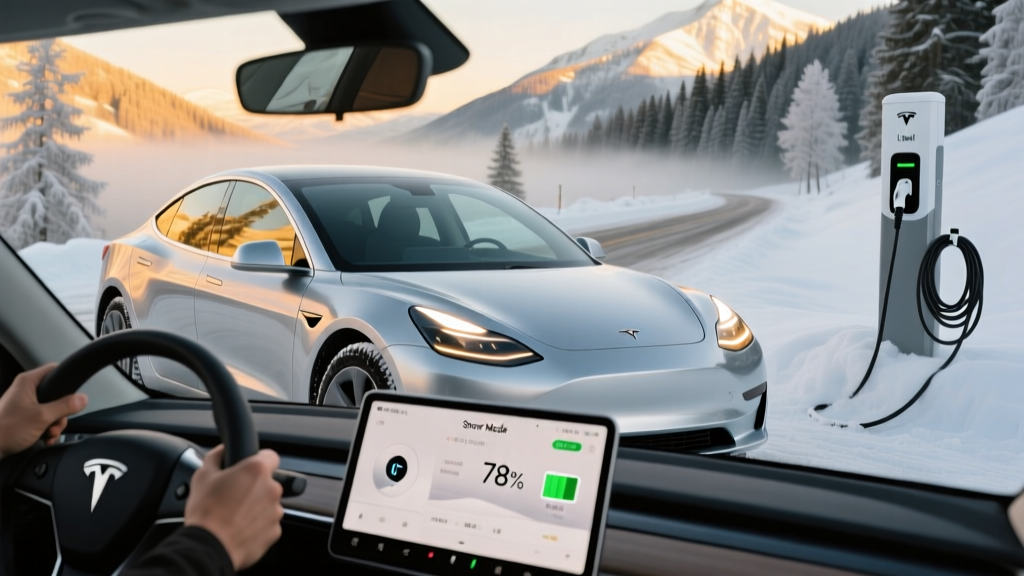
Tesla does not brand a specific "Snow Mode" in the Model 3's software. What owners and reviewers refer to as snow mode is a combination of settings and hardware behaviors that activate in low-traction conditions:
- Chill Acceleration Mode: Limits torque delivery off the line, reducing wheelspin on ice and packed snow. Engage this from Controls > Pedals & Steering > Acceleration.
- Dual-Motor Torque Vectoring (AWD trims): The front and rear motors can shift torque independently in milliseconds — far faster than a mechanical center differential. If the rear wheels slip, torque transfers forward instantly.
- Traction and Stability Control: Tesla's system is calibrated to allow minimal slip before intervening, which helps maintain momentum in deep snow rather than cutting power entirely.
- Regenerative Braking Behavior: In cold or slippery conditions, the car may automatically reduce regen to prevent rear-wheel lockup during lift-off. You'll notice the car coasting more than usual.
- Heat Pump: Standard on all 2026 Model 3 trims. This is critical — it scavenges waste heat from the drivetrain and ambient air to warm the cabin and battery, reducing the energy penalty of winter heating by roughly 30% compared to older resistive heaters.
Real-World Range in Cold Weather: What the EPA Number Doesn't Tell You
Cold weather reduces EV range through three mechanisms: increased battery internal resistance (the chemistry becomes less efficient below ~40°F), cabin heating demand (even with a heat pump, warming a cabin from 20°F to 70°F draws significant energy), and denser cold air increasing aerodynamic drag. The Model 3's heat pump is one of the best in the industry — Tesla pioneered the "octovalve" thermal management system that routes heat between the battery, motors, and cabin — but physics still applies.
For the RWD model with the smaller 60 kWh LFP battery, winter range drops hit harder in percentage terms: from 272 miles EPA down to roughly 190-215 miles highway in deep cold. If your commute exceeds 80 miles round-trip in a cold climate, the Long Range AWD is the safer choice.
Battery preconditioning is essential in winter. When you set a Supercharger as your navigation destination, the car preheats the battery en route, which can cut your 10-80% charge time from 40+ minutes (cold-soaked battery) to the rated ~25 minutes. Always navigate to your charger rather than just driving there.
Charging Speed: DC Fast, Level 2, and Cold-Weather Behavior
| Charging Level | Power (kW) | Miles Added per Hour | Notes |
|---|---|---|---|
| Level 1 (120V household) | ~1.4 kW | ~5 mi/hr | Emergency/trickle only |
| Level 2 (240V home, 48A) | 11.5 kW | ~44 mi/hr | Full charge in ~7 hrs (LR AWD) |
| DC Fast (V3 Supercharger) | Peak 250 kW | ~175 mi in 15 min | 10-80% in ~25 min (preconditioned) |
| DC Fast (cold battery, <40°F) | ~50-100 kW initially | Varies | Charge curve severely limited until battery warms |
The 250 kW peak on the Long Range and Performance trims is impressive, but it's a peak — not a sustained rate. The charge curve tapers significantly above 60% state of charge, and drops to a trickle above 90%. For road trips, plan your stops around 10-80% charges; the last 20% can take as long as the first 70%.
The RWD model's LFP battery charges at a lower 170 kW peak. LFP chemistry has an advantage, however: Tesla recommends charging LFP batteries to 100% regularly (unlike NMC, which prefers an 80% daily limit for longevity). This effectively gives the RWD model more daily usable capacity than the kWh number alone suggests.
Home charging installation for a Tesla Wall Connector (240V, 48A) typically costs $500-$1,500 for the electrician work if your panel has capacity, plus $400-$475 for the hardware. If you need a 200-amp panel upgrade, add $1,500-$3,000. Always get a quote from a licensed electrician before purchase.
Pricing, Trims, and Federal Tax Credit Eligibility (2026)
| Trim | Base MSRP | Est. §30D Credit | Effective Price (if eligible) |
|---|---|---|---|
| Model 3 RWD | $38,990 | Up to $7,500 | ~$31,490 |
| Model 3 Long Range AWD | $45,990 | Up to $7,500 | ~$38,490 |
| Model 3 Performance | $52,990 | Up to $7,500 | ~$45,490 |
The IRS §30D Clean Vehicle Credit remains available for qualifying Model 3 trims in 2026, but eligibility is not automatic. Key requirements:
- MSRP Cap: Sedans must be under $55,000 MSRP (including destination). The Performance trim at $52,990 qualifies; options that push it over $55,000 may disqualify it.
- Buyer Income Cap: Modified AGI must not exceed $150,000 (single), $225,000 (head of household), or $300,000 (joint filers).
- Battery Sourcing: The full $7,500 requires meeting both critical-mineral and battery-component sourcing thresholds set by the Treasury Department. Partial credits ($3,750) apply if only one threshold is met. Tesla's supply chain has generally qualified, but rules tighten annually — verify at the point of sale.
- Point-of-Sale Transfer: As of 2024, you can transfer the credit to the dealer at purchase, reducing your out-of-pocket cost immediately rather than waiting for tax filing.
Consult a tax professional to confirm your personal eligibility. State incentives (Colorado, California, Massachusetts, and others) may stack on top — check your state energy office for current programs.
Interior, Cargo, and Daily Usability in Winter
The refreshed Model 3 interior (codenamed "Highland" and carried into 2026) is significantly quieter and better-built than pre-2024 models. Winter-relevant features include:
- Heated seats (all four outboard positions) and a heated steering wheel — standard on all trims. These draw far less energy than cabin air heating.
- 15.4-inch center touchscreen handles all climate, navigation, and vehicle settings. No physical buttons means gloved fingers can be imprecise; the screen is responsive but plan your climate adjustments before driving.
- Cargo volume: 23 cu ft trunk + 3 cu ft frunk (front trunk). The trunk opening is narrow compared to a hatchback like the Ioniq 6 or Model Y — fitting a large snow blower or bulky winter gear requires creative packing.
- Legroom: 42.3 inches front / 35.2 inches rear. Adequate for adults in winter coats, though the rear seat is tighter than a midsize sedan.
- Glass roof: The panoramic glass is tinted and UV-treated, but in bright snow conditions, glare can be noticeable. A sunshade (sold separately by third parties) helps.
Notable drawback: The lack of a traditional instrument cluster means all speed and range information is on the center screen, requiring a glance to the right. In heavy snow where you're scanning for road edges, this is a minor ergonomic compromise. A small driver-facing display (as in the Model S/X) would be preferable.
Pros and Cons: Model 3 for Snow-Belt Owners
- Dual-motor AWD with instant torque vectoring excels on ice and packed snow
- Heat pump minimizes winter range loss vs. competitors without one
- Supercharger network reliability (17,000+ U.S. stalls) reduces winter road-trip stress
- Chill mode + traction control = confident low-speed winter handling
- Over-the-air updates continuously improve thermal management
- Low center of gravity (battery pack under floor) reduces rollover risk on slippery roads
- No dedicated "Snow Mode" toggle — requires manual Chill mode activation
- RWD trim's LFP battery suffers steeper cold-weather range loss
- Trunk opening is narrow for winter gear and cargo
- Autopilot degrades in heavy snow (obscured lane lines, camera obstruction)
- Cold-soaked DC fast charging is slow without preconditioning navigation
- Ground clearance is 5.5 inches — deep unplowed snow will be a problem
Is the Model 3 Worth It vs. Winter-Ready Competitors?
For snow-belt buyers, the key competitors are the Hyundai Ioniq 6 AWD (305 mi EPA, ~$49,000), BMW i4 xDrive40 (282 mi EPA, ~$57,000), and Polestar 2 Long Range Dual Motor (276 mi EPA, ~$52,000). The Model 3 Long Range AWD wins on range (341 mi), efficiency (134 MPGe combined), and Supercharger network access. The Ioniq 6 charges faster on 800V architecture (10-80% in ~18 min on a 350 kW charger) but has fewer miles. The BMW i4 offers a more traditional luxury interior and physical controls — a genuine advantage with gloves on.
If you prioritize winter range above all else, the Model 3 Long Range AWD is the segment leader. If you want a hatchback cargo opening and faster peak charging, the Ioniq 6 is compelling. If interior quality and physical buttons matter in cold-weather fumbling, test-drive the i4.
Frequently Asked Questions
Does the Tesla Model 3 have a dedicated snow mode?
No. Tesla does not include a labeled "Snow Mode" in the Model 3. Winter-capable behavior comes from enabling Chill acceleration mode, relying on the dual-motor AWD torque vectoring (AWD trims), and the car's automatic traction and stability control. The heat pump and battery preconditioning further optimize cold-weather operation.
How much range does the Model 3 lose in winter?
Expect a 20-30% range reduction at highway speeds in temperatures below 30°F. The Long Range AWD drops from 341 EPA miles to roughly 240-275 real-world winter highway miles. City driving with regen recapture and seat heaters (rather than cabin air heat) can keep losses closer to 15%.
Should I get the RWD or Long Range AWD for snow?
AWD is strongly recommended for regular snow driving. The dual-motor system provides significantly better traction on ice and snow than RWD, and the Long Range's larger NMC battery provides a winter range buffer. The RWD with winter tires is usable in light snow but not ideal for snow-belt commutes.
Do I need winter tires on the Model 3?
Yes, if you drive in sustained winter conditions. The stock all-season tires are adequate for occasional snow, but dedicated winter tires (e.g., Michelin X-Ice Snow, Bridgestone Blizzak) dramatically improve braking distance and cornering grip on ice. The Model 3's weight and instant torque make tire choice especially impactful.
Does the Model 3 qualify for the $7,500 federal tax credit in 2026?
Most Model 3 trims qualify, subject to IRS §30D rules: buyer income caps ($150K/$225K/$300K by filing status), the $55,000 sedan MSRP cap, and battery critical-mineral/component sourcing requirements. The credit can be transferred at point of sale. Verify current eligibility on irs.gov and with your tax professional.
How fast does the Model 3 charge at home in winter?
A Level 2 Tesla Wall Connector (11.5 kW, 240V/48A) adds roughly 44 miles of range per hour, fully charging a Long Range AWD in about 7 hours. In winter, the car may use some of that energy to warm the battery, slightly extending charge time. A full overnight charge is standard practice and ensures a warm, preconditioned battery for morning driving.
Who Should Buy the Model 3 for Winter Driving?
The 2026 Tesla Model 3 Long Range AWD is best suited for: snow-belt commuters with round-trip drives under 150 miles who have home Level 2 charging; tech-forward buyers who value OTA updates, Supercharger access, and efficiency; and two-adult households who don't need hatchback cargo space. It is less ideal for buyers in areas with frequent deep unplowed snow (5.5 inches of ground clearance is a limit), those who regularly haul bulky winter cargo, or anyone uncomfortable with a touchscreen-only interface while wearing gloves.
If you commit to winter tires, use Chill mode, precondition before fast charging, and lean on seat heaters over cabin air heat, the Model 3 is one of the most capable and efficient winter EVs on the market. The 341-mile EPA range — even discounted for cold — provides a buffer that most competitors can't match, and the Supercharger network remains the most reliable DC fast-charging option for winter road trips.