Quick Verdict: The Benchmark Sedan Still Holds Up
The Tesla Model 3 remains the default compact electric sedan against which every rival is measured. Its sleek side profile—characterized by a fastback roofline, flush door handles, and minimal overhangs—translates directly into a low drag coefficient that boosts highway efficiency. For 2026, the refreshed "Highland" platform continues to refine ride quality, cabin insulation, and steering feel, narrowing the gap with luxury competitors while keeping the starting price near $39,000 before incentives.
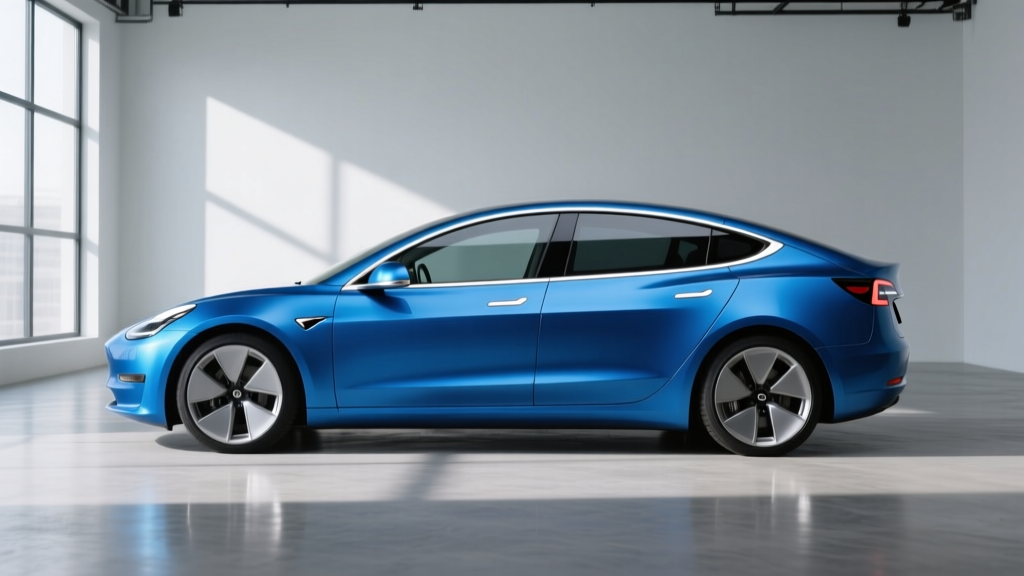
Buyers searching for a Tesla Model 3 side view online are usually evaluating the car's proportions, wheel options, and color palettes. This review pairs that visual research with the hard data you actually need to make a purchase decision: EPA range, charging curves, battery chemistry, real-world efficiency, and total cost after the federal tax credit.
Exterior Profile: What the Side View Reveals About Aerodynamics
Seen in profile, the Model 3's design language is dominated by a single sweeping arc from windshield to rear decklid. This fastback shape isn't cosmetic—it yields a drag coefficient (Cd) of approximately 0.219, one of the lowest in the production-sedan segment. The 2026 model retains the slim LED light bar up front and the C-shaped taillights introduced with the Highland refresh, along with updated 18-inch Photon and 19-inch Nova wheel designs.
Dimensionally, the side view confirms a wheelbase of 113.2 inches and an overall length of 184.8 inches—shorter than a Toyota Camry but with a cabin pushed toward the corners for interior space. Ground clearance sits at 5.5 inches, and the curb weight ranges from 3,862 lbs (RWD) to 4,034 lbs (Long Range AWD).
Real-World Range vs. EPA Sticker
RWD (LFP): EPA 272 miles — expect ~230–250 miles on the highway at 70 mph; ~200–220 miles in sustained sub-30°F cold.
Long Range AWD (NMC): EPA 341 miles — expect ~290–310 miles highway; ~240–260 miles in cold weather.
Performance AWD (NMC): EPA 315 miles — expect ~270–285 miles highway; ~230–245 miles in cold weather.
Source: EPA Fuel Economy
Battery, Range, and Efficiency by Trim
Tesla offers the 2026 Model 3 in three trims, each with distinct battery chemistry and range characteristics. The base RWD uses a lithium iron phosphate (LFP) pack, while the Long Range and Performance trims use nickel-manganese-cobalt (NMC) chemistry.
| Spec | RWD | Long Range AWD | Performance AWD |
|---|---|---|---|
| EPA Range | 272 mi | 341 mi | 315 mi |
| Battery Capacity (usable) | ~60 kWh (LFP) | ~75 kWh (NMC) | ~75 kWh (NMC) |
| Drivetrain | Rear-Wheel Drive | Dual-Motor AWD | Dual-Motor AWD |
| Horsepower | 271 hp | 346 hp | ~450 hp |
| 0–60 mph | 5.8 sec | 4.2 sec | 2.9 sec |
| MPGe (combined) | 132 MPGe | 125 MPGe | 118 MPGe |
| Efficiency (kWh/100 mi) | 25 kWh | 27 kWh | 29 kWh |
| Base MSRP | $38,990 | $45,990 | $52,990 |
LFP vs. NMC — what it means for you: The LFP pack in the RWD is heavier per kWh but can be charged to 100% daily without accelerated degradation. Tesla recommends periodic full charges to recalibrate the battery management system. NMC packs in the Long Range and Performance trims offer higher energy density and better cold-weather performance but are best kept between 20–80% for daily use to maximize longevity.
Charging Speed: DC Fast Charge and Home Level 2
Charging speed is where the Model 3's NACS (North American Charging Standard) connector gives it a distinct advantage: full access to Tesla's Supercharger network, which remains the most reliable DC fast-charging infrastructure in the U.S.
| Charging Level | RWD (LFP) | Long Range / Performance (NMC) |
|---|---|---|
| DC Fast Charge (peak kW) | 170 kW | 250 kW |
| 10–80% DCFC Time | ~25 min | ~18–20 min |
| Sustained Charge (avg kW, 10–80%) | ~110 kW | ~160 kW |
| Level 2 Home (11.5 kW / 48A) | ~30 mi/hr | ~44 mi/hr |
| Level 1 (120V / 12A) | ~3 mi/hr | ~3 mi/hr |
Charging-curve reality check: The 250 kW peak on Long Range/Performance trims is reached briefly between roughly 10–30% State of Charge (SoC). Above 50%, the rate tapers significantly—by 80% you're typically at 60–80 kW. This means the last 20% (80–100%) can take nearly as long as the first 70%. For road trips, plan stops around 10–80% to minimize total charging time.
Preconditioning matters: If you navigate to a Supercharger using the car's built-in navigation, the battery thermal management system will begin warming the pack miles before you arrive. In cold weather, this can shave 5–10 minutes off your charge session. Without preconditioning (e.g., arriving at a non-Tesla charger via adapter), cold packs charge much slower.
Interior, Cargo, and Daily Practicality
The Model 3's minimalist cabin centers on a 15.4-inch touchscreen that controls virtually every function—there are no physical buttons for climate, media, or even glovebox release. The 2026 Highland update added ventilated front seats, ambient lighting, rear-seat ventilation, and a rear touchscreen for passengers, addressing longstanding comfort complaints.
Passenger Space
- Front headroom: 40.3 inches
- Front legroom: 42.7 inches
- Rear headroom: 37.8 inches (reduced by the sloping roofline)
- Rear legroom: 35.2 inches (adequate for adults under 6'0", tight for taller passengers)
Cargo Volume
- Trunk: 21.0 cu ft (including under-floor storage)
- Frunk (front trunk): 3.1 cu ft (enough for a charging cable bag or small backpack)
- Total with rear seats folded: ~64.9 cu ft
The trunk opening is a conventional sedan lid rather than a hatchback, which limits access for bulky items compared to the Model Y or Hyundai Ioniq 5. However, the under-floor compartment is deep enough to store groceries out of sight.
Pricing, Tax Credits, and Total Cost
Federal tax credit eligibility for the Model 3 depends on IRS §30D rules, which include buyer income caps, MSRP limits, and battery-component/critical-mineral sourcing requirements. Here's the current landscape:
| Trim | Base MSRP | Destination | Est. Max Credit | Effective Price* |
|---|---|---|---|---|
| RWD | $38,990 | $1,390 | $3,750–$7,500 | ~$32,880–$36,640 |
| Long Range AWD | $45,990 | $1,390 | $3,750–$7,500 | ~$39,880–$43,640 |
| Performance AWD | $52,990 | $1,390 | $3,750–$7,500 | ~$46,880–$50,640 |
*Effective price assumes full or partial §30D credit. Actual credit depends on battery sourcing, which Tesla adjusts throughout the model year.
IRS §30D Federal Tax Credit Requirements (2026)
- MSRP cap: Sedans must be ≤$55,000 (all Model 3 trims qualify)
- Buyer income cap: AGI ≤$150,000 (single), $225,000 (head of household), $300,000 (joint)
- Battery sourcing: Critical minerals and battery components must meet phased-in domestic/free-trade-agreement thresholds — credit splits into $3,750 (minerals) + $3,750 (components)
- Point-of-sale transfer: Eligible buyers can apply the credit as an instant discount at purchase rather than waiting for tax filing
- Verify current status: Tesla's checkout page and IRS.gov list real-time credit amounts, which can change mid-year
Technology, Safety, and Driver Assistance
The Model 3 comes standard with Tesla's Basic Autopilot (traffic-aware cruise control and lane centering), which is an SAE Level 2 driver-assistance system. The driver must remain fully engaged—hands on the wheel (detected via torque sensing) and eyes on the road at all times.
SAE Automation Level: Level 2 (Driver Assist)
Tesla Autopilot and Full Self-Driving (Supervised) are Level 2 systems. They do not make the car self-driving. The driver is legally and operationally responsible for all vehicle control. Only Level 4 robotaxi services (Waymo, Zoox) operate without a human driver in defined areas.
Full Self-Driving (Supervised) remains an $8,000 add-on (or $99/month subscription as of early 2026). It adds automatic lane changes, navigate-on-autopilot for highway interchanges, and city-street traffic-light/stop-sign recognition. Despite the name, FSD Supervised requires constant driver oversight and is not a hands-off system.
Notable Tech Features
- 15.4-inch center touchscreen with Netflix, YouTube, and gaming while parked
- Over-the-air (OTA) updates that add features post-purchase
- Sentry Mode (cameras record surroundings when parked)
- Dog Mode (climate stays on for pets with a cabin-temperature display)
- Phone-as-key with Bluetooth proximity unlock
- 8-camera vision system (Tesla Vision, no radar or ultrasonic sensors)
Safety Ratings
The Model 3 earns top marks from both U.S. safety agencies. NHTSA awarded it a 5-star overall rating, and IIHS named it a Top Safety Pick+ with good ratings across all crashworthiness tests (IIHS). Standard active-safety features include automatic emergency braking, blind-spot monitoring, and lane-departure warning.
Warranty and Long-Term Ownership
| Coverage | Terms |
|---|---|
| Limited Vehicle Warranty | 4 years / 50,000 miles |
| Battery & Drive Unit (RWD) | 8 years / 100,000 miles (min 70% retention) |
| Battery & Drive Unit (LR/Perf) | 8 years / 120,000 miles (min 70% retention) |
Tesla's battery warranty guarantees that the pack will retain at least 70% of its original capacity during the warranty period. Real-world data from fleet operators and owner surveys suggests LFP packs degrade roughly 5–8% over 100,000 miles, while NMC packs typically lose 8–12% over the same distance—well within the warranty threshold. Battery replacement outside warranty currently runs $12,000–$16,000 at Tesla service centers, though prices continue to decline as cell costs fall.
Competitor Comparison: Model 3 vs. Key Rivals
| Spec | Tesla Model 3 LR | Hyundai Ioniq 6 SE LR | BMW i4 eDrive40 |
|---|---|---|---|
| EPA Range | 341 mi | 361 mi | 301 mi |
| Battery (kWh) | ~75 (NMC) | 77.4 (NMC) | 81.5 (NMC) |
| Peak DCFC | 250 kW | 240 kW | 205 kW |
| 0–60 mph | 4.2 sec | 5.1 sec | 5.5 sec |
| Base MSRP | $45,990 | $42,715 | $57,900 |
| Charging Network | Supercharger (native) | NACS adapter required | NACS adapter required |
The Ioniq 6 edges out the Model 3 Long Range on EPA range and undercuts it on price, but Tesla's Supercharger access remains a tangible advantage for road-trippers. The BMW i4 offers superior build quality and driving dynamics but at a significant price premium and with less range. For buyers prioritizing the lowest cost-per-mile and the most reliable charging ecosystem, the Model 3 still leads.
Pros
- Class-leading Supercharger network access (native NACS)
- Strong efficiency (25–29 kWh/100 mi depending on trim)
- OTA updates continuously add features
- LFP option for daily 100% charging without degradation worry
- Top safety ratings (NHTSA 5-star, IIHS TSP+)
- Low total cost of ownership vs. gas sedans
Cons
- Sedan trunk opening limits cargo flexibility vs. hatchbacks/SUVs
- Rear headroom tight for tall passengers (sloping roofline)
- No physical buttons — all controls via touchscreen
- Vision-only system (no radar/ultrasonic) can struggle in heavy rain
- Insurance premiums 15–25% above segment average
- FSD (Supervised) remains expensive and not truly autonomous
Who Should Buy the 2026 Tesla Model 3?
Decision Framework
Choose the RWD ($38,990) if: You commute under 40 miles daily, charge at home, want the lowest entry price, and prefer the LFP battery's tolerance for daily 100% charging.
Choose the Long Range AWD ($45,990) if: You take regular road trips, live in a cold climate (AWD + larger NMC pack), or need the extra 70 miles of EPA range for peace of mind.
Choose the Performance AWD ($52,990) if: You prioritize acceleration (2.9 sec 0–60) and track-capable handling, and are willing to trade ~26 miles of range for it.
Look elsewhere if: You need hatchback cargo flexibility (consider the Model Y or Ioniq 5), require more rear-seat headroom, or want a traditional button-and-knob interior.
Frequently Asked Questions
What is the real-world range of the Tesla Model 3?
The RWD (LFP) delivers roughly 230–250 miles on the highway at 70 mph and drops to ~200–220 miles in sustained cold weather. The Long Range AWD (NMC) achieves ~290–310 miles highway and ~240–260 miles in cold conditions. City driving with regenerative braking often exceeds EPA estimates.
How fast does the Model 3 charge at home and on DC fast chargers?
On a Level 2 home charger (11.5 kW / 48A), the Long Range adds roughly 44 miles per hour—a full overnight session restores the entire battery. On DC fast chargers, the Long Range peaks at 250 kW and charges 10–80% in approximately 18–20 minutes. The RWD peaks at 170 kW with a 10–80% time of ~25 minutes.
Does the Tesla Model 3 qualify for the federal EV tax credit?
All Model 3 trims fall under the $55,000 MSRP cap for sedans. However, the actual credit amount ($3,750 or $7,500) depends on battery-component and critical-mineral sourcing, which Tesla adjusts throughout the year. Buyer income must not exceed $150K (single), $225K (head of household), or $300K (joint). Check IRS.gov and Tesla's checkout page for real-time eligibility.
Is the Tesla Model 3 worth buying over competitors like the Ioniq 6 or BMW i4?
If Supercharger network access and over-the-air updates are priorities, the Model 3 retains a clear advantage. The Ioniq 6 offers slightly more range at a lower price but requires a NACS adapter for Supercharger access. The BMW i4 delivers premium refinement at a higher cost. For most buyers, the Model 3 Long Range remains the best balance of range, charging infrastructure, and value.
How much does insurance cost for the Model 3?
Model 3 insurance premiums typically run 15–25% above the compact-sedan average, reflecting higher repair costs and Tesla's integrated body structure. National averages range from $1,800–$2,600 per year depending on state, driving record, and coverage level. Tesla offers its own insurance product in many states, which uses real-time driving data to set premiums—safe drivers may see lower rates.
Can the Model 3 tow a trailer?
Tesla does not rate the Model 3 for towing and does not offer a factory tow hitch. If towing is a requirement, the Model Y (up to 3,500 lbs) or a competitor like the Ford Mustang Mach-E (1,500 lbs with hitch) are better options.