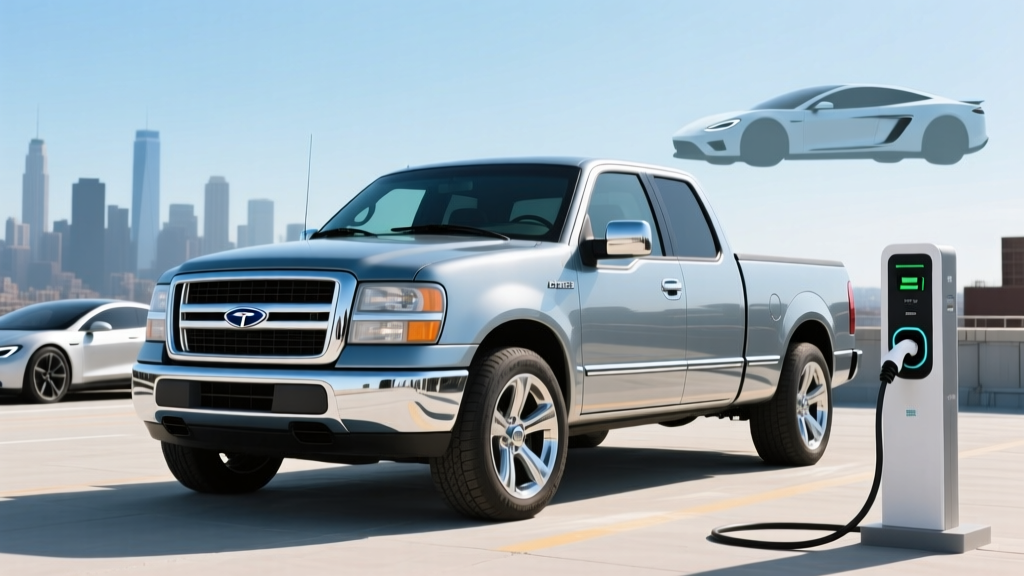
If you've been searching for the "2001 F-150 Lightning," you've likely encountered a fascinating piece of electric vehicle history that many EV enthusiasts overlook. The 2001 Ford F-150 Lightning was not the production electric truck we know today — it was a limited-run, internal-combustion performance truck built on the 10th-generation F-150 SVT platform. However, Ford did experiment with electric F-150 prototypes around this same era, and understanding this history helps explain how the modern F-150 Lightning (2022–present) came to be.
This article clarifies what the 2001 F-150 Lightning actually was, covers the early Ford electric truck experiments of that period, and then provides a complete buyer's guide to the current-generation F-150 Lightning — the production BEV that carries the Lightning nameplate today. If you're researching the Lightning nameplate for a potential EV truck purchase, this is your comprehensive resource.
What Was the 2001 F-150 Lightning? Setting the Record Straight
The 2001 Ford F-150 SVT Lightning was a high-performance, gasoline-powered pickup truck produced by Ford's Special Vehicle Team (SVT). It featured a supercharged 5.4-liter V8 producing 380 horsepower and 470 lb-ft of torque — making it the fastest production pickup of its era. It was not an electric vehicle.
However, Ford was simultaneously experimenting with electric truck technology during this period. The Ford Electric Vehicle Program of the late 1990s and early 2000s produced limited-run electric Rangers and explored electrified F-150 concepts, though none reached mass production. These early prototypes used nickel-metal hydride (NiMH) and early lithium-ion battery packs with ranges typically under 100 miles.
The Lightning nameplate went dormant after 2004, only to be revived in 2022 as a fully electric vehicle — the F-150 Lightning — built on Ford's dedicated BEV truck architecture with dual-motor AWD, up to 320 miles of EPA range, and available DC fast charging up to 150 kW.
2026 Ford F-150 Lightning: Full EV Review & Specs
Since the 2001 model was a gas truck, and you're likely here because you're researching an electric F-150, let's cover the current F-150 Lightning in detail. For the 2025–2026 model years, Ford has refined the Lightning with updated battery chemistry, improved software, and expanded trim availability.
| Spec | Standard Range | Extended Range |
|---|---|---|
| EPA Range | 240 mi | 320 mi |
| Battery Capacity (usable) | 98 kWh (NMC) | 131 kWh (NMC) |
| Drivetrain | Dual-Motor AWD | Dual-Motor AWD |
| Horsepower | 452 hp | 580 hp |
| Torque | 775 lb-ft | 775 lb-ft |
| 0–60 mph | ~4.5 sec | ~3.8 sec |
| Max DC Fast Charge | 120 kW | 150 kW |
| 10–80% DCFC Time | ~44 min | ~41 min |
| Level 2 Home Charging | 11.5 kW (~22 mi/hr) | 19.2 kW (~30 mi/hr) / 11.5 kW (~22 mi/hr) |
| Efficiency (MPGe) | 68 MPGe combined | 70 MPGe combined |
| Towing (max) | 7,700 lbs | 10,000 lbs |
| Payload | ~2,235 lbs | ~1,800 lbs |
Charging: DC Fast, Level 2, and Home Setup
Charging speed remains a critical consideration for electric truck buyers, especially those planning to tow or take road trips. The F-150 Lightning's charging profile is adequate but not class-leading compared to trucks on 800V architectures (like the Hyundai Ioniq 5-based platforms or the Rivian R1T's updated charging).
| Charge Level | Power | Speed (mi/hr added) | Notes |
|---|---|---|---|
| Level 1 (120V household) | ~1.4 kW | ~2–3 mi/hr | Emergency/trickle only |
| Level 2 (240V, 48A) | 11.5 kW | ~22 mi/hr | Standard onboard charger |
| Level 2 (240V, 80A) | 19.2 kW | ~30 mi/hr | Extended Range with dual onboard chargers (Ford Charge Station Pro) |
| DC Fast Charge (Standard Range) | Up to 120 kW peak | — | 10–80% in ~44 min; tapers sharply above 80% |
| DC Fast Charge (Extended Range) | Up to 150 kW peak | — | 10–80% in ~41 min; sustained ~100–120 kW through 60%, then tapers |
Charging curve reality: The F-150 Lightning peaks at its maximum kW only briefly (typically between 15–35% State of Charge). Above 60% SoC, charging power drops significantly. On the Extended Range pack, expect sustained rates of 100–120 kW through the middle of the curve, then a taper to under 50 kW past 80%. This means a 10–90% session takes considerably longer than the advertised 10–80% time — plan for roughly 55–65 minutes total if you need a near-full charge on a road trip.
The Lightning uses the CCS1 connector for DC fast charging (and J1772 for Level 2 AC). Ford has announced NACS (Tesla Supercharger) adapter support, and by 2025–2026, many Lightning owners can access Tesla's Supercharger network using the Ford-provided adapter — a significant expansion of available public charging infrastructure.
Pricing, Trims, and Federal Tax Credit Eligibility
The 2026 F-150 Lightning is available in multiple trims, and pricing has shifted as Ford adjusts to market demand and battery cost reductions. Here's the current MSRP breakdown:
| Trim | Battery | MSRP | Est. After §30D Credit |
|---|---|---|---|
| Pro (Standard Range) | 98 kWh | ~$52,000 | ~$44,500* |
| XLT (Standard Range) | 98 kWh | ~$58,000 | ~$50,500* |
| Lariat (Extended Range) | 131 kWh | ~$72,000 | ~$64,500* |
| Platinum (Extended Range) | 131 kWh | ~$82,000 | ~$74,500* |
*Tax credit estimates assume full §30D eligibility. Actual credit depends on buyer income, vehicle MSRP cap compliance, battery sourcing, and point-of-sale transfer rules.
- Credit amount: Up to $7,500 ($3,750 for battery components + $3,750 for critical minerals sourcing)
- MSRP cap: Trucks/vans/SUVs must have an MSRP at or below $80,000 — the Lightning Platinum may exceed this depending on options
- Buyer income cap: AGI must not exceed $150,000 (single), $225,000 (head of household), or $300,000 (joint)
- Battery sourcing: Critical minerals and battery components must meet escalating domestic/free-trade-partner sourcing thresholds per IRS guidelines
- Point-of-sale transfer: Eligible buyers can transfer the credit to the dealer at purchase for an immediate price reduction
Always verify current eligibility on IRS.gov and consult a tax professional before purchasing.
Interior, Cargo, and Technology
The F-150 Lightning leverages the familiar SuperCrew cab configuration, offering generous interior space and a practical frunk (front trunk) that gas F-150s simply cannot match.
- Frunk (Mega Power Frunk): 14.1 cu ft of lockable, weather-sealed storage with 400 lbs payload capacity — includes 4× 120V outlets and USB ports
- Rear seat legroom: ~43.6 inches (SuperCrew)
- Bed length: 5.5 ft (Styleside) with available tonneau cover
- Bed payload: Varies by battery — Standard Range offers higher payload (~2,235 lbs) vs Extended Range (~1,800 lbs) due to battery weight
- Infotainment: 12-inch touchscreen (Pro/XLT) or available 15.5-inch portrait screen (Lariat/Platinum) with SYNC 4A, wireless Apple CarPlay and Android Auto
- Driver assistance: Ford BlueCruise (SAE Level 2 hands-free driving on pre-approved divided highways) available on Lariat and above
Pro Power Onboard is a standout feature: the Lightning can export up to 9.6 kW of AC power (with the available 80A Pro Power Onboard system), effectively turning the truck into a mobile generator for job sites, tailgating, or home backup power during outages. This is a genuine differentiator vs competitors and a practical feature that the 2001 gas Lightning could never offer.
Pros, Cons, and the Verdict
Pros
- Mega Power Frunk (14.1 cu ft) — best-in-class front storage
- Pro Power Onboard (up to 9.6 kW) — mobile power for work/home
- 775 lb-ft instant torque — effortless towing and acceleration
- BlueCruise hands-free highway driving on 200,000+ mi of mapped roads
- Familiar F-150 ergonomics — minimal learning curve for truck buyers
- NACS adapter access to Tesla Supercharger network (2025+)
Cons
- DC fast charging peaks at 150 kW — slower than 800V competitors
- Extended Range battery adds ~600 lbs, reducing payload significantly
- Real-world highway range falls 15–25% below EPA sticker
- Cold-weather range loss is substantial (20–30% below 32°F)
- Platinum trim may exceed $80,000 MSRP cap for §30D credit
- Towing range is limited — expect 100–150 mi at max tow weight
F-150 Lightning vs. Key Competitors
If you're cross-shopping the Lightning, you're likely comparing it against the Rivian R1T, Chevrolet Silverado EV, and the Tesla Cybertruck. Here's how they stack up on the metrics that matter:
| Metric | F-150 Lightning (Ext. Range) | Rivian R1T (Dual Max) | Silverado EV (4WT) | Cybertruck (AWD) |
|---|---|---|---|---|
| EPA Range | 320 mi | 410 mi | ~390 mi | 340 mi |
| Peak DCFC | 150 kW | 220+ kW | ~350 kW (800V) | ~250 kW |
| 0–60 mph | 3.8 sec | ~3.5 sec | ~4.5 sec | 4.1 sec |
| Starting MSRP | ~$52,000 | ~$75,000 | ~$55,000 | ~$80,000 |
| Frunk | 14.1 cu ft | 11 cu ft | 10.7 cu ft | None (frunk unavailable) |
The Lightning's advantage: It's the most accessible electric truck by price and the most practical for traditional F-150 buyers who need familiar dimensions, dealer support, and the frunk + Pro Power Onboard combination. The Rivian R1T is more capable off-road and charges faster but costs significantly more. The Silverado EV offers superior DC charging speeds on its 800V architecture but has a larger footprint and less intuitive tech. The Cybertruck is polarizing and limited in availability.
Who Should Buy the F-150 Lightning?
Choose the F-150 Lightning if:
- You need a work truck with onboard power export (Pro Power Onboard)
- You want a full-size pickup with a familiar driving experience and nationwide Ford dealer service
- Most of your driving is within 200 miles round-trip with home Level 2 charging
- You value the Mega Power Frunk for secure, weather-sealed gear storage
- You want to access Tesla Superchargers via NACS adapter for road trips
Look elsewhere if:
- You need maximum DC fast-charge speed for frequent long road trips (consider Silverado EV or Rivian)
- You regularly tow heavy loads over long distances (towing cuts EV range by 50%+)
- You live in a region with extreme cold and limited charging infrastructure
- You need a compact truck footprint (consider Rivian R1T or wait for midsize electric trucks)
Frequently Asked Questions
Was the 2001 F-150 Lightning an electric vehicle?
No. The 2001 F-150 SVT Lightning was a gasoline-powered, supercharged V8 performance truck. Ford did experiment with electric truck prototypes around the same era (electric Ranger EVs, limited EV concepts), but no production electric F-150 existed until the 2022 F-150 Lightning debuted.
What is the real-world range of the F-150 Lightning?
The EPA rates the Extended Range at 320 miles and the Standard Range at 240 miles. Real-world highway driving typically yields 250–280 miles (Extended) and 180–210 miles (Standard). In cold weather below freezing, expect a 20–30% reduction. Towing at max capacity can cut range to 100–150 miles.
How fast does the F-150 Lightning charge at home?
With the Ford Charge Station Pro (80A, 240V) and the Extended Range model's dual onboard chargers, you can add approximately 30 miles of range per hour — a full overnight charge from empty. The Standard Range model with a single 11.5 kW onboard charger adds about 22 miles per hour. Home installation typically costs $500–$2,000 depending on your electrical panel and run length.
Does the F-150 Lightning qualify for the $7,500 federal tax credit?
Eligibility depends on your income (AGI caps: $150K single / $300K joint), the vehicle's MSRP (must be ≤$80,000 for trucks), and battery sourcing compliance with IRS §30D rules. Most Lightning trims qualify, but a fully optioned Platinum may exceed the MSRP cap. The credit can be transferred to the dealer at point of sale for an immediate price reduction. Always verify with a tax professional.
How does the Lightning's battery hold up over time?
Ford covers the F-150 Lightning's battery with an 8-year / 100,000-mile warranty (whichever comes first), guaranteeing at least 70% capacity retention over that period. The NMC chemistry in both battery packs is proven but does degrade faster than LFP if regularly charged to 100% or exposed to extreme heat. Ford recommends daily charging to 80–90% for optimal longevity.
Is the F-150 Lightning worth buying in 2026?
For traditional F-150 buyers transitioning to electric, the Lightning remains the most practical and accessible choice — familiar size, strong dealer network, the best frunk in the segment, and Pro Power Onboard for work use. However, if fast-charging speed and maximum range are your priorities, the Rivian R1T and Silverado EV are compelling alternatives. Test-drive all three and compare real-world charging access in your area before committing.