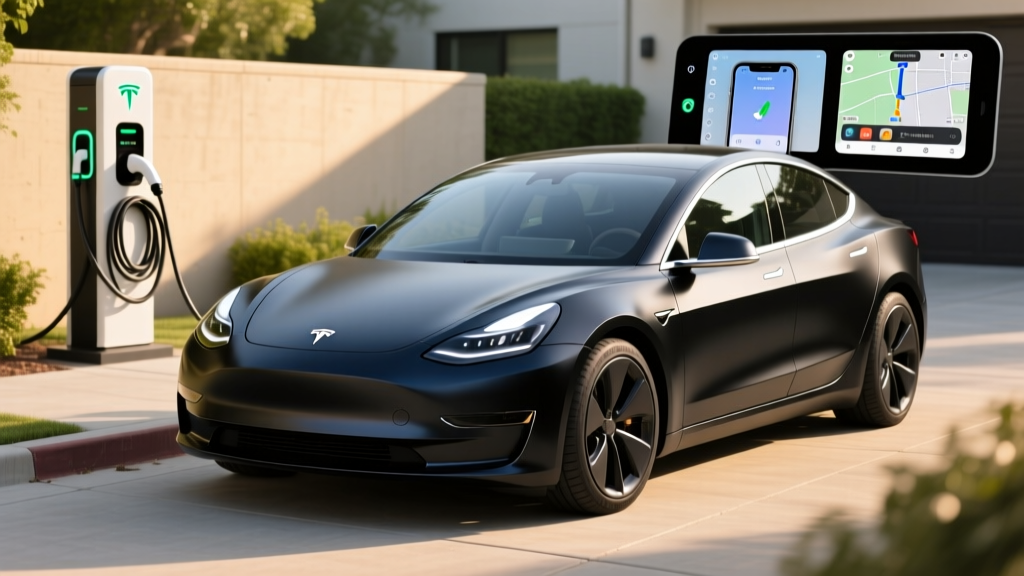
The Tesla Model 3 remains the default benchmark in the electric sedan segment, and Tesla's rolling software updates keep it feeling fresh years after the Highland refresh. The latest over-the-air push — which owners are calling the Tesla screenshare update — adds the ability to mirror your vehicle's touchscreen to a paired smartphone or cast compatible phone content (navigation waypoints, media queues, trip planning) directly to the car's 15.4-inch center display. It's a quality-of-life feature that underscores Tesla's software-first approach. But software doesn't move the car. Below, we break down the 2026 Model 3's hard numbers: range, charging speed, pricing, tax-credit eligibility, and how it stacks up against rivals like the Hyundai Ioniq 6 and BMW i4.
Quick Verdict: Who Should Buy the 2026 Model 3?
The Model 3 is best suited for tech-forward commuters and road-trippers who want access to the Supercharger network, minimalist interiors, and continuous feature additions via OTA updates. The screenshare update makes trip planning and media management smoother for passengers, though the driver should never interact with mirrored content while the vehicle is in motion. If you prioritize traditional luxury materials, physical buttons, or dealership service, look at the BMW i4 or Hyundai Ioniq 6 instead.
- You want the most mature public charging network (Supercharger)
- You value OTA feature updates like the new screenshare capability
- You prioritize efficiency (kWh/100 mi) over interior opulence
- You want physical climate/audio controls
- You need a hatchback or SUV cargo layout
- You prefer a traditional dealership service experience
Range, Battery & Real-World Efficiency
| Spec | Model 3 Long Range AWD | Model 3 Performance | Model 3 RWD |
|---|---|---|---|
| EPA Range | 341 mi | 315 mi | 272 mi |
| Battery (usable) | ~75 kWh (NMC) | ~75 kWh (NMC) | ~57.5 kWh (LFP) |
| MPGe (combined) | 132 MPGe | 121 MPGe | 132 MPGe |
| Efficiency | 25 kWh/100 mi | 28 kWh/100 mi | 25 kWh/100 mi |
| Drivetrain | Dual-Motor AWD | Dual-Motor AWD | RWD |
The Long Range and Performance trims use NMC (nickel manganese cobalt) chemistry, which offers higher energy density but is best kept between 20–80% for daily use to minimize degradation. The base RWD model uses an LFP (lithium iron phosphate) pack — lower energy density, but Tesla recommends charging it to 100% regularly, which helps with battery calibration and gives you access to the full 272 miles more often. LFP also degrades more slowly over thousands of cycles, making it a pragmatic choice for high-mileage commuters.
Charging Speed: DC Fast, Level 2 & the Supercharger Advantage
| Charging Level | Max Rate | Speed / Time |
|---|---|---|
| DC Fast Charge (Supercharger V4) | 250 kW peak | 10–80% in ~25 min (Long Range) |
| Level 2 (Home Wall Connector, 48A) | 11.5 kW | ~44 mi/hr added |
| Level 2 (Mobile Connector, 32A) | 7.7 kW | ~30 mi/hr added |
| Level 1 (120V household) | ~1.4 kW | ~3–5 mi/hr added |
The Model 3's 250 kW peak DC charge rate applies to the Long Range and Performance trims. The RWD with LFP peaks around 170 kW. In practice, the Long Range sustains roughly 150–170 kW through the 30–60% state-of-charge window before tapering. That 10–80% session takes about 25 minutes at a V3 or V4 Supercharger. One practical advantage: Tesla's NACS connector is now the industry standard, with Ford, GM, Rivian, and others adopting it — meaning Supercharger stalls are expanding, not contracting.
For home charging, Tesla's Wall Connector at 48 amps on a 60-amp circuit delivers 11.5 kW — enough to fully replenish the Long Range battery in about 7 hours. Budget roughly $500–$1,200 for a licensed electrician to install a NEMA 14-50 outlet or hardwire the Wall Connector, depending on panel proximity and local permit costs. If your home has a 200-amp panel with capacity, this is straightforward; older 100-amp panels may require a $1,500–$3,000 service upgrade.
Performance & Driving Dynamics
| Trim | 0–60 mph | Horsepower | Top Speed |
|---|---|---|---|
| RWD | 5.8 sec | 271 hp | 125 mph |
| Long Range AWD | 4.2 sec | 346 hp | 125 mph |
| Performance | 2.9 sec | 510 hp | 163 mph |
Even the base RWD Model 3 feels quick off the line thanks to instant electric torque. The Long Range AWD hits 60 mph in 4.2 seconds — faster than most buyers will ever need — while the Performance trim's 2.9-second sprint rivals dedicated sports cars. Handling is composed with a low center of gravity, though the Performance model's stiffer suspension trades some ride comfort for cornering confidence. All trims feature one-pedal driving via strong regenerative braking, which Tesla reinstated after briefly removing the option in earlier model years.
The Tesla Screenshare Update: What It Adds
The 2026 screenshare update (rolled out via OTA in software version 2026.x) allows passengers to cast compatible content from a paired smartphone to the vehicle's 15.4-inch touchscreen. Use cases include:
- Trip planning: A passenger can browse charging stops, restaurants, or destinations on their phone and push the waypoint to the car's navigation instantly.
- Media queue management: Share a Spotify playlist or podcast queue from your phone to the car's audio system without fumbling through the car's native interface.
- Photo/video sharing: Display photos or short clips to passengers while parked (disabled while in drive for safety).
This feature works over the vehicle's local Wi-Fi or Bluetooth connection and requires Tesla app version 4.38+ on iOS or Android. It does not support full screen mirroring of arbitrary apps — it's limited to Tesla-approved content categories to minimize driver distraction. Think of it as a smarter, more integrated version of Apple CarPlay's handoff, built natively into Tesla's OS.
Pricing, Tax Credit Eligibility & Ownership Costs
| Trim | Base MSRP | Est. After §30D Credit* |
|---|---|---|
| RWD | $38,990 | ~$31,490 |
| Long Range AWD | $45,740 | ~$38,240 |
| Performance | $52,990 | ~$45,490 |
*Pricing includes destination. Tax credit estimates assume full $7,500 eligibility under IRS §30D. Eligibility depends on buyer income caps ($150K single / $300K joint MAGI), vehicle MSRP caps ($55K for sedans), and battery critical-mineral and component sourcing requirements that change annually. The Model 3 RWD and Long Range currently qualify for the full credit; verify with a tax professional before purchase. Point-of-sale transfer is available at participating dealers, reducing your out-of-pocket at delivery.
- MSRP cap: Sedans must be ≤$55,000 — all Model 3 trims qualify
- Income cap: Modified AGI ≤$150K (single), $225K (head of household), $300K (joint)
- Battery sourcing: Critical minerals and battery components must meet escalating domestic-content thresholds (check fueleconomy.gov for current eligibility)
- Transfer option: Credit can be applied at point-of-sale to reduce purchase price directly
Five-year ownership costs benefit from low electricity costs (roughly $0.04–$0.06/mile at residential rates vs. $0.12–$0.18/mile for a comparable gas sedan), zero oil changes, and minimal brake wear thanks to regen braking. Insurance, however, tends to run 15–25% higher than a comparable ICE sedan — budget $150–$250/month depending on your state and driving record.
Interior, Cargo & Tech
The Model 3's interior is famously minimalist: a single 15.4-inch touchscreen handles climate, media, navigation, and vehicle settings. The 2026 Highland-refresh interior adds ventilated front seats, ambient lighting, and a rear 8-inch screen for climate and media controls. Build quality has improved noticeably over pre-2024 models, with tighter panel gaps and soft-touch materials throughout.
| Dimension | Measurement |
|---|---|
| Front legroom | 42.7 in |
| Rear legroom | 35.2 in |
| Cargo (trunk) | 21.0 cu ft |
| Front trunk (frunk) | 3.1 cu ft |
| Total cargo | 24.1 cu ft |
The 24.1 cu ft total cargo space is adequate for a sedan but trails hatchback competitors like the Model Y (76 cu ft with seats folded). Rear-seat passengers get decent legroom but a low seat cushion that can cause a knees-up posture on longer trips.
Standout tech: The Tesla screenshare update, 17-speaker premium audio, full-speed adaptive cruise with Autosteer (Level 2 SAE), Sentry Mode dashcam recording, and Dog Mode climate control for pets. The optional Full Self-Driving (Supervised) package ($8,000 or $99/month) adds automatic lane changes, traffic light recognition, and city-street navigation — but it remains SAE Level 2, meaning the driver must remain fully engaged and hands on the wheel at all times.
Pros, Cons & Competitor Comparison
- Class-leading efficiency (25 kWh/100 mi on Long Range)
- Supercharger network access — most reliable public charging
- Continuous OTA updates (screenshare, UI improvements, new features)
- Strong performance even in base RWD trim
- LFP battery option allows daily 100% charging
- No physical buttons — everything goes through the touchscreen
- Rear seat cushion is low; not ideal for tall passengers on long trips
- No Apple CarPlay or Android Auto (screenshare partially bridges this gap)
- Insurance costs run 15–25% above comparable gas sedans
- FSD package is expensive and still requires full driver attention
Against the Hyundai Ioniq 6 (EPA 361 mi, 350 kW max charge), the Model 3 trades a slight range and charging-speed deficit for superior software, the Supercharger network, and better long-term OTA support. The BMW i4 offers a more luxurious interior and physical controls but starts $10K+ higher and lacks DC fast-charge speeds above 205 kW.
Warranty & Long-Term Battery Outlook
| Coverage | Term |
|---|---|
| Basic vehicle | 4 years / 50,000 miles |
| Battery & drive unit (Long Range/Perf) | 8 years / 120,000 miles (≥70% retention) |
| Battery & drive unit (RWD) | 8 years / 100,000 miles (≥70% retention) |
Tesla's battery warranty guarantees at least 70% capacity retention over the covered period. Real-world data from high-mileage owners shows NMC packs retaining 85–90% capacity at 100,000 miles with proper charging habits (20–80% daily, occasional 100% for trips). LFP packs in the RWD model show even slower degradation curves, with many owners reporting 92%+ retention at 80,000 miles. Out-of-warranty battery replacement currently runs $12,000–$16,000 depending on trim, though prices have trended downward.
Frequently Asked Questions
What is the real-world range of the 2026 Tesla Model 3?
The Long Range AWD is EPA-rated at 341 miles, but expect 260–285 miles on a 75-mph highway drive in cold weather (below 40°F). In mild city driving, you may match or exceed the EPA figure. The RWD's 272-mile EPA rating holds up well in city use thanks to LFP chemistry and consistent 100% charging.
How fast does the Model 3 charge at home and on the road?
On a DC fast charger (Supercharger V3/V4), the Long Range peaks at 250 kW and charges from 10–80% in about 25 minutes. At home on a 48-amp Level 2 Wall Connector (11.5 kW), you'll add roughly 44 miles of range per hour — a full overnight charge for most drivers.
Does the 2026 Model 3 qualify for the $7,500 federal EV tax credit?
The Model 3 RWD and Long Range AWD currently qualify for the full $7,500 under IRS §30D, provided you meet income caps ($150K single / $300K joint) and the battery sourcing requirements are satisfied at time of purchase. The Performance trim also qualifies at $52,990 MSRP, which is under the $55K sedan cap. Always verify current eligibility on fueleconomy.gov before purchasing.
Is the Tesla screenshare update available on older Model 3 vehicles?
The screenshare update requires hardware 4.0 (HW4), which is standard on all 2024+ Model 3 Highland-refresh vehicles. 2023 and earlier Model 3 vehicles with HW3 may receive limited functionality via OTA, but full screenshare capability is currently restricted to HW4-equipped cars.
Is the Model 3 worth buying vs. the Ioniq 6 or BMW i4?
Choose the Model 3 if you want the Supercharger network, continuous OTA feature additions, and class-leading efficiency. Choose the Ioniq 6 if you prioritize maximum EPA range (361 mi) and faster 350 kW charging capability. Choose the BMW i4 if you want a premium interior, physical controls, and a traditional dealership experience — but expect to pay $10K+ more.
How much cargo space does the Model 3 have?
The 2026 Model 3 offers 21.0 cu ft in the trunk and 3.1 cu ft in the frunk, totaling 24.1 cu ft. That's competitive for a sedan but significantly less than the Model Y's hatchback layout. The rear seats fold 60/40 for longer items.