Quick Verdict: The Model 3 With Roof Racks in 2026
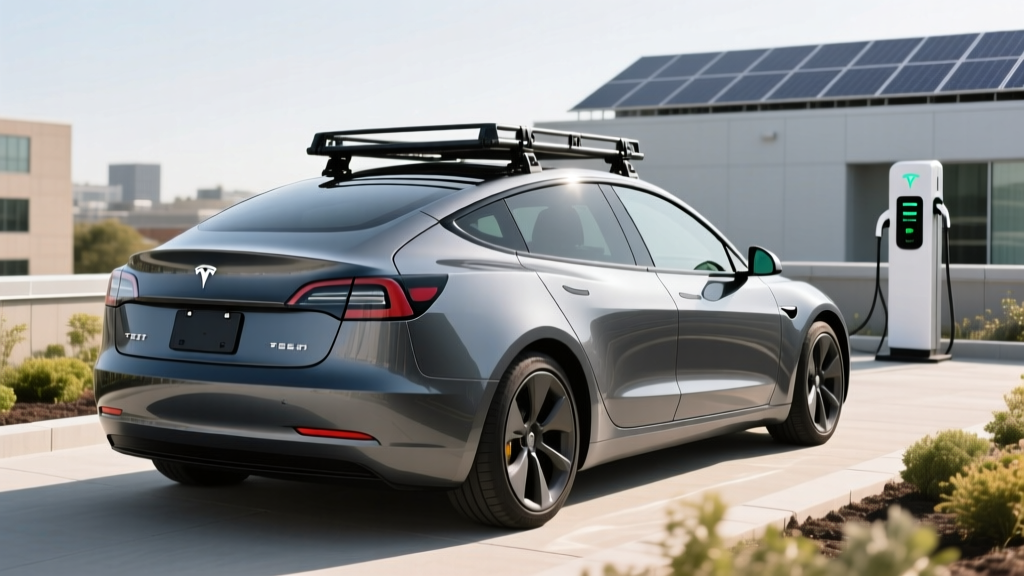
The 2026 Tesla Model 3 remains the efficiency benchmark among electric sedans, but bolting on roof racks changes the math in ways every buyer should understand before loading up for a road trip. Tesla offers an official Tesla Model 3 Roof Rack accessory (sold as a pair of crossbars) that integrates with the glass roof mounting points on the refreshed "Highland" body style. With the rack installed and unloaded, expect a 5–10% range penalty at highway speeds; loaded with a cargo box or bikes, that figure can climb to 15–20%. For a Long Range AWD rated at 341 miles EPA, that means roughly 270–300 miles of usable highway range with a loaded rack — still viable for most trips, but enough to require slightly more charging stops on long hauls.
Beyond the roof-rack question, the 2026 Model 3 continues to offer class-leading efficiency, a strong Supercharger network advantage, and pricing that undercuts rivals like the BMW i4 and Hyundai Ioniq 6 — especially after the federal tax credit. This review covers the full picture: range, charging, cargo capacity with racks, performance, pricing, and whether the Model 3 still earns its spot as the default EV sedan recommendation.
Range, Efficiency, and the Roof-Rack Drag Penalty
The 2026 Tesla Model 3 is offered in three main configurations, each with distinct range and efficiency profiles:
| Trim | Drivetrain | EPA Range | MPGe (Combined) | kWh/100mi | Battery (Usable) |
|---|---|---|---|---|---|
| RWD | Rear-Wheel Drive | 272 mi | 132 MPGe | 25 | ~60 kWh (LFP) |
| Long Range AWD | Dual-Motor AWD | 341 mi | 132 MPGe | 25 | ~75 kWh (NMC) |
| Performance | Dual-Motor AWD | 315 mi | 119 MPGe | 28 | ~75 kWh (NMC) |
The efficiency penalty comes down to aerodynamics. The Model 3's 0.219 drag coefficient is among the lowest of any production sedan. A roof rack with crossbars alone adds turbulence; a loaded cargo box or bike rack can push effective drag up substantially, particularly above 65 mph where aerodynamic resistance dominates energy consumption. If you primarily commute at city speeds under 45 mph, the rack's impact is minimal — perhaps 3–5%. It's sustained highway driving where the penalty compounds.
Roof Rack Specs: What Tesla Offers and Third-Party Options
Tesla's official Model 3 Roof Rack consists of two aerodynamically shaped aluminum crossbars that attach to integrated mounting points hidden beneath the glass roof trim. Key specifications:
- Max dynamic load (driving): 165 lbs (75 kg) evenly distributed
- Max static load (parked): Higher — suitable for rooftop tent use with caution
- Crossbar profile: Low-drag, Tesla-branded aero bars
- Compatibility: Fits the 2024+ "Highland" Model 3 refresh; earlier 2017–2023 models use a different mounting system
- Accessories: Compatible with Tesla ski/snowboard carriers, bike racks, and third-party cargo boxes using standard T-slot or clamp attachments
- Price: ~$350–$400 for the crossbar set (check Tesla's accessories store for current pricing)
Third-party options from Thule, Yakima, and Rhino-Rack also offer Model 3–specific fit kits. These can provide wider crossbar spreads (useful for larger cargo boxes) but may not integrate as cleanly with the Highland roof contours. If you're choosing aftermarket, confirm the kit explicitly lists 2024+ Model 3 compatibility — the roof geometry changed with the refresh.
Charging Speed: DC Fast, Level 2, and Road-Trip Practicality
Charging speed is critical when roof racks are eating into your range. The 2026 Model 3 supports Tesla's Supercharger network natively (NACS connector) and remains one of the fastest-charging sedans in its class.
| Charging Level | Max Power | Speed / Time | Notes |
|---|---|---|---|
| Level 1 (120V household) | ~1.4 kW | ~3–5 mi/hr | Emergency/trickle only |
| Level 2 (240V home) | 11.5 kW (48A) | ~44 mi/hr | Full charge in ~7–8 hours (Long Range) |
| DC Fast (Supercharger V3/V4) | 250 kW peak (Long Range/Perf) | 10–80% in ~25 min | Tapers above 60%; precondition via nav |
| DC Fast (RWD trim) | ~170 kW peak | 10–80% in ~30 min | LFP battery charges differently; Tesla recommends 100% periodically |
Charging-curve reality check: The 250 kW peak on Long Range and Performance trims is sustained roughly from 10–35% state of charge (SoC). From 35–60%, expect ~150–180 kW. Above 60%, the rate tapers significantly — from 80–100% can take as long as the 10–80% portion. On a road trip with a roof rack, plan your Supercharger stops to stay in the 15–75% sweet spot for fastest charging, rather than charging to 100% at every stop.
The RWD trim uses an LFP (lithium iron phosphate) battery, which has a different charging profile. Tesla recommends charging LFP batteries to 100% at least once per week for accurate SoH calibration. LFP also handles frequent full charges with less long-term degradation than NMC chemistry — a meaningful advantage for daily commuters who charge at home nightly.
Performance, Cargo Space, and Practicality
The 2026 Model 3 lineup covers a wide performance spectrum:
| Trim | 0–60 mph | Horsepower | Top Speed | Drivetrain |
|---|---|---|---|---|
| RWD | 5.8 sec | 271 hp | 125 mph | Rear-Wheel Drive |
| Long Range AWD | 4.2 sec | 346 hp | 125 mph | Dual-Motor AWD |
| Performance | 2.9 sec | 510 hp | 163 mph | Dual-Motor AWD |
Cargo capacity is where roof racks earn their keep. The Model 3 offers:
- Trunk: 21.0 cu ft (rear trunk)
- Frunk (front trunk): 3.1 cu ft
- With rear seats folded (60/40 split): Approximately 43 cu ft total
- Rear legroom: 35.3 inches
- Front legroom: 42.4 inches
The trunk is deep and well-shaped but the sedan's opening is narrower than a hatchback or crossover. For bulkier items — skis, large luggage sets, camping gear — the roof rack transforms the Model 3's cargo versatility. A rooftop cargo box like the Thule Motion XT XL adds roughly 16–18 cu ft of enclosed storage above the car, effectively doubling usable space for road trips. Bike racks can carry 2–4 bikes depending on the mount type.
One caveat: the glass roof on the Highland Model 3 is fixed (no opening). The roof rack mounting points are robust, but you'll want to be mindful of total weight distribution and avoid exceeding the 165-lb dynamic limit, especially with heavier cargo boxes loaded with gear.
Pricing, Trims, and Federal Tax Credit Eligibility
Here's how the 2026 Model 3 lineup is priced before incentives, along with the key IRS §30D federal tax credit rules:
| Trim | Base MSRP | As-Tested (Typical Config) | §30D Credit Eligible? | Effective Price (After Credit) |
|---|---|---|---|---|
| RWD | $38,990 | $40,490 (w/ paint + wheels) | Yes — up to $3,750* | ~$35,240–$36,740 |
| Long Range AWD | $45,740 | $48,240 (w/ FSD transfer) | Yes — up to $7,500* | ~$38,240–$40,740 |
| Performance | $52,990 | $54,490 | Yes — up to $7,500* | ~$45,490–$47,490 |
*§30D credit caveats (2026 rules):
- MSRP cap: Sedans must be under $55,000 MSRP (all Model 3 trims qualify)
- Income cap: Modified AGI ≤ $150,000 (single) / $225,000 (head of household) / $300,000 (joint)
- Battery sourcing: The credit is split into two halves — $3,750 for meeting critical-mineral requirements and $3,750 for meeting battery-component requirements. The RWD trim (with LFP battery sourced primarily from CATL in China) may only qualify for partial credit depending on current-year sourcing thresholds. Long Range and Performance trims (NMC batteries with more diversified sourcing) typically qualify for the full $7,500.
- Point-of-sale transfer: Buyers can transfer the credit to the dealer at purchase for an immediate price reduction rather than waiting to claim it on their tax return.
Always verify current eligibility at IRS.gov before purchasing — battery sourcing rules tighten annually and can change mid-year.
Tech, Driver Assistance, and Notable Drawbacks
The Highland-refreshed Model 3 interior is markedly improved over the pre-2024 generation:
- Infotainment: 15.4-inch center touchscreen with Tesla's latest UI, ambient lighting, ventilated front seats, and an 8-inch rear touchscreen for passengers
- Audio: 17-speaker premium system (Long Range/Performance) with immersive audio
- Driver assist (standard): Tesla Autopilot — adaptive cruise control + lane centering (SAE Level 2 — requires active driver supervision)
- Optional FSD (Supervised): Full Self-Driving capability adds city-street navigation, stop-light recognition, and automated parking — still SAE Level 2, not autonomous. Currently available as a subscription ($99/month) or one-time purchase ($8,000)
- Connectivity: Built-in LTE for navigation, streaming, and over-the-air updates; Wi-Fi for faster OTA downloads at home
Notable drawbacks:
- No physical instrument cluster — all info routes through the center screen (a dealbreaker for some drivers)
- Turn-signal buttons on the steering wheel rim (replacing the traditional stalk) take adjustment
- Gear selector is touchscreen-only (with backup buttons on the overhead console)
- No Apple CarPlay or Android Auto — Tesla's native system is capable but closed
- Rear-seat headroom is tighter than competitors due to the sloping roofline (37.8 inches)
- Service center availability varies by region — mobile service handles many issues, but body/paint work can have longer wait times
Warranty and Long-Term Ownership
Tesla's warranty structure is straightforward and competitive:
- Basic vehicle: 4 years / 50,000 miles
- Battery & drive unit (RWD): 8 years / 100,000 miles (70% minimum capacity retention)
- Battery & drive unit (Long Range/Performance): 8 years / 120,000 miles (70% minimum capacity retention)
The 70% retention threshold is the warranty trigger — if your battery drops below 70% of original capacity within the warranty period, Tesla will repair or replace it. In practice, Tesla's battery degradation data shows most Model 3 packs retain 88–92% capacity at 100,000 miles, well above the warranty floor. LFP batteries in the RWD trim tend to degrade even more slowly under regular use patterns, though they have lower energy density (hence the shorter range despite similar physical pack size).
Insurance costs remain a consideration: Model 3 premiums average 15–25% higher than comparable gas sedans due to repair costs and Tesla's proprietary body panels. Get a quote before purchasing — it varies significantly by state, age, and driving record.
Who Should Buy the Model 3 (and Who Shouldn't)
Pros
- Best-in-class efficiency (25 kWh/100mi)
- Supercharger network access — the most reliable DC fast-charging ecosystem
- Strong performance across all trims
- Over-the-air updates continuously add features
- Low operating cost: ~$0.04–0.06/mile on home charging
- Roof rack enables genuine road-trip cargo versatility
- Competitive pricing after §30D credit
Cons
- No Apple CarPlay/Android Auto
- Screen-only gear selector and turn-signal buttons require adaptation
- Roof rack adds drag — 15–20% range loss with cargo loaded
- Rear headroom is tight for taller passengers
- Insurance premiums above segment average
- RWD LFP range is modest (272 mi EPA) for road trips
Best for: Daily commuters, tech-forward buyers, couples or small families who value efficiency and charging infrastructure. The Long Range AWD with roof racks is an excellent road-trip sedan for two adults and gear.
Consider alternatives if: You need three-across rear seating, maximum cargo flexibility (look at the Model Y or Hyundai Ioniq 5), prefer physical buttons and Apple CarPlay, or regularly tow (the Model 3 is not rated for towing).
Frequently Asked Questions
Does installing Tesla Model 3 roof racks void the warranty?
No. Tesla's official roof rack is a factory accessory and does not void the vehicle warranty. However, damage caused by improper installation, overloading beyond the 165-lb dynamic limit, or third-party racks that damage the roof mounting points may not be covered. Use the official Tesla rack or a reputable third-party fit kit designed specifically for the Highland Model 3.
How much range do I lose with a cargo box on the roof rack?
Expect a 15–20% reduction in highway range with a loaded aerodynamic cargo box. At city speeds under 45 mph, the penalty drops to roughly 5%. On a Long Range AWD, that translates to approximately 270–290 miles of real-world highway range with a loaded box, versus 290–310 without. Remove the box when not in use — even empty crossbars cost about 5–8% at highway speeds.
Can I put a rooftop tent on the Model 3 roof rack?
Tesla's roof rack is rated for 165 lbs dynamic (while driving) and a higher static load when parked. Some owners use lightweight rooftop tents (under 100 lbs) successfully, but this is an edge case. Confirm your tent's weight and the rack's static rating. The glass roof beneath the rack is structural but not designed for sustained heavy point loads — proceed with caution and check Tesla's latest guidance.
Is the Model 3 RWD (LFP) a good choice for road trips with a roof rack?
It's viable but requires more planning. The RWD's 272-mile EPA range drops to roughly 220–240 miles real-world highway, and with a loaded roof rack, you're looking at approximately 180–210 miles between charges. That's workable on the Supercharger network (stops every 2.5–3 hours) but noticeably more frequent than the Long Range AWD. If road trips are a regular use case, the Long Range is worth the ~$6,750 premium.
Does the 2026 Model 3 qualify for the full $7,500 federal tax credit?
The Long Range AWD and Performance trims typically qualify for the full $7,500 under current §30D rules, assuming you meet the income caps ($150K single / $300K joint) and the vehicle's battery sourcing meets both critical-mineral and component thresholds. The RWD trim, with its LFP battery, may qualify for only the $3,750 half depending on the current year's sourcing requirements. Always check the IRS qualified vehicles list before purchasing, as eligibility can change.
What's the best roof rack cargo box for the Model 3?
Aerodynamic, low-profile boxes minimize the range penalty. The Thule Motion XT XL (16 cu ft), Yakima SkyBox 16, and Thule Vector Alpine (12 cu ft, ski-oriented) are popular choices that fit the Tesla crossbar T-slot system. Choose a box no wider than the car's roofline and as low-profile as your cargo needs allow — every extra inch of frontal area increases drag and range loss at highway speed.