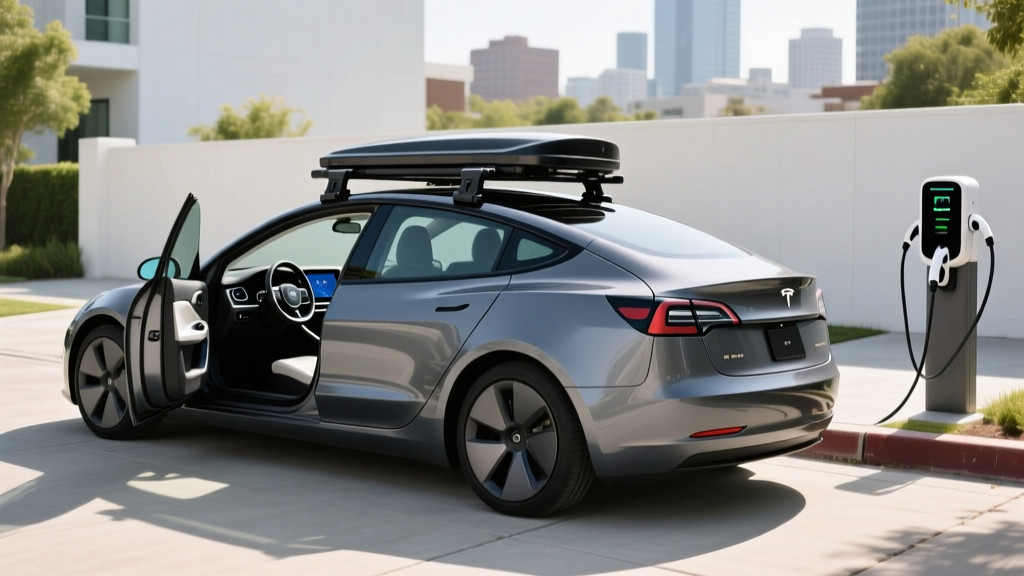
The Tesla Model 3 remains one of the most efficient electric sedans on the market, but its sleek, minimalist roofline has always posed a practical question: how do you carry bulky gear? Unlike SUVs and crossovers, the Model 3 doesn't ship with factory roof rails. Yet for owners who need to transport skis, kayaks, bicycles, or cargo boxes on road trips, a roof rack is the only viable solution beyond stuffing the trunk and frunk.
This review covers the 2026 Tesla Model 3 lineup — RWD, Long Range AWD, and Performance — through the lens of real-world ownership with a roof rack installed. We'll quantify the range penalty you can expect, break down charging speeds and battery specs, and evaluate whether the Model 3 still makes sense as a gear-hauling EV sedan compared to crossover alternatives like the Model Y.
2026 Tesla Model 3: Trims, Range, and Core Specs
The current-generation Model 3 (refreshed for 2024 and carried into 2026) comes in three trims. Tesla streamlined the lineup, dropping the mid-tier options in favor of clear differentiation between the base RWD, the long-haul Long Range, and the track-oriented Performance variant.
| Spec | RWD | Long Range AWD | Performance AWD |
|---|---|---|---|
| EPA Range | 272 mi | 341 mi | 315 mi |
| Battery (usable) | ~57.5 kWh (LFP) | ~75 kWh (NMC) | ~75 kWh (NMC) |
| Drivetrain | Rear-Wheel Drive | Dual-Motor AWD | Dual-Motor AWD |
| Horsepower | 271 hp | 346 hp | 510 hp |
| 0–60 mph | 5.8 sec | 4.2 sec | 2.9 sec |
| EPA Efficiency | 132 MPGe / 25 kWh/100mi | 134 MPGe / 25 kWh/100mi | 119 MPGe / 28 kWh/100mi |
| Peak DC Fast Charge | 170 kW | 250 kW | 250 kW |
| 10–80% DCFC Time | ~30 min | ~25 min | ~25 min |
| Level 2 Home Rate | 11.5 kW (~44 mi/hr) | 11.5 kW (~44 mi/hr) | 11.5 kW (~44 mi/hr) |
| Base MSRP | $38,990 | $45,990 | $52,990 |
Source: fueleconomy.gov and Tesla.com. Prices exclude destination fee.
Real-World Range: What the EPA Sticker Doesn't Tell You
Long Range AWD: EPA 341 mi → Expect 280–310 mi on mixed highway driving at 70–75 mph; 230–260 mi in freezing weather (below 32°F) with cabin heat.
RWD: EPA 272 mi → Expect 220–250 mi highway; 175–200 mi in cold weather.
Performance: EPA 315 mi → Expect 250–280 mi highway; aggressive driving drops this further.
The Model 3's efficiency is genuinely class-leading among electric sedans. At roughly 25 kWh per 100 miles for the Long Range, it sips electrons in a way that heavier crossovers simply can't match. But efficiency on the sticker assumes moderate temperatures, mixed driving, and no aerodynamic accessories — like a roof rack.
The Roof Rack Range Penalty: Expect 10–15% Loss
Adding a roof rack — whether Tesla's OEM crossbar system or a third-party solution from Yakima or Thule — disrupts the Model 3's carefully optimized aerodynamics. The sedan's drag coefficient (Cd ≈ 0.219) is among the lowest of any production car. Roof rails, crossbars, and especially a loaded cargo box add turbulent airflow that the heat pump and thermal management system can't compensate for.
Based on owner-reported data and real-world highway testing:
- Empty crossbars only: 5–8% range reduction at highway speeds (roughly 15–25 mi lost on the Long Range)
- Crossbars + cargo box (e.g., Thule Motion XT): 10–15% reduction (35–50 mi lost on the Long Range)
- Crossbars + bikes or kayaks: 12–18% reduction depending on frontal area of the load
For a Long Range AWD owner starting with 341 EPA miles, a loaded cargo box on the roof means planning for roughly 290–305 miles of real-world range on a highway trip. That's still ample for most drives, but it compresses your margin between Supercharger stops. On the RWD trim with 272 EPA miles, the penalty bites harder — you may drop to around 210–230 miles of usable highway range with a loaded rack, which requires more careful route planning.
Cold weather compounds the penalty. Battery chemistry becomes less efficient below freezing, and cabin heating draws additional power. A roof rack on a Model 3 Long Range in January, driving 75 mph through Minnesota, could push real-world range down to 200–230 miles. Preconditioning the battery before fast charging (which the navigation system does automatically when a Supercharger is set as your destination) helps mitigate charging-side losses but doesn't recover the aerodynamic drag.
Charging Speed and Infrastructure
| Charging Level | Power / Rate | Miles of Range Added | Best For |
|---|---|---|---|
| Level 1 (120V household) | ~1.4 kW | ~5 mi/hr | Overnight trickle; emergency top-off |
| Level 2 (240V home wall connector) | 11.5 kW | ~44 mi/hr | Daily home charging; full charge in 7–8 hrs |
| DC Fast Charge (Supercharger V3/V4) | Up to 250 kW (LR/Perf) Up to 170 kW (RWD) | Up to 175 mi in 15 min (LR) | Road trips; 10–80% in ~25–30 min |
The Model 3 uses Tesla's proprietary NACS (North American Charging Standard) connector, which as of 2025–2026 has become the dominant fast-charging standard in North America. Ford, GM, Rivian, Volvo, and others now access Tesla Superchargers via NACS adapters, meaning the Supercharger network is both the Model 3's native ecosystem and increasingly a shared resource.
Charging curve reality check: The 250 kW peak rate on the Long Range and Performance trims is not sustained across the entire session. The charge curve peaks around 10–30% State of Charge (SoC) and tapers progressively. By 60% SoC, you'll see roughly 120–140 kW; by 80%, it drops to around 50–60 kW. This is why Tesla (and every other automaker) quotes 10–80% times rather than 0–100%. Charging past 80% at a DC fast charger is painfully slow — plan to unplug and drive on.
The RWD trim's LFP (lithium iron phosphate) battery has a lower peak charge rate (170 kW) but offers one significant ownership advantage: Tesla recommends charging LFP batteries to 100% regularly, even daily. NMC batteries (Long Range, Performance) are best kept between 20–80% for daily use to minimize long-term degradation, reserving 100% for road trips. This means the RWD's 57.5 kWh pack, charged to full, gives you all 272 EPA miles every day — while Long Range owners typically operate within a ~270-mile daily window (80% of 341).
Roof Rack Options: What Fits and What to Know
Tesla does not include roof rails on any Model 3 trim. The roof is a single piece of glass (rear) and metal (front), and mounting a rack requires clamp-style crossbars that grip the door jambs — not bolt-on rails.
Available Roof Rack Solutions
- Tesla OEM Roof Rack Crossbars: Sold through Tesla's accessories store (~$350–$400). These are aerodynamically shaped aluminum bars designed specifically for the Model 3's roofline. They integrate with Tesla-approved cargo boxes, bike racks, and ski carriers. Maximum dynamic load rating: approximately 165 lbs (75 kg) evenly distributed.
- Yakima/CoreBar or Thule/WingBar Evo systems: Third-party clamp-on crossbar systems that fit the Model 3. These offer broader accessory compatibility (any Yakima or Thule attachment) but may produce slightly more wind noise due to less vehicle-specific shaping. Expect to spend $300–$500 for a complete bar + fit-kit setup.
- SeaSucker vacuum-mount racks: A niche option using industrial suction cups. No clamps or contact with door jambs. Useful for owners who want zero scratch risk, but weight limits are lower (~100 lbs total) and you must re-check vacuum seals on long trips.
Weight and efficiency note: The Model 3's roof is not rated for heavy loads like a rooftop tent. Keep total roof cargo (rack + box + contents) under the manufacturer's dynamic limit. Exceeding it risks damage to the glass roof panel and affects handling dynamics, particularly in crosswinds at highway speed.
Interior Space, Cargo, and the Roof Rack Workaround
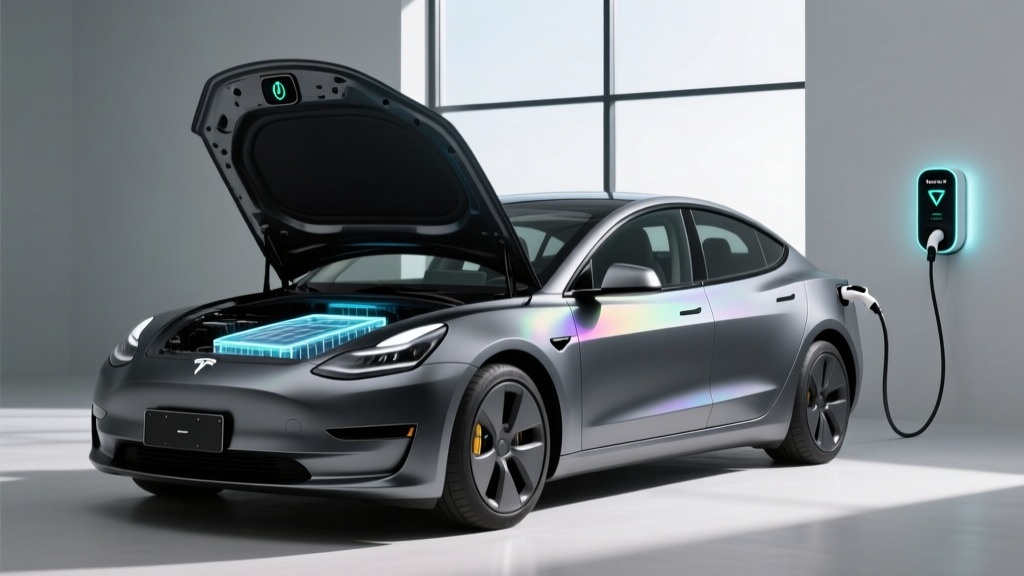
The Model 3's cargo situation is a tale of two trunks. The rear trunk offers 23 cubic feet of space — generous for a sedan, thanks to the liftback design that opens the entire rear glass. The front trunk (frunk) adds 3.1 cubic feet, useful for charging cables, a soft bag, or groceries.
| Dimension | Measurement |
|---|---|
| Rear Trunk Volume | 23.0 cu ft |
| Frunk Volume | 3.1 cu ft |
| Front Legroom | 42.7 in |
| Rear Legroom | 35.2 in |
| Front Headroom | 40.3 in |
| Rear Headroom | 37.8 in |
For most daily needs, the Model 3's 26.1 total cubic feet of enclosed storage is sufficient. But for road trips with four passengers and luggage, or for anyone hauling sports equipment, the roof rack becomes essential. Four adults with full-size suitcases will max out the trunk — skis, snowboards, or a kayak simply won't fit inside without folding rear seats and losing passenger capacity.
This is where the Model 3 owner makes a choice: accept the 10–15% range penalty of a roof rack for gear-heavy trips, or upgrade to a Model Y (which offers 76 cu ft of cargo space with seats folded and available factory roof rails). The math is straightforward — if you need a roof rack more than a few times a year, the Model Y's higher cargo utility may outweigh the Model 3's efficiency advantage.
Pricing, Tax Credits, and Ownership Cost
| Trim | Base MSRP | §30D Credit (if eligible) | Effective Price |
|---|---|---|---|
| RWD | $38,990 | Up to $7,500 | ~$31,490 |
| Long Range AWD | $45,990 | Up to $7,500 | ~$38,490 |
| Performance AWD | $52,990 | Up to $7,500 | ~$45,490 |
Federal tax credit eligibility is not automatic. Under the current IRS §30D rules, the Model 3 qualifies for the full $7,500 credit only if you meet all of the following requirements:
- Income caps: Modified adjusted gross income (MAGI) must not exceed $150,000 (single), $225,000 (head of household), or $300,000 (joint filers).
- MSRP cap: The vehicle's MSRP must be at or below $55,000 for sedans. The RWD and Long Range trims qualify. The Performance trim at $52,990 (base) also qualifies, but adding options that push MSRP above $55,000 could disqualify it.
- Battery sourcing requirements: A percentage of critical minerals and battery components must be sourced from the U.S. or free-trade-agreement countries. Tesla has shifted supply chains to meet these thresholds, but the IRS updates eligible vehicle lists periodically. Always verify current eligibility on IRS.gov before purchasing.
- Point-of-sale transfer: As of 2024, you can transfer the credit to the dealer at purchase, reducing your out-of-pocket cost immediately rather than waiting to claim it on your tax return. Tesla supports this at checkout.
Consult a tax professional for your specific situation. Credit rules are subject to legislative change, and state/local incentives may stack on top — check AFDC's state incentive database for details in your area.
Warranty Coverage
Tesla covers the Model 3 with a 4-year/50,000-mile basic vehicle warranty and an 8-year/100,000-mile battery and drive unit warranty (Long Range/Performance). The RWD trim's battery warranty is 8 years/100,000 miles as well. Tesla guarantees the battery will retain at least 70% of its original capacity during the warranty period. Real-world degradation data from high-mileage Model 3 owners suggests most packs lose roughly 5–10% capacity over the first 100,000 miles, with the curve flattening significantly afterward.
Technology, Driver Assistance, and Safety
The refreshed Model 3 interior centers on a 15.4-inch touchscreen that controls virtually every vehicle function — climate, mirrors, glovebox, and drive settings. There is no instrument cluster; speed and navigation info display on the upper-left corner of the main screen. A rear 8-inch screen serves second-row passengers for climate and media controls.
Tesla Autopilot comes standard and includes adaptive cruise control, lane-keeping assist, and automatic emergency braking. Full Self-Driving (Supervised) is a $8,000 option (or $99/month subscription) that adds automated lane changes, traffic light recognition, and city-street navigation. However, FSD remains a SAE Level 2 driver-assistance system — you must keep your hands on the wheel and eyes on the road at all times. This is not autonomous driving.
Tesla Autopilot and FSD (Supervised) are Level 2 systems. The driver is fully responsible for vehicle operation, must monitor the driving environment continuously, and must be prepared to intervene instantly. Level 4 (true driverless) is currently only available in limited robotaxi services like Waymo — not in any consumer vehicle.
Safety ratings are strong. The Model 3 earned a 5-star overall rating from NHTSA and a Top Safety Pick+ designation from IIHS with acceptable or good ratings across all crash-test categories.
Pros, Cons, and the Verdict
- Class-leading efficiency (25 kWh/100mi on Long Range)
- Supercharger network access (NACS native)
- Strong real-world range even with roof rack penalty
- Quick DC fast charging (10–80% in ~25 min on LR)
- Excellent safety ratings (NHTSA 5-star, IIHS TSP+)
- LFP battery on RWD allows daily 100% charging
- Over-the-air updates continuously add features
- No factory roof rails — aftermarket rack required for gear
- Roof rack reduces range by 10–15% under load
- Rear seat headroom is tight for taller passengers (37.8 in)
- Touchscreen-only controls frustrate some drivers
- FSD (Supervised) is expensive and still Level 2
- RWD LFC pack has slower DC fast-charge rate (170 kW)
- Panel gaps and build consistency still draw criticism
Who the Model 3 with Roof Rack Suits Best
The Model 3 with a roof rack works well for commuters who occasionally need gear-hauling capability — think weekend warriors who drive to the office Monday through Friday and head to the mountains or lake on Saturdays. The Long Range AWD trim is the sweet spot: 341 EPA miles gives you enough buffer that even with a 15% rack penalty, you retain 290+ miles of real-world range, which covers most single-leg road trips without en-route charging.
If you need a roof rack every week — regular cycling trips, frequent kayak outings, or family ski weekends — the cumulative range penalty and added wind noise make a strong case for stepping up to the Model Y or a competing electric crossover like the Hyundai Ioniq 5 or Ford Mustang Mach-E, both of which offer factory roof rails and substantially more enclosed cargo space.
Frequently Asked Questions
Does Tesla sell an official roof rack for the Model 3?
Yes. Tesla offers OEM crossbars through its accessories store, typically priced around $350–$400. They're designed specifically for the Model 3's roofline and integrate with Tesla-approved cargo carriers and bike mounts. Third-party options from Yakima and Thule also fit using clamp-style attachment kits.
How much range do I lose with a roof rack on the Model 3?
Expect a 5–8% reduction with empty crossbars and a 10–15% reduction with a loaded cargo box or bike rack at highway speeds. On the Long Range AWD (341 mi EPA), that translates to roughly 35–50 fewer miles per charge. Cold weather compounds the loss.
Can I put a rooftop tent on the Model 3?
No. Tesla does not rate the Model 3 roof for the static load of a rooftop tent with occupants. The dynamic load limit is approximately 165 lbs for driving. Exceeding this risks damage to the panoramic glass roof and voids related warranty coverage.
Does the Model 3 qualify for the $7,500 federal tax credit?
The RWD ($38,990), Long Range ($45,990), and Performance ($52,990 base) trims all fall under the $55,000 MSRP cap for sedans. However, you must also meet IRS income caps ($150K single / $300K joint) and the vehicle's battery must meet current critical-mineral and component sourcing thresholds. Always verify on IRS.gov before purchasing.
Is the Model 3 or Model Y better for road trips with gear?
If gear-hauling is a regular need, the Model Y is the stronger choice — it has 76 cu ft of cargo space with seats folded, available factory roof rails, and only slightly lower efficiency. The Model 3 is the better pick if you prioritize driving dynamics, efficiency, and lower cost, and only need roof-rack capability a few times per year.
How fast does the Model 3 charge at home?
With a Tesla Wall Connector on a 60-amp circuit, all Model 3 trims charge at up to 11.5 kW (Level 2), adding roughly 44 miles of range per hour. A full charge from near-empty takes approximately 7–8 hours. On a standard 240V/40A dryer-style outlet with a Mobile Connector, expect roughly 7.7 kW and about 30 miles per hour of charging.
What's the real-world range of the Model 3 Long Range on a road trip?
On a 70–75 mph highway drive in moderate temperatures (60–80°F), expect 280–310 miles from a full charge — roughly 82–91% of the 341-mile EPA estimate. Add a loaded roof rack and plan for 250–275 miles. In freezing weather without a roof rack, expect 230–260 miles.