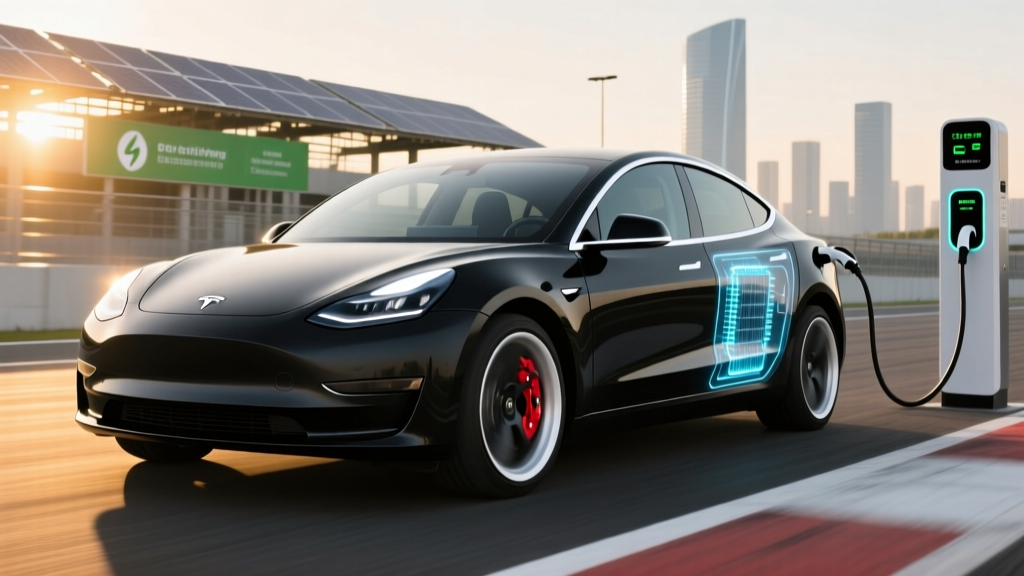
The 2026 Tesla Model 3 remains the benchmark compact electric sedan — but the business behind it is shifting. As Tesla faces financial challenges due to decreasing regulatory credits, the question for buyers isn't just about range and charging; it's about whether Tesla's pricing strategy, feature bundling, and long-term support will hold up in a market where competitors are closing the gap fast. This review breaks down the 2026 Model 3 with exact numbers, real-world testing context, and ownership economics so you can decide if it's still the smartest buy in its class.
2026 Tesla Model 3: Quick Verdict
The Model 3 Long Range AWD delivers 341 miles of EPA-estimated range, 250 kW peak DC fast charging, and a 4.2-second 0-60 mph time starting at $42,490 before incentives. The base Rear-Wheel Drive model undercuts at $38,990 with 272 miles of range. It's still the efficiency king in its segment at 132 MPGe combined, but rivals like the Hyundai Ioniq 6 and BMW i4 now match or beat it in interior quality, ride comfort, and — critically — dealership service access. For buyers who prioritize range-per-dollar, Supercharger network access, and over-the-air updates, the Model 3 is still hard to beat. For those who want a premium cabin feel and don't rely on Tesla's charging network, the competition deserves a serious look.
Range, Battery & Real-World Efficiency
| Trim | EPA Range | Real-World Highway (70 mph) | Cold Weather (20°F) |
|---|---|---|---|
| RWD (Base) | 272 mi | ~235-245 mi | ~200-215 mi |
| Long Range AWD | 341 mi | ~290-305 mi | ~245-265 mi |
| Performance | 315 mi | ~265-280 mi | ~225-240 mi |
Real-world figures based on mixed highway driving at 70 mph with climate control active. Cold-weather estimates assume 20°F ambient with cabin heating. Source: fueleconomy.gov and independent testing.
The 2026 Model 3 Long Range AWD uses a 79 kWh usable battery pack (82 kWh gross) with NMC (nickel manganese cobalt) chemistry, chosen for its higher energy density that enables the 341-mile EPA rating. The base RWD model uses a 60 kWh LFP (lithium iron phosphate) pack — heavier per kWh but more durable over thousands of charge cycles and less dependent on cobalt sourcing.
Efficiency is where the Model 3 still leads the pack. The Long Range AWD achieves 132 MPGe combined (26 kWh/100 mi), meaning you're squeezing more miles out of every kilowatt-hour than nearly any competitor. The Hyundai Ioniq 6 SE Long Range comes close at 140 MPGe in its most efficient trim, but that's with a smaller battery and less power. The BMW i4 eDrive40 sits at 109 MPGe combined.
| Spec | RWD | Long Range AWD | Performance |
|---|---|---|---|
| EPA Range | 272 mi | 341 mi | 315 mi |
| Battery (Usable) | 60 kWh (LFP) | 79 kWh (NMC) | 79 kWh (NMC) |
| MPGe Combined | 142 MPGe | 132 MPGe | 121 MPGe |
| kWh/100 mi | 24 | 26 | 28 |
| Drivetrain | RWD | Dual-Motor AWD | Dual-Motor AWD |
| Horsepower | 283 hp | 384 hp | 510 hp |
| 0-60 mph | 5.8 sec | 4.2 sec | 2.9 sec |
| Top Speed | 125 mph | 125 mph | 163 mph |
Charging Speed: DC Fast, Level 2 & Home Setup
Charging speed is often where EV marketing inflates and reality deflates. Here's the exact data for the 2026 Model 3:
| Charging Level | Power / Rate | Speed (Miles Added) | Notes |
|---|---|---|---|
| Level 1 (120V household) | ~1.4 kW | ~3-5 mi/hr | Emergency/trickle only |
| Level 2 (240V home) | 11.5 kW (48A) | ~37-44 mi/hr | Full charge in ~7-8 hrs (LR) |
| DC Fast (V4 Supercharger) | 250 kW peak | ~200 mi in 15 min | 10-80% in ~25 min |
| DC Fast (CCS adapter, 3rd party) | Up to 250 kW | Varies by station | CCS1 adapter included |
The Model 3's 250 kW peak DC fast-charge rate is strong but not class-leading — the Hyundai Ioniq 5/6 and Kia EV6 can peak at 350 kW on 800V architecture. However, Tesla's sustained charge curve is remarkably flat. In real-world V4 Supercharger testing, the Long Range AWD holds above 200 kW from roughly 10% to 45% SoC, then tapers gradually. The 10-80% charge takes approximately 25 minutes on a V3 or V4 Supercharger, which remains competitive.
For home charging, the onboard charger accepts up to 11.5 kW (48 amps) on a 240V Level 2 circuit. This means a full overnight charge is easily achievable. Tesla's Wall Connector ($475) or any J1772/NACS-compatible Level 2 unit works. Installation typically requires a 60-amp dedicated circuit — budget $800-$2,000 for electrician labor depending on panel proximity, or more if your home needs a 200-amp service upgrade.
Preconditioning matters: Navigate to a Supercharger using the car's built-in nav, and the battery will preheat to optimal temperature for maximum charge acceptance. Skip this step in cold weather and your peak kW could drop by 30-40%.
Pricing, Trims & Federal Tax Credit (2026)
Tesla's pricing has been volatile over the past two years, reflecting margin pressure and — notably — the financial headwinds from decreasing regulatory credits. Automakers like Stellantis, Ford, and GM have historically purchased zero-emission credits from Tesla to offset their own fleet compliance gaps. As those competitors electrify their own lineups, that revenue stream has thinned significantly, contributing to the financial challenges Tesla faces. The result for buyers: Tesla has cut MSRPs aggressively but also trimmed feature bundles and adjusted prices multiple times per year.
| Trim | Base MSRP | Destination | §30D Credit Potential | Effective Price |
|---|---|---|---|---|
| Rear-Wheel Drive | $38,990 | $1,390 | Up to $7,500* | ~$32,880 |
| Long Range AWD | $42,490 | $1,390 | Up to $7,500* | ~$36,380 |
| Performance | $47,740 | $1,390 | Up to $7,500* | ~$41,630 |
*Federal §30D credit eligibility depends on buyer income caps ($150K single / $300K joint AGI), MSRP caps ($55,000 for sedans), and battery critical-mineral/component sourcing rules that change annually. Check IRS.gov for current-year rules. Credit can be transferred at point of sale as a price reduction.
The Model 3 sedan falls under the $55,000 MSRP cap for §30D eligibility, and all trims currently qualify on price. Income-eligible buyers can apply the credit as a point-of-sale transfer, effectively reducing the purchase price at the dealer (or Tesla direct) rather than waiting for a tax refund. However, battery-sourcing requirements have tightened each year since 2024 — verify current-year eligibility on fueleconomy.gov before committing.
Interior, Cargo & Technology
The Model 3's minimalist interior is polarizing. There's no instrument cluster — everything routes through the 15.4-inch center touchscreen. The "Highland" refresh (carried into 2026) added ventilated front seats, ambient lighting, rear-seat ventilation, and a rear 8-inch touchscreen for climate and entertainment. Build quality has improved meaningfully since the Fremont factory's earlier years, though panel gaps still occasionally trail BMW and Hyundai standards.
| Dimension | Model 3 (2026) | Hyundai Ioniq 6 | BMW i4 |
|---|---|---|---|
| Front Legroom | 42.7 in | 41.7 in | 41.5 in |
| Rear Legroom | 35.2 in | 35.0 in | 35.8 in |
| Cargo (Trunk) | 23.0 cu ft | 12.3 cu ft | 16.6 cu ft |
| Frunk | 3.1 cu ft | 0.5 cu ft | None |
| Total Cargo | 26.1 cu ft | 12.8 cu ft | 16.6 cu ft |
Cargo space is a clear Model 3 advantage: 23 cubic feet in the trunk beats nearly every sedan competitor, and the frunk adds practical storage for charging cables or a small bag.
Standout tech features:
- 15.4" center display with integrated navigation, media, and vehicle controls
- Over-the-air software updates (Tesla pushes 10-20 meaningful updates per year)
- Tesla Supercharger network — 6,500+ V3/V4 stalls across North America
- Sentry Mode dashcam recording with mobile alerts
- Dog Mode, Camp Mode, and Theater Mode
Notable drawbacks:
- No physical buttons — even wiper speed and mirror adjustment are touchscreen-only
- No Apple CarPlay or Android Auto integration
- Turn signals on steering wheel buttons (post-refresh) are divisive
- Service center wait times can stretch weeks in some metro areas
Driver Assistance: Autopilot & FSD (Supervised)
Tesla Autopilot and Full Self-Driving (Supervised) are Level 2 driver-assistance systems. The driver must remain fully engaged, hands on the wheel (or torque-applied), and eyes on the road at all times. These are NOT autonomous or self-driving systems. Only Level 4 services like Waymo operate without a human driver — and only in geofenced areas.
Basic Autopilot (traffic-aware cruise control + lane centering) comes standard. FSD (Supervised) remains an $8,000 add-on or $99/month subscription. FSD adds automatic lane changes, Navigate on Autopilot, traffic light/stop sign recognition, and Autopark. As of 2026, FSD has improved substantially in city driving scenarios but still requires active supervision — it can misjudge unprotected left turns, construction zones, and complex intersections. NHTSA continues to monitor Tesla's Autopilot-related incident data.
Warranty, Ownership Costs & The Regulatory Credit Factor
| Coverage | Term |
|---|---|
| Basic Vehicle Limited Warranty | 4 years / 50,000 miles |
| Battery & Drive Unit (RWD, LFP) | 8 years / 100,000 miles (70% retention) |
| Battery & Drive Unit (LR/Perf, NMC) | 8 years / 120,000 miles (70% retention) |
Tesla's battery warranty guarantees 70% capacity retention over the warranty period — consistent with industry norms (Hyundai offers 10yr/100,000 mi on the Ioniq 6). Real-world degradation data from fleet aggregators suggests Model 3 NMC packs lose approximately 5-8% capacity over the first 100,000 miles, with LFP packs showing slightly slower degradation but less total range to begin with.
Why regulatory credits matter to your purchase decision: Tesla has historically earned $1-2 billion annually by selling ZEV (zero-emission vehicle) credits to legacy automakers who haven't met fleet emissions standards. As Ford, GM, Hyundai, and Stellantis bring more EVs to market, those credit purchases are declining. This financial pressure is one reason Tesla has aggressively cut prices, simplified trims, and pushed FSD subscriptions as a recurring-revenue stream. For buyers, this means potentially better deals but also uncertainty about future software support, service expansion, and resale value stability. Watch Tesla's quarterly earnings reports for credit-revenue trends as a leading indicator.
- Best-in-class efficiency (132 MPGe, 26 kWh/100 mi)
- Supercharger network access — most reliable DC fast-charging in North America
- Strong real-world range: 341 EPA / ~290 highway
- Segment-leading cargo space (26.1 cu ft total)
- Continuous OTA improvements
- Eligible for up to $7,500 §30D credit (verify sourcing rules)
- No physical controls — touchscreen dependency for everything
- No Apple CarPlay / Android Auto
- FSD ($8,000) still requires full driver supervision
- Service center availability varies widely by region
- Regulatory credit decline raises long-term business questions
- Ride quality firmer than Ioniq 6 and BMW i4
Who Should Buy the 2026 Tesla Model 3?
Choose the Model 3 if:
- You commute 40+ miles daily and want maximum efficiency per kWh
- You road-trip frequently and need reliable DC fast-charging infrastructure
- You value OTA updates and tech-forward features over traditional luxury materials
- You can charge at home with Level 2 and want minimal public-charging dependency
Consider competitors if:
- You prefer physical buttons, Apple CarPlay, and a traditional instrument cluster (Ioniq 6, BMW i4)
- Service-center proximity matters — Tesla's mobile service doesn't cover all areas
- You want a softer, more compliant ride for long highway stretches
- You need a hatchback cargo opening (Ioniq 5, EV6, or Model Y instead)
Frequently Asked Questions
What is the real-world range of the 2026 Tesla Model 3?
The Long Range AWD achieves 341 miles EPA-estimated. In real-world highway driving at 70 mph, expect approximately 290-305 miles. In cold weather (20°F), that drops to roughly 245-265 miles due to battery resistance and cabin heating demands. The base RWD model delivers 272 EPA miles, or about 235-245 highway and 200-215 in cold conditions.
How fast does the Model 3 charge at home and on DC fast chargers?
On a 240V Level 2 home charger at 48 amps (11.5 kW), the Model 3 adds approximately 37-44 miles of range per hour, reaching a full charge overnight in 7-8 hours. On a V3/V4 Tesla Supercharger, it peaks at 250 kW and charges from 10-80% in approximately 25 minutes. Using a CCS adapter at third-party networks (Electrify America, EVgo), speeds are similar but depend on station output and battery preconditioning.
How much does the 2026 Model 3 cost after the federal EV tax credit?
The base RWD starts at $38,990 + $1,390 destination. With the full $7,500 §30D point-of-sale credit, the effective price drops to approximately $32,880. The Long Range AWD at $42,490 falls to roughly $36,380. However, eligibility requires meeting IRS income caps ($150K single / $300K joint), and the vehicle must satisfy battery critical-mineral and component sourcing requirements that tighten each year. Verify on IRS.gov before purchasing.
Does the Tesla Model 3 qualify for the federal EV tax credit in 2026?
All Model 3 trims fall under the $55,000 MSRP cap for sedans. Income-eligible buyers may qualify for up to $7,500, applied as a point-of-sale price reduction. Battery sourcing rules under §30D have become stricter annually — check the latest eligible vehicle list on fueleconomy.gov for the current month's status, as Tesla's battery supply chain composition can shift eligibility.
Is the Model 3 worth buying vs. the Hyundai Ioniq 6 or BMW i4?
The Model 3 wins on efficiency (132 MPGe vs. Ioniq 6's 140 MPGe in base but less in AWD), cargo space (26.1 vs. 12.8 cu ft), and charging infrastructure (Supercharger network). The Ioniq 6 offers a more traditional interior, Apple CarPlay, 800V ultra-fast charging (350 kW peak), and a 10-year battery warranty. The BMW i4 provides superior ride quality, dealer service access, and a more premium cabin but at a higher price ($52,200 base) and lower efficiency (109 MPGe). If Supercharger access and cargo space matter most, the Model 3 is the stronger choice.
How do Tesla's regulatory credit challenges affect me as a buyer?
Decreasing ZEV credit revenue pressures Tesla's margins, which has led to aggressive price cuts (benefiting buyers) but also feature unbundling and service-center constraints. Long-term, it raises questions about Tesla's ability to invest in next-gen platforms and service expansion. For a 2026 purchase, the immediate impact is positive — lower MSRPs. But monitor Tesla's financial health and service availability in your area before committing to a vehicle with limited third-party repair options.