Quick Verdict: The Benchmark EV Gets Smarter on Your Phone
The 2026 Tesla Model 3 remains the default answer for buyers entering the EV space — and for good reason. With up to 363 miles of EPA-estimated range in Long Range AWD trim, a maturing Supercharger network, and continuous over-the-air updates, it's a package that's hard to beat on pure value-per-mile. But ownership in 2026 extends beyond the car itself. For Android users, the Tesla widget for Android has become a meaningful quality-of-life layer: checking State of Charge (SoC), cabin temperature, and charging status without opening the full app. This review covers the 2026 Model 3 end-to-end — specs, real-world range, charging, pricing, tax credits, and how Android integration fits into daily driving.
Range, Battery, and Real-World Efficiency
| Spec | RWD | Long Range AWD | Performance |
|---|---|---|---|
| EPA Range | 272 mi | 363 mi | 315 mi |
| Battery (usable) | ~57.5 kWh (LFP) | ~75 kWh (NMC) | ~75 kWh (NMC) |
| MPGe (combined) | 132 MPGe | 134 MPGe | 121 MPGe |
| kWh/100 mi | 25 | 25 | 28 |
| Drivetrain | RWD, single motor | AWD, dual motor | AWD, dual motor |
| 0-60 mph | 5.8 sec | 4.2 sec | 2.9 sec |
| Horsepower | 271 hp | 346 hp | 510 hp |
The EPA sticker on the Long Range AWD says 363 miles, but plan for reality. On sustained highway driving at 70-75 mph, expect roughly 290-310 miles before needing a charger. In cold weather (below 32°F), range can drop an additional 15-25% due to battery resistance and cabin heating demands — putting realistic winter highway range around 230-260 miles. The LFP-equipped RWD model is more sensitive to cold because LFP chemistry has higher internal resistance at low temperatures, though its heat pump helps mitigate cabin energy draw. City driving with frequent regenerative braking recovers energy and gets you closer to the EPA number.
The RWD trim uses a lithium iron phosphate (LFP) battery, which trades energy density for longevity and cost. LFP cells tolerate regular 100% charging without degradation concerns — Tesla actually recommends charging to 100% at least weekly for LFP packs to keep the battery management system calibrated. The Long Range and Performance trims use nickel manganese cobalt (NMC) chemistry, which offers higher energy density but benefits from daily charging limits of 80-90% unless you need full range for a trip. Source: fueleconomy.gov.
Charging Speed: DC Fast, Level 2, and Level 1
| Charging Level | Max Rate | Speed (approx.) | Notes |
|---|---|---|---|
| DC Fast (Supercharger V4) | 250 kW peak (LR/Perf), 170 kW (RWD LFP) | 10-80% in ~25 min (LR), ~30 min (RWD) | Peak rate sustained only to ~50% SoC; tapers significantly above 80% |
| Level 2 (Home 48A / 11.5 kW) | 11.5 kW | ~44 mi/hr (LR), ~33 mi/hr (RWD) | Full charge in 7-9 hours; requires 60A circuit |
| Level 2 (Wall Connector 32A / 7.7 kW) | 7.7 kW | ~30 mi/hr (LR), ~22 mi/hr (RWD) | Good for 50A circuit; overnight is sufficient |
| Level 1 (120V outlet) | ~1.4 kW | ~3-5 mi/hr | Emergency/top-up only; 20+ hours for full charge |
Tesla's charge curve is among the most predictable in the industry. On a V3 or V4 Supercharger, the Long Range AWD peaks near 250 kW but only holds that rate up to roughly 40-50% SoC. From 50-80%, the rate ramps down to approximately 100-120 kW. This is why the 10-80% time (~25 minutes) is the meaningful metric — not the peak kW number. The RWD's LFP battery charges slower in absolute terms (~170 kW peak), but because the pack is smaller (57.5 kWh), the actual charging time difference is modest.
For home charging, the Tesla Wall Connector at 48 amps (11.5 kW) is the sweet spot. Plan on a dedicated 60-amp circuit installed by a licensed electrician. A 50-amp circuit supporting 40 amps (9.6 kW) is the next step down and still provides roughly 35 miles of range per hour on the Long Range. Always precondition your battery via the Tesla app or navigation to a Supercharger — this warms the pack for faster DC charging speeds, especially in cold weather.
Pricing, Tax Credits, and Total Cost
| Trim | Base MSRP | Federal Credit (§30D) | Effective Price |
|---|---|---|---|
| Model 3 RWD | $38,990 | Up to $7,500 (see eligibility below) | From ~$31,490 |
| Model 3 Long Range AWD | $44,990 | Up to $7,500 | From ~$37,490 |
| Model 3 Performance | $52,990 | Up to $7,500 | From ~$45,490 |
Federal tax credit eligibility under IRS §30D has several conditions that buyers must verify for their specific situation:
- MSRP cap: Sedans must be priced at or below $55,000. All 2026 Model 3 trims qualify at base MSRP, but adding options can push the Performance trim above the cap.
- Income limits: Modified adjusted gross income must not exceed $150,000 (single), $225,000 (head of household), or $300,000 (joint filing).
- Battery sourcing: The credit splits into two halves — $3,750 for critical minerals sourcing and $3,750 for battery component manufacturing. Sourcing requirements tighten annually; verify current-year compliance on irs.gov.
- Point-of-sale transfer: As of 2024, you can transfer the credit to the dealer at purchase, reducing your out-of-pocket cost immediately rather than waiting for tax filing.
Always confirm eligibility with a tax professional before relying on the credit in your purchase decision. Rules change, and individual circumstances vary. State and local incentives may stack on top — check your state's energy office or AFDC state incentive database for specifics.
Interior, Cargo, and Daily Livability
The 2026 Model 3 cabin is minimalist by design — a single 15.4-inch center touchscreen handles climate, media, navigation, and vehicle controls. There are no physical buttons for HVAC or audio, which is polarizing but keeps the dashboard clean. Build quality has improved significantly since early Model 3 production years; panel gaps are tight and material quality is solid for the price point.
Passenger space is competitive with compact sedans:
- Front legroom: 42.7 inches
- Rear legroom: 35.2 inches
- Cargo volume (trunk + frunk): 23 cu ft combined
- Rear seat fold-down: expands cargo to ~43 cu ft
The frunk (front trunk) adds roughly 3 cu ft of secure, weatherproof storage — useful for charging cables or a small bag. The rear trunk is deep but the opening is narrow compared to a hatchback or liftback, so large items like a full-size bike require folding the rear seats.
Tech, Autopilot, and the Tesla Widget for Android
Tesla Autopilot and Full Self-Driving (Supervised) are Level 2 driver-assistance systems. The driver must remain attentive, hands on or near the wheel, and ready to take over at any time. These systems do not make the car self-driving. Only Level 4 services like Waymo operate without a driver.
Standard Autopilot includes Traffic-Aware Cruise Control and Autosteer (lane centering) on divided highways. The FSD (Supervised) package ($8,000 one-time or $99/month as of 2026) adds automatic lane changes, Navigate on Autopilot, and city-street steering assistance — but still requires active supervision. FSD's capability has improved through neural-network-based end-to-end driving, but it remains a driver-assist feature, not autonomy.
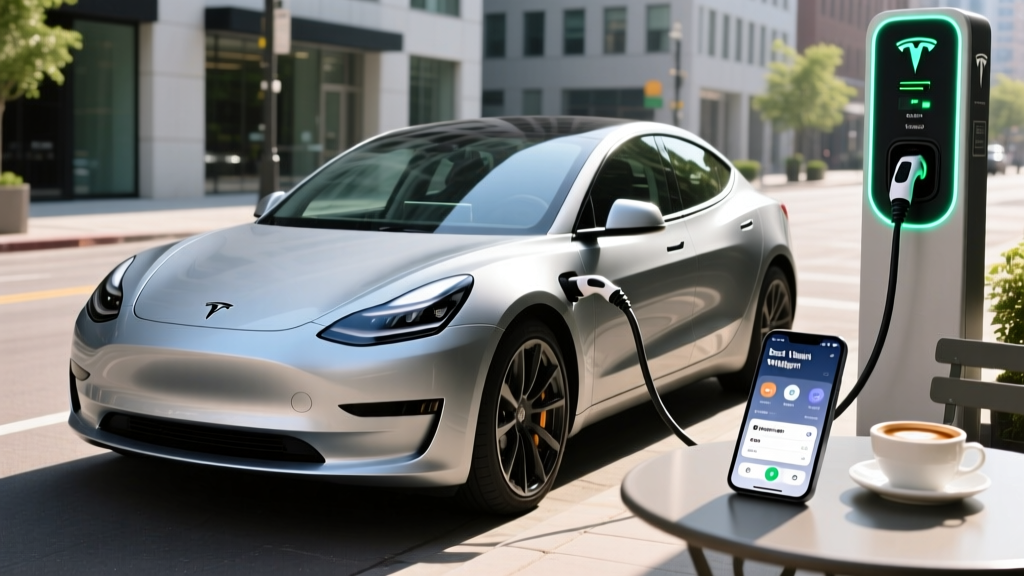
For Android owners, the Tesla widget for Android is where daily ownership gets a practical upgrade. Available through the Tesla app's widget settings or third-party apps like "Tesla Unplugged" or "Stats for Tesla" on the Google Play Store, the Android home screen widget surfaces critical information without opening the full app:
- Current State of Charge — battery percentage and estimated range at a glance
- Charging status — actively charging, charge rate in kW, and time to target SoC
- Cabin climate — interior temperature, useful for preconditioning before you walk to the car
- Location — confirms where the vehicle is parked (helpful in large lots or when family members share the car)
- Quick actions — lock/unlock, open frunk, flash lights, or start climate control with a single tap
On Android 14 and newer, Tesla's official app supports a resizable widget with a dark-mode variant. Third-party widgets like "Widget for Tesla" offer more customization — combining SoC, tire pressure, odometer, and charging graph in a single tile. These third-party widgets use Tesla's Fleet API and require a one-time OAuth login; they don't store your credentials. The practical value is significant: checking charge status from your home screen before a morning commute saves 10-15 seconds versus opening the app, and those seconds compound over daily use.
Tesla widgets (official and third-party) rely on the vehicle's cellular connection and Tesla's servers. If your car is parked in an underground garage with no signal, data will be stale until the car reconnects. Widgets also cannot control driving features — they are status and convenience tools only. Third-party widgets may require a Tesla API token that expires periodically and needs re-authentication.
Warranty, Ownership Costs, and Longevity
Tesla's warranty coverage for the 2026 Model 3:
- Basic vehicle: 4 years / 50,000 miles
- Battery & drive unit (RWD): 8 years / 100,000 miles (minimum 70% capacity retention)
- Battery & drive unit (LR/Performance): 8 years / 120,000 miles (minimum 70% capacity retention)
The 70% retention threshold is the warranty trigger — if your battery degrades below 70% of original capacity within the warranty period, Tesla replaces or refurbishes it at no cost. In practice, Tesla's NMC packs have shown roughly 10-12% degradation over 100,000 miles based on fleet data, and LFP packs degrade even slower in warm climates. Replacement cost out of warranty for a Model 3 battery is estimated at $12,000-$16,000 depending on the pack, though most owners will never face this.
Insurance premiums for the Model 3 are above average for its class — expect $1,800-$2,800 annually depending on location, driving record, and trim. Tesla's own insurance product (available in select states) uses real-time driving data and can be competitive for safe drivers. Maintenance costs are minimal: no oil changes, no spark plugs, cabin air filter replacement every 2-3 years, and tire rotation every 6,250 miles. Brake pads last well past 100,000 miles thanks to regenerative braking.
Pros and Cons
Pros
- Class-leading efficiency (134 MPGe combined on Long Range)
- Access to Tesla Supercharger network — the most reliable DC fast-charging infrastructure in the US
- Over-the-air updates continuously add features and refine performance
- LFP battery on RWD offers excellent longevity with 100% charging tolerance
- Strong Tesla widget for Android integration improves daily ownership convenience
- Low running costs — approximately $0.04-$0.06 per mile on home electricity
Cons
- No physical HVAC or audio controls — everything runs through the touchscreen
- Rear visibility is limited; relies heavily on cameras and mirrors
- FSD (Supervised) costs $8,000 and still requires full driver attention
- Cargo opening is narrow compared to hatchback competitors
- Insurance costs are higher than comparable non-Tesla EVs
- RWD LFP battery loses more range in cold weather than NMC variants
Who Should Buy the 2026 Tesla Model 3?
- Your daily commute is under 80 miles round-trip and you charge at home
- You live in a moderate climate where LFP cold-weather range loss is manageable
- You want the lowest entry price with maximum battery longevity
- You take regular road trips of 200+ miles and need range buffer
- You live in a cold-weather region where AWD traction and NMC cold performance matter
- You want the best combination of range, performance, and price in the EV sedan market
- Sub-3-second 0-60 acceleration and track capability are priorities
- You accept the range trade-off (315 mi EPA) for the performance uplift
- You prefer physical buttons and a more traditional interior layout
- You want a hatchback/liftback cargo opening for larger items
- You prefer CCS/NACS flexibility without adapter reliance (though Tesla now uses NACS natively)
Frequently Asked Questions
What is the real-world range of the 2026 Tesla Model 3?
The EPA estimates 363 miles for the Long Range AWD, but real-world highway driving at 70+ mph delivers approximately 290-310 miles. In cold weather below freezing, expect 230-260 miles. The RWD (272 mi EPA) realistically delivers 210-240 miles highway, less in winter.
How fast does the Model 3 charge at home and on the road?
On a Supercharger, the Long Range peaks at 250 kW and charges from 10-80% in about 25 minutes. At home on a 48-amp Level 2 Wall Connector (11.5 kW), you gain roughly 44 miles of range per hour, fully charging overnight in 7-9 hours. The RWD's LFP battery peaks at ~170 kW DC and takes about 30 minutes for 10-80%.
How much does the 2026 Model 3 cost after tax credits?
The RWD starts at $38,990 MSRP. If you qualify for the full $7,500 federal credit under §30D (income limits, MSRP cap, and battery sourcing rules apply), the effective price drops to approximately $31,490. The Long Range AWD starts at $44,990, or roughly $37,490 after the credit. Confirm eligibility on irs.gov and with your tax professional.
Is the Tesla Model 3 worth buying vs. the Hyundai Ioniq 6 or BMW i4?
The Model 3 wins on Supercharger network access, efficiency, and OTA updates. The Ioniq 6 offers more rear headroom, an 800V architecture for faster charging (10-80% in ~18 min on a 350 kW charger), and physical buttons. The BMW i4 provides a more premium interior and traditional driving dynamics. If Supercharger access and software are top priorities, the Model 3 leads. If interior ergonomics or cargo flexibility matter more, cross-shop the alternatives.
Does the 2026 Model 3 qualify for the federal EV tax credit?
All 2026 Model 3 trims are under the $55,000 MSRP cap for sedans. Eligibility depends on your income (under $150K single / $300K joint), the battery's critical mineral and component sourcing compliance, and purchasing new from a dealer. The credit can be transferred at point of sale. Verify current-year sourcing compliance at irs.gov before purchase.
How does the Tesla widget for Android work?
The Tesla app includes a home screen widget (Android 14+) that shows battery SoC, estimated range, charging status, and cabin temperature. Third-party widgets on Google Play offer expanded layouts with tire pressure, odometer, and charging history. All widgets require the car to have an active cellular connection and update when the vehicle sends data to Tesla's servers.
Is Tesla Autopilot or FSD actually self-driving?
No. Both Autopilot and FSD (Supervised) are SAE Level 2 driver-assistance systems. You must remain alert, keep your hands on or near the wheel, and be prepared to take over immediately. They do not replace an attentive driver.