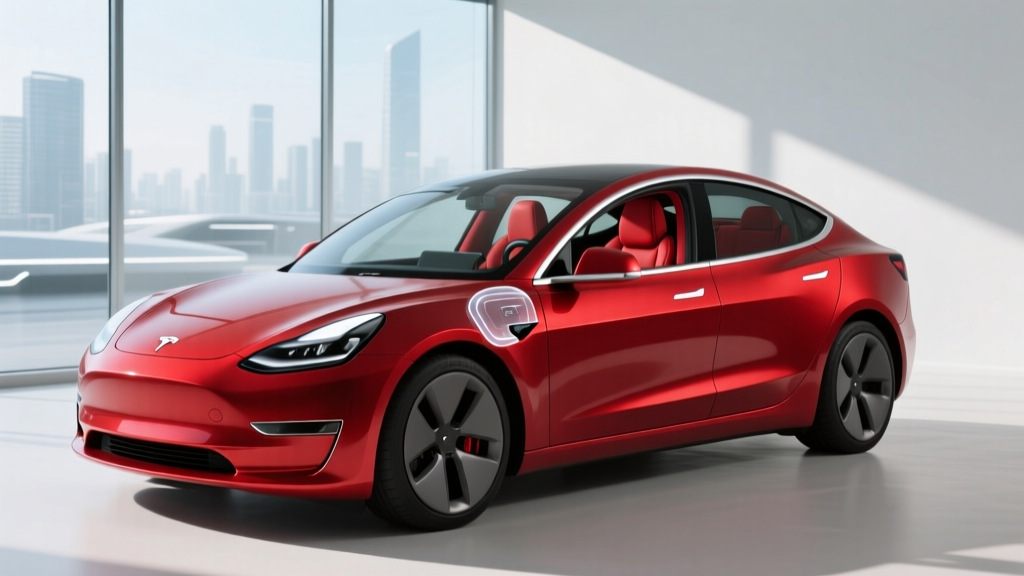
The Tesla Model 3 remains one of the most popular electric sedans on the road, but one option consistently generates debate among buyers: the Tesla red interior. Priced as a premium upgrade over the standard black or black-and-white cabins, the red interior transforms the Model 3's minimalist cabin into something with genuine visual warmth. But beyond aesthetics, the 2026 Model 3 is a fundamentally strong EV — excellent efficiency, fast DC charging, and access to the Supercharger network. This review covers the full ownership picture: real-world range, charging speeds, tax-credit eligibility, and whether the red interior justifies its cost.
2026 Tesla Model 3 at a Glance: Key Specs
| Specification | Rear-Wheel Drive | Long Range AWD | Performance |
|---|---|---|---|
| EPA Range | 272 mi | 341 mi | 315 mi |
| Battery (usable) | ~57.5 kWh (LFP) | ~75 kWh (NMC) | ~75 kWh (NMC) |
| Peak DC Fast Charge | 170 kW | 250 kW | 250 kW |
| 10–80% DC Charge Time | ~30 min | ~25 min | ~25 min |
| Level 2 Home Charge | 11.5 kW (~44 mi/hr) | 11.5 kW (~44 mi/hr) | 11.5 kW (~44 mi/hr) |
| 0–60 mph | 5.8 sec | 4.2 sec | 2.9 sec |
| Horsepower | 271 hp | 346 hp | 510 hp |
| Drivetrain | RWD (single motor) | AWD (dual motor) | AWD (dual motor) |
| Efficiency | 132 MPGe / 25 kWh/100mi | 134 MPGe / 25 kWh/100mi | 119 MPGe / 28 kWh/100mi |
| Base MSRP | $38,990 | $44,990 | $52,990 |
Source: fueleconomy.gov and Tesla.com. Pricing reflects 2026 MSRP before destination fees or incentives.
Real-World Range: What the EPA Sticker Doesn't Tell You
| Trim | EPA Est. | Highway (70 mph) | Cold Weather (32°F) |
|---|---|---|---|
| RWD | 272 mi | ~230–245 mi | ~200–220 mi |
| Long Range AWD | 341 mi | ~285–305 mi | ~250–275 mi |
| Performance | 315 mi | ~265–285 mi | ~230–255 mi |
Highway and cold-weather estimates based on independent EV range testing and typical LFP/NMC cold-weather behavior. Actual results vary with terrain, HVAC use, and driving style.
The Long Range AWD is the sweet spot for buyers who road-trip regularly. Its 341-mile EPA rating is among the best in the compact luxury EV sedan class, and on real-world highway loops at 70–75 mph, expect roughly 285–305 miles before needing a charger. That's enough for stretches like LA to Las Vegas or Chicago to Indianapolis with one brief stop.
The RWD trim uses an LFP (lithium iron phosphate) battery. LFP cells are heavier and less energy-dense than NMC, which is why the RWD carries fewer miles. However, LFP chemistry offers longer cycle life and can be charged to 100% daily without the degradation concerns that NMC owners manage by staying at 80% for routine use. For commuters with home charging, the RWD's 272 EPA miles — realistically 230–245 on the highway — covers most daily needs with margin to spare.
In cold weather, all EVs lose range due to battery resistance and cabin heating demands. Tesla's heat pump is among the more efficient systems on the market, but you should still plan for 20–25% range reduction when temperatures drop below freezing. Preconditioning the battery while plugged in (using the Tesla app's scheduled departure feature) mitigates this loss and improves regenerative braking performance in cold conditions.
Charging Speed: DC Fast Charging and Home Setup
Tesla's Supercharger network remains a decisive ownership advantage, with over 50,000 Superchargers globally and growing. But how fast does the Model 3 actually charge?
| Charging Level | Power | Miles Added per Hour | Notes |
|---|---|---|---|
| Level 1 (120V household) | ~1.4 kW | ~5 mi/hr | Emergency/trickle only |
| Level 2 (240V home, 48A) | 11.5 kW | ~44 mi/hr | Full charge overnight (~7–8 hrs) |
| DC Fast (V3 Supercharger, LR/Perf) | 250 kW peak | ~170 mi in 15 min | 10–80% in ~25 min; tapers above 80% |
| DC Fast (V3 Supercharger, RWD) | 170 kW peak | ~130 mi in 15 min | 10–80% in ~30 min |
A critical nuance for first-time EV buyers: kW (kilowatts) measures charging power — the rate at which energy flows into the battery. kWh (kilowatt-hours) measures battery capacity — the total energy the battery holds. A 250 kW peak charge rate doesn't mean sustained speed; the Model 3's charge curve tapers significantly above 50–60% state of charge, which is why the 10–80% metric matters more than peak kW figures alone.
For home charging, a Level 2 wall connector on a 60-amp circuit delivers the full 48 amps (11.5 kW) the Model 3's onboard charger can accept. This adds roughly 44 miles of range per hour of charging — enough to fully replenish even the Long Range battery overnight. Installation costs typically range from $500 to $2,000 depending on panel capacity and run length; a licensed electrician should assess whether your panel has headroom for a 60-amp breaker.
With the 2026 Model 3's NACS (North American Charging Standard) port, you also gain native access to the growing number of non-Tesla networks adopting the connector, though CCS adapters remain useful for Electrify America and other legacy networks during the industry transition.
The Red Interior: What You Get for the Premium
The Tesla red interior option costs $1,000 above the standard all-black interior (the black-and-white two-tone is also $1,000). Here's what distinguishes it:
- Premium vegan leather in a deep crimson/red across seats, door panels, and center console
- Black Alcantara-style headliner replacing the standard cloth
- Black dashboard and trim — the red pairs exclusively with black upper surfaces
- 12-way power front seats with heating and ventilation (ventilated seats standard on all 2026 trims)
- Rear heated seats with dedicated climate controls on the rear touchscreen
- Premium audio — 17-speaker system with immersive sound (standard on LR and Performance; 9-speaker on RWD)
The red interior is purely a cosmetic and materials upgrade — it doesn't change performance, range, or technology. But in a vehicle where the cabin is nearly all you interact with (no physical gauges, no traditional buttons), the interior color has outsized impact on daily satisfaction. The red is notably more resistant to showing dirt and denim transfer than the white, and it photographs dramatically for resale listings.
One honest drawback: Tesla's "vegan leather" (synthetic polyurethane) doesn't breathe like genuine leather, and some owners report seat surfaces becoming sticky in extreme summer heat without ventilated cooling active. The seat ventilation helps, but it's a mild limitation versus the perforated leather you'd find in a BMW i4 or Mercedes EQB.
Pricing, Tax Credits, and Total Cost
| Trim | Base MSRP | + Red Interior | + Destination | As-Tested (before credit) | Est. After §30D Credit |
|---|---|---|---|---|---|
| RWD | $38,990 | +$1,000 | +$1,390 | $41,380 | ~$33,880* |
| Long Range AWD | $44,990 | +$1,000 | +$1,390 | $47,380 | ~$39,880* |
| Performance | $52,990 | +$1,000 | +$1,390 | $55,380 | ~$47,880* |
*Estimated prices assume full $7,500 federal tax credit eligibility. Actual credit depends on individual circumstances.
- MSRP Cap: Sedans must have an MSRP ≤ $55,000 (all Model 3 trims qualify)
- Buyer Income Cap: AGI ≤ $150,000 (single) / $225,000 (head of household) / $300,000 (joint)
- Battery Sourcing: Critical minerals and battery components must meet phased-in domestic/FCA-partner sourcing thresholds — verify current-year compliance at IRS.gov before purchasing
- Point-of-Sale Transfer: Eligible buyers can transfer the credit to the dealer at purchase, reducing the purchase price directly rather than waiting for a tax refund
- One-Time Use: You can only claim one new clean vehicle credit per year
Tax credit rules are subject to change. Consult a tax professional and verify eligibility at IRS.gov before relying on credit estimates.
All three Model 3 trims fall under the $55,000 sedan MSRP cap, making them potentially eligible for the full $7,500 federal credit — a significant advantage over competitors like the BMW i4 (starting ~$52,000, near or above the cap depending on options). The point-of-sale transfer option means you can apply the credit directly at delivery, effectively lowering your out-of-pocket cost or monthly payment without waiting until tax season.
Technology, Driver Assistance, and Safety
The Model 3's cabin revolves around a 15.4-inch center touchscreen running Tesla's proprietary software. There are no physical buttons for climate, media, or vehicle settings — everything routes through the display or voice commands. The 2026 "Highland" refresh added ambient lighting, ventilated seats, rear-seat touchscreen, and improved sound insulation over the pre-2024 model.
Driver Assistance (SAE Level 2):
Tesla's Autopilot (standard) and Full Self-Driving Supervised ($8,000 option or $99/mo subscription) are SAE Level 2 driver-assistance systems. The driver must remain fully engaged, hands on the wheel (or providing steering-torque confirmation), and eyes on the road at all times. These systems assist with lane centering, adaptive cruise control, and highway lane changes — they do not drive the car independently. Only Level 4 robotaxi services like Waymo operate without a human driver, and those are limited to geofenced urban areas.
Autopilot is competent for highway cruising and stop-and-go traffic. FSD Supervised adds city-street navigation, traffic-light recognition, and more assertive lane changes, but its performance varies significantly by geography and complexity. Many owners find the standard Autopilot sufficient and the FSD subscription hard to justify at its current price point unless you frequently drive in well-mapped urban areas where it performs best.
Safety ratings are strong: the Model 3 earns a 5-star overall rating from NHTSA and has historically been a Top Safety Pick+ from IIHS (verify current-year status as testing criteria evolve).
Cargo, Passenger Space, and Practicality
| Dimension | Measurement |
|---|---|
| Cargo (rear trunk) | 21 cu ft |
| Frunk (front trunk) | 3.1 cu ft |
| Total Cargo | 24.1 cu ft |
| Front Legroom | 42.7 in |
| Rear Legroom | 35.2 in |
| Front Headroom | 40.3 in |
| Rear Headroom | 37.8 in |
| Seating Capacity | 5 passengers |
The Model 3's trunk is generous for a compact sedan, and the rear seats fold flat (60/40 split) for longer items. The frunk is small — useful for a charging cable bag or small groceries, not much more. Rear legroom at 35.2 inches is adequate for adults under 6 feet but tighter than a Hyundai Ioniq 6 (38.4 in rear legroom) or BMW i4 (36.0 in). If you regularly carry tall rear passengers, this is worth a test-sit.
Pros, Cons, and Verdict
Pros
- Class-leading efficiency (25 kWh/100mi on LR) keeps charging costs low
- 250 kW peak DC charging on LR/Performance — 10–80% in ~25 min
- Supercharger network access — still the most reliable public charging ecosystem
- Strong performance across all trims (2.9 sec 0–60 on Performance)
- All trims qualify for $7,500 federal credit under current MSRP caps
- OTA software updates continuously add features
- Red interior adds genuine visual appeal vs. the austere standard black
Cons
- Rear legroom is tight for taller passengers (35.2 in)
- No physical controls — everything through the touchscreen
- Panel gaps and paint quality remain inconsistent vs. legacy luxury brands
- FSD at $8,000 or $99/mo is expensive for a Level 2 system
- RWD's LFP battery limits cold-weather range and DC charge speed
- Insurance premiums tend to run higher than comparable sedans
- Synthetic leather seats can feel sticky in extreme heat without ventilation
Who Should Buy the Tesla Model 3 with the Red Interior?
- You want a tech-forward EV sedan with access to the most reliable fast-charging network
- You value efficiency and low per-mile charging costs over traditional luxury materials
- You commute 30–80 miles daily and can charge at home overnight
- You take road trips 4–8 times per year and want minimal charging-stop friction
- You want a cabin with personality — the red interior breaks the monotony of the typical black EV interior
- You regularly carry tall adults in the rear seat (consider Ioniq 6 or BMW i4)
- You prefer physical buttons, knobs, and traditional luxury fit-and-finish
- You need towing capability (Model 3 is not rated for towing; consider Model Y or Rivian R2)
- You live in a region with extreme cold and no garage — the LFP RWD trim loses meaningful range below freezing
Frequently Asked Questions
What is the real-world range of the Tesla Model 3?
The EPA rates the Long Range AWD at 341 miles, but expect roughly 285–305 miles at sustained highway speeds (70–75 mph) and 250–275 miles in freezing weather. The RWD delivers about 230–245 highway miles from its 272 EPA rating. These are real-world figures based on typical driving conditions; aggressive acceleration, mountain terrain, and heavy HVAC use will reduce them further.
How fast does the Model 3 charge at home and on the road?
At home on a Level 2 (240V, 48A) wall connector, the Model 3 charges at 11.5 kW, adding about 44 miles of range per hour — a full overnight charge for any trim. On a V3 Supercharger, the Long Range and Performance trims peak at 250 kW and charge from 10–80% in approximately 25 minutes. The RWD peaks at 170 kW and takes about 30 minutes for the same 10–80% session.
How much does a Tesla Model 3 with the red interior cost after tax credits?
With the red interior ($1,000) and destination fee ($1,390), the Long Range AWD comes to approximately $47,380 before incentives. If you qualify for the full $7,500 federal §30D credit, your effective cost drops to roughly $39,880. Eligibility depends on your income (≤$150K single / ≤$300K joint), the vehicle's battery-sourcing compliance, and MSRP cap adherence. Verify at IRS.gov and consider consulting a tax professional.
Is the Tesla Model 3 worth buying vs. competitors like the BMW i4 or Hyundai Ioniq 6?
The Model 3 wins on charging infrastructure (Supercharger network), efficiency (lowest kWh/100mi in class), and software. The BMW i4 offers superior build quality, more rear legroom, and physical controls but costs more and may not qualify for the full federal credit. The Hyundai Ioniq 6 offers more rear space and a smoother ride but charges slower on DC and lacks Supercharger access (though NACS adoption is expanding). If charging convenience and efficiency are your top priorities, the Model 3 remains the benchmark.
Does the Tesla Model 3 qualify for the federal EV tax credit?
Yes — all 2026 Model 3 trims fall under the $55,000 MSRP cap for sedans. However, buyer eligibility also depends on your adjusted gross income (≤$150K single, ≤$300K joint filers), and the vehicle must meet battery critical-mineral and component sourcing requirements that phase in annually. The credit can be transferred to the dealer at point of sale. Always verify current-year rules at IRS.gov before committing to a purchase.
Is the red interior worth the $1,000 upgrade?
If you care about cabin ambiance, yes. The red vegan leather adds warmth and visual contrast that the standard black lacks, and it hides wear better than the white option. It's a purely cosmetic choice with no impact on range, performance, or technology. For resale, the red interior tends to photograph well and appeals to a segment of buyers who find the default black too plain. At $1,000 on a ~$45,000 vehicle, it's a modest premium for a daily-experience upgrade.
What is the Model 3's battery warranty?
Tesla covers the battery and drive unit for 8 years or 100,000 miles (whichever comes first) on the RWD, and 8 years or 120,000 miles on the Long Range and Performance trims. The warranty guarantees the battery will retain at least 70% of its original capacity during that period. Real-world degradation data from Tesla's fleet reports shows most Model 3 batteries retain approximately 85–90% capacity at 100,000 miles — well within the warranty threshold.