Tesla Model 3 in 2026: Still the EV Benchmark?
The Tesla Model 3 remains the default answer for shoppers cross-referencing efficiency, performance, and charging infrastructure. The current-generation "Highland" refresh brought meaningful improvements in cabin insulation, suspension tuning, and interior materials — but the core appeal still comes down to the numbers: EPA range, charge speed, and straight-line acceleration that embarrasses sports cars costing three times as much.
Whether you're researching the base Rear-Wheel Drive for commuting or the dual-motor Long Range for cross-country road trips, this review covers every spec that matters — including the Model 3's surprisingly quick quarter-mile times and how its real-world range holds up outside the lab.
Full Spec Sheet: Tesla Model 3 Trims at a Glance
| Spec | Rear-Wheel Drive | Long Range AWD | Performance |
|---|---|---|---|
| Base MSRP | $38,990 | $45,990 | $52,990 |
| EPA Range | 272 mi | 341 mi | 315 mi |
| Battery (usable) | ~57.5 kWh (LFP) | ~75 kWh (NMC) | ~75 kWh (NMC) |
| Drivetrain | RWD, single motor | AWD, dual motor | AWD, dual motor |
| Horsepower | 271 hp | 346 hp | 510 hp |
| 0–60 mph | 5.8 sec | 4.2 sec | 2.9 sec |
| 1/4 Mile (est.) | 14.3 sec @ 97 mph | 12.6 sec @ 113 mph | 10.9 sec @ 128 mph |
| MPGe (combined) | 132 MPGe | 131 MPGe | 119 MPGe |
| Efficiency | 25 kWh/100 mi | 26 kWh/100 mi | 28 kWh/100 mi |
| Max DC Fast Charge | 170 kW | 250 kW | 250 kW |
| 10–80% DC Time | ~30 min | ~25 min | ~25 min |
| Level 2 Home Rate | 11.5 kW (~44 mi/hr) | 11.5 kW (~44 mi/hr) | 11.5 kW (~44 mi/hr) |
| Battery Warranty | 8 yr / 100,000 mi | 8 yr / 120,000 mi | 8 yr / 120,000 mi |
Sources: fueleconomy.gov, Tesla official specifications.
Real-World Range: What the EPA Number Doesn't Tell You
EPA sticker: 341 miles
Real-world highway (75 mph, moderate climate): ~285–305 miles
Real-world cold weather (30°F, highway): ~240–265 miles
City driving with regen: ~310–330 miles
The EPA test cycle includes generous low-speed city segments where regenerative braking recovers energy — a scenario that flatters every EV. On sustained highway driving at 70–80 mph, aerodynamic drag dominates and efficiency drops. Expect the Long Range AWD to deliver roughly 285–305 real-world miles in mild conditions.
Cold weather compounds the loss. Lithium-ion batteries lose efficiency below freezing, and cabin heating draws significant power. The Highland refresh includes a heat pump (standard on all trims), which recovers waste heat from the drivetrain and reduces HVAC energy draw compared to resistive heaters — but you'll still see 15–25% range reduction in sustained sub-40°F driving.
The RWD trim's smaller LFP battery means its real-world highway range drops to roughly 225–245 miles in temperate weather and 190–210 miles in cold conditions. For commuters with home charging and a sub-100-mile daily round trip, this is plenty. For road trippers, the Long Range is the pragmatic choice.
Quarter-Mile Performance: The Number Behind the Keyword
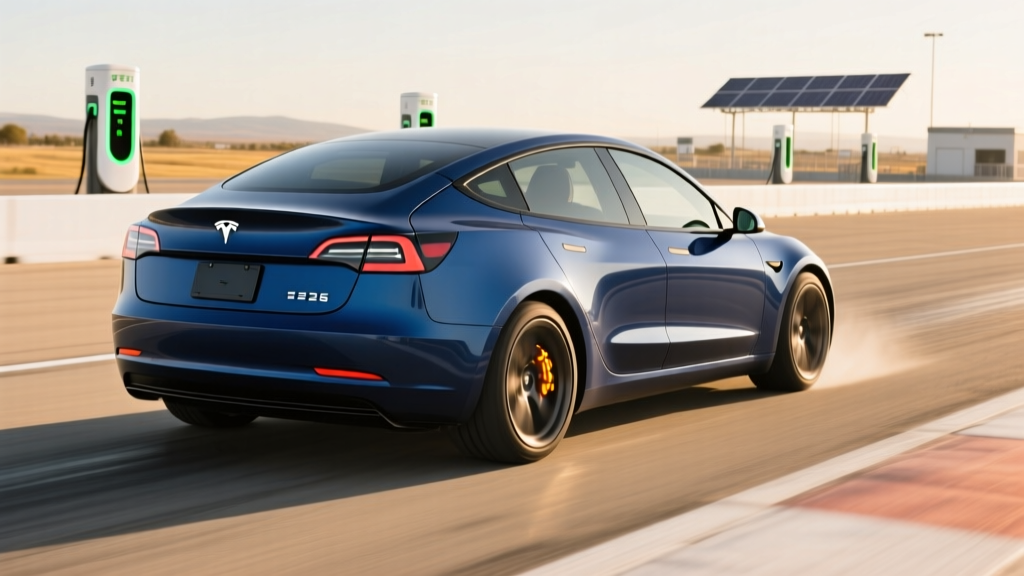
Searches for "Tesla Model 3 1/4 mile" spike for good reason: this sedan posts drag-strip numbers that rival dedicated sports cars. The Performance trim's dual-motor AWD system delivers instantaneous torque to all four wheels, launching the car through the quarter mile in approximately 10.9 seconds at 128 mph — territory occupied by the BMW M3, Porsche Cayman GT4, and Chevrolet Corvette.
The Long Range AWD isn't far behind at roughly 12.6 seconds at 113 mph, which still outpaces most turbocharged sport sedans. Even the base RWD model, constrained by a single motor and lower output, manages a respectable 14.3-second pass at 97 mph.
What makes these numbers remarkable is the effortlessness. There's no launch-control ritual, no waiting for turbo spool-up or transmission kickdown. You press the accelerator, and the Model 3 delivers maximum torque from 0 rpm. On a drag strip or a highway on-ramp, the sensation is the same: instant, linear, relentless.
The Performance trim adds Track Mode, which adjusts torque distribution, regen, and cooling for sustained high-effort driving. It also includes a lowered sport suspension, performance brakes, and 20-inch wheels — though those wheels reduce EPA range compared to the standard 18- and 19-inch options.
Charging Speed: DC Fast, Level 2, and the Supercharger Advantage
| Charging Level | Power / Rate | Miles Added per Hour | Notes |
|---|---|---|---|
| Level 1 (120V household) | ~1.4 kW | ~5–6 mi/hr | Emergency/trickle only |
| Level 2 (240V home, Wall Connector) | 11.5 kW | ~44 mi/hr | Full charge in 7–9 hours |
| DC Fast (RWD max) | 170 kW peak | ~175 mi in 15 min | Tapers above 60% SoC |
| DC Fast (Long Range / Performance max) | 250 kW peak | ~200 mi in 15 min | 10–80% in ~25 min |
The Model 3 Long Range and Performance trims peak at 250 kW on V3 Tesla Superchargers — among the fastest in the segment. However, peak rate is not sustained rate. The charge curve tapers progressively: you'll see 250 kW only between roughly 10–30% State of Charge (SoC). By 60%, the rate drops to ~100 kW, and above 80% it slows to ~40 kW to protect the battery. This is normal for all lithium-ion packs, but it means charging from 80–100% takes nearly as long as 10–80%.
The RWD trim, using an LFP (lithium iron phosphate) battery, peaks at a lower 170 kW. LFP chemistry trades peak charge speed for longer cycle life and the ability to charge regularly to 100% without accelerated degradation — a practical advantage for daily drivers who want the full pack available every morning.
At home, Tesla's Wall Connector delivers up to 11.5 kW on a 48-amp circuit (requires a 60-amp breaker). A typical overnight session (8 hours) adds roughly 350 miles — more than enough to replenish any daily driving. Installation costs vary widely: expect $500–$1,500 if your electrical panel has spare capacity, or $2,000–$4,000+ if a panel upgrade to 200 amps is needed.
With the industry-wide shift to NACS (North American Charging Standard), the Model 3 natively uses the Tesla connector — the same standard now adopted by Ford, GM, Rivian, and most major automakers. Supercharger network access remains the strongest charging-infrastructure advantage Tesla holds.
Pricing, Tax Credits, and Total Cost
| Trim | MSRP | Destination | Est. §30D Credit | Effective Price |
|---|---|---|---|---|
| RWD | $38,990 | $1,390 | Up to $7,500* | ~$32,880 |
| Long Range AWD | $45,990 | $1,390 | Up to $7,500* | ~$39,880 |
| Performance | $52,990 | $1,390 | Up to $7,500* | ~$46,880 |
*Federal EV tax credit (§30D) eligibility depends on multiple requirements. See IRS.gov for current rules. Credit can be transferred to the dealer at point of sale as an upfront discount. Eligibility requires:
- MSRP cap: Sedans must be ≤ $55,000 (all Model 3 trims qualify).
- Buyer income cap: AGI ≤ $150,000 (single), $225,000 (head of household), $300,000 (joint).
- Battery sourcing: Critical minerals and battery components must meet phased-in domestic/free-trade sourcing thresholds. Check Tesla's website or the IRS eligible-vehicle list for current-year compliance.
- Final assembly: Must occur in North America (Model 3 is assembled in Fremont, CA and Austin, TX).
Beyond the purchase price, the Model 3's total cost of ownership benefits from low fueling costs (electricity averages $0.14–$0.18/kWh nationally, or roughly $0.04–$0.05/mile) and minimal maintenance (no oil changes, fewer brake replacements thanks to regen). Insurance premiums, however, run 15–30% higher than comparable gas sedans — get quotes before committing.
Interior, Tech, and Daily Livability
The Highland refresh addressed the most common complaints about the pre-2024 Model 3: cabin noise, ride harshness, and material quality. Acoustic glass, improved door seals, and retuned suspension bushings make the 2026 Model 3 noticeably quieter at highway speed. Ventilated front seats, ambient lighting, and a rear-seat touchscreen are now standard.
Dimensions:
- Cargo volume: 23 cu ft (rear trunk + frunk combined)
- Front legroom: 42.7 in
- Rear legroom: 35.2 in
- Wheelbase: 113.2 in
The 15.4-inch center touchscreen handles all vehicle controls — there are no physical buttons for climate, mirrors, or glovebox. This minimalism divides buyers: some find it clean and intuitive, others miss tactile controls. The steering-column stalks for turn signals and gear selection have been replaced by steering-wheel buttons and touchscreen sliders, which require an adjustment period.
Driver assistance: Tesla's Autopilot (SAE Level 2) is standard and includes adaptive cruise control, lane-centering, and automatic emergency braking. Full Self-Driving (Supervised) — also SAE Level 2, despite the name — is an optional upgrade that adds automated lane changes, traffic-light recognition, and navigation-guided steering on mapped roads. The driver must remain attentive and keep hands on the wheel at all times. This is not autonomous driving; it is an advanced driver-assist system.
Who Should Buy the Model 3 — And Who Shouldn't
- You want the most efficient long-range EV sedan under $50,000
- You value Supercharger network access for road trips
- You prioritize acceleration and performance per dollar
- You have (or can install) Level 2 home charging
- You need SUV cargo space or easy child-seat installation (consider Model Y or Hyundai Ioniq 5)
- You prefer physical buttons and traditional instrument clusters
- You tow (Model 3 is not rated for towing in the US)
- You want the longest possible range regardless of price (Lucid Air exceeds 500 mi)
Pros and Cons
- Class-leading efficiency (25–28 kWh/100 mi)
- 250 kW DC fast charging on Long Range/Performance
- Supercharger network reliability
- Sub-3-second 0–60 on Performance trim
- Over-the-air updates add features post-purchase
- Strong resale value relative to EV segment average
- Rear-seat space is tight for tall adults
- Touchscreen-only controls require adaptation
- No towing capability
- RWD trim limited to 170 kW DC charging
- Insurance costs above segment average
- Turn-signal buttons on steering wheel are unintuitive for some
Frequently Asked Questions
What is the real-world range of the Tesla Model 3?
The Long Range AWD is EPA-rated at 341 miles, but expect 285–305 miles on the highway in mild weather and 240–265 miles in cold conditions. The RWD trim (272 mi EPA) delivers roughly 225–245 miles real-world in temperate climates.
How fast does the Tesla Model 3 charge?
Long Range and Performance trims peak at 250 kW on a V3 Supercharger, reaching 10–80% in approximately 25 minutes. The RWD trim peaks at 170 kW, taking about 30 minutes for the same 10–80% session. At home on a Level 2 Wall Connector (11.5 kW), a full charge takes 7–9 hours.
How much does the Tesla Model 3 cost after tax credits?
The RWD starts at $38,990 + destination. With the full $7,500 federal credit (§30D, subject to income and sourcing requirements), the effective price drops to roughly $32,880. The Long Range comes in around $39,880 after credit, and the Performance around $46,880. State incentives may reduce cost further.
Does the Tesla Model 3 qualify for the federal EV tax credit?
All current Model 3 trims meet the $55,000 MSRP cap for sedans and are assembled in North America. However, buyer income limits (≤$150K single / $300K joint) and battery critical-mineral sourcing thresholds apply. Verify current eligibility at IRS.gov or through Tesla's point-of-sale transfer process at purchase.
Is the Tesla Model 3 worth buying vs. competitors?
Against the Hyundai Ioniq 6 (361 mi EPA, $37,500) and BMW i4 (301 mi, $52,200), the Model 3 offers the best combination of range, charging speed, and Supercharger network access. The Ioniq 6 edges it on EPA range and offers more physical controls; the i4 delivers a more traditional luxury interior. For pure efficiency and tech, the Model 3 remains the default.
What is the Tesla Model 3's quarter-mile time?
The Performance trim runs the quarter mile in approximately 10.9 seconds at 128 mph. The Long Range AWD achieves roughly 12.6 seconds at 113 mph, and the base RWD posts around 14.3 seconds at 97 mph.