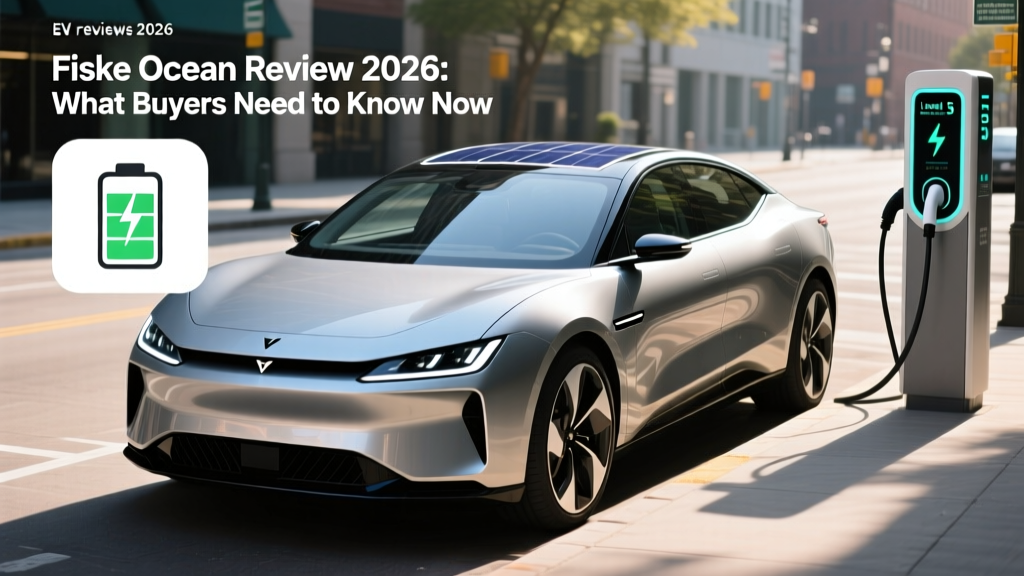
The Fisker Ocean arrived with bold promises: up to 360 miles of EPA range, solar-panel roof, and aggressive pricing that undercut the Tesla Model Y and Ford Mustang Mach-E. But the story of Fisker Inc. took a dramatic turn when the company filed for bankruptcy in mid-2024. For 2026 buyers evaluating used Fisker Ocean SUVs—or anyone researching these vehicles as they circulate on the secondary market—understanding the real-world specs, charging behavior, and ownership realities is critical.
This profile covers every Fisker Ocean variant that reached customer hands: the base Sport (FWD), the mid-tier Ultra (AWD), and the flagship Extreme/One (AWD, full solar roof). We break down EPA range versus highway reality, charging curves, battery chemistry, cargo dimensions, and the federal tax credit landscape as it stands today.
Fisker Ocean Spec Sheet at a Glance
| Spec | Sport (FWD) | Ultra (AWD) | Extreme / One (AWD) |
|---|---|---|---|
| EPA Range | 250 mi | 346 mi | 360 mi |
| Battery (usable) | ~80 kWh (LFP) | ~113 kWh (NMC) | ~113 kWh (NMC) |
| Drivetrain | Single-motor FWD | Dual-motor AWD | Dual-motor AWD (Hyper Range) |
| Horsepower | 275 hp | 540 hp | 550 hp |
| 0–60 mph | 6.9 sec | 3.9 sec | 3.7 sec |
| Max DC Fast Charge | ~170 kW | ~250 kW | ~250 kW |
| 10–80% DC Time | ~33 min | ~30 min | ~30 min |
| Level 2 (240V / 48A) | ~11.5 kW | ~11.5 kW | ~11.5 kW |
| MPGe (combined) | 107 MPGe | 95 MPGe | 97 MPGe |
| Cargo (rear seats up) | 32.5 cu ft | 32.5 cu ft | 32.5 cu ft |
| Cargo (rear seats folded) | 65.3 cu ft | 65.3 cu ft | 65.3 cu ft |
| Original Base MSRP | $37,499 | $52,999 | $68,999 |
| Battery/Powertrain Warranty | 10 yr / 100,000 mi* | 10 yr / 100,000 mi* | 10 yr / 100,000 mi* |
*Warranty was issued by Fisker Inc. prior to bankruptcy. Honor of remaining warranty terms depends on successor entities and state lemon-law provisions. Verify coverage before purchase.
Real-World Range: EPA Sticker vs. Highway and Cold Weather
Fisker Ocean Extreme (360 mi EPA): Expect roughly 290–310 miles on a flat highway at 70 mph in mild weather. In freezing temperatures (below 32°F), plan for 240–270 miles due to battery resistance and cabin heating load. The Ultra (346 mi EPA) tracks similarly at ~280–300 mi highway.
Fisker Ocean Sport (250 mi EPA): Highway driving yields approximately 210–230 miles; cold weather drops that to roughly 175–200 miles.
The Ocean Extreme's 360-mile EPA rating was among the highest of any production SUV at launch, rivaling the Lucid Air sedan. That figure comes from the 113 kWh usable NMC pack paired with the Hyper Range drive mode, which optimizes thermal management and limits accessory draw. In practice, independent testers from Edmunds and fueleconomy.gov confirmed strong efficiency—roughly 29–31 kWh/100 mi in mixed driving—but sustained 75+ mph highway speeds and sub-freezing temperatures erode any EV's range by 15–30%.
The Sport trim uses a smaller LFP (lithium iron phosphate) pack. LFP chemistry is more tolerant of daily 100% charging and degrades more slowly over time, but its lower energy density means less total range. For urban commuters who charge nightly, the trade-off is favorable.
Charging Speed: DC Fast Charging and Home Level 2
| Charging Level | Power / Rate | Miles Added per Hour | Notes |
|---|---|---|---|
| Level 1 (120V / 12A) | ~1.4 kW | ~4–5 mi/hr | Emergency/trickle only |
| Level 2 (240V / 48A) | ~11.5 kW | ~35–40 mi/hr | Full overnight charge in ~10 hr |
| DC Fast (Ultra/Extreme) | Peak 250 kW | ~195 mi in 10 min (peak) | 10–80% in ~30 min; tapers above 80% |
| DC Fast (Sport) | Peak ~170 kW | ~130 mi in 10 min (peak) | 10–80% in ~33 min |
The Ocean's peak 250 kW DC fast-charge capability (on Ultra and Extreme trims) was competitive at launch, though the charge curve matters more than the peak number. Like most NMC-pack EVs, the Ocean sustains its highest charge rate between roughly 10–50% state of charge, then progressively tapers. From 50–80%, expect the rate to drop to 80–120 kW, which is why the 10–80% time is approximately 30 minutes rather than the theoretical minimum.
On a CCS1 connector, the Ocean is compatible with Electrify America, EVgo, and ChargePoint DC networks. Post-bankruptcy, some Fisker-specific charging agreements have lapsed, so rely on standard network apps and RFID cards. The Ocean does not have a native NACS (Tesla) port, so a CCS-to-NACS adapter is required for Supercharger access—and adapter compatibility should be verified with the specific Supercharger station.
For home charging, a 48-amp Level 2 station on a 60-amp circuit delivers the full 11.5 kW, adding roughly 35–40 miles of range per hour. A full 0–100% charge of the 113 kWh pack takes about 10 hours. Installation costs for a Level 2 home charger typically run $800–$2,500 depending on panel capacity and conduit distance—factor this into your budget if you don't already have a 240V outlet in your garage.
Battery Chemistry, Degradation, and Warranty Reality
Fisker sourced two distinct battery packs for the Ocean:
| Attribute | LFP (Sport) | NMC (Ultra / Extreme) |
|---|---|---|
| Usable Capacity | ~80 kWh | ~113 kWh |
| Energy Density | Lower (heavier per kWh) | Higher (lighter per kWh) |
| Cycle Life | 3,000+ cycles to 80% SoH | 1,000–1,500 cycles to 80% SoH |
| Daily Charging to 100% | Recommended | Not recommended (80% daily limit) |
| Cold-Weather Performance | Moderate loss | Moderate loss; heat pump equipped |
| Estimated Replacement Cost | $12,000–$16,000 | $18,000–$25,000 |
The original Fisker battery warranty covered 10 years / 100,000 miles with a capacity-retention threshold of 70%. However, Fisker Inc.'s bankruptcy complicates warranty enforcement. Some states require successor entities or insurance pools to honor warranties; others do not. Before purchasing a used Ocean, request a State of Health (SoH) report from the vehicle's telematics system or a qualified EV service center. An SoH above 90% is expected for vehicles with fewer than 40,000 miles.
The NMC pack in the Ultra and Extreme trims was supplied by CATL. Long-term degradation data is still accumulating, but industry averages for liquid-cooled NMC packs suggest 8–12% capacity loss over 150,000 miles under normal use patterns.
Performance, Efficiency, and Driving Dynamics
The Ocean Extreme and One deliver genuine sports-SUV acceleration: 550 horsepower and a 3.7-second 0–60 mph time put them in the same territory as the BMW iX M60 and Tesla Model Y Performance. The dual-motor AWD system provides torque vectoring that translates to confident cornering for a vehicle weighing over 5,400 pounds.
The Sport's single-motor FWD setup (275 hp, 6.9-second 0–60) is less thrilling but perfectly adequate for commuting and highway merging. Its lighter front end and smaller battery make it the most efficient variant at 107 MPGe combined—roughly 31 kWh/100 mi.
Regenerative braking offers multiple levels adjustable via the center touchscreen. The Ocean supports one-pedal driving in its strongest regen mode, though the pedal feel is somewhat less progressive than Tesla's or Hyundai's implementations. A heat pump is standard on AWD trims, improving cold-weather efficiency by reducing resistive heating draw.
Pricing, Trims, and Federal Tax Credit Eligibility
| Trim | Original MSRP | §30D Federal Credit | Effective Price (New) | 2026 Used Market (est.) |
|---|---|---|---|---|
| Sport | $37,499 | $0–$7,500* | $29,999–$37,499 | $18,000–$24,000 |
| Ultra | $52,999 | $0–$7,500* | $45,499–$52,999 | $28,000–$36,000 |
| Extreme | $68,999 | $0–$7,500* | $61,499–$68,999 | $35,000–$45,000 |
| Ocean One (launch ed.) | $68,999 | $0–$7,500* | $61,499–$68,999 | $36,000–$46,000 |
*Per IRS §30D rules, the credit depends on battery-sourcing and critical-minerals requirements, buyer income caps ($150K single / $300K joint), and the $80,000 SUV MSRP cap. The Ocean qualifies as an SUV. However, Fisker's battery-sourcing documentation was in flux at the time of bankruptcy—confirm credit eligibility for any remaining new-old-stock units with a tax professional.
For 2026 buyers, the Fisker Ocean is overwhelmingly a used-vehicle purchase. Depreciation has been steep due to the brand's collapse, meaning well-equipped Extreme models now trade at roughly half their original MSRP. The federal used EV credit (§25E) may apply: 30% of the sale price, up to $4,000, for used EVs priced under $25,000 sold by a licensed dealer to buyers under income caps ($75K single / $150K joint). This makes the Ocean Sport particularly attractive on the used market—potentially dropping the effective cost below $15,000.
Interior, Cargo, and Standout Technology
The Ocean's interior is defined by its 17.1-inch rotating center display ("Revolve" screen), which flips between a landscape "Control" mode and a portrait "Hollywood" mode for media. The screen is impressive in concept, though early software was plagued by lag and bugs—many of which were addressed via OTA updates before Fisker's dissolution, but ongoing software support is now uncertain.
Cargo space is generous: 32.5 cubic feet behind the second row and 65.3 cubic feet with seats folded, rivaling the Tesla Model Y (30.2 / 76.2 cu ft). Rear-seat legroom measures approximately 40.5 inches, comfortably fitting adults on longer trips. There is no frunk (front trunk)—the space is occupied by HVAC and power electronics.
Standout features:
- California Mode: A one-touch setting that simultaneously lowers all four door windows and opens the rear hatch glass and the "Solar Roof" panel for an open-air experience—unique in the segment.
- Solar Roof (Extreme/One): Photovoltaic cells embedded in the roof panel can add up to 1,500 miles of range per year under ideal sun conditions (~5 miles/day). Real-world gains are modest but measurable.
- Fisker Intelligent Pilot: The ADAS suite includes adaptive cruise, lane-centering, and automated parking. This is an SAE Level 2 driver-assist system—the driver must remain engaged at all times. It does not offer hands-free driving like GM's Super Cruise or Ford's BlueCruise.
- Taco Tray: A fold-out tray in the center console—a quirky but practical touch for drive-through meals.
Notable drawbacks:
- Software reliability was inconsistent; some OTA updates failed or introduced new bugs.
- No frunk reduces front cargo versatility.
- Build quality varied significantly between early and later production units.
- Service network is extremely limited post-bankruptcy—no authorized Fisker dealerships remain.
Pros
- Class-leading EPA range (360 mi on Extreme)
- 250 kW DC fast charging on Ultra/Extreme
- Unique California Mode and solar roof
- Spacious cargo area and rear legroom
- Strong depreciation = compelling used-market value
- LFP option (Sport) for longevity-focused buyers
Cons
- Company bankrupt — no dealer network or guaranteed warranty
- Software/OTA support uncertain going forward
- Limited service centers familiar with Fisker-specific systems
- No frunk
- Spare parts availability may tighten over time
- Resale value unpredictable
Who Should Buy a Fisker Ocean in 2026?
Choose the Fisker Ocean if:
- You want maximum EPA range per dollar on the used market (Extreme at ~$38K used vs. comparable Model Y Long Range at ~$35K but with 310 mi EPA).
- You're a tech-tolerant early adopter comfortable with limited service infrastructure.
- You value the solar roof and open-air California Mode for lifestyle reasons.
- You're a commuter who can charge at home nightly and rarely needs dealer service.
Look elsewhere if:
- You need reliable warranty coverage and a nationwide dealer network — consider the Hyundai Ioniq 5, Kia EV6, or Tesla Model Y.
- You frequently road-trip through charging deserts where service support matters.
- You need a frunk for front-cargo flexibility.
- You want hands-free Level 2+ highway driving (BlueCruise/Super Cruise).
Frequently Asked Questions
What is the real-world range of the Fisker Ocean?
The Ocean Extreme delivers approximately 290–310 miles at highway speeds in mild weather, dropping to 240–270 miles in freezing temperatures. The Sport (FWD, LFP) yields roughly 210–230 highway miles, or 175–200 in cold weather. These figures assume standard tire pressure, moderate HVAC use, and no towing.
How fast does the Fisker Ocean charge?
Ultra and Extreme trims peak at 250 kW on DC fast chargers, achieving a 10–80% charge in approximately 30 minutes. The Sport peaks at roughly 170 kW with a 10–80% time of about 33 minutes. On a home Level 2 charger (240V/48A), all trims charge at ~11.5 kW, adding 35–40 miles of range per hour.
Does the Fisker Ocean qualify for the federal EV tax credit?
For new purchases (if any remaining stock exists), §30D eligibility depends on battery-sourcing compliance, buyer income caps ($150K single / $300K joint AGI), and the $80,000 MSRP cap for SUVs. Fisker's sourcing documentation was incomplete at the time of bankruptcy, so verification with a tax professional is essential. For used purchases, the §25E credit (up to $4,000) may apply to Ocean Sports priced under $25,000 from a licensed dealer.
Is it worth buying a Fisker Ocean vs. a Tesla Model Y or Hyundai Ioniq 5?
If you prioritize range-per-dollar on the used market and accept the service-risk trade-off, the Ocean Extreme offers 360 EPA miles at roughly $38,000 used—more range than a Model Y Long Range (310 mi) at a similar price. However, Tesla's Supercharger network, proven service infrastructure, and stronger resale value make the Model Y the safer long-term bet. The Ioniq 5 offers 800V ultra-fast charging and a robust dealer network but tops out at 303 EPA miles.
What are the biggest risks of owning a Fisker Ocean post-bankruptcy?
The primary risks are: (1) warranty enforcement uncertainty, (2) limited service centers with Fisker-specific diagnostic tools, (3) potential parts shortages as the supply chain winds down, and (4) unpredictable resale depreciation. Mitigate these by purchasing an extended third-party warranty (if available for the model), identifying an independent EV shop in your area before you need one, and budgeting for out-of-pocket repairs.
Does the Fisker Ocean have self-driving capability?
No. Fisker Intelligent Pilot is an SAE Level 2 driver-assistance system offering adaptive cruise control and lane-centering. The driver must keep hands on the wheel and eyes on the road at all times. It does not provide hands-free or eyes-off capability like GM Super Cruise (Level 2+ with driver monitoring) or Waymo's Level 4 robotaxi service.