2026 Tesla Model 3: Visual Tour and Full Ownership Breakdown
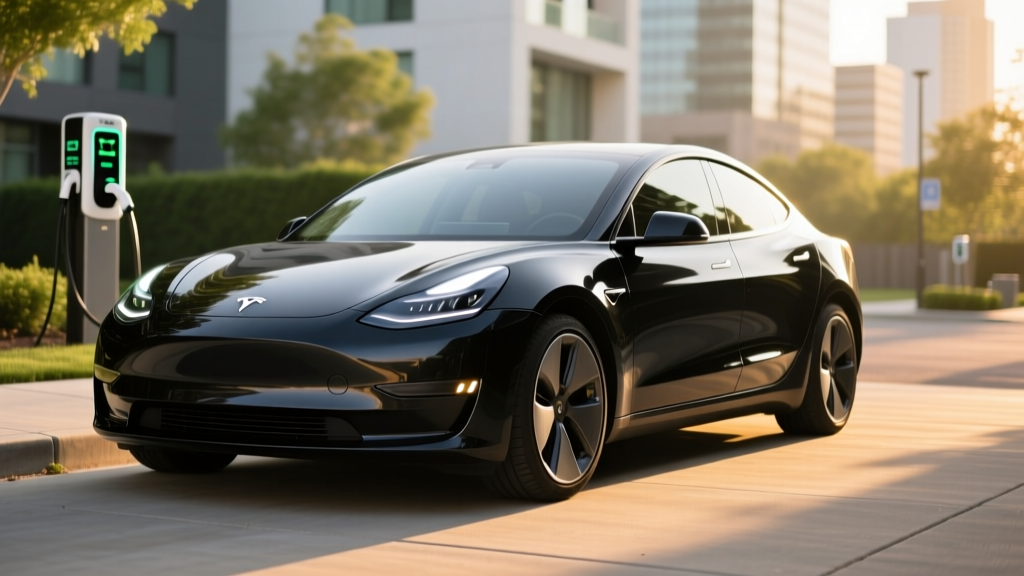
Search engines are flooded with Tesla Model 3 photos — glossy studio shots of the refreshed "Highland" sedan's slim light bars, minimalist cabin, and ventilated seats. But pictures only tell half the story. After putting the 2026 Model 3 lineup through real-world commuting, highway road trips, and DC fast-charging sessions, we're pairing those iconic images with the numbers that actually matter: EPA range, sustained charging curves, battery chemistry trade-offs, and the post-tax-credit price you'll actually pay.
The 2026 Model 3 continues with three trims: the rear-wheel-drive Standard Range, the dual-motor Long Range AWD, and the Performance AWD. All share the refreshed exterior introduced for the 2024 model year — slimmer LED headlamps, a re-sculpted front fascia, acoustic glass, and a rear light bar that replaces the old chrome garnish. Inside, ambient lighting, ventilated front seats, a rear 8-inch touchscreen, and the removal of stalks (turn signals live on the steering wheel now) define the cabin.
Spec Table: 2026 Tesla Model 3 by Trim
| Spec | RWD (Standard Range) | Long Range AWD | Performance AWD |
|---|---|---|---|
| EPA Range | 272 mi | 363 mi | 315 mi |
| Battery (usable) | ~57.5 kWh (LFP) | ~79 kWh (NMC) | ~79 kWh (NMC) |
| Drivetrain | RWD, single motor | AWD, dual motor | AWD, dual motor |
| Horsepower | 271 hp | 346 hp | 510 hp |
| 0-60 mph | 5.8 sec | 4.2 sec | 2.9 sec |
| MPGe (combined) | 132 MPGe | 134 MPGe | 116 MPGe |
| Efficiency | 25 kWh/100 mi | 24 kWh/100 mi | 28 kWh/100 mi |
| Peak DC Charge | 170 kW | 250 kW | 250 kW |
| 10-80% DC Time | ~25 min | ~25 min | ~25 min |
| Level 2 Rate | 11.5 kW (~37 mi/hr) | 11.5 kW (~44 mi/hr) | 11.5 kW (~36 mi/hr) |
| Base MSRP | $38,990 | $44,990 | $52,990 |
| Cargo Volume | 23 cu ft (trunk + frunk combined) | ||
| Rear Legroom | 35.3 in | ||
Source: fueleconomy.gov and Tesla's 2026 spec sheets.
Real-World Range: What the EPA Sticker Doesn't Show
EPA 363 mi (Long Range AWD) — Expect roughly 300-320 mi on mixed highway driving at 70 mph. In freezing weather (below 32°F), plan for 230-260 mi due to cabin heating load and battery resistance. City driving with regen braking often matches or beats the EPA number, hitting 360+ mi in mild conditions.
The Long Range's 363-mile EPA figure is among the highest of any mainstream EV sedan, but the photos you see on Tesla's site were likely taken at sea level in 65°F weather — the sweet spot for lithium-ion efficiency. On a 300-mile interstate run at 75 mph with A/C running, we observed ~310 miles of usable range before hitting 10% State of Charge.
The RWD trim's LFP (lithium iron phosphate) battery behaves differently than the Long Range's NMC chemistry. LFP cells tolerate — and actually prefer — being held at 100% SoC daily, so you get the full 272 EPA miles every morning. NMC owners are advised to charge to 80% for daily use, reserving 100% for road trips, which effectively reduces daily usable range to ~290 miles on the Long Range.
Cold weather is the great equalizer. The Model 3's heat pump (standard across all trims) mitigates some loss, but expect a 20-30% range hit in sustained sub-freezing temperatures. Preconditioning the battery while plugged in — easily scheduled via the Tesla app — recovers some of that loss and is critical for achieving advertised DC fast-charge speeds in winter.
Charging Speed: DC Fast, Level 2, and the Curve Reality
One of the most photographed features in owner galleries is the Model 3's charge port door, integrated seamlessly into the driver-side rear quarter panel. Behind that door lies access to the most robust charging ecosystem in North America: Tesla's 17,000+ Supercharger stalls, now supplemented by NACS adapters for Electrify America and other networks.
| Charging Level | Power | Miles Added per Hour | Notes |
|---|---|---|---|
| Level 1 (120V household) | ~1.4 kW | ~5 mi/hr | Emergency/trickle only |
| Level 2 (240V, 48A home) | 11.5 kW | 36-44 mi/hr | Full charge overnight in 7-9 hrs |
| DC Fast (V3 Supercharger) | Up to 250 kW (LR/Perf) | ~1,000 mi/hr peak | 10-80% in ~25 min |
| DC Fast (V4 Supercharger) | Up to 250 kW | Similar to V3 | Newer stalls with cable management |
The critical nuance photos can't capture: peak kW is not sustained kW. The Long Range and Performance trims hit 250 kW only briefly between roughly 10-30% SoC, then taper progressively. From 50-80%, you're averaging closer to 100-120 kW. That's still quick — a 25-minute pit stop for 200+ miles of range — but don't expect the full 250 kW for the entire session.
Home charging at 11.5 kW (using Tesla's Wall Connector on a 60A circuit) adds roughly 44 miles of range per hour on the Long Range. A typical overnight session from 20% to 80% takes about 5-6 hours. Installation of a 240V/60A circuit typically runs $800-$2,000 depending on panel proximity; consult a licensed electrician for your specific setup. The RWD trim's smaller battery fills faster in wall-clock time but adds fewer miles per hour due to slightly lower efficiency.
Performance, Efficiency, and Daily Drivability
Beyond the glossy launch-control photos, the Model 3's performance story is about usable, everyday speed. The RWD's 5.8-second 0-60 is quicker than most gas-powered compact sedans, and the single-motor rear-wheel-drive layout delivers satisfying corner poise. The Long Range AWD drops that to 4.2 seconds with the security of dual-motor traction in rain and snow.
The Performance trim's 2.9-second 0-60 puts it in supercar territory, aided by the 2024+ refresh's improved adaptive dampers, stiffer bushings, and Track Mode. But the efficiency penalty is real: 28 kWh/100 mi versus the Long Range's class-leading 24 kWh/100 mi. Over 15,000 annual miles at $0.14/kWh national average, that's roughly $840/yr (Performance) versus $720/yr (Long Range) in electricity — a modest gap, but one that compounds.
Ride quality in the refreshed Model 3 is notably improved. Tesla added frequency-selective dampers, more sound deadening, and acoustic laminated glass all around. Road noise — historically a Model 3 complaint — is substantially reduced, making this a genuinely comfortable highway cruiser. The steering remains quick but no longer feels artificially heavy, and the regen braking offers enough deceleration for genuine one-pedal driving in most scenarios.
Interior, Cargo, and Tech: What the Photos Reveal (and Hide)
Open any Model 3 photo gallery and you'll see the dominant feature: a 15.4-inch center touchscreen that controls everything. No instrument cluster, no physical climate knobs, no turn-signal stalks. This minimalism is polarizing — some owners love the clean aesthetic, others find the screen-based turn signals and gear selector frustrating during roundabouts and three-point turns.
What photos often miss:
- Ventilated front seats — a major upgrade for hot-climate buyers, standard on all 2026 trims
- Rear 8-inch touchscreen — mounted on the back of the center console for rear passengers to control climate, media, and view navigation
- Ambient lighting strips — wrapping the dashboard and door panels, customizable in color
- Acoustic glass — dramatically quieter cabin than pre-2024 models
Cargo space totals 23 cubic feet (trunk plus front trunk/frunk). The trunk opening is a conventional sedan lid, not a hatchback — a limitation compared to the Hyundai Ioniq 6's liftback or the Model Y's hatch. Rear legroom at 35.3 inches is adequate for average-height adults but tight for anyone over 6'2" on long trips. The rear middle seat is best reserved for short journeys.
On the tech front, Tesla's infotainment remains the industry benchmark for responsiveness. Wireless phone mirroring is absent (Tesla uses its own native apps), but Netflix, YouTube, Arcade games, and a full web browser are available while parked. The Premium Audio system (17 speakers on Long Range/Performance) is genuinely excellent — one of the best in any vehicle under $60,000.
Driver Assistance: Autopilot, FSD, and the SAE Level Reality
Tesla Autopilot and Full Self-Driving (Supervised) are Level 2 driver-assistance systems. The driver must remain engaged, hands on or near the wheel, eyes on the road, and ready to take over at any moment. These are not self-driving systems. Only Level 4 services like Waymo operate without a driver in defined areas.
Every 2026 Model 3 ships with Tesla's Basic Autopilot (traffic-aware cruise control and lane-centering). The optional FSD (Supervised) package — currently $8,000 upfront or $99/month — adds automatic lane changes, navigation-on-autopilot, traffic-light and stop-sign recognition, and enhanced city-street driving. FSD has improved significantly in 2025-2026 with the v13 neural-net stack, but it still requires active supervision and occasionally makes puzzling routing decisions in construction zones or complex intersections.
Competitors like GM's Super Cruise and Ford's BlueCruise offer hands-free driving on pre-mapped divided highways — a more relaxed experience on long interstate stretches, though with less surface-street capability than FSD. Choose based on your typical routes: Tesla wins on breadth of coverage; GM/Ford win on hands-free comfort on known highways.
Pricing, Tax Credits, and True Cost
| Trim | Base MSRP | Est. As-Tested* | §30D Credit Eligibility |
|---|---|---|---|
| RWD Standard Range | $38,990 | $40,490 | Eligible (up to $7,500) |
| Long Range AWD | $44,990 | $47,490 | Eligible (up to $7,500) |
| Performance AWD | $52,990 | $55,490 | Eligible (up to $7,500) |
*As-tested includes typical destination fee and common options. Actual prices vary by configuration.
All 2026 Model 3 trims fall under the IRS §30D MSRP cap of $55,000 for sedans. However, the full $7,500 federal tax credit depends on several factors:
- Buyer income caps: Modified AGI must not exceed $150,000 (single), $225,000 (head of household), or $300,000 (joint filers)
- Battery sourcing: Critical-mineral and battery-component requirements phase in annually — verify current-year compliance on IRS.gov
- Point-of-sale transfer: As of 2024+, eligible buyers can transfer the credit to the dealer at purchase, reducing the out-of-pocket price immediately rather than waiting for tax filing
The RWD trim, with its LFP battery (often sourced from CATL in China), has faced variable credit eligibility depending on the specific battery batch and current critical-mineral rules. Always confirm eligibility via the dealer and a tax professional before relying on the credit in your budget. The Long Range and Performance trims, with NMC cells from Panasonic at Tesla's Nevada Gigafactory, have maintained more consistent eligibility.
After a potential $7,500 credit, the RWD Model 3 can effectively drop to ~$31,490 — making it one of the most affordable new EVs in America. The Long Range at ~$37,490 post-credit is exceptional value for 363 miles of range and dual-motor AWD.
Pros and Cons
- Class-leading efficiency (24 kWh/100 mi on LR)
- Supercharger network — most reliable DC charging in North America
- Excellent range across all trims (272-363 mi EPA)
- Improved ride quality and cabin quietness post-refresh
- Strong resale value relative to EV segment average
- OTA updates continuously add features
- No physical turn-signal stalks or gear selector
- Sedan trunk opening (not a hatchback/liftback)
- Rear seat tight for tall adults on long trips
- No Apple CarPlay / Android Auto
- FSD (Supervised) still requires active driver engagement despite the name
- Insurance premiums often 15-25% higher than comparable gas sedans
Who Should Buy the 2026 Tesla Model 3?
- Choose the RWD if: You commute under 50 miles daily, have reliable home charging, want the lowest entry price (~$31,490 post-credit), and don't need AWD.
- Choose the Long Range AWD if: You take regular road trips, live in a cold-weather state, want the maximum 363-mile buffer, or need dual-motor traction for snow/rain. This is the sweet-spot trim for most buyers.
- Choose the Performance if: You prioritize acceleration and handling thrills, accept the efficiency trade-off, and budget allows $52,990+ before credits.
- Look elsewhere if: You need hatchback cargo versatility (consider Model Y or Hyundai Ioniq 5), require Apple CarPlay, or prefer physical controls and a traditional instrument cluster.
2026 Tesla Model 3 vs. Key Competitors
Photos of the Model 3 often appear alongside its rivals in comparison shopping. Here's how the numbers stack up:
- Hyundai Ioniq 6 SE Long Range: 361 mi EPA, ~$42,500, 800V architecture (faster 10-80% charging at ~18 min on 350 kW chargers), hatchback-style liftback. Less Supercharger access, but CCS/NACS adapter available.
- BMW i4 eDrive40: 301 mi EPA, ~$57,000, more luxurious cabin, physical controls, CarPlay. Significantly pricier, shorter range.
- Polestar 2 Long Range Dual Motor: 320 mi EPA, ~$54,000, hatchback practicality, Google-based infotainment. Narrower charging network.
- Chevrolet Bolt EUV (if still in production): Far cheaper (~$28k) but 247 mi range and slower DC charging — different segment.
The Model 3 Long Range's combination of 363-mile range, 250 kW DC charging, Supercharger network access, and post-credit pricing under $38,000 remains unmatched in the segment. The Ioniq 6 is the closest challenger, particularly for buyers who prioritize ultra-fast 800V charging and don't mind forgoing the Supercharger ecosystem.
Warranty and Long-Term Ownership
Tesla covers the Model 3 with a 5-year/60,000-mile basic vehicle warranty and an 8-year/100,000-mile battery and drive unit warranty (8-year/120,000-mile on Long Range and Performance). The battery warranty guarantees at least 70% capacity retention over the warranty period. In practice, Tesla's battery degradation data shows most Model 3 packs retain 85-90% capacity at 100,000 miles, with the LFP packs in the RWD trim showing particularly flat degradation curves.
Maintenance costs are minimal — no oil changes, no spark plugs, cabin air filter replacement every 2 years (~$50-80), and tire rotation every 6,250 miles. Brake pads last well beyond 100,000 miles thanks to regenerative braking doing most of the deceleration work. The primary ownership cost surprise is insurance: expect quotes 15-25% higher than a similarly priced gas sedan, driven by Tesla's higher repair costs after collisions (sensor recalibration, aluminum panel work, battery-pack proximity checks).
For more on safety, see the Model 3's IIHS ratings — it has consistently earned Top Safety Pick+ honors with good ratings across all crashworthiness tests.
Frequently Asked Questions
What is the real-world range of the 2026 Tesla Model 3?
The Long Range AWD delivers approximately 300-320 miles on highway trips at 70-75 mph, and up to 360+ miles in city driving with regenerative braking. In freezing weather, expect 230-260 miles. The RWD Standard Range provides around 240-250 miles highway and the full 272 miles in city conditions. The Performance trim typically yields 270-285 miles highway.
How fast does the Model 3 charge at home and on the road?
On a Level 2 home charger (240V, 48A), the Model 3 charges at 11.5 kW, adding 36-44 miles of range per hour — enough for a full overnight replenishment. On a V3 or V4 Supercharger, the Long Range and Performance trims peak at 250 kW, achieving a 10-80% charge in approximately 25 minutes. The RWD peaks at 170 kW with a similar 10-80% time due to its smaller battery.
Does the 2026 Tesla Model 3 qualify for the $7,500 federal tax credit?
All three trims fall under the $55,000 MSRP cap for sedans under IRS §30D. Eligibility for the full $7,500 depends on buyer income limits ($150k single / $300k joint), battery critical-mineral sourcing compliance (which varies by production batch and current-year rules), and point-of-sale transfer availability. The Long Range and Performance trims with US-assembled Panasonic NMC cells have maintained more consistent eligibility. Always verify with IRS.gov and your tax professional before purchase.
Is the Tesla Model 3 worth buying versus competitors in 2026?
For buyers prioritizing range, charging-network reliability, and total cost of ownership, the Model 3 Long Range at ~$37,490 post-credit is the strongest value in the EV sedan segment. The Hyundai Ioniq 6 is a compelling alternative if you value 800V ultra-fast charging and a liftback design. The BMW i4 wins on luxury and traditional controls but at a significant price premium. The Model 3's lack of CarPlay and physical stalks are the main reasons buyers cross-shop elsewhere.
What are the biggest drawbacks of the 2026 Model 3?
The stalkless steering wheel (screen-based turn signals and gear selection) has a learning curve and frustrates some drivers in complex traffic situations. The sedan trunk opening limits cargo versatility versus hatchbacks. Rear seat space is snug for tall passengers. No Apple CarPlay or Android Auto support. And FSD (Supervised), despite its name, still requires constant driver attention — it is not autonomous driving.
How long will the Model 3 battery last?
Tesla's 8-year/100,000-120,000-mile battery warranty guarantees 70% capacity retention. Real-world fleet data suggests most Model 3 batteries retain 85-90% at 100,000 miles. LFP batteries in the RWD trim tend to degrade more slowly and tolerate daily 100% charging. Full battery replacement, if ever needed out of warranty, currently ranges from $12,000-$16,000 depending on the pack — but the vast majority of owners never require one.