Quick Verdict: The Benchmark Sports Sedan, Now Refined
The 2026 Tesla Model 3 Performance (officially the "Performance" trim of the refreshed "Highland" generation) remains the electric sports sedan that every competitor measures itself against. With 510 horsepower, a 2.9-second 0-60 mph time, and an EPA-estimated 315 miles of range, it threads a needle few vehicles can: genuine track capability wrapped in a daily-driver package that sips electricity at 25 kWh/100 miles. The adaptive damping suspension introduced with the Highland refresh finally addresses the ride-quality complaints that plagued earlier Model 3 variants, while the ventilated seats and redesigned interior bring cabin quality closer to its luxury-sedan price point.
But the Model 3 Performance isn't for everyone. Rear-seat headroom remains tight for taller passengers, the touchscreen-centric controls demand a learning curve, and Tesla's Autopilot remains a Level 2 driver-assist system — not the autonomous experience some marketing has implied. This review breaks down every number that matters for a real buyer.
Range, Battery, and Real-World Efficiency
| Spec | Value |
|---|---|
| EPA Range | 315 miles |
| Battery Capacity (usable) | ~79 kWh |
| Battery Chemistry | NMC (Nickel Manganese Cobalt) |
| Drivetrain | Dual-Motor AWD |
| Horsepower | 510 hp |
| 0-60 mph | 2.9 seconds |
| Top Speed | 163 mph |
| EPA Efficiency | 113 MPGe combined / 25 kWh/100 mi |
| Cargo Volume | 23.1 cu ft (trunk + frunk) |
| Base MSRP | $52,990 (before incentives) |
| Battery Warranty | 8 years / 120,000 miles |
The Model 3 Performance uses an NMC (nickel manganese cobalt) lithium-ion pack with approximately 79 kWh of usable capacity. Tesla does not publish official kWh figures, but independent teardowns and EPA test data confirm this range. Unlike the base Model 3 RWD — which uses an LFP (lithium iron phosphate) battery that can be charged to 100% daily — the NMC pack in the Performance variant benefits from an 80% daily charge limit to maximize long-term cell health. Reserve 100% charges for road trips.
The EPA rates the 2026 Model 3 Performance at 315 miles. In real-world mixed driving at moderate temperatures (60-75°F), expect approximately 270-290 miles before needing a charge. On sustained highway driving at 75 mph, range drops to roughly 250-265 miles due to aerodynamic drag scaling with the square of velocity. In cold weather (below 30°F), plan for a 20-30% reduction, yielding roughly 220-250 miles of usable range — a function of cabin heating loads and increased battery internal resistance. The heat pump standard on the Highland generation mitigates this loss compared to earlier Model 3s, but physics is physics.
Efficiency is a genuine strong suit. At 25 kWh per 100 miles (113 MPGe combined per fueleconomy.gov), the Model 3 Performance extracts more miles per electron than the BMW i4 M50 (30 kWh/100 mi) and the Hyundai Ioniq 6 AWD (27 kWh/100 mi). This efficiency directly translates into lower charging costs and longer intervals between stops on road trips.
Charging Speed: DC Fast Charging and Home Level 2
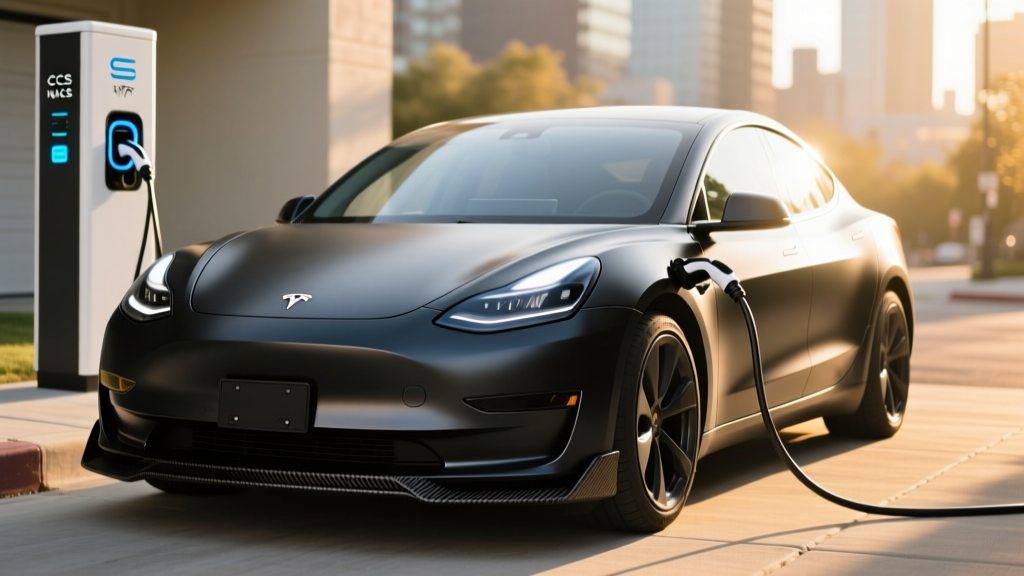
The Model 3 Performance charges via the NACS (North American Charging Standard) connector — Tesla's proprietary plug that has now been adopted by Ford, GM, Rivian, and most major automakers. This gives Tesla owners native access to the Supercharger network, which remains the most reliable and geographically comprehensive DC fast-charging infrastructure in the United States.
| Charging Level | Power / Rate | Speed | Notes |
|---|---|---|---|
| Level 1 (120V household) | ~1.4 kW | ~4-5 miles/hour | Emergency/trickle only |
| Level 2 (240V home / public) | Up to 11.5 kW (48A) | ~38-44 miles/hour | Full charge in ~8 hours |
| DC Fast Charge (Supercharger V3/V4) | Peak 250 kW | 10-80% in ~25 minutes | Curve tapers above 50% SoC |
| DC Fast Charge (non-Tesla CCS via adapter) | Up to 150-250 kW (station-dependent) | Varies | Requires Tesla CCS adapter (included) |
A critical detail many spec sheets bury: the 250 kW peak charge rate is not sustained. The Model 3 Performance's charge curve peaks near 250 kW between roughly 10-20% state of charge, then progressively tapers. From 50-80%, expect rates closer to 60-90 kW. This is why Tesla quotes a 10-80% time of approximately 25 minutes rather than a simple peak-kW figure. On a road trip, preconditioning the battery (the car does this automatically when you navigate to a Supercharger) is essential to hit peak rates — skip preconditioning and your first several minutes at the charger will be significantly slower.
For home charging, the Model 3 Performance's onboard charger accepts up to 11.5 kW (48 amps) on a 240V Level 2 circuit. A full charge from 10% to 100% takes roughly 8 hours — ideal for overnight replenishment. Home Level 2 installation typically costs $800-$2,500 depending on whether your electrical panel needs an upgrade to support a 60-amp dedicated circuit. Consult a licensed electrician for your specific situation.
Performance and Driving Dynamics
The numbers tell part of the story: 510 horsepower, 546 lb-ft of torque, and a 2.9-second 0-60 mph time place the Model 3 Performance in supercar territory for straight-line acceleration. The dual-motor all-wheel-drive system provides instantaneous torque vectoring, and the new Track Mode (updated for the Highland generation) allows adjustable front/rear torque bias and regenerative braking intensity for closed-course driving.
But the bigger improvement for 2025-2026 is ride quality. The adaptive damping suspension — standard on the Performance trim — offers Comfort and Sport modes that meaningfully change the car's character. In Comfort, the Model 3 Performance absorbs highway expansion joints and broken pavement with a compliance that earlier generations simply could not match. In Sport, body control tightens for canyon roads without becoming punishing. The 19-inch or optional 20-inch wheels with performance tires deliver strong mechanical grip, though the added unsprung weight of the 20-inch setup slightly reduces range (EPA drops to approximately 295 miles on 20s).
Braking remains an area where Porsche's Taycan and the BMW i4 M50 feel more communicative. The Model 3's regenerative braking is strong (up to ~0.3g of deceleration without touching the friction brakes), but the blend between regen and the mechanical brakes can feel slightly inconsistent during spirited driving. For daily commuting and one-pedal driving, it's excellent; for track lapping, enthusiasts will want more pedal feel.
Interior, Technology, and Driver Assistance
The Highland-generation interior represents a genuine step up from the pre-2024 Model 3. Ventilated front seats (finally), ambient lighting, an 8-inch rear touchscreen for passengers, improved sound deadening, and higher-quality materials throughout close the gap with competitors like the BMW i4. The 15.4-inch center touchscreen runs Tesla's latest software and handles everything from climate control to navigation to media — there are no physical buttons for any primary function, which some buyers love and others find distracting.
Cargo capacity totals 23.1 cubic feet split between the rear trunk (including a wide hatchback opening) and a modest front trunk (frunk). Rear-seat legroom measures 35.2 inches — adequate for average-height adults but snug for anyone over 6 feet on longer trips. Rear headroom is the Model 3's perennial weak point due to the sloping roofline; taller passengers will notice.
Tesla's Autopilot (standard) and Full Self-Driving Supervised ($8,000 option or $99/month subscription) are both SAE Level 2 driver-assistance systems. This means the driver must remain fully engaged, hands on or near the wheel, and eyes on the road at all times. FSD Supervised can navigate on-ramps, handle traffic lights, and manage city streets with impressive capability, but it makes errors that require immediate driver intervention. It is not autonomous driving. Only Level 4 services like Waymo operate without a human driver — and those are limited to specific geofenced areas.
The standard Autopilot package includes adaptive cruise control, lane-keeping assist, and automatic emergency braking. It works well on highways. FSD Supervised adds city-street navigation, stop-sign recognition, and more assertive lane changes. Whether FSD is worth $8,000 depends on your commute and tolerance for beta software — many owners find standard Autopilot sufficient and skip the upgrade.
Pricing, Trims, and Federal Tax Credit Eligibility
The 2026 Model 3 Performance starts at $52,990 (MSRP, before destination and incentives). This positions it against the BMW i4 M50 ($67,000+), the Hyundai Ioniq 6 AWD Limited (~$52,000), and the Porsche Taycan (starting ~$92,000). A typical as-tested price with common options — Ultra Red paint ($2,500), 20-inch wheels ($5,000), and FSD Supervised ($8,000) — can push to $68,490 before incentives.
| Item | Amount |
|---|---|
| Base MSRP | $52,990 |
| Typical As-Tested (paint + wheels + FSD) | ~$68,490 |
| Federal §30D Tax Credit (if eligible) | Up to $7,500 |
| Effective Price After Max Credit | ~$45,490 (base) / ~$60,990 (as-tested) |
- MSRP Cap: Sedans must be at or below $55,000 MSRP. The Model 3 Performance at $52,990 qualifies; optioned builds above $55,000 do not exceed the cap because the IRS uses base MSRP plus destination, not the final transaction price.
- Buyer Income Cap: Modified adjusted gross income must not exceed $150,000 (single), $225,000 (head of household), or $300,000 (joint filers).
- Battery Sourcing: The full $7,500 credit requires meeting both critical-mineral and battery-component sourcing requirements set by the IRS. Tesla's supply chain has been evolving to meet these thresholds, but partial credit ($3,750) may apply if only one requirement is met. Verify current compliance on fueleconomy.gov at time of purchase.
- Point-of-Sale Transfer: As of 2024, the credit can be transferred to the dealer at purchase, reducing your out-of-pocket cost immediately rather than waiting for a tax refund. Confirm with your Tesla advisor.
Tax credit rules are subject to change. Consult a tax professional and verify eligibility on irs.gov before purchasing.
Ownership Costs, Warranty, and Long-Term Value
Tesla covers the Model 3 Performance with a 4-year/50,000-mile basic warranty and an 8-year/120,000-mile battery and drive unit warranty. The battery warranty guarantees that the pack will retain at least 70% of its original capacity during the warranty period — a standard threshold across the industry. Real-world data from Tesla's fleet and third-party tracking suggests NMC packs in the Model 3 typically degrade 10-15% over the first 100,000 miles, meaning most owners will retain 85-90% capacity well within warranty limits.
Insurance costs are a real consideration: the Model 3 Performance carries higher premiums than the base RWD model due to its power output and repair costs. Expect annual premiums in the $2,200-$3,500 range depending on your state, driving record, and age. Tesla Insurance is available in many states and can sometimes offer competitive rates, though experiences vary.
Maintenance costs are minimal compared to internal-combustion equivalents. No oil changes, no spark plugs, no transmission fluid. Budget for cabin air filter replacement (~$100-150 every 2 years), tire rotation, brake fluid checks, and windshield washer fluid. Tires are the major recurring expense — performance tires on 20-inch wheels can run $250-$400 per corner and may need replacement every 20,000-30,000 miles under spirited driving.
How It Compares: Model 3 Performance vs. Key Rivals
The Model 3 Performance competes in a tightening segment. Here's how it stacks up on the metrics that matter:
- BMW i4 M50: More engaging steering feel, superior brake feedback, traditional luxury interior — but starts ~$14,000 higher and delivers only 227 miles of EPA range. Choose BMW if driving feel and badge prestige outweigh value and range.
- Hyundai Ioniq 6 AWD Limited: Comparable price, striking design, 270-mile EPA range, CCS charging (growing network access via NACS adoption). Slower to 60 (4.5s) and less engaging to drive. Choose Ioniq 6 if you prioritize design and value over outright performance.
- Polestar 2 Long Range Dual Motor: Strong build quality, physical buttons, Google-based infotainment, 276-mile range. Starting price ~$53,000 with the Performance Pack. Choose Polestar if you want a more traditional Scandinavian interior and don't need Tesla's Supercharger network.
- Porsche Taycan (base AWD): The driving-dynamics benchmark, with 800V architecture enabling faster sustained DC charging. But starts at ~$92,000 and delivers only 225-246 miles of range. Choose Taycan if budget is flexible and driving engagement is paramount.
- You want the best acceleration-per-dollar in any sedan, electric or gas
- Supercharger network access is important for your road-trip habits
- You value over-the-air updates that meaningfully improve the car over time
- You want a daily driver that can legitimately handle a track day
- You prioritize traditional luxury materials and physical controls (BMW i4, Polestar 2)
- Rear-seat comfort for tall adults is a priority (consider Model Y or Ioniq 5)
- You want the fastest possible DC charging (Hyundai/Kia E-GMP platform at 350 kW, or Taycan at 800V)
Pros and Cons
- 2.9-second 0-60 mph — supercar acceleration at a sedan price
- 315-mile EPA range with class-leading 25 kWh/100 mi efficiency
- Native Supercharger access — the most reliable DC charging network
- Adaptive suspension finally delivers a compliant daily ride
- Minimal maintenance costs vs. ICE sports sedans
- Over-the-air updates continuously add features
- $52,990 MSRP qualifies for the $7,500 federal tax credit (if eligible)
- Rear headroom is tight for passengers over 6 feet
- Touchscreen-only controls require adaptation and can distract
- FSD Supervised is expensive ($8,000) and still requires full driver attention
- Brake pedal feel less communicative than BMW/Porsche rivals
- 20-inch wheels reduce range and increase tire replacement cost
- Insurance premiums are above segment average
- NMC battery requires 80% daily charge limit for longevity (vs. LFP's 100%)
Frequently Asked Questions
What is the real-world range of the 2026 Model 3 Performance?
The EPA rates it at 315 miles. In real-world mixed driving at moderate temperatures, expect 270-290 miles. Sustained highway driving at 75 mph yields roughly 250-265 miles, and cold weather below 30°F can reduce range to 220-250 miles.
How fast does the Model 3 Performance charge at home and on the road?
On a home Level 2 charger (240V, 48A), it charges at up to 11.5 kW — adding roughly 38-44 miles per hour for a full overnight charge. On a Tesla Supercharger V3/V4, it peaks at 250 kW and charges from 10-80% in approximately 25 minutes, though the charge curve tapers significantly above 50% state of charge.
Does the 2026 Model 3 Performance qualify for the federal EV tax credit?
Yes, conditionally. At $52,990 MSRP, it falls under the $55,000 sedan cap. You must also meet IRS income limits ($150K single / $300K joint) and the vehicle must meet battery critical-mineral and component sourcing requirements. The credit can be up to $7,500 and transferred at point of sale. Verify current eligibility at fueleconomy.gov and irs.gov.
Is the Model 3 Performance worth buying over the BMW i4 M50 or Hyundai Ioniq 6?
It depends on priorities. The Model 3 Performance wins on acceleration (2.9s vs. 3.7s for the i4 M50), range (315 vs. 227 miles), efficiency, and charging network access — at a lower base price. The BMW i4 M50 wins on steering feel, brake feedback, and traditional luxury. The Ioniq 6 wins on design and comparable value with a slightly different character.
What is the battery warranty and expected degradation?
Tesla covers the battery and drive unit for 8 years or 120,000 miles, whichever comes first, with a minimum 70% capacity retention guarantee. Real-world fleet data suggests NMC packs in the Model 3 lose roughly 10-15% capacity over the first 100,000 miles, well within warranty limits.
Can I charge a Model 3 Performance at non-Tesla charging stations?
Yes. Tesla includes a CCS adapter, and the growing adoption of NACS by other charging networks means increasing compatibility. You can use Electrify America, EVgo, and other networks — though Supercharger reliability and availability remain superior in most regions.