Quick Verdict: The Dual-Personality EV Sedan
The 2026 Tesla Model 3 Performance is an anomaly in the EV market: a compact luxury sedan that sprints to 60 mph in 2.9 seconds, delivers up to 315 miles of EPA-estimated range, and includes a track-oriented Drift Mode that redistributes torque to the rear axle for controlled oversteer — all while undercutting most German performance sedans on price. For buyers researching Tesla Drift Mode and wondering whether the Model 3 Performance is genuinely a driver's car or just a tech-forward commuter, this review breaks down every spec that matters, from real-world range and charging curves to the fine print of federal tax credit eligibility.
| Spec | Value |
|---|---|
| EPA Range | 315 miles |
| Battery (usable) | ~79 kWh, NMC (nickel manganese cobalt) |
| Drivetrain | Dual-motor AWD (permanent magnet rear + induction front) |
| Horsepower | 510 hp (combined) |
| 0–60 mph | 2.9 seconds |
| Top Speed | 163 mph |
| Max DC Fast Charge | 250 kW peak (V3 Supercharger) |
| 10–80% DC Charge | ~25 minutes |
| Level 2 Home Charge | 11.5 kW (~44 miles/hr) |
| MPGe (combined) | 121 MPGe |
| Efficiency | 28 kWh/100 mi |
| Base MSRP | $54,990 (incl. destination) |
| Federal Tax Credit | Up to $7,500 (§30D, eligibility varies) |
| Battery Warranty | 8 years / 120,000 miles (70% retention) |
Range & Efficiency: EPA Sticker vs. Real-World Driving
The 2026 Model 3 Performance carries an EPA-estimated range of 315 miles on a full charge. That figure is measured on a mixed driving cycle, but real-world results vary meaningfully depending on conditions.
- City/commuter driving (mild weather): 300–320 miles — regenerative braking in stop-and-go traffic recovers energy and can match or slightly exceed the EPA sticker.
- Highway cruising (70–80 mph, 65°F): 260–285 miles — aerodynamic drag dominates at sustained speed; expect a 10–15% reduction from EPA.
- Cold weather (below 32°F, mixed driving): 220–260 miles — battery internal resistance increases and cabin heating draws significant power. The Model 3's heat pump helps, but winter range loss of 20–30% is typical for NMC packs.
- Track/Drift Mode sessions: Range drops precipitously — aggressive throttle and sustained high-power output can cut effective range below 150 miles if pushed continuously.
At 28 kWh per 100 miles (combined), the Model 3 Performance is remarkably efficient for a 510-hp AWD sedan. For context, the BMW i4 M50 consumes roughly 32 kWh/100 mi with comparable power, and the Polestar 2 BST sits around 31 kWh/100 mi. Tesla's advantage comes from a low drag coefficient (~0.219 Cd), lightweight motor design, and aggressive thermal management that keeps the battery in its optimal temperature window.
Charging Speed: DC Fast Charge and Home Level 2
Charging speed is where buyers often encounter surprises. The headline number — 250 kW peak on a Tesla V3 Supercharger — does not mean the car charges at 250 kW from start to finish. Understanding the charge curve is essential for trip planning.
| Charge Level | Power (kW) | Speed (mi/hr added) | Notes |
|---|---|---|---|
| Level 1 (120V household) | ~1.4 kW | ~5 mi/hr | Emergency/trickle only; ~63 hours for full charge |
| Level 2 (240V home Wall Connector) | 11.5 kW | ~44 mi/hr | Full charge in ~7 hours; ideal for overnight |
| Level 2 (public, 48A) | ~9.6 kW | ~36 mi/hr | Common at workplaces and shopping centers |
| DC Fast (V3 Supercharger) | 250 kW peak | Up to ~1,000 mi/hr at peak | 10–80% in ~25 min; tapers above 50% SoC |
| DC Fast (CCS via adapter) | ~150–200 kW typical | Varies by station | Useful on Electrify America / EVgo networks |
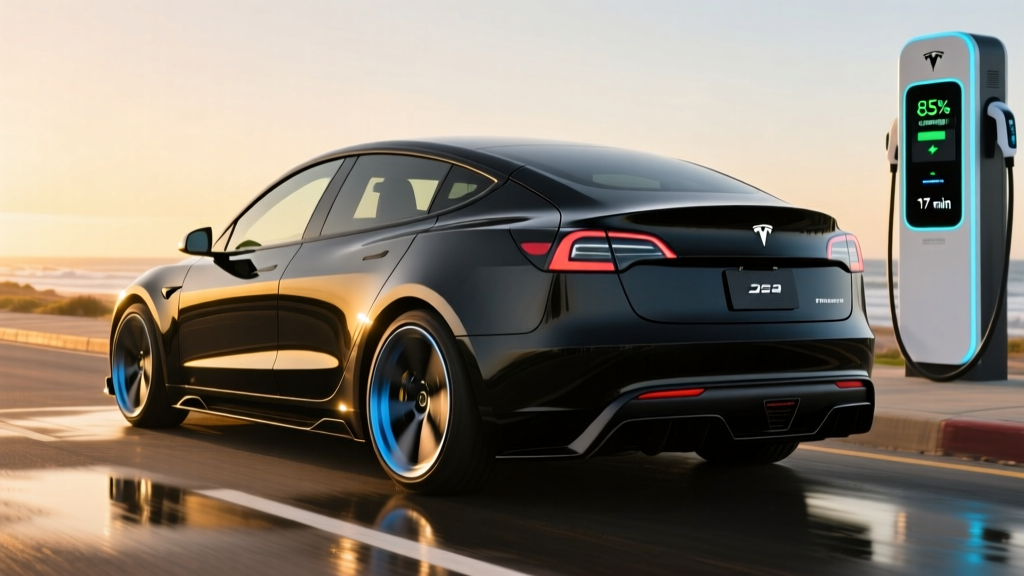
The charge curve matters: the Model 3 Performance hits its 250 kW peak only at a low state of charge (roughly 5–15% SoC) and under ideal thermal conditions. Tesla's onboard preconditioning warms the battery when you navigate to a Supercharger, which is critical for hitting peak rates. Without preconditioning — say, arriving at a charger after the car has sat cold — you may peak closer to 120–150 kW. Above 50% SoC, the rate tapers progressively; above 80%, it drops to roughly 30–40 kW to protect cell longevity. The 10–80% session takes approximately 25 minutes, which is competitive but not class-leading — the Hyundai Ioniq 5 and Kia EV6, with their 800V architectures, can do 10–80% in about 18 minutes at a 350 kW charger.
For home charging, Tesla's Wall Connector at 11.5 kW (48 amps on a 60-amp circuit) adds roughly 44 miles of range per hour. A typical overnight session from 30% to 80% takes about 3.5 hours. Installation costs for a dedicated 240V/60A circuit typically range from $500 to $2,000 depending on panel proximity and local permitting — always get a quote from a licensed electrician, as older homes may require a panel upgrade to 200A service.
Performance & Drift Mode: What Tesla's Track Feature Actually Does
The headline reason many shoppers land on this page is Tesla Drift Mode, and it deserves a clear technical explanation. Drift Mode is part of Tesla's Track Mode suite, accessible only on the Model 3 Performance (and Model S Plaid). When activated through the vehicle's touchscreen, it reconfigures the dual-motor torque split to bias power heavily to the rear axle — up to 100% rear torque distribution — and reduces the stability control intervention threshold.
Here's what happens mechanically:
- Torque vectoring: The front induction motor decouples or reduces output, sending the majority of the 510 hp to the rear permanent-magnet motor. This creates a rear-drive-dominant character that enables controlled oversteer.
- Stability control relaxation: Electronic stability control (ESC) remains active but allows greater yaw angles before intervening, giving the driver room to initiate and sustain a drift without the car immediately correcting.
- Thermal management: Track Mode preconditions the battery and powertrain for high-load operation, increasing cooling flow to the motors and inverter. The battery management system also adjusts the discharge limit to sustain higher power output for longer.
- Regenerative braking: Regen is reduced in Track/Drift Mode to provide more natural deceleration feel and prevent abrupt weight transfer mid-corner.
In practice, Drift Mode transforms the Model 3 Performance from a grippy, understeer-biased AWD sedan into something that rotates more willingly. On a closed course with adequate runoff, it's genuinely capable of sustained, controllable slides. However, this is not a replacement for a purpose-built drift car — the Model 3's 4,000+ lb curb weight and street-tire grip mean that drift angles are moderate, and tire wear is aggressive. Expect to burn through a set of rear tires in a handful of track sessions if Drift Mode is used frequently.
Outside of track use, the Model 3 Performance is a seriously quick daily driver. The 2.9-second 0–60 mph time is achieved with launch control engaged and the battery above 50% SoC. At lower charge states, expect 0–60 times in the 3.5–4.0 second range. The adaptive dampers (standard on the Performance trim) provide a noticeably firmer ride than the Long Range variant, but they're compliant enough for daily use on imperfect roads.
Interior, Cargo & Daily Practicality
The 2026 Model 3 Performance carries forward the minimalist "Highland" refresh interior introduced for the 2024 model year. The cabin is clean, tech-forward, and polarizing — nearly all vehicle controls route through the 15.4-inch center touchscreen, including climate, mirrors, and glovebox release.
Key interior and cargo dimensions:
- Front legroom: 42.7 inches
- Rear legroom: 35.2 inches — adequate for adults on shorter trips, tight for tall passengers on long drives
- Cargo volume (rear trunk): 23 cu ft (with rear seats up)
- Front trunk (frunk): 3.1 cu ft — useful for charging cables or a small bag
- Total cargo (seats folded): ~56 cu ft
Compared to the BMW i4 (which offers 36.5 cu ft of rear cargo as a liftback), the Model 3's trunk is smaller and its opening narrower. The frunk partially compensates, but families who need to load strollers or large suitcases will find the space limiting.
The 17-speaker audio system, ventilated front seats, and ambient lighting are all standard on the Performance trim. The rear-seat entertainment screen (8 inches) is a nice touch for passengers, though it's primarily useful for media playback rather than climate controls as some reviews suggest. Build quality on the 2026 model continues to improve, with tighter panel gaps and higher-quality materials than pre-2024 vehicles.
Tech, Driver Assistance & Autopilot
The Model 3 Performance comes standard with Tesla's Basic Autopilot, which includes Traffic-Aware Cruise Control and Autosteer (lane centering). This is an SAE Level 2 driver-assistance system — meaning the driver must remain fully engaged, hands on the wheel (or providing steering-torque input), and eyes on the road at all times.
Tesla Autopilot and Full Self-Driving (Supervised) are Level 2 systems. They do not drive the car autonomously. The driver is legally and practically responsible for all vehicle operation. Level 4 autonomy (no driver required in defined conditions) is currently available only in limited robotaxi services like Waymo in select cities.
Full Self-Driving (Supervised) is available as a $8,000 add-on (or $99/month subscription as of early 2026). FSD Supervised adds features like automatic lane changes, traffic light and stop sign recognition, and enhanced navigation on city streets. In our experience, FSD has improved substantially in urban environments but still requires constant vigilance — it occasionally misjudges construction zones, unprotected left turns, and complex intersections. It is not a system you can disengage from; treat it as an advanced cruise control that reduces fatigue on long highway drives and handles some surface-street navigation.
The infotainment system remains one of the best in the EV segment: fast, responsive, with Netflix/YouTube/Theater mode for charging stops, a solid navigation system with real-time Supercharger availability, and over-the-air updates that regularly add features. However, the absence of Apple CarPlay and Android Auto remains a dealbreaker for some buyers — Tesla's native system is capable, but if you rely heavily on your phone ecosystem, this is a genuine limitation.
Pricing, Trims & Federal Tax Credit Eligibility
The 2026 Tesla Model 3 is available in three trims. The Performance sits at the top:
| Trim | MSRP (incl. destination) | EPA Range | Est. Price After §30D Credit |
|---|---|---|---|
| Long Range RWD | $42,490 | 363 mi | ~$34,990 (if eligible) |
| Long Range AWD | $47,490 | 341 mi | ~$39,990 (if eligible) |
| Performance AWD | $54,990 | 315 mi | ~$47,490 (if eligible) |
The Performance trim at $54,990 includes the dual-motor AWD powertrain, Track/Drift Mode, adaptive dampers, 20-inch wheels, performance brakes, and all premium interior features. The only factory option is paint color (Solid Black is included; Ultra Red, Deep Blue, Pearl White, and Quicksilver add $1,000–$2,500) and FSD.
As tested with Ultra Red paint and FSD: $65,490 before any incentives.
The Model 3 Performance may qualify for up to $7,500, but eligibility depends on multiple factors. Per IRS guidelines:
- MSRP cap: Vehicle must have an MSRP below $55,000 for sedans. The Model 3 Performance at $54,990 clears this threshold — but adding options does not change the MSRP cap calculation (it's based on the base trim MSRP plus destination).
- Buyer income cap: Modified adjusted gross income (MAGI) must not exceed $150,000 (single), $225,000 (head of household), or $300,000 (joint filing).
- Battery sourcing: The vehicle must meet critical minerals and battery component sourcing requirements that phase in annually. Tesla's Fremont-built Model 3 has historically qualified for the full $7,500, but sourcing rules tighten each year — verify current eligibility on fueleconomy.gov before purchasing.
- Point-of-sale transfer: As of 2024, the credit can be transferred to the dealer at purchase, reducing your out-of-pocket cost at the time of sale rather than waiting for a tax refund. This requires dealer participation and IRS registration.
Consult a tax professional to confirm your personal eligibility. Rules are subject to change.
Warranty & Battery Longevity
Tesla covers the Model 3 Performance with the following warranty terms:
- Basic vehicle: 4 years / 50,000 miles
- Battery & drive unit: 8 years / 120,000 miles, with a guaranteed minimum 70% capacity retention
The 70% retention threshold is the warranty trigger — if the battery drops below 70% of its original capacity within the warranty period, Tesla will replace or refurbish it at no cost. In practice, Tesla's NMC batteries in the Model 3 have shown strong longevity. Data aggregated from owner reports and fleet studies (including Tesla's own impact reports) suggest that Model 3/Y batteries lose approximately 10–12% capacity over the first 100,000 miles, with degradation slowing significantly after the initial break-in period. Frequent use of Track/Drift Mode and repeated DC fast charging at maximum rate can accelerate degradation, so owners who plan to use Drift Mode regularly should monitor their State of Health (SoH) through the Tesla app and consider limiting routine charging to 80–90% for daily use.
Out-of-warranty battery replacement for the Model 3 Performance currently ranges from $12,000 to $16,000 depending on the service center and whether a refurbished pack is available. This is a cost to factor into long-term ownership projections, though the vast majority of owners never need a replacement within the typical ownership period.
Competitor Comparison: Model 3 Performance vs. BMW i4 M50 & Polestar 2 BST
The Model 3 Performance doesn't exist in a vacuum. Two rivals consistently come up in cross-shopping:
| Spec | Tesla Model 3 Perf. | BMW i4 M50 | Polestar 2 BST 270 |
|---|---|---|---|
| Base MSRP | $54,990 | $69,900 | $69,900 |
| EPA Range | 315 mi | 269 mi | 280 mi |
| 0–60 mph | 2.9 sec | 3.7 sec | 4.1 sec |
| Horsepower | 510 hp | 536 hp | 476 hp |
| Max DC Charge | 250 kW | 205 kW | 205 kW |
| Drift/Track Mode | Yes (Drift Mode) | No | No (Performance software) |
| Federal Tax Credit | Up to $7,500 | $0 (MSRP > cap) | $0 (MSRP > cap) |
The price gap is striking. The Model 3 Performance undercuts both the i4 M50 and Polestar 2 BST by roughly $15,000 before tax credits, and after the §30D credit, the effective price advantage widens to $20,000+. It's also quicker to 60, charges faster, and goes farther on a charge. The BMW counters with superior interior materials, a more traditional (and to some, more intuitive) control layout, and a hatchback cargo area. The Polestar offers a more distinctive design and Android Automotive OS with Google Maps built in. But on pure value and performance metrics, the Tesla is difficult to beat.
- You want the fastest 0–60 time and longest range at the lowest price in this segment
- You plan to use Drift Mode or Track Mode at track days
- You value Supercharger network access for road trips
- You qualify for the §30D tax credit and want to maximize savings
- Interior luxury, build quality, and brand cachet are top priorities
- You prefer a hatchback cargo layout and physical control interfaces
- Budget is less of a constraint
Who This EV Suits Best
The 2026 Model 3 Performance is ideal for:
- Enthusiast commuters who want a daily driver that doubles as a weekend track car — Drift Mode is the differentiator here.
- Tech-forward professionals who prioritize OTA updates, Supercharger convenience, and a minimalist cabin over traditional luxury cues.
- Value-conscious performance buyers who want supercar-rivaling acceleration without the six-figure price tag.
It is less suited for:
- Families needing maximum cargo space — consider the Model Y Performance or Kia EV9 instead.
- Buyers who rely on Apple CarPlay/Android Auto — Tesla's walled garden is non-negotiable.
- Drivers in areas with limited Supercharger or CCS charging access — though the NACS/CCS adapter helps, public charging infrastructure remains uneven in rural regions.
- 2.9-second 0–60 mph at a $54,990 price point
- 315 miles EPA range — best in the performance-sedan segment
- Drift Mode is a genuine, functional track feature, not a gimmick
- 250 kW peak charging with Supercharger network access
- Qualifies for up to $7,500 federal tax credit (MSRP under $55K cap)
- Continuous OTA updates add features post-purchase
- No Apple CarPlay or Android Auto
- Rear seat space is tight for tall adults on long trips
- Cargo volume (23 cu ft) trails hatchback competitors
- FSD (Supervised) costs $8,000 extra and is not autonomous
- Track/Drift Mode accelerates tire wear significantly
- Minimalist interior lacks physical buttons — polarizing for some
Frequently Asked Questions
What is Tesla Drift Mode and how do I activate it?
Drift Mode is a sub-function of Tesla's Track Mode, available exclusively on the Model 3 Performance and Model S Plaid. It shifts torque distribution to the rear axle (up to 100% rear bias) and relaxes stability control thresholds to enable controlled oversteer on closed courses. To activate, navigate to Controls > Pedals & Steering > Track Mode on the touchscreen, then select Drift Mode. It is intended for closed-course use only — using it on public roads is dangerous and likely illegal in most jurisdictions.
What is the real-world range of the 2026 Model 3 Performance?
The EPA estimates 315 miles. In real-world driving, expect approximately 300–320 miles in city conditions, 260–285 miles on the highway at 70–80 mph, and 220–260 miles in cold weather below freezing. Aggressive driving or Track Mode use will reduce range further.
How fast does the Model 3 Performance charge?
On a Tesla V3 Supercharger (250 kW peak), the Model 3 Performance charges from 10–80% in approximately 25 minutes, provided the battery is preconditioned. At home on a Level 2 Wall Connector (11.5 kW), it adds about 44 miles of range per hour, with a full charge taking roughly 7 hours.
Does the 2026 Model 3 Performance qualify for the federal EV tax credit?
It may qualify for up to $7,500 under IRS §30D rules. The Model 3 Performance's MSRP of $54,990 falls under the $55,000 sedan cap. However, buyer income limits ($150K single / $300K joint), battery sourcing requirements, and point-of-sale dealer registration all affect eligibility. Verify on fueleconomy.gov and consult a tax professional before purchasing.
Is the Model 3 Performance worth buying over the BMW i4 M50?
On performance-per-dollar, yes — the Tesla is quicker, goes farther, charges faster, and costs roughly $15,000 less before tax credits. The BMW i4 M50 offers a more luxurious interior, a hatchback cargo design, and traditional physical controls. If cabin refinement and brand prestige matter more than raw value, the BMW has merit. If you want the best numbers on the spec sheet and Drift Mode capability, the Tesla wins.
Can I use Drift Mode on public roads?
No. Drift Mode is designed for closed-course, controlled environments such as race tracks or private facilities. Using it on public roads endangers you and others, violates traffic laws in virtually all jurisdictions, and could void portions of your warranty if Tesla's telemetry data shows misuse. Track Mode records detailed session data that Tesla can access during warranty claims.
How does Drift Mode affect tire wear and battery degradation?
Significantly. Drift Mode induces rear-tire slip, which accelerates tread wear — owners who use Drift Mode regularly report needing rear tire replacement in as few as 3,000–5,000 miles of track use. Battery degradation is also modestly increased by the high-discharge-rate demands of track driving, though Tesla's thermal management system mitigates this to some degree. Plan for higher tire costs if Drift Mode is a regular activity.