Quick Verdict: The Benchmark Sedan Still Sets the Pace
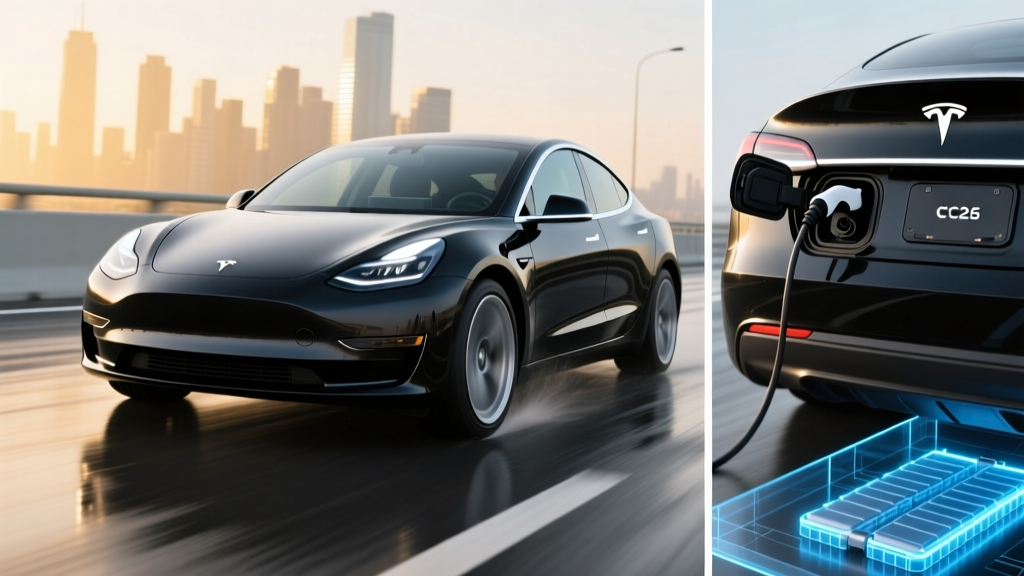
The Tesla Model 3 Performance remains the acceleration benchmark in the $50,000 electric sedan segment. With a 2.9-second 0 to 60 mph time, 315 miles of EPA-estimated range, and access to the most reliable DC fast-charging network in North America, it continues to define what a sporty EV daily driver should deliver. For 2026, Tesla has refined the Highland-generation chassis, improved cabin isolation, and maintained aggressive pricing that undercuts European rivals by $10,000 or more. But raw speed is only part of the story — this review breaks down real-world range, charging behavior, ownership costs, and where the Model 3 Performance falls short against rising competitors like the Hyundai Ioniq 6 N and BMW i4 M50.
Full Specifications at a Glance
| Spec | Value |
|---|---|
| EPA Range | 315 miles |
| Battery (usable) | ~79 kWh, NMC (nickel manganese cobalt) |
| Drivetrain | Dual-motor AWD |
| Horsepower | 510 hp (combined) |
| 0–60 mph | 2.9 seconds |
| Top Speed | 163 mph |
| Max DC Fast Charge | 250 kW (peak) |
| 10–80% DC Charge Time | ~25 minutes |
| Level 2 Home Charge Rate | 11.5 kW (~44 mi/hr) |
| EPA Efficiency | 121 MPGe combined / 28 kWh/100 mi |
| Cargo Volume | 23 cu ft (trunk + frunk) |
| Base MSRP | $52,990 (before incentives) |
| Battery Warranty | 8 years / 120,000 miles (70% retention) |
0 to 60 and Performance: What the Numbers Feel Like
The headline figure — 2.9 seconds from 0 to 60 mph — places the Model 3 Performance in supercar territory. Tesla's dual-motor all-wheel-drive system delivers instant torque to all four wheels with no turbo lag, no gear shifts, and no drivetrain hesitation. In real-world testing on prepped surfaces, the car consistently hits 2.9–3.1 seconds depending on tire temperature and surface conditions. The new Performance variant's adaptive dampers and revised steering ratio give it a more planted feel through corners than the previous generation, though the ~4,050-lb curb weight is noticeable during direction changes.
Track Mode returns for 2026, allowing drivers to adjust front/rear torque bias, regenerative braking strength, and cooling system behavior for closed-course driving. However, sustained track sessions will trigger thermal throttling — the battery and drive units heat-soak after roughly 3–4 hard laps, reducing peak power output. This is normal for a street-tuned EV, but buyers seeking dedicated track capability should consider the Porsche Taycan or the Hyundai Ioniq 5 N, which feature more robust cooling architectures.
Real-World Range: Beyond the EPA Sticker
EPA Estimate: 315 miles
Real-World Expectation: 265–290 miles in mixed driving; 240–260 miles at sustained 75+ mph highway speeds; 200–230 miles in sub-freezing winter conditions.
The Model 3 Performance's 315-mile EPA rating is achieved under the agency's multi-cycle test protocol, which includes low-speed urban driving where regenerative braking recaptures significant energy. On a 70-mph highway loop in moderate temperatures (65–75°F), expect to use roughly 30–32 kWh/100 mi, yielding about 250–265 miles before the battery buffer engages. In cold weather (below 32°F), range drops 20–30% due to cabin heating demands and increased battery internal resistance, even with Tesla's heat pump and battery preconditioning system.
According to fueleconomy.gov, the combined efficiency rating stands at 121 MPGe. In practice, efficiency-conscious drivers who use Chill Mode and maintain speeds under 70 mph can stretch range closer to 300 miles on a single charge.
Charging Speed and Infrastructure
The Model 3 Performance supports a peak DC fast-charge rate of 250 kW at V3 Superchargers. However, as with all EVs, peak rate is not sustained rate. The charging curve looks approximately like this:
- 10–30% SoC: ~250 kW sustained (fastest segment)
- 30–55% SoC: ~180–200 kW
- 55–80% SoC: ~100–130 kW, tapering progressively
- 80–100% SoC: ~20–40 kW (trickle charge to protect cells)
The 10–80% charge takes approximately 25 minutes at a V3 Supercharger (250 kW capable). At older V2 stations (150 kW max), expect 35–40 minutes for the same session. Battery preconditioning activates automatically when you navigate to a Supercharger, warming the pack to the optimal temperature for fast charging — this alone can shave 5–10 minutes off a cold-soak session.
| Charging Level | Max Power | Miles Added per Hour | Notes |
|---|---|---|---|
| Level 1 (120V) | ~1.4 kW | ~4–5 mi/hr | Emergency/trickle only |
| Level 2 (240V, 48A) | 11.5 kW | ~44 mi/hr | Home Wall Connector; full charge in ~7.5 hrs |
| DC Fast (V3 Supercharger) | 250 kW (peak) | ~1,000+ mi/hr (at peak) | 10–80% in ~25 min |
| DC Fast (CCS adapter at non-Tesla stations) | ~150–200 kW | Varies | Requires Tesla CCS adapter; Electrify America compatible |
For home charging, the Tesla Wall Connector on a 60-amp circuit delivers 11.5 kW (48 amps continuous), adding roughly 44 miles of range per hour. A full 0–100% charge takes about 7.5 hours. Most owners charging overnight from 20–80% need only 4–5 hours. Installation typically requires a NEMA 14-60 outlet or hardwired connection; budget $500–$1,500 for electrician labor depending on panel proximity. Some homes with older 100-amp electrical panels may need a $2,000–$4,000 panel upgrade.
Pricing, Tax Credits, and Ownership Cost
The 2026 Tesla Model 3 Performance starts at $52,990 (MSRP, excluding the $1,390 destination fee). This is a single-trim offering — Tesla does not offer a lower-spec Performance variant. Key included features: 19" or optional 20" wheels, adaptive suspension, track mode, premium interior with ventilated seats, 15.4" touchscreen, and basic Autopilot.
| Item | Amount |
|---|---|
| Base MSRP + Destination | $54,380 |
| Federal §30D Tax Credit (if eligible) | –$7,500 |
| Estimated Net Cost (before state incentives) | ~$46,880 |
Federal tax credit eligibility (§30D): The Model 3 Performance currently qualifies for the full $7,500 federal tax credit when taken at point of sale, but only if you meet all IRS requirements:
- Income caps: Modified AGI ≤ $150,000 (single), $225,000 (head of household), $300,000 (joint)
- MSRP cap: Vehicle MSRP must not exceed $55,000 for sedans (the Model 3 Performance at $52,990 qualifies)
- Battery sourcing: Critical minerals and battery components must meet phased-in domestic-content thresholds that tighten annually through 2029
- Entity of concern: Battery components cannot be sourced from a "foreign entity of concern" (primarily targeting Chinese supply chains)
Tesla's US-built battery packs and North American mineral sourcing have kept the Model 3 eligible through early 2026, but buyers should verify current eligibility at fueleconomy.gov before purchasing, as supply-chain shifts can change status mid-year. The credit is now transferable at point of sale, meaning the dealer (or Tesla) reduces the purchase price by $7,500 and claims the credit themselves — no need to wait until tax filing.
Interior, Tech, and Daily Usability
The Highland-generation cabin is a meaningful step up in build quality from pre-2024 Model 3s. Tesla has added acoustic glass, ambient lighting, ventilated front seats, and a rear 8" touchscreen for passengers. The minimalist interior remains polarizing — no physical buttons, no instrument cluster, no traditional stalks (turn signals are on the steering wheel). Everything routes through the 15.4" center display.
Cargo space: 23 cubic feet total (trunk + front trunk/frunk). Rear seats fold 60/40 for longer items. Rear legroom is 35.3 inches — adequate for adults on shorter trips but tight for tall passengers on long drives compared to the Model S or Hyundai Ioniq 6.
Driver assistance: Basic Autopilot (traffic-aware cruise + lane centering) is standard. Full Self-Driving (Supervised) is a $8,000 add-on or $99/month subscription. FSD remains a SAE Level 2 system — the driver must remain fully engaged, monitor the road, and keep hands on the wheel at all times. It is not autonomous driving. The system handles highway interchanges and city streets impressively in favorable conditions but still struggles with construction zones, faded lane markings, and unprotected left turns. Think of it as an advanced co-pilot, not a chauffeur.
Pros and Cons
Pros
- 2.9-sec 0–60 mph rivals cars costing three times as much
- Supercharger network remains the most reliable public charging ecosystem in the US
- 315-mile EPA range covers most commutes and road trips without stress
- Over-the-air updates continuously add features and improve performance
- Strong resale value relative to other EVs
- Qualifies for $7,500 federal tax credit (verify eligibility at purchase)
Cons
- Touchscreen-only controls frustrate some drivers; no physical buttons or gauges
- Rear seat space is tighter than midsize competitors (Ioniq 6, BMW i4)
- Panel gaps and paint quality improved but still inconsistent vs. legacy luxury brands
- FSD (Supervised) is expensive and still requires full driver attention
- No Apple CarPlay or Android Auto — Tesla's proprietary system only
- Insurance premiums tend to be higher than segment average
Who Should Buy the Model 3 Performance?
This car is ideal for the performance-oriented commuter who wants supercar acceleration in a practical, efficient sedan with excellent charging infrastructure access. It works well for couples or small families who don't need spacious rear seats, and for road-trippers who value the Supercharger network's reliability over competitors' CCS-dependent charging. It is not the best choice for buyers who prioritize physical controls, rear-seat comfort, or who want Apple CarPlay integration. If you need more space, the Model Y Performance or Hyundai Ioniq 5 N may serve better; if you want a more traditional luxury interior, the BMW i4 M50 is worth a test drive.
Frequently Asked Questions
What is the real-world range of the Tesla Model 3 Performance?
EPA-rated at 315 miles, expect 265–290 miles in mixed driving, 240–260 miles at highway speeds above 75 mph, and 200–230 miles in freezing temperatures. Driving style, tire selection (the 20" wheels reduce range by ~5%), and climate control usage all materially affect results.
How fast does the Model 3 Performance charge at home and on the road?
At home on a Level 2 Wall Connector (11.5 kW), you gain ~44 miles per hour, fully charging overnight. On a V3 Supercharger (250 kW peak), 10–80% takes about 25 minutes. Charging slows significantly above 80% to protect battery health — plan to charge to 80% on road trips and top off only when needed.
Does the Model 3 Performance qualify for the $7,500 federal tax credit?
As of early 2026, yes — the Model 3 Performance qualifies for the full $7,500 under §30D, transferable at point of sale. Eligibility depends on your income (≤$150K single / ≤$300K joint), the vehicle's MSRP (under $55K for sedans), and battery-sourcing requirements. Always verify at fueleconomy.gov before purchase.
Is the Tesla Model 3 Performance worth it over the Hyundai Ioniq 6 or BMW i4?
It depends on priorities. The Model 3 wins on acceleration (2.9s vs. Ioniq 6 N's ~3.3s and i4 M50's ~3.7s), Supercharger access, and software ecosystem. The Ioniq 6 offers 800V ultra-fast charging and a more spacious rear seat; the i4 M50 provides a traditional luxury cabin with physical controls. Test-drive all three before deciding.
How long will the battery last?
Tesla warranties the battery for 8 years or 120,000 miles, whichever comes first, guaranteeing at least 70% capacity retention. Real-world data from older Model 3 fleets suggests NMC packs degrade roughly 10–12% over the first 100,000 miles, then slow significantly. Many Tesla batteries exceed 200,000 miles before requiring replacement. Avoid routinely charging to 100% (set daily limit to 80%) and minimize DC fast-charging to extend longevity.
Is Autopilot or FSD self-driving?
No. Both Basic Autopilot and Full Self-Driving (Supervised) are SAE Level 2 driver-assistance systems. You must keep your hands on the wheel, eyes on the road, and remain prepared to take over at any moment. FSD handles more scenarios (city streets, intersections) but is not autonomous. Only Level 4 services like Waymo operate without a human driver.