Quick Verdict: The Benchmark EV Sedan Still Delivers
The Tesla Model 3 remains the default answer for buyers asking how far an affordable electric sedan can go. For 2026, the Long Range AWD variant pushes an EPA-estimated 363 miles on a full charge, while the base Rear-Wheel Drive model — now equipped with a lithium iron phosphate (LFP) battery — delivers 272 miles at a significantly lower entry price. The question isn't whether the Model 3 can handle daily driving; it's whether its real-world miles hold up on highway road trips, in freezing temperatures, and across years of ownership. This review dissects every mile, kilowatt-hour, and dollar to answer that.
EPA Range vs. Real-World Miles: What to Actually Expect
EPA Estimated: 363 miles
Real-World Highway (70-75 mph, mild weather): ~300–325 miles
Real-World Mixed Commuting: ~320–345 miles
Cold Weather (below 32°F, highway): ~250–290 miles
Note: EV range drops 15–30% in sustained cold due to battery heating demands and reduced regenerative braking efficiency.
The EPA's combined cycle tests are weighted toward city driving, where regenerative braking recovers energy and aerodynamic drag is lower. Highway driving at 70+ mph is where the Model 3 — like every EV — reveals its true consumption. In controlled testing, the Long Range AWD typically achieves 3.8–4.1 kWh/mile on flat interstate routes, translating to roughly 300–325 usable miles before you'd want to stop and charge.
Cold weather compounds the loss. LFP batteries (in the RWD model) are particularly sensitive to low temperatures, losing more range than NMC chemistry in sub-freezing conditions. Tesla's heat pump and battery preconditioning mitigate this, but expect a 20–25% reduction in winter highway range if you're in the northern tier of states. Owners in Minnesota and Maine consistently report 250–270 winter highway miles from the Long Range trim.
The RWD model's 272-mile EPA rating translates to approximately 225–245 real-world highway miles in mild weather, and closer to 185–210 in cold conditions. For commuters with home charging, this is more than adequate. For road-trippers, it means more frequent Supercharger stops — roughly every 2.5 hours at interstate speeds.
Battery Chemistry, Capacity, and Long-Term Degradation
| Spec | RWD | Long Range AWD | Performance |
|---|---|---|---|
| Battery Chemistry | LFP (Lithium Iron Phosphate) | NMC (Nickel Manganese Cobalt) | NMC |
| Usable Capacity | ~57.5 kWh | ~75 kWh | ~75 kWh |
| EPA Range | 272 mi | 363 mi | 315 mi |
| Efficiency (kWh/100mi) | 25 | 25 | 28 |
| MPGe (Combined) | 132 | 134 | 119 |
The chemistry split matters for ownership. LFP batteries (RWD) tolerate daily charging to 100% without accelerated degradation — Tesla actually recommends it. They also offer longer cycle life (2,000–3,000+ full cycles vs. ~1,000–1,500 for NMC). The trade-off: lower energy density (heavier pack for fewer miles), reduced cold-weather performance, and slower DC fast-charge speeds.
NMC batteries (Long Range, Performance) deliver higher energy density and better cold-weather resilience but should be charged to 80–90% for daily use, reserving 100% for road trips. This means your daily usable range from a Long Range is closer to 290–325 miles on a typical 80% charge — still excellent for nearly all use cases.
Degradation data from high-mileage Model 3 fleets shows approximately 10–12% capacity loss at 100,000 miles for NMC packs and 8–10% for LFP. Tesla's battery warranty covers defects and capacity loss below 70% for 8 years or 100,000 miles (RWD) and 8 years or 120,000 miles (Long Range/Performance).
Charging Speed: DC Fast Charge and Home Level 2
| Charging Method | RWD (LFP) | Long Range / Performance (NMC) |
|---|---|---|
| Max DC Fast Charge | 170 kW peak | 250 kW peak |
| 10–80% DC Time | ~30 minutes | ~25 minutes |
| Sustained DC Rate (10-80%) | ~110 kW avg | ~150 kW avg |
| Level 2 Home Charging | 11.5 kW (44 mi/hr) | 11.5 kW (44 mi/hr) |
| Full Level 2 Charge Time | ~5.5 hours | ~7 hours |
| Level 1 (120V Outlet) | ~1.3 kW (5 mi/hr) | ~1.3 kW (5 mi/hr) |
| Connector | NACS (native) | NACS (native) |
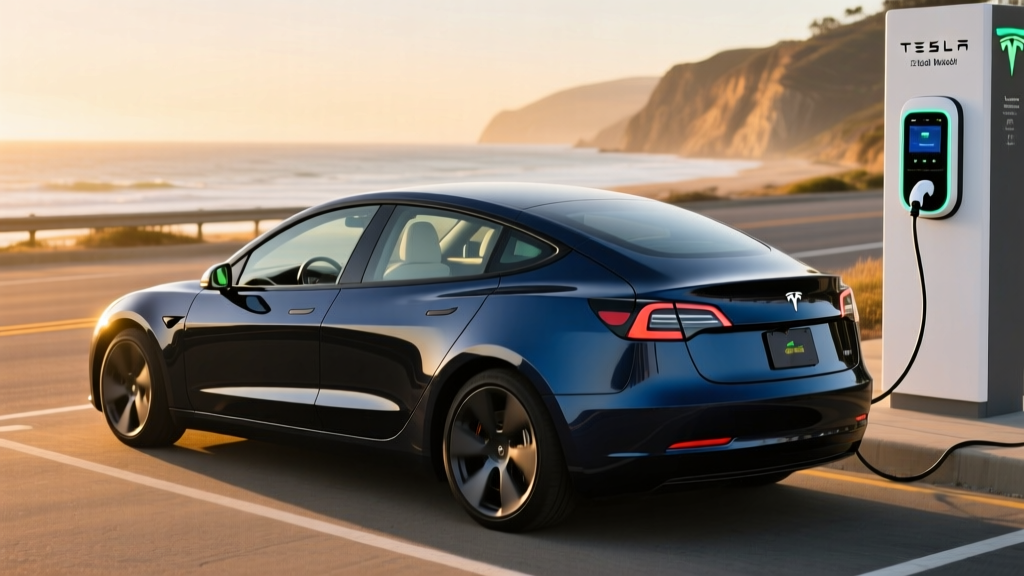
The Model 3 uses the North American Charging Standard (NACS) connector natively — no adapter needed for Tesla Superchargers. With the Supercharger network now exceeding 60,000 stalls globally, this remains a significant infrastructure advantage. Third-party networks (Electrify America, EVgo) also support NACS as of 2025, though adapter availability varies by station.
The charge curve is where real-world experience separates from spec-sheet marketing. The Long Range peaks at 250 kW but only sustains that rate briefly between roughly 10–25% State of Charge (SoC). From 25–60%, expect 130–160 kW; from 60–80%, it tapers to 80–100 kW. This is why the 10–80% time of ~25 minutes is a more honest metric than peak kW. The RWD's LFP pack charges more conservatively, with a flatter but lower curve — adequate for road trips but noticeably slower on long interstate drives.
For home charging, a 48-amp Level 2 wall connector on a 60-amp circuit delivers the full 11.5 kW, adding roughly 44 miles of range per hour of charging. Overnight (8 hours) restores a full battery for either trim. Installation costs typically run $800–$2,000 depending on panel capacity and conduit distance — budget for a licensed electrician to assess your 200-amp panel headroom.
Performance, Efficiency, and Drivetrain Specs
| Performance Metric | RWD | Long Range AWD | Performance |
|---|---|---|---|
| 0–60 mph | 5.8 sec | 4.2 sec | 2.9 sec |
| Horsepower | 271 hp | 346 hp | 510 hp |
| Drivetrain | Single motor RWD | Dual motor AWD | Dual motor AWD |
| Top Speed | 125 mph | 125 mph | 163 mph |
Even the base RWD Model 3 outperforms most gas-powered compact sedans off the line. The instant torque delivery of a single rear motor makes merging and city driving feel effortless. The Long Range AWD adds a front motor for all-weather traction and a meaningful 0–60 improvement. The Performance trim is a legitimate sports sedan rival — 2.9 seconds to 60 mph competes with BMW M3 and Mercedes AMG territory at a fraction of the price.
Efficiency is where Tesla's engineering stands out. At 25 kWh/100 miles (Long Range), the Model 3 is among the most efficient EVs on the market. Compare that to the Ford Mustang Mach-E Extended Range at 32 kWh/100mi or the Hyundai Ioniq 6 at 27 kWh/100mi. This efficiency directly translates to more miles per kWh at the charger and lower operating costs.
Pricing, Trim Levels, and Federal Tax Credit Eligibility
| Trim | Base MSRP | Est. Federal Credit | Net Price (if eligible) |
|---|---|---|---|
| RWD | $38,990 | Up to $7,500 | ~$31,490 |
| Long Range AWD | $47,740 | Up to $7,500 | ~$40,240 |
| Performance | $54,990 | Up to $7,500 | ~$47,490 |
- MSRP Cap: Sedans must be ≤ $55,000 (all Model 3 trims qualify)
- Income Cap: Modified AGI ≤ $150,000 (single), $225,000 (HOH), $300,000 (joint)
- Battery Sourcing: Critical minerals and battery components must meet phased-in domestic/free-trade-partner thresholds — verify current-year compliance on IRS.gov
- Point-of-Sale Transfer: Eligible buyers can apply the credit as an immediate price reduction at the dealer
- Tax Liability: The credit is non-refundable — you must owe at least $7,500 in federal tax to claim the full amount
As of early 2026, the Tesla Model 3 qualifies for the full $7,500 federal tax credit across all trims, assuming buyer income and battery-sourcing requirements are met. The point-of-sale transfer option means you can apply the credit directly to your purchase price rather than waiting until tax filing. Consult a tax professional to confirm your specific eligibility — sourcing rules have tightened annually and may shift mid-year.
With the credit applied, the RWD Model 3 becomes one of the most affordable new EVs with over 270 miles of range. The Long Range at ~$40,240 undercuts comparably equipped competitors like the BMW i4 eDrive40 ($52,200) and approaches Hyundai Ioniq 6 territory ($42,715 before credits).
Interior Space, Cargo, and Daily Practicality
The Model 3 is a compact sedan, and its dimensions reflect that positioning:
- Cargo volume (trunk + frunk): 23 cu ft total (19.8 cu ft rear trunk, 3.1 cu ft front trunk)
- Rear legroom: 35.2 inches
- Front legroom: 42.4 inches
- Seating: 5 passengers (3-across rear is tight for adults on longer trips)
Compared to the Model Y (76 cu ft with seats folded), the Model 3 sacrifices cargo versatility. A stroller, golf clubs, or a week's groceries for a family of four fit, but barely. The frunk is useful for charging cables and small bags. If you regularly haul cargo or rear-seat passengers, the Model Y or a competitor like the Hyundai Ioniq 5 (with its hatchback design and 27 cu ft behind the rear seats) may serve you better.
The refreshed "Highland" interior (introduced for the 2024 model year and carried forward) features ventilated front seats, ambient lighting, improved sound insulation, and rear-seat ventilation. The minimalist cabin relies entirely on the 15.4-inch center touchscreen — no physical stalks for turn signals (they're on the steering wheel) and no instrument cluster. Some buyers love the simplicity; others find the lack of physical controls frustrating for basic adjustments like climate or mirror positioning.
Tech, Driver Assistance, and Notable Drawbacks
Tesla Autopilot and Full Self-Driving (Supervised) are Level 2 driver-assist systems. The driver must remain fully attentive, keep hands on the wheel, and be prepared to take over at any moment. This is not autonomous or self-driving capability. Only Level 4 robotaxi services (Waymo, Zoox) operate without a human driver in defined areas.
Standard tech includes:
- 15.4-inch touchscreen with navigation, streaming, and gaming
- Tesla Autopilot (adaptive cruise control + lane centering)
- Over-the-air software updates that add features post-purchase
- 8-camera vision suite (no radar or ultrasonic sensors — Tesla Vision only)
- Phone-as-key with Bluetooth proximity unlock
- Sentry Mode dashcam recording when parked
FSD (Supervised) remains a $8,000 add-on (or $99/month subscription as of 2026). It adds automated lane changes, traffic light/stop sign recognition, and city-street navigation. In practice, FSD handles many scenarios competently but still requires frequent driver intervention in construction zones, complex intersections, and adverse weather. Treat it as an advanced cruise-control convenience feature, not a replacement for attentive driving.
Notable drawbacks:
- No physical turn-signal stalks — steering-wheel buttons can be unintuitive during roundabouts or lane changes
- Rear visibility is limited; the camera-based mirror option helps but isn't standard
- No Apple CarPlay or Android Auto — Tesla's ecosystem is closed
- Insurance premiums run 15–30% higher than comparable gas sedans in most states
- Panel gaps and paint quality, while improved, still lag behind German and Korean competitors at this price point
Who Should Buy the Model 3 — And Who Shouldn't
- You want maximum range per dollar (363 mi Long Range is class-leading for the price)
- You have access to home Level 2 charging and Supercharger corridors for road trips
- You value over-the-air updates, Tesla's software ecosystem, and the Supercharger network
- Your household doesn't need hatchback cargo space or frequent rear-seat adult passengers
Look elsewhere if:
- You need SUV cargo room or easy rear-seat access (consider Model Y, Ioniq 5, or EV6)
- You prefer physical controls, Apple CarPlay, or a traditional instrument cluster
- You live in an area with sparse Supercharger coverage and no home charging option
- You tow — the Model 3 is not rated for towing
Pros and Cons at a Glance
- Class-leading efficiency (25 kWh/100mi)
- 363-mile EPA range on Long Range trim
- 250 kW peak DC fast charging (Long Range/Performance)
- Extensive Supercharger network access
- Strong performance even on base RWD (5.8s 0–60)
- Continuous OTA software improvements
- Full $7,500 federal tax credit eligibility (subject to rules)
- No physical turn-signal stalks or instrument cluster
- Tight rear-seat legroom and cargo space vs. crossovers
- No Apple CarPlay or Android Auto
- Higher insurance costs than gas equivalents
- FSD (Supervised) is expensive and still requires full driver attention
- LFP battery in RWD charges slower and loses more range in cold
- No towing capability
Frequently Asked Questions
What is the real-world range of the 2026 Tesla Model 3?
The Long Range AWD achieves approximately 300–325 miles on highway road trips in mild weather, dropping to 250–290 miles in sustained cold (below 32°F). The RWD model delivers roughly 225–245 highway miles in mild conditions and 185–210 in cold weather. City and mixed driving with regenerative braking yields results closer to the EPA sticker numbers.
How fast does the Model 3 charge on DC fast chargers and at home?
The Long Range and Performance trims peak at 250 kW on DC fast chargers, achieving 10–80% in approximately 25 minutes (sustaining ~150 kW average). The RWD peaks at 170 kW with a 10–80% time of ~30 minutes. At home on a 48-amp Level 2 charger (11.5 kW), all trims add about 44 miles of range per hour, fully charging overnight.
How much does the Tesla Model 3 cost after the federal tax credit?
With the full $7,500 §30D credit applied at point of sale, the RWD starts at approximately $31,490, the Long Range AWD at ~$40,240, and the Performance at ~$47,490. Eligibility requires meeting income caps ($150K single / $300K joint), MSRP caps (all trims qualify at ≤$55K sedan cap), and current-year battery-sourcing requirements. Verify eligibility on IRS.gov and with a tax professional.
Does the Tesla Model 3 qualify for the federal EV tax credit in 2026?
Yes — as of early 2026, all Model 3 trims qualify for the full $7,500 credit, provided the buyer meets income thresholds and the vehicle's battery components and critical minerals satisfy the phased domestic-sourcing requirements. Rules tighten annually, so confirm current compliance before purchasing. The credit can be transferred at point of sale as an immediate price reduction.
Is the Tesla Model 3 worth buying vs. the Hyundai Ioniq 6, BMW i4, or Polestar 2?
The Model 3 Long Range wins on range-per-dollar (363 miles at ~$40K after credit) and charging infrastructure (native Supercharger access). The IIHS Top Safety Pick+ rated Model 3 also leads in efficiency. The Ioniq 6 offers a more conventional interior and CarPlay but trails on range (361 mi) and charges at a similar 250 kW. The BMW i4 costs significantly more but delivers premium build quality. The Polestar 2 is being discontinued. For most buyers prioritizing range, efficiency, and charging access, the Model 3 remains the benchmark.
What is the Model 3 battery warranty?
Tesla covers the battery and drive unit for 8 years or 100,000 miles on the RWD, and 8 years or 120,000 miles on the Long Range and Performance trims. The warranty guarantees the battery will retain at least 70% of its original capacity during that period. Real-world data from high-mileage Model 3 owners suggests 10–12% degradation at 100,000 miles for NMC packs, well within warranty thresholds.
Can I charge a Tesla Model 3 on non-Tesla charging networks?
Yes. The Model 3 uses the NACS connector, which is now supported by Electrify America, EVgo, and other major networks as of 2025–2026. Some older CCS-only stations may require an adapter. Tesla's in-car navigation routes through Superchargers by default but can plan routes around third-party chargers when configured.