The Tesla Model 3 remains one of the most-searched electric sedans in the U.S. market, and for good reason. It blends sports-sedan acceleration with class-leading efficiency and access to the largest fast-charging network in North America. But buyers searching for the Tesla Model 3 max speed often discover there is much more to the story than top-end velocity. This review covers every variant currently on sale for the 2025–2026 model year, from the base Rear-Wheel Drive to the dual-motor Performance, with exact EPA figures, charging data, and ownership economics.
Tesla Model 3 Max Speed and Performance by Trim
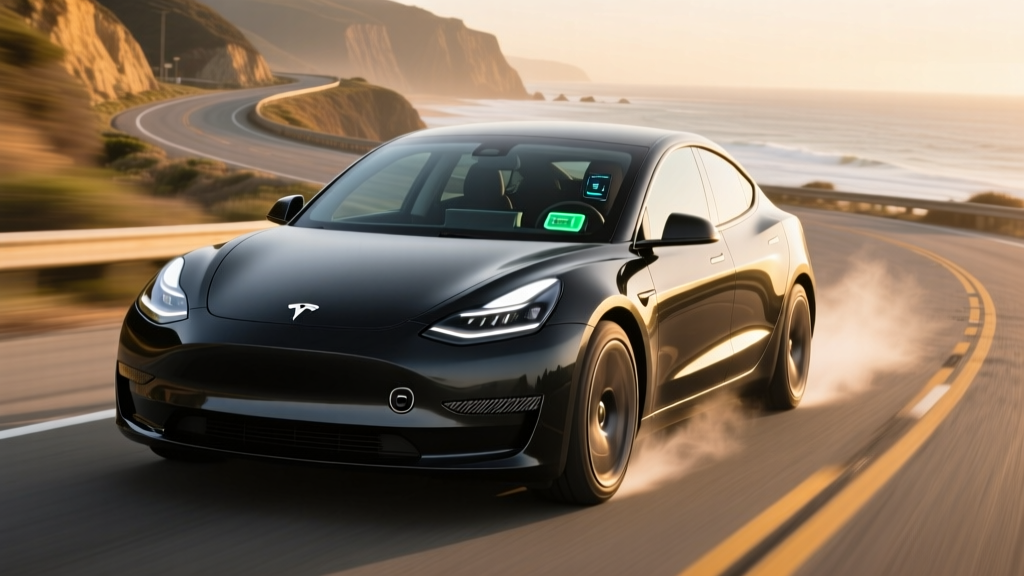
The Model 3 lineup splits into three distinct performance tiers. The base Long Range Rear-Wheel Drive prioritizes efficiency, while the Long Range All-Wheel Drive adds traction and a modest power bump. The Performance variant is the one buyers associate with the Tesla Model 3 max speed conversation.
| Specification | Long Range RWD | Long Range AWD | Performance AWD |
|---|---|---|---|
| 0–60 mph | 5.8 sec | 4.2 sec | 2.9 sec |
| Top Speed (Max Speed) | 125 mph | 125 mph | 163 mph |
| Horsepower | ~271 hp | ~346 hp | ~510 hp |
| Drivetrain | RWD (single motor) | AWD (dual motor) | AWD (dual motor) |
| EPA Range | 363 mi | 341 mi | 315 mi (est.)* |
| Battery (usable) | ~79 kWh NMC | ~79 kWh NMC | ~79 kWh NMC |
| MPGe (combined) | 142 MPGe | 131 MPGe | ~119 MPGe |
| Efficiency (kWh/100 mi) | 24 | 26 | ~28 |
*EPA figures for the latest Performance trim may vary slightly by model year. Verify at fueleconomy.gov.
The Performance variant's 163 mph top speed and 2.9-second 0–60 time place it in direct competition with the BMW M3 and Mercedes-AMG C63, but at a fraction of the price. However, max speed is largely academic for daily driving. What matters more is how the Model 3 delivers its power: instant torque from standstill, seamless single-speed reduction gearing, and a low center of gravity that keeps the sedan planted through corners.
Real-World Range: EPA Sticker vs. What You'll Actually See
- Long Range RWD (EPA 363 mi): Expect 300–330 mi in mixed driving; 250–280 mi sustained highway at 75+ mph; 200–230 mi in freezing temperatures.
- Long Range AWD (EPA 341 mi): Expect 280–310 mi mixed; 240–270 mi highway; 190–220 mi in cold weather.
- Performance AWD (EPA 315 mi est.): Expect 260–290 mi mixed; 220–250 mi highway; 170–200 mi in cold weather.
Tesla's efficiency engineering is among the best in the industry. The Highland refresh (introduced for the 2024 model year and continuing through 2026) improved aerodynamics with a lower drag coefficient, revised heat pump, and optimized thermal management. Still, the laws of physics apply: sustained highway speeds above 70 mph increase consumption significantly, and lithium-ion batteries lose effective capacity in sub-freezing temperatures. The heat pump helps mitigate cabin heating draw, but battery chemistry inherently slows in cold weather, reducing range by 25–35% in extreme conditions.
For most commuters driving 30–60 miles round-trip, any Model 3 trim provides more than enough range to charge exclusively at home, only using public DC fast chargers for road trips.
Charging Speed: DC Fast Charging and Home Level 2
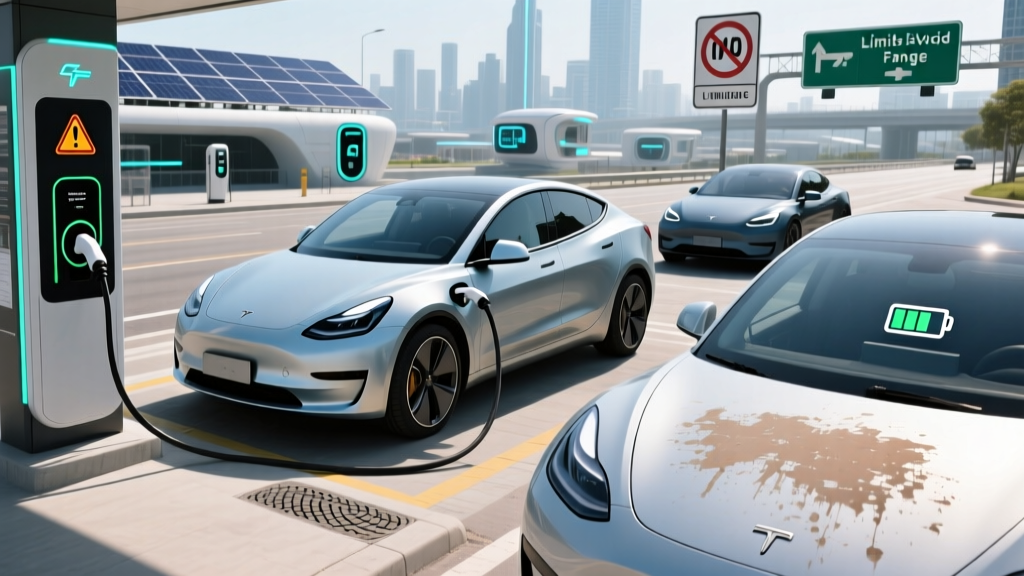
Charging speed is where the Model 3's access to the Tesla Supercharger network — now increasingly open to NACS-equipped EVs from other brands — becomes a genuine ownership advantage. Here are the exact charging rates across all trims:
| Charging Method | Power / Rate | Time / Miles Added |
|---|---|---|
| DC Fast Charge (Supercharger V3/V4) | Peak 250 kW | 10–80% in ~25–30 min |
| DC Fast Charge (Sustained avg.) | ~150–170 kW avg (10–80%) | ~175 mi added in 15 min |
| Level 2 Home (Tesla Wall Connector, 48A) | 11.5 kW | ~44 mi/hr of charging |
| Level 2 Home (32A mobile connector) | 7.7 kW | ~30 mi/hr of charging |
| Level 1 (120V standard outlet) | ~1.4 kW | ~3–5 mi/hr of charging |
A critical detail many spec sheets obscure: the Model 3's 250 kW peak charge rate is not sustained across the entire session. The charge curve peaks early (between 10–30% SoC) and tapers progressively above 50%, dropping significantly past 80%. This is normal lithium-ion behavior to protect cell longevity, but it means a 10–90% session will take substantially longer than a 10–80% session. For road trips, the practical strategy is to charge to 80% and move on — the time penalty of charging from 80–100% rarely justifies the wait.
Preconditioning matters. When navigating to a Supercharger, the Model 3 automatically warms the battery to optimal charging temperature. If you arrive at a DC fast charger without preconditioning (e.g., a third-party CCS station with an adapter), expect slower initial charge rates, especially in cold weather.
For home charging, the Tesla Wall Connector at 48 amps on a 60-amp circuit is the recommended setup. Installation costs typically range from $500–$2,500 depending on panel proximity and whether a 200-amp service upgrade is needed. See our home charging installation guide for detailed cost breakdowns.
Pricing, Trims, and Federal Tax Credit Eligibility
Tesla adjusts pricing periodically throughout the year, so the figures below reflect the most recent MSRP data available for the 2025–2026 model year. Always verify current pricing at Tesla's configurator before purchasing.
| Trim | Base MSRP | §30D Credit (est.) | Effective Price |
|---|---|---|---|
| Long Range RWD | ~$44,130 | Up to $7,500* | ~$36,630* |
| Long Range AWD | ~$47,130 | Up to $7,500* | ~$39,630* |
| Performance AWD | ~$54,130 | Up to $7,500* | ~$46,630* |
*Federal EV tax credit eligibility under IRS §30D depends on buyer income, vehicle MSRP caps, and battery critical-mineral/country-of-origin sourcing requirements. Rules are subject to change. Consult IRS.gov and a tax professional before relying on credit eligibility.
Key §30D rules to know for the Model 3:
- MSRP cap: Sedans must be under $55,000 MSRP to qualify. All current Model 3 trims fall below this threshold.
- Income cap: Modified adjusted gross income must not exceed $150,000 (single), $225,000 (head of household), or $300,000 (joint).
- Battery sourcing: Critical minerals and battery component requirements phase in annually and can reduce the credit to $3,750 or eliminate it entirely depending on the manufacturing period.
- Point-of-sale transfer: As of 2024, eligible buyers can transfer the credit to the dealer at purchase, reducing the purchase price directly rather than waiting for a tax refund.
Interior, Tech, and Driver Assistance
The Model 3 Highland refresh brought meaningful interior upgrades: ventilated front seats, ambient lighting, a rear touchscreen for passengers, improved sound insulation, and a redesigned center console. Build quality has improved noticeably compared to early Model 3 production, though panel gap consistency still varies.
Dimensions and Space:
- Front headroom: 40.3 in | Rear headroom: 37.8 in
- Front legroom: 42.7 in | Rear legroom: 35.2 in
- Cargo (trunk + frunk): ~23 cu ft total (trunk ~21 cu ft, frunk ~2 cu ft)
The rear seat is adequate for adults on shorter trips but tighter than a Hyundai Ioniq 6 or BMW i4 for tall passengers. Cargo space is generous for a sedan, and the 60/40 split-folding rear seat accommodates longer items.
Infotainment: The 15.4-inch center touchscreen handles everything — navigation, media, vehicle settings, climate — with no physical buttons. This minimalist approach is polarizing. Some buyers love the clean aesthetic; others find simple tasks like adjusting mirrors or windshield wipers cumbersome through a screen. The native navigation system integrates Supercharger routing and preconditioning, which is a real functional advantage over Apple CarPlay/Android Auto (not natively supported, though Tesla has added limited phone-mirroring in some markets).
Driver Assistance — Autopilot and FSD (Supervised):
Tesla Autopilot and Full Self-Driving (Supervised) are Level 2 driver-assistance systems. The driver must remain fully engaged, hands on or near the wheel, and eyes on the road at all times. These systems do NOT make the vehicle self-driving. Only Level 4 services like Waymo operate without a human driver in defined areas.
Standard Autopilot includes adaptive cruise control and lane-centering on highways. FSD (Supervised), available as a $8,000 option or $99/month subscription, adds automatic lane changes, traffic light/stop sign recognition, and navigation-assisted driving. Real-world performance has improved substantially, but FSD still requires active supervision and occasionally makes unexpected decisions in construction zones or complex intersections. NHTSA continues to monitor automated driving system safety data.
Ownership Costs, Warranty, and Long-Term Value
Warranty Coverage:
- New Vehicle Limited Warranty: 4 years / 50,000 miles
- Battery & Drive Unit Warranty: 8 years / 100,000 miles (Long Range RWD); 8 years / 120,000 miles (Long Range AWD & Performance)
- Battery warranty guarantees minimum 70% capacity retention during the warranty period
Tesla's battery warranty is competitive, though some rivals like Hyundai/Kia offer 10-year/100,000-mile powertrain coverage. Real-world degradation data from Tesla's fleet suggests the NMC cells in the Model 3 retain approximately 90% capacity after 100,000 miles under normal use. Battery replacement outside of warranty currently costs $12,000–$18,000 depending on the pack and labor, though this is rare within the first decade.
Total Cost of Ownership (5-Year Estimate — Long Range AWD):
| Category | Estimated Cost |
|---|---|
| Purchase (after §30D credit) | ~$39,630 |
| Electricity (home charging avg.) | ~$3,200 |
| Insurance (avg. premium) | ~$12,000–$15,000 |
| Maintenance (tires, cabin filter, fluid) | ~$2,500 |
| Depreciation (est.) | ~$18,000–$22,000 |
| Estimated Total | ~$57,000–$72,000 |
Insurance premiums for the Model 3 tend to run 15–25% higher than comparable gas sedans due to repair costs and performance classification. Get quotes before purchasing. Maintenance is minimal — no oil changes, no spark plugs — but tires wear faster on EVs due to instant torque and heavier curb weight. Budget for a tire rotation every 6,000 miles and replacement every 30,000–40,000 miles.
Pros and Cons
- Class-leading efficiency (up to 142 MPGe combined)
- Supercharger network access — most reliable DC fast-charging in North America
- Strong performance across all trims (2.9-sec 0–60 on Performance)
- Over-the-air updates continuously add features
- Excellent cargo space with trunk + frunk
- Competitive pricing after tax credit
- No Apple CarPlay or Android Auto
- Screen-only controls frustrate some drivers
- Rear seat space tighter than some competitors
- Higher insurance premiums than gas equivalents
- FSD (Supervised) requires active driver attention — not autonomous
- No HUD (head-up display)
Who Should Buy the Tesla Model 3?
Frequently Asked Questions
What is the Tesla Model 3 max speed?
The Tesla Model 3 Performance has a top speed of 163 mph. The Long Range RWD and Long Range AWD trims are electronically limited to 125 mph. These are manufacturer-stated figures.
What is the real-world range of the Tesla Model 3?
The EPA rates the Long Range RWD at 363 miles, the Long Range AWD at 341 miles, and the Performance at approximately 315 miles. In real-world driving, expect 10–15% less in mixed conditions, 20–30% less at sustained highway speeds above 70 mph, and 25–35% less in freezing weather.
How fast does the Tesla Model 3 charge?
On a V3 or V4 Tesla Supercharger, the Model 3 peaks at 250 kW and charges from 10–80% in approximately 25–30 minutes. At home on a Level 2 Wall Connector (11.5 kW / 48 amps), it adds about 44 miles of range per hour.
Does the Tesla Model 3 qualify for the federal EV tax credit?
All current Model 3 trims fall under the $55,000 MSRP sedan cap for §30D eligibility. However, the actual credit amount ($3,750 or $7,500) depends on battery sourcing requirements that change periodically, and buyer income must not exceed IRS limits ($150K single / $300K joint). Always verify current eligibility at IRS.gov.
Is the Tesla Model 3 worth buying vs. competitors?
The Model 3 remains the efficiency and charging-network leader in its class. The Hyundai Ioniq 6 offers more rear-seat room and Apple CarPlay. The BMW i4 provides a more traditional luxury interior. The Polestar 2 has a distinctive design but lower range. For buyers who prioritize range, charging speed, and software integration, the Model 3 is still the benchmark. For those who prefer conventional controls or need more rear-seat space, the alternatives are compelling.
What battery chemistry does the Model 3 use?
The Long Range and Performance trims use NMC (nickel manganese cobalt) chemistry with approximately 79 kWh of usable capacity. The previously available Standard Range RWD used LFP (lithium iron phosphate) chemistry, which offers longer cycle life and can be charged to 100% daily without degradation concerns, but with lower energy density and reduced cold-weather performance.
Is Tesla Autopilot or FSD self-driving?
No. Both Autopilot and FSD (Supervised) are SAE Level 2 driver-assistance systems. The driver must remain fully engaged and ready to take over at any moment. Tesla's naming of "Full Self-Driving" has been widely criticized as misleading — the system requires continuous human supervision.