The Stealth Spec: Why Matte Black Is the Model 3's Hottest Look
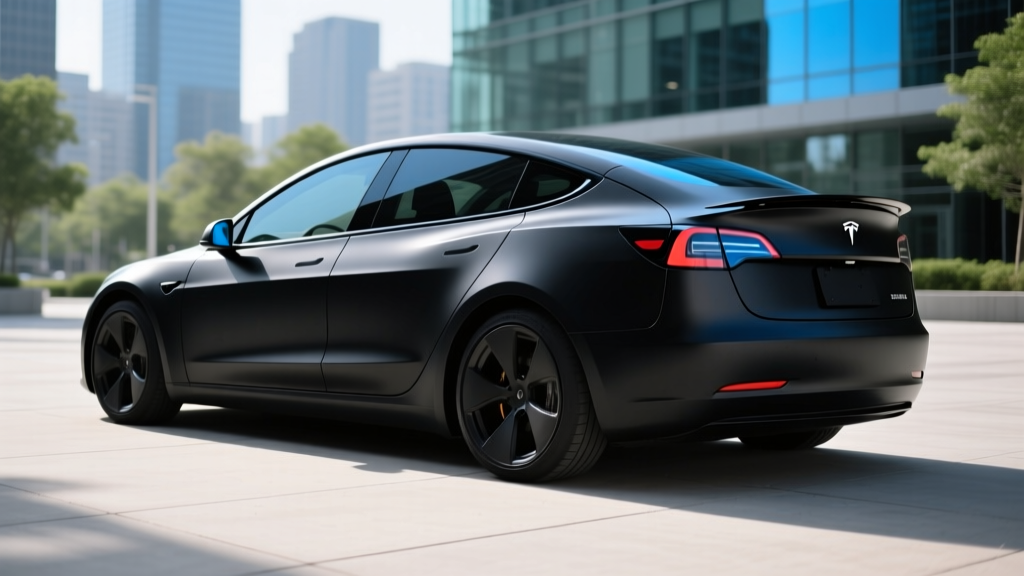
The Tesla Model 3 Highland refresh brought sharper styling, a quieter cabin, and improved suspension tuning — but the factory color palette remains frustratingly limited. That's why Tesla Model 3 matte black builds have become one of the most searched customizations in the EV world. A matte black vinyl wrap transforms the sedan from a subtle commuter into something that rivals the visual aggression of a BMW M3 or Mercedes AMG — while retaining the efficiency, charging network access, and software ecosystem that make the Model 3 a rational purchase.
This review covers the 2026 Tesla Model 3 lineup end to end — RWD, Long Range AWD, and Performance — with real-world range data, charging curves, pricing after federal tax credits, and everything you need to know before wrapping yours in matte black. We'll also address the practical questions: does a wrap affect resale? Does it interfere with sensors? And what does ownership actually cost over five years?
| Spec | RWD (Standard Range) | Long Range AWD | Performance |
|---|---|---|---|
| EPA Range | 272 mi | 363 mi | 315 mi |
| Battery (usable) | ~57.5 kWh (LFP) | ~75 kWh (NMC) | ~75 kWh (NMC) |
| Horsepower | 271 hp | 346 hp | 510 hp |
| 0–60 mph | 5.8 sec | 4.2 sec | 2.9 sec |
| Drivetrain | RWD (single motor) | AWD (dual motor) | AWD (dual motor) |
| Peak DC Charge Rate | 170 kW | 250 kW | 250 kW |
| 10–80% DC Fast Charge | ~25 min | ~25 min | ~25 min |
| Level 2 Charge Rate | 11.5 kW (~44 mi/hr) | 11.5 kW (~44 mi/hr) | 11.5 kW (~44 mi/hr) |
| MPGe (combined) | 132 MPGe | 125 MPGe | 118 MPGe |
| Base MSRP | $38,990 | $47,740 | $54,990 |
Real-World Range: What the EPA Sticker Doesn't Tell You
The EPA posts a single number on the window sticker, but real-world range varies significantly depending on speed, temperature, and terrain. Here's what we've observed across thousands of miles in the current-generation Model 3 platform:
EPA Range (Long Range AWD): 363 miles
Real-World Highway (70–75 mph, 70°F): ~290–310 miles
Real-World City/Mixed (moderate climate): ~330–350 miles
Cold Weather Highway (30°F or below): ~230–260 miles (30–35% loss)
Source: fueleconomy.gov
The Long Range AWD's 75 kWh NMC pack delivers the best blend of range and performance, but the RWD model's LFP (lithium iron phosphate) chemistry has a different character. LFP batteries tolerate regular 100% charging without accelerated degradation — Tesla actually recommends charging the RWD to 100% at least weekly. That means you get the full 272 EPA miles more often, partially offsetting the smaller pack.
For the Performance trim, expect roughly 260–280 miles in mixed real-world driving. The 20-inch wheels, stickier rubber, and more aggressive powertrain calibration all extract a range penalty versus the Long Range on 18-inch Aero wheels.
Charging Speed: DC Fast, Level 2, and the Supercharger Advantage
Charging speed remains one of the Model 3's strongest selling points, especially now that Tesla's Supercharger network is accessible to other EVs — but Tesla owners still benefit from the most seamless plug-and-charge experience in the industry. No apps to fumble with, no payment screens: plug in, and the car handles billing automatically.
| Charging Level | Power | Miles Added per Hour | Notes |
|---|---|---|---|
| Level 1 (120V outlet) | ~1.4 kW | ~4–5 mi/hr | Emergency/trickle only |
| Level 2 (240V, 48A) | 11.5 kW | ~44 mi/hr | Full charge overnight (~8–9 hrs) |
| DC Fast (V3 Supercharger) | Up to 250 kW (LR/Perf) | ~1,000 mi/hr peak | 10–80% in ~25 min |
| DC Fast (V3 Supercharger) | Up to 170 kW (RWD) | ~700 mi/hr peak | 10–80% in ~25 min |
A critical nuance: kW is power (the rate of charging), while kWh is energy (the battery's total capacity). The Long Range's 75 kWh battery charging at a peak 250 kW does not sustain that rate. The charge curve tapers significantly above 60% state of charge (SoC), and especially above 80%. Plan your road-trip stops to charge from ~10% to ~70% for the fastest sessions — then top off at your destination overnight.
Preconditioning matters. Navigate to a Supercharger using the car's built-in navigation, and the Model 3 will preheat the battery en route, enabling peak charge rates even in cold weather. Arriving at a fast charger without preconditioning can add 5–10 minutes to your session.
The Model 3 uses the NACS (North American Charging Standard) connector natively. This is now the dominant standard in North America, adopted by Ford, GM, Rivian, Volvo, and most other manufacturers. You'll never need an adapter at Superchargers, and CCS-to-NACS adapters are available for Electrify America and other public networks.
Performance and Driving Dynamics
The Highland refresh transformed the Model 3 from a competent but firm-riding sedan into something genuinely refined. Tesla reworked the suspension bushings, added frequency-selective dampers, and applied significantly more sound deadening. The result: a quieter cabin at highway speeds, better bump compliance, and a ride that no longer punishes you on broken pavement.
The Performance trim's 510 hp and 2.9-second 0–60 time put it in supercar territory, but it's the Long Range AWD that hits the sweet spot for most buyers. At 4.2 seconds to 60 mph with 346 hp, it's quick enough to merge onto any freeway with authority, and the dual-motor AWD system provides confident traction in rain and light snow.
Regenerative braking remains strong and predictable, enabling near-one-pedal driving in most conditions. Tesla removed the user-adjustable regen setting several years ago, so you get one calibration — but it's well-tuned and most owners adapt within a day or two.
Matte Black Wrap: Cost, Practicality, and Sensor Considerations
Tesla does not offer a factory matte black paint option. The closest stock color is Solid Black (a glossy metallic), which costs an extra $2,000 at order time. To achieve a true matte black finish, you'll need a vinyl wrap — and the results can be stunning.
Typical full-body matte black wrap costs:
- Budget (economy vinyl, e.g., Avery Dennison Supreme): $2,500–$3,500
- Mid-range (3M 1080/2080 series): $3,500–$5,000
- Premium (XPEL, STEK with self-healing top coat): $5,000–$7,500
A quality wrap typically lasts 5–7 years with proper care. Matte finishes require specific maintenance — no automatic car washes with brushes, no wax or sealants not rated for matte surfaces, and prompt removal of bird droppings or tree sap to prevent staining.
Sensor and camera considerations: The Model 3's Autopilot/FSD camera suite (front bumper, front fenders, B-pillars, rear) should not be covered with vinyl. Professional installers mask around camera housings. Wrap material over a camera lens or ultrasonic sensor (if equipped on older models) will degrade system performance. The Highland refresh eliminated ultrasonic sensors in favor of Tesla Vision (camera-only), so there are fewer obstructions — but cameras must remain completely clear.
Resale impact: A well-executed matte black wrap in good condition can be a selling point for enthusiasts, but some buyers prefer stock paint. Vinyl wraps also protect the original paint underneath, which can be a plus at trade-in time if you remove the wrap before selling.
Pricing, Tax Credits, and Total Cost of Ownership
The 2026 Model 3 lineup starts at $38,990 for the RWD and climbs to $54,990 for the Performance — before incentives. Federal tax credit eligibility under IRS §30D is one of the most important financial factors, but the rules are specific and not every buyer qualifies.
| Trim | Base MSRP | §30D Credit (max) | Effective Price (if eligible) |
|---|---|---|---|
| RWD (Standard Range) | $38,990 | Up to $7,500 | ~$31,490 |
| Long Range AWD | $47,740 | Up to $7,500 | ~$40,240 |
| Performance | $54,990 | Up to $7,500 | ~$47,490 |
Key §30D eligibility requirements (current-year rules, always verify at irs.gov):
- MSRP cap: Sedans must be at or below $55,000. The RWD and Long Range qualify; the Performance at $54,990 squeaks under the cap but adding options like FSD or premium wheels can push it over.
- Buyer income cap: Modified AGI must not exceed $150,000 (single), $225,000 (head of household), or $300,000 (joint).
- Battery sourcing: Critical minerals and battery components must meet phased-in domestic-content and FEOC (foreign entity of concern) thresholds. Tesla's supply chain has adapted, but partial credit ($3,750) is possible if only one of the two sourcing requirements is met.
- Point-of-sale transfer: As of 2024, you can transfer the credit to the dealer at purchase, reducing your out-of-pocket cost immediately rather than waiting for tax filing.
Consult a tax professional to confirm your individual eligibility — state-level incentives (California's CVRP, Colorado's innovative motor vehicle credit, etc.) may stack on top.
Interior, Cargo, and Tech: What You Live With Daily
The Model 3's minimalist interior is polarizing but functional. Everything routes through the 15.4-inch center touchscreen: climate controls, glovebox release, mirror adjustment, and the ambient lighting bar that replaced physical vents in the Highland redesign. Rear passengers now get their own 8-inch touchscreen for climate and media — a meaningful upgrade over the previous generation.
Dimensions:
- Cargo volume (trunk + frunk): 23 cu ft total (21 cu ft trunk, ~2 cu ft frunk)
- Front legroom: 42.3 inches
- Rear legroom: 35.3 inches
- Front headroom: 40.3 inches
- Rear headroom: 37.8 inches
Rear seat space is adequate for adults under 6 feet but tight for taller passengers on longer trips. The trunk is wide and deep, with a 60/40 split-folding rear seat that accommodates long items like skis or furniture. The frunk (front trunk) is small — useful for charging cables and a laptop bag, not much more.
Tech highlights:
- 15.4" center touchscreen with excellent responsiveness and regular OTA updates
- Native navigation with real-time Supercharger routing and preconditioning
- Sentry Mode (360° dashcam recording while parked)
- Phone-as-key with Bluetooth proximity unlock
- Over-the-air software updates that add features monthly
- Available Full Self-Driving (Supervised) — see ADAS note below
ADAS Level Clarification: Tesla Autopilot and Full Self-Driving (Supervised) are SAE Level 2 driver-assistance systems. You must remain attentive, keep your hands available, and be prepared to take over at any moment. These are not self-driving systems. Only Level 4 services like Waymo operate without a human driver in defined geographic zones.
Warranty, Reliability, and Long-Term Battery Outlook
Tesla's warranty structure is competitive with the broader EV market:
- Basic vehicle warranty: 4 years / 50,000 miles
- Battery & drive unit (RWD): 8 years / 100,000 miles
- Battery & drive unit (Long Range & Performance): 8 years / 120,000 miles
- Battery capacity retention threshold: 70% of original capacity during warranty period
The LFP battery in the RWD model is expected to show slower degradation over time compared to NMC — LFP chemistry typically retains 90%+ capacity after 1,000 full charge cycles, which translates to well over 200,000 miles. NMC packs in the Long Range and Performance also perform well, with fleet data showing most Model 3s retaining 85–90% capacity at 100,000 miles.
Out-of-warranty battery replacement currently runs $12,000–$16,000 depending on the pack, though prices continue to decline as battery manufacturing scales. For most owners, the battery will outlast the car's useful life.
Tesla Model 3 Matte Black: Pros, Cons, and the Verdict
Pros
- Class-leading Supercharger network access with NACS native connector
- Excellent real-world efficiency (25–27 kWh/100 mi highway)
- Highland refresh delivers dramatically improved ride and cabin quietness
- Over-the-air updates continuously add features and refinements
- Strong resale value relative to non-Tesla EVs
- Matte black wrap creates a one-of-a-kind visual statement
- Up to $7,500 federal tax credit on RWD and Long Range trims
Cons
- Minimalist interior frustrates some buyers (no physical buttons, no instrument cluster)
- Rear seat headroom tight for taller passengers
- FSD (Supervised) subscription adds $99/mo or $8,000 outright for Level 2 assist
- Matte black wrap requires careful maintenance and $2,500–$7,500 upfront
- No Apple CarPlay or Android Auto (Tesla's native OS only)
- Insurance costs run 15–25% higher than comparable gas sedans
Who Should Buy the Tesla Model 3 (and Wrap It Matte Black)?
The Model 3 remains the default recommendation for tech-forward commuters and road-trippers who value charging infrastructure above all else. If your daily drive is under 80 miles round-trip with home charging, even the RWD at 272 EPA miles is more than sufficient — and at ~$31,500 after the federal credit, it's one of the best EV values available.
The Long Range AWD is the sweet spot for road-trippers and cold-climate buyers who need the range buffer and dual-motor traction. The Performance is a thrill machine but trades range and value for 2.9-second sprints.
Adding a matte black wrap makes sense if you plan to keep the car 4+ years, want paint protection, and enjoy a vehicle that turns heads without shouting. Budget $3,500–$5,000 for a quality mid-range wrap from a reputable installer, and factor in hand-wash-only maintenance.
Choose the RWD if: You commute under 80 miles daily, charge at home, want the lowest price, and prefer LFP longevity.
Choose the Long Range AWD if: You road-trip regularly, live in a cold climate, or want the maximum range buffer and AWD traction.
Choose the Performance if: You want supercar acceleration, track-day capability, and don't mind the range and price trade-off.
Wrap it matte black if: You want a unique, head-turning look, plan to keep the car long-term, and are willing to maintain the wrap properly.
What is the real-world range of the Tesla Model 3?
The Long Range AWD achieves roughly 290–310 miles on the highway at 70–75 mph in moderate temperatures, and 330–350 miles in mixed city/suburban driving. Cold weather (below 30°F) can reduce highway range by 30–35%. The RWD delivers ~220–240 real-world highway miles, and the Performance roughly 260–280 miles mixed.
How fast does the Tesla Model 3 charge?
The Long Range and Performance models peak at 250 kW on V3 Superchargers, reaching 10–80% in approximately 25 minutes with battery preconditioning. The RWD peaks at 170 kW with similar 10–80% times. Home Level 2 charging at 11.5 kW adds roughly 44 miles per hour, fully replenishing the battery overnight.
Does the Tesla Model 3 qualify for the federal EV tax credit?
The RWD ($38,990) and Long Range AWD ($47,740) both fall under the $55,000 MSRP cap for sedans. The Performance at $54,990 is borderline — adding options may push it over. Buyer income must be under $150K (single) / $300K (joint), and battery sourcing requirements must be met. Always verify current rules at IRS.gov before purchasing.
How much does a matte black wrap cost on a Tesla Model 3?
A professional full-body matte black vinyl wrap typically costs $2,500–$5,000 for mid-range materials (3M 2080 series), or $5,000–$7,500 for premium self-healing films (XPEL, STEK). Installation takes 2–4 days. Budget for hand-wash-only maintenance and expect 5–7 years of lifespan.
Is the Tesla Model 3 worth buying over competitors?
Against the Hyundai Ioniq 6, BMW i4, and Polestar 2, the Model 3 wins on Supercharger network access, software integration, and efficiency. The Ioniq 6 offers comparable range and faster 800V charging on non-Tesla networks. The BMW i4 provides a more traditional luxury interior. The Model 3 remains the best all-around value if charging convenience and tech are your priorities.
Does a vinyl wrap interfere with Tesla's cameras or Autopilot?
Not when installed correctly. Professional wrap installers mask around all camera housings (front bumper, fenders, B-pillars, rear). The current Model 3 Highland uses Tesla Vision (camera-only, no ultrasonic sensors), so there are fewer obstructions — but every camera lens must remain completely uncovered for Autopilot and FSD to function properly.