Quick Verdict: The Benchmark Compact EV Sedan
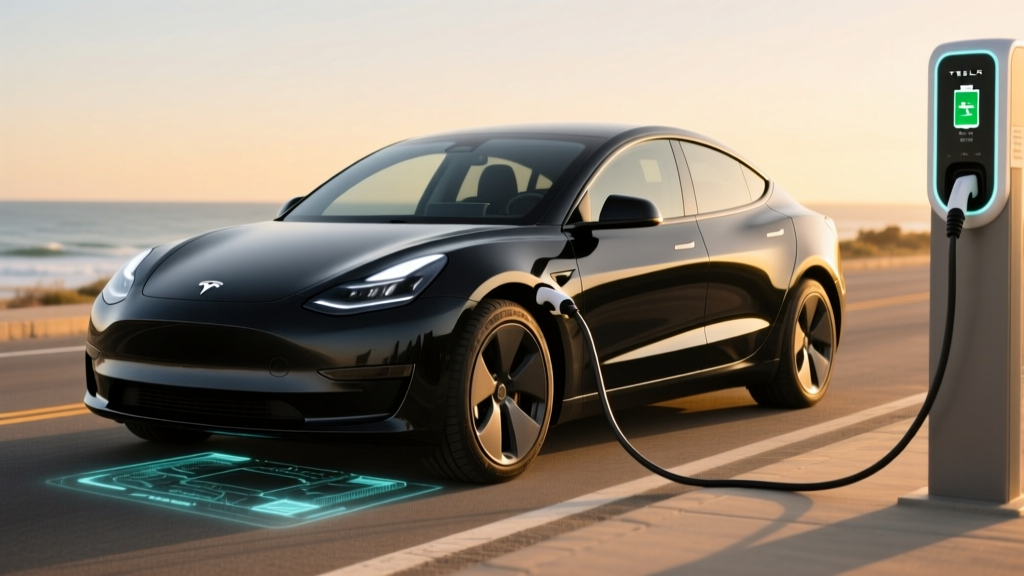
The Tesla Model 3 Long Range AWD remains the default recommendation for buyers seeking a premium electric sedan under $50,000. With an EPA-estimated 363 miles of range, a mature Supercharger network, and class-leading efficiency, it sets the bar that competitors like the Hyundai Ioniq 6 and BMW i4 struggle to match on total value. The 2026 model year carries forward the "Highland" refresh architecture introduced in late 2023, with incremental software and efficiency refinements rather than a full redesign.
This isn't a perfect car — the minimalist interior polarizes, the ride is firm, and Tesla's body-panel quality still trails legacy automakers. But if your priorities are range, charging speed, and over-the-air updates that keep the car feeling current, the Model 3 Long Range earns its reputation.
Range, Battery & Efficiency: The Numbers That Matter
| Spec | 2026 Model 3 Long Range AWD |
|---|---|
| EPA Range | 363 miles |
| Battery (usable) | ~79 kWh (NMC chemistry) |
| Efficiency | 132 MPGe combined / 25 kWh/100mi |
| Drivetrain | Dual-motor AWD |
| Horsepower | ~384 hp combined |
| 0–60 mph | 4.2 seconds |
| Top Speed | 125 mph |
The EPA's 363-mile figure assumes a mix of city and highway driving at moderate temperatures. In our experience and consistent with third-party testing, expect approximately 300–320 miles on a sustained highway trip at 70–75 mph, and 250–280 miles in freezing weather (below 32°F) due to battery heating demands and cabin climate load. City driving with regenerative braking can actually exceed the EPA number, occasionally reaching 370+ miles in mild conditions.
The Long Range uses NMC (nickel manganese cobalt) cell chemistry, which offers higher energy density than the LFP cells in the base RWD Model 3 but requires more careful state-of-charge management — Tesla recommends daily charging to 80% and 100% only for trips.
Efficiency is where Tesla's engineering advantage shows. At roughly 25 kWh per 100 miles, the Model 3 Long Range sips electrons compared to rivals: the Ioniq 6 SE Long Range returns about 27 kWh/100mi, and the BMW i4 eDrive40 sits around 30 kWh/100mi. That efficiency gap translates directly into more miles per charging session and lower electricity costs over time. Source: fueleconomy.gov.
Charging Speed: DC Fast, Level 2 & Home Setup
| Charging Level | Power / Rate | Speed (approx.) |
|---|---|---|
| DC Fast Charge (peak) | 250 kW (CCS via NACS adapter or native NACS at V4 Superchargers) | 10–80% in ~25 min |
| DC Fast Charge (sustained avg.) | ~170 kW average to 80% | ~180 miles added in 15 min |
| Level 2 (240V / 48A) | 11.5 kW | ~44 miles per hour of charging |
| Level 2 (240V / 32A Mobile Connector) | 7.7 kW | ~30 miles per hour |
| Level 1 (120V) | ~1.4 kW | ~4–5 miles per hour |
DC Fast Charging Deep-Dive: The Model 3 Long Range peaks at 250 kW on V3 and V4 Tesla Superchargers (and compatible CCS stations via the included NACS-to-CCS adapter). However, peak rate is not sustained rate. The charge curve tapers noticeably above 50% state-of-charge, dropping to roughly 100 kW by 70% and below 50 kW past 85%. The practical 10–80% time is approximately 25 minutes under ideal conditions (battery preconditioned via navigation routing to the charger).
Preconditioning matters. If you navigate to a Supercharger using the car's built-in navigation, the battery thermal management system begins warming the pack 10–20 minutes before arrival. Without preconditioning — for example, pulling into a charger after the car has been parked cold — peak charge rates can drop by 30–50% for the first several minutes.
Home Charging: Tesla's Wall Connector ($420) delivers up to 48 amps (11.5 kW) on a 60-amp circuit, adding roughly 44 miles of range per hour. A full overnight charge from 20% to 80% takes about 4.5 hours. Installation costs typically range from $500 to $2,000 depending on panel proximity and whether your home needs a service upgrade. We recommend a licensed electrician evaluate your panel capacity before purchasing any Level 2 equipment.
Performance & Driving Dynamics
The dual-motor AWD powertrain delivers 384 combined horsepower and launches the Model 3 Long Range to 60 mph in 4.2 seconds. That's genuinely quick for a sedan in this price class — quicker than a BMW 330i and only a half-second behind the Porsche Taycan base model.
Ride quality improved meaningfully with the Highland refresh: new frequency-selective dampers absorb sharp impacts better than the pre-2024 Model 3, though the overall tuning remains firm compared to a Hyundai Ioniq 6 or Toyota Camry. Road noise is noticeably reduced thanks to acoustic glass and additional insulation, bringing the cabin closer to luxury-sedan quietness.
Regenerative braking remains strong and predictable. Tesla removed the user-adjustable regen setting years ago, so one-pedal driving is the default behavior — lift off the accelerator and the car decelerates assertively. Most EV owners adapt within a week and prefer it, but if you want a coasting feel, this isn't the car for you.
Handling is a genuine strength. The low center of gravity, precise steering, and well-managed body roll make the Model 3 one of the most engaging EVs to drive on a canyon road. The trade-off is that ride comfort over broken pavement still trails comfort-oriented competitors.
Interior, Cargo & Technology
Dimensions:
- Front legroom: 42.2 inches
- Rear legroom: 35.3 inches
- Cargo volume (rear trunk): 21.0 cu ft
- Front trunk (frunk): 3.1 cu ft
- Total cargo: 24.1 cu ft
The Model 3's interior follows Tesla's ultra-minimalist philosophy: a single 15.4-inch center touchscreen controls virtually everything, including climate vents (adjusted by swiping on-screen), mirror positioning, and glovebox release. The 2026 model retains the rear 8-inch touchscreen for rear-seat passengers, added with the Highland refresh, which handles climate and entertainment.
Build quality has improved substantially since the Fremont factory's early days. Panel gaps are tighter, materials are soft-touch where they matter, and the ventilated front seats with premium upholstery are genuinely comfortable for long drives. However, some competitors — notably the Genesis Electrified G80 and even the Ioniq 6 — offer more traditional luxury cues like physical buttons, ambient lighting variety, and richer material textures.
Standout Tech:
- Tesla Supercharger Network: 60,000+ global connectors with industry-leading reliability and plug-and-charge simplicity. Now opening to other brands via adapters, but Tesla owners still get the most seamless experience.
- Over-the-Air Updates: Tesla pushes meaningful software updates monthly — new features, efficiency improvements, UI refinements — keeping older cars feeling current.
- Sentry Mode & Dashcam: Built-in camera system records surroundings when parked and captures driving footage, with no aftermarket hardware needed.
- Tesla App Integration: Remote preconditioning, location tracking, service scheduling, and phone-as-key functionality are best-in-class.
Notable Drawbacks:
- No physical instrument cluster — speed and navigation info appear on the left third of the center screen
- Turn signal buttons on the steering wheel (replacing the traditional stalk) remain divisive
- No Apple CarPlay or Android Auto — Tesla's native infotainment is the only option
- Rear visibility is compromised by the sloping roofline; the backup camera is essential
Pricing, Trims & Federal Tax Credit Eligibility
| Trim | MSRP | Est. After §30D Credit |
|---|---|---|
| Model 3 Long Range AWD | $47,740 | ~$40,240* |
| Model 3 Performance AWD | $54,990 | ~$47,490* |
*Destination fee ($1,390) included in MSRP. Tax credit estimates assume full eligibility — see below.
Federal Tax Credit (§30D) Eligibility: The Model 3 Long Range AWD currently qualifies for the full $7,500 federal tax credit when purchased new, provided the buyer meets IRS requirements. As of 2026, the key rules are:
- MSRP Cap: Sedan MSRP must not exceed $55,000 — the Long Range at $47,740 clears this easily; the Performance at $54,990 also qualifies.
- Buyer Income Cap: Modified AGI must not exceed $150,000 (single), $225,000 (head of household), or $300,000 (joint filers).
- Battery Sourcing: Critical minerals and battery components must meet escalating domestic-content thresholds. Tesla's US-built battery packs currently satisfy these requirements. Rules tighten annually — verify at IRS.gov before purchasing.
- Point-of-Sale Transfer: Buyers can transfer the credit to the dealer at purchase, reducing the out-of-pocket price immediately rather than waiting for a tax refund.
We recommend consulting a tax professional to confirm eligibility, as rules are subject to change and individual circumstances vary. State and local incentives (such as California's CVRP or Colorado's $5,000 credit) may stack on top — check your state energy office for current programs.
Warranty & Long-Term Ownership
Warranty Coverage:
- Basic Vehicle: 4 years / 50,000 miles
- Battery & Drive Unit: 8 years / 120,000 miles (whichever comes first), with minimum 70% capacity retention guaranteed
Tesla's battery warranty is competitive with the industry standard (Hyundai offers 10yr/100,000mi; most others match 8yr/100,000–120,000mi). Real-world data from Teslas with 150,000+ miles shows NMC battery degradation typically levels off around 10–15% loss after the first 50,000 miles, meaning most owners retain 85–90% of original range through year eight. Following Tesla's recommended 80% daily charge limit and avoiding frequent 100% charges or DC fast-charging from very low states of charge helps maximize longevity.
Maintenance costs are minimal — no oil changes, no transmission fluid, no spark plugs. Expect to replace cabin air filters ($40–$80 DIY), wiper fluid, and tires (EVs wear tires faster due to weight and instant torque; budget $800–$1,200 for a set of four every 30,000–40,000 miles).
Insurance premiums tend to run 15–25% higher than comparable gas sedans due to repair costs and Tesla's integrated body construction. Get quotes before purchasing — we've seen annual premiums ranging from $1,800 to $3,200 depending on driver profile and location.
Pros
- Class-leading 363-mile EPA range with outstanding efficiency
- Access to Tesla Supercharger network — the most reliable DC fast-charging infrastructure
- Strong performance: 4.2-sec 0–60, sharp handling
- Continuous OTA updates add features years after purchase
- Full $7,500 federal tax credit eligibility
- Best-in-class app integration and phone-as-key experience
Cons
- Minimalist interior lacks physical controls — not for everyone
- No Apple CarPlay / Android Auto support
- Firm ride quality compared to comfort-oriented rivals
- Rear-seat headroom limited by sloping roofline
- Insurance costs higher than segment average
- Turn-signal buttons on steering wheel take adjustment
Who Should Buy the Model 3 Long Range?
Choose the Model 3 Long Range if:
- You want maximum range in a compact sedan for road trips and commuting
- You value Supercharger network access for hassle-free long-distance travel
- You prefer a sporty, engaging driving experience over plush ride comfort
- You're comfortable with touchscreen-centric controls and no CarPlay
- You qualify for the $7,500 federal credit, bringing effective price below $41,000
Look elsewhere if:
- You need a spacious rear seat for adults (consider the Hyundai Ioniq 6 or Tesla Model Y)
- You want physical buttons, a traditional instrument cluster, or Apple CarPlay (try the BMW i4 or Polestar 2)
- You prioritize ride comfort over handling (the Genesis GV60 or Ioniq 6 are softer)
- You need hatchback/crossover cargo flexibility (the Model Y offers 30+ cu ft)
Frequently Asked Questions
What is the real-world range of the Tesla Model 3 Long Range?
The EPA rates it at 363 miles, but real-world highway driving at 70–75 mph typically yields 300–320 miles. In cold weather (below freezing), expect 250–280 miles. City driving with regenerative braking can sometimes exceed the EPA figure in mild temperatures.
How fast does the Model 3 Long Range charge?
On a V3/V4 Tesla Supercharger or compatible 250 kW DC fast charger, the 10–80% charge takes approximately 25 minutes with a preconditioned battery. At home on a 48-amp Level 2 charger (11.5 kW), you'll add about 44 miles of range per hour, or a full 20–80% charge in roughly 4.5 hours.
Does the Model 3 Long Range qualify for the $7,500 federal tax credit?
Yes, as of 2026, the Model 3 Long Range AWD qualifies for the full $7,500 §30D credit, provided the buyer's income is under the IRS thresholds ($150K single / $300K joint) and the vehicle's battery sourcing meets current domestic-content rules. The credit can be applied at the point of sale, reducing your purchase price immediately. Always verify current eligibility at IRS.gov before committing.
Is the Model 3 Long Range worth it vs. the Hyundai Ioniq 6 or BMW i4?
The Model 3 wins on range (363 vs. 361 for the Ioniq 6, 301 for the i4), Supercharger network access, and software experience. The Ioniq 6 offers a more traditional interior, physical buttons, and slightly softer ride. The BMW i4 delivers premium materials and CarPlay but sacrifices ~60 miles of range and costs more. For most buyers prioritizing range and charging convenience, the Model 3 Long Range remains the strongest overall value.
How long will the battery last?
Tesla warranties the battery for 8 years / 120,000 miles with at least 70% capacity retention. Real-world fleet data suggests NMC batteries in the Model 3 degrade roughly 10–15% over the first 50,000 miles, then plateau. With proper care (80% daily charge limit, moderate fast-charging frequency), most owners retain 85%+ of original range through year eight and beyond.
Is Tesla Autopilot self-driving?
No. Tesla Autopilot and Full Self-Driving (Supervised) are SAE Level 2 driver-assistance systems — the driver must remain fully attentive, keep hands on the wheel, and be prepared to take over at any moment. No consumer Tesla vehicle is a self-driving car. FSD adds features like automatic lane changes and traffic-light recognition, but it does not remove driver responsibility.