Quick Verdict: Is Tesla Model 3 Leasing Smart in 2026?
The Tesla Model 3 remains the benchmark compact electric sedan, and leasing one in 2026 can be a strategic move — especially if you want the latest Highland-refresh tech without long-term depreciation risk. With a starting MSRP around $38,990 for the rear-wheel-drive (RWD) trim and up to 363 miles of EPA range on the Long Range AWD variant, the Model 3 delivers efficiency and charging speed that still lead the segment. But leasing also means navigating Tesla's unique approach to the federal §30D tax credit, real-world range that falls short of the sticker in cold weather, and a minimalist interior that polarizes buyers. Here's everything you need to decide.
2026 Tesla Model 3: Core Specs at a Glance
| Spec | RWD (Base) | Long Range AWD | Performance AWD |
|---|---|---|---|
| EPA Range | 272 mi | 363 mi | 315 mi |
| Battery Capacity (usable) | ~57.5 kWh (LFP) | ~75 kWh (NMC) | ~75 kWh (NMC) |
| Drivetrain | Rear-Wheel Drive | Dual Motor AWD | Dual Motor AWD |
| Horsepower | 271 hp | 346 hp | ~510 hp |
| 0–60 mph | 5.8 sec | 4.2 sec | 2.9 sec |
| Peak DC Fast Charge | 170 kW | 250 kW | 250 kW |
| 10–80% DC Fast Charge | ~25 min | ~20 min | ~20 min |
| Level 2 Home Charge Rate | 11.5 kW (~37 mi/hr) | 11.5 kW (~37 mi/hr) | 11.5 kW (~37 mi/hr) |
| MPGe (combined) | 142 MPGe | 132 MPGe | 118 MPGe |
| Base MSRP | $38,990 | $47,740 | $54,990 |
| Battery Warranty | 8 yr / 100,000 mi | 8 yr / 120,000 mi | 8 yr / 120,000 mi |
Real-World Range: What the EPA Sticker Doesn't Tell You
RWD (EPA 272 mi): Expect ~230–250 mi on highway trips at 70+ mph. In freezing temperatures (below 32°F), plan for 180–210 mi.
Long Range AWD (EPA 363 mi): Real-world highway driving yields ~300–320 mi. Cold weather drops this to ~250–280 mi.
Performance AWD (EPA 315 mi): Aggressive driving and 20" wheels reduce practical range to ~250–275 mi highway.
The Model 3's EPA numbers are among the best in the segment, but as with every EV, your actual range depends heavily on driving style, speed, and temperature. The RWD trim uses an LFP (lithium iron phosphate) battery, which tolerates daily 100% charging without degradation concerns — a real advantage for commuters. The trade-off is lower energy density, meaning fewer total miles per charge. The Long Range and Performance trims use NMC (nickel manganese cobalt) chemistry for greater range but recommend daily charging to 80–90% for longevity, reserving 100% for road trips.
According to fueleconomy.gov, the RWD Model 3 achieves 142 MPGe combined (25 kWh/100 mi), making it one of the most energy-efficient EVs sold in the U.S. The Long Range AWD comes in at 132 MPGe combined. For context, that translates to roughly 3–4 miles per kWh of electricity — exceptional efficiency that keeps charging costs low whether you're plugging in at home or paying at a public DC fast charger.
Charging Speed: DC Fast, Level 2, and the Charge Curve Reality
| Charging Method | Max Power (kW) | Miles Added per Hour | Notes |
|---|---|---|---|
| Level 1 (120V household) | ~1.4 kW | ~4–5 mi/hr | Emergency/trickle only |
| Level 2 (240V home, 48A) | 11.5 kW | ~37 mi/hr | Full charge overnight (~8–9 hrs) |
| DC Fast Charge (RWD) | 170 kW peak | ~150 mi in 15 min | Tapers significantly above 80% |
| DC Fast Charge (LR/Perf) | 250 kW peak | ~200 mi in 15 min | Peak rate sustained only to ~50% SoC |
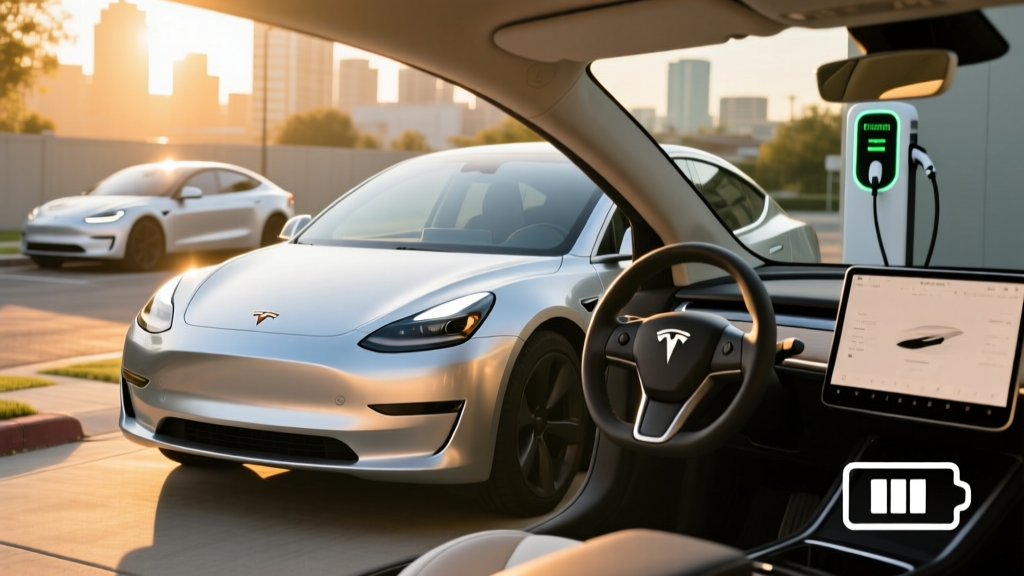
Tesla's Supercharger network remains the gold standard for public charging reliability, and the Model 3's native NACS connector gives you seamless access to over 20,000 Supercharger stalls nationwide. The Long Range and Performance trims peak at 250 kW at V3 and V4 Superchargers, but understand that this is a peak rate — not sustained. The charge curve tapers progressively: you'll see 250 kW from roughly 10–30% state of charge, dropping to ~150 kW by 50%, and falling below 50 kW once you pass 80%. This is why Tesla (and every EV maker) quotes 10–80% charge times rather than 0–100%.
For home charging, a Level 2 wall connector on a 60-amp circuit delivers 48 amps / 11.5 kW, adding roughly 37 miles of range per hour. Most owners plug in overnight and wake to a full battery. A professional installation typically runs $500–$2,000 depending on your panel capacity and run distance from the breaker box to the garage. If your home has a 200-amp electrical panel with available capacity, installation is straightforward. Older homes with 100-amp panels may need a $1,500–$3,000 panel upgrade.
Starting in 2025, Tesla also opened its Supercharger network to non-Tesla EVs via a built-in adapter or Magic Dock. For Model 3 owners, this means the network you already use natively is expanding in revenue and stall count — a long-term reliability positive.
Interior, Tech, and the Minimalist Cabin
The refreshed Model 3 (internally called "Highland") brought meaningful improvements to ride quality, cabin noise, and materials. Acoustic glass all around, revised suspension bushings, and a rear subframe redesign cut road noise substantially compared to pre-2024 models. The 15.4-inch center touchscreen handles nearly all vehicle controls — there are no physical stalks for turn signals (they're on the steering wheel) and no instrument cluster behind the wheel.
Standout tech features:
- Tesla Autopilot (included): Adaptive cruise control and lane-keeping on highways. This is SAE Level 2 — you must keep hands on the wheel and eyes on the road.
- Full Self-Driving Supervised ($8,000 option or $99/mo): Adds automatic lane changes, traffic light/stop sign recognition, and Navigate on Autopilot. Still Level 2 — not autonomous.
- Ventilated front seats (new for Highland refresh), ambient lighting, and a rear 8-inch touchscreen for passengers.
- Over-the-air updates that periodically add features and refine existing ones.
Notable drawbacks:
- No physical turn-signal stalks — steering-wheel buttons take adjustment and frustrate some drivers, especially in roundabouts.
- No Apple CarPlay or Android Auto — Tesla's native infotainment only.
- Rear seat legroom (35.3 inches) is adequate but trails the Hyundai Ioniq 6 (38.4 inches rear legroom).
- No heads-up display.
Cargo Space and Practicality
The Model 3 offers 23 cubic feet of cargo volume with the rear seats up (trunk plus front trunk/frunk). The trunk opening is narrower than a hatchback or liftback, which limits what you can load. Folding the 60/40 rear seat expands capacity for longer items, but if you regularly haul bulky cargo, the Model Y's hatchback form factor (30 cu ft behind the rear seats) is meaningfully more practical.
Front legroom is generous at 42.3 inches. Headroom is comfortable for most adults, though the panoramic glass roof (now with a slightly tinted Highland panel) can make the cabin feel warm in direct summer sun — the included sunshade helps.
Leasing the Model 3: Pricing, Tax Credits, and Monthly Costs
| Factor | RWD Lease (est.) | RWD Purchase |
|---|---|---|
| Base MSRP | $38,990 | $38,990 |
| Federal §30D Credit (if eligible) | Passed through as lease discount* | Up to $7,500 (point-of-sale) |
| Estimated Monthly Payment (36 mo, $4,500 down) | ~$349–$429/mo | ~$540/mo (financed at 6.5%) |
| End of Term | Return or buy at residual | You own the vehicle |
| Mileage Limit | Typically 10,000–12,000 mi/yr | Unlimited |
*Under IRS rules, EV leases are structured as commercial loans to the leasing company (the lessor), which claims the §30D credit and may pass savings to you as a "lease cash" reduction — often called a capitalized cost reduction. This is sometimes referred to as the "lease loophole," because the income caps and MSRP caps that apply to purchases do not strictly apply to the lessor's credit claim. However, whether Tesla passes the full $7,500 through varies by promotion and month. Always confirm the exact lease terms and credit pass-through before signing.
Federal §30D Tax Credit Eligibility for Purchase (not lease):
- MSRP cap: Sedans must be $55,000 or less (the Model 3 RWD and Long Range qualify; the Performance at $54,990 just clears the cap).
- Buyer income cap: Modified AGI ≤ $150,000 (single), $225,000 (head of household), $300,000 (joint).
- Battery sourcing: Critical minerals and battery components must meet escalating domestic-content thresholds per IRS guidelines. Tesla has shifted significant battery supply to U.S. and FTA-partner sources, but exact eligibility can change — verify on the IRS qualified vehicles list at the time of purchase.
- Point-of-sale transfer: You can transfer the credit to the dealer at purchase, reducing your out-of-pocket cost immediately rather than waiting for tax filing.
Pros and Cons of Leasing a Tesla Model 3
- Best-in-class efficiency (142 MPGe combined, RWD)
- Supercharger network access — the most reliable DC fast-charging ecosystem in the U.S.
- Highland refresh: significantly quieter, better ride quality than pre-2024 models
- Over-the-air updates keep software current
- LFP battery (RWD) allows daily 100% charging without degradation worry
- Strong safety ratings — NHTSA 5-star, IIHS Top Safety Pick+
- Low operating costs: ~$0.04–$0.06 per mile on home electricity vs ~$0.12–$0.15 for gas
- No physical turn-signal stalks — steep learning curve for some
- Lease mileage penalties if you exceed 10K–12K mi/yr
- No CarPlay/Android Auto — Tesla-only ecosystem
- Rear seat space trails Ioniq 6 and some rivals
- Narrow trunk opening limits cargo versatility
- FSD ($8,000 or $99/mo) remains Level 2 despite the "Full Self-Driving" name
- Tesla's lease residual values can make end-of-lease buyout expensive if market shifts
How the Model 3 Compares to Key Rivals
If you're cross-shopping, here's how the Model 3 stacks up against its main competitors in 2026:
- Hyundai Ioniq 6: More rear legroom, CarPlay support, and a similarly sleek design. Range tops out at 361 mi (SE Long Range RWD). DC charging peaks at ~240 kW with an 800V architecture that sustains high rates well. But the Supercharger network advantage still favors Tesla for road-trip convenience.
- BMW i4 eDrive40: Premium interior and traditional driving dynamics, but starts ~$57,000 and delivers 301 mi of range. More expensive per mile of range than the Model 3.
- Polestar 2: Strong build quality and Google-based infotainment with CarPlay, but range maxes at ~320 mi and DC charging peaks at 205 kW. Smaller service network.
Choose the Model 3 if: You prioritize charging network reliability, efficiency, and tech-forward features — and you're comfortable with Tesla's minimalist controls.
Choose the Ioniq 6 if: Rear-seat space, CarPlay, and a more conventional cabin layout matter to you.
Choose the BMW i4 if: You want a luxury badge, premium materials, and traditional driving feel and are willing to pay for it.
Who Should Lease the Tesla Model 3?
The Model 3 is best suited for:
- Daily commuters who can charge at home and want minimal running costs. The RWD's 272-mi range covers virtually any commute with margin to spare.
- Tech enthusiasts who value OTA updates, Tesla's app integration, and the Supercharger ecosystem.
- Lessee who want a 2–3 year commitment without long-term depreciation risk — especially relevant as EV pricing and battery tech continue to evolve rapidly.
It's less ideal for:
- Families needing rear-seat space — the Model Y or Ioniq 5 are better choices for child seats and cargo.
- High-mileage drivers — typical lease limits of 10,000–12,000 mi/yr can be restrictive. If you drive 20,000+ miles annually, buying is usually cheaper.
- Frequent road-trippers in cold climates — while the Supercharger network is excellent, cold-weather range loss of 25–35% on the RWD LFP model means more frequent stops on winter highway drives.
Frequently Asked Questions
What is the real-world range of the Tesla Model 3?
The EPA rates the RWD at 272 miles, the Long Range AWD at 363 miles, and the Performance at 315 miles. In real-world highway driving at 70–75 mph, expect roughly 230–250 mi (RWD), 300–320 mi (Long Range), and 250–275 mi (Performance). Cold weather below freezing reduces these figures by 20–35%, depending on whether you precondition the battery and use seat heaters vs. cabin heat.
How fast does the Model 3 charge at home and on the road?
At home on a Level 2 (240V, 48A) charger, the Model 3 charges at up to 11.5 kW, adding about 37 miles of range per hour — a full overnight charge takes 7–9 hours. On DC fast chargers, the Long Range and Performance peak at 250 kW, going from 10–80% in roughly 20 minutes. The RWD peaks at 170 kW with a 10–80% time around 25 minutes. Actual speeds depend on battery temperature (preconditioning helps), state of charge, and charger capability.
Does the Tesla Model 3 qualify for the federal EV tax credit?
For purchase, the Model 3 RWD ($38,990) and Long Range ($47,740) fall under the $55,000 MSRP sedan cap. Eligibility depends on your income (≤$150K single / $300K joint), and the vehicle's battery must meet current-year critical-mineral and component sourcing thresholds per the IRS §30D rules. For leases, the leasing company claims the commercial clean vehicle credit (§45W), and savings may be passed to you as a capitalized cost reduction — but this is not guaranteed and varies by Tesla's current lease promotions.
Is leasing the Model 3 better than buying?
Leasing makes sense if you want lower monthly payments, plan to drive under 12,000 miles per year, and prefer upgrading every 3 years without worrying about EV depreciation. Buying makes more sense if you drive high miles, want to keep the car long-term, or plan to capture the full §30D point-of-sale credit on a purchase. Run the numbers: a 36-month lease at ~$399/mo with $4,500 down costs roughly $18,864 over three years. Buying at $38,990 with a $7,500 credit brings the net price to $31,490 — and you own an asset (albeit a depreciating one).
What are the biggest drawbacks of the Model 3?
The most common complaints are the lack of physical turn-signal stalks, no Apple CarPlay or Android Auto, a relatively tight rear seat (35.3 inches of legroom), and the narrow trunk opening. The "Full Self-Driving" package, despite its name, is SAE Level 2 driver assistance — it does not make the car autonomous, and you must remain fully engaged at all times.
How does the Model 3's warranty compare?
Tesla covers the battery and drive unit for 8 years / 100,000 miles on the RWD and 8 years / 120,000 miles on Long Range and Performance trims, with a minimum 70% capacity retention guarantee. The basic vehicle limited warranty is 4 years / 50,000 miles. This battery warranty is competitive with Hyundai's 10-year/100,000-mile battery coverage but in line with most premium EV makers. According to NHTSA, the Model 3 carries a 5-star overall safety rating.