The Quick Verdict on Leasing a Tesla Model 3
If you want access to the Supercharger network, industry-leading efficiency, and Tesla's software ecosystem without committing to long-term ownership, a Tesla Model 3 lease can be a strategic entry point. The refreshed "Highland" Model 3 (introduced for the 2024 model year and carried into 2026) fixed most of the original car's noise, ride, and interior-quality complaints — making it a far more complete daily driver than the pre-2024 versions. But before you sign a 36-month lease, you need to understand exactly what you're getting in terms of range, charging speed, credit eligibility, and the fine print around mileage caps and purchase options.
EPA sticker: 341 miles
Real-world highway (70-75 mph, 65°F): ~285-300 miles
Real-world winter highway (30°F, heater on): ~235-260 miles
City/regenerative driving: Can meet or exceed EPA at ~340+ miles
The Model 3's heat pump and excellent thermal management help limit cold-weather losses compared to rivals, but physics still wins at sustained highway speeds in freezing temps. Plan charging stops around 240 miles of usable range in winter to keep a safety buffer.
2026 Tesla Model 3 Lease Options at a Glance
Tesla periodically offers lease programs directly through its own financing arm, and availability varies by state and quarter. As of early 2026, the typical lease structure looks like this:
| Trim | Base MSRP | Typical Lease (36 mo / 10k mi/yr) | Due at Signing | Federal Credit Applied? |
|---|---|---|---|---|
| Model 3 RWD | $38,990 | ~$349-$399/mo | ~$3,500-$4,500 | Passed through as cap reduction (if eligible) |
| Model 3 Long Range AWD | $45,990 | ~$439-$499/mo | ~$4,500-$5,500 | Passed through as cap reduction (if eligible) |
| Model 3 Performance | $52,990 | ~$549-$619/mo | ~$5,000-$6,500 | Passed through as cap reduction (if eligible) |
Critical lease-credit nuance: Under IRS §30D rules, when you lease an EV rather than buy it, the $7,500 federal tax credit technically goes to the lessor (the financing company), not to you. Most automakers — Tesla included when it offers leases — pass this credit through as a "capitalized cost reduction," effectively lowering your monthly payment. But this is not automatic. Always confirm in writing that the $7,500 is reflected in your lease quote as a cap-cost reduction before signing. If Tesla is not offering direct leases in your state, third-party lessors may or may not pass the credit through.
Specs That Matter: Range, Battery, and Efficiency
| Spec | RWD | Long Range AWD | Performance |
|---|---|---|---|
| EPA Range | 272 mi | 341 mi | 315 mi |
| Battery (usable) | ~57.5 kWh (LFP) | ~75 kWh (NMC) | ~75 kWh (NMC) |
| Drivetrain | Rear-Wheel Drive | Dual-Motor AWD | Dual-Motor AWD |
| Horsepower | 271 hp | 346 hp | 510 hp |
| 0-60 mph | 5.8 sec | 4.2 sec | 2.9 sec |
| MPGe (combined) | 132 MPGe | 130 MPGe | 121 MPGe |
| Efficiency (kWh/100 mi) | 25 kWh | 26 kWh | 28 kWh |
| Top Speed | 125 mph | 125 mph | 163 mph |
Chemistry matters for ownership habits. The RWD trim uses a lithium iron phosphate (LFP) battery, which Tesla recommends charging to 100% regularly — great for daily commuting and long-term longevity. The Long Range and Performance trims use nickel-manganese-cobalt (NMC) chemistry, which prefers daily charging limits of 80% to minimize degradation, with 100% reserved for road trips. If your routine involves frequent full charges, the LFP-equipped RWD is the more carefree choice.
Efficiency is where the Model 3 still leads the segment. At 25-28 kWh per 100 miles depending on trim, it sips less energy per mile than the Hyundai Ioniq 6, BMW i4, or Polestar 2. That translates directly to lower charging costs and more real-world miles from the same battery size.
Charging Speed: DC Fast Charging and Home Level 2
| Charging Method | RWD (LFP) | Long Range / Performance (NMC) |
|---|---|---|
| Max DC Fast Charge Rate | 170 kW peak | 250 kW peak |
| 10-80% DC Fast Charge Time | ~25 min | ~18-20 min |
| Sustained DC Rate (20-60%) | ~120-140 kW | ~190-220 kW |
| Level 2 Home Charging (48A / 11.5 kW) | ~30 mi/hr added | ~44 mi/hr added |
| Level 2 Home Charging (32A / 7.7 kW) | ~20 mi/hr added | ~30 mi/hr added |
| Level 1 (120V / 12A) | ~3 mi/hr added | ~4 mi/hr added |
| Connector | NACS (native Tesla) — full Supercharger access | |
Charging-curve reality check: The Long Range's 250 kW peak rate is not sustained for the entire session. In real-world testing, the car holds roughly 200-240 kW between 10% and 40% State of Charge, then tapers progressively — dropping to ~100 kW around 60% and ~40 kW above 85%. The 10-80% time of ~18-20 minutes assumes you arrive at a V3 or V4 Supercharger (or equivalent 250+ kW CCS/NACS station) with a preconditioned battery. Always use the car's navigation to route to a Supercharger before arriving — this triggers battery preconditioning, which can shave 5-8 minutes off your charge time in cold weather.
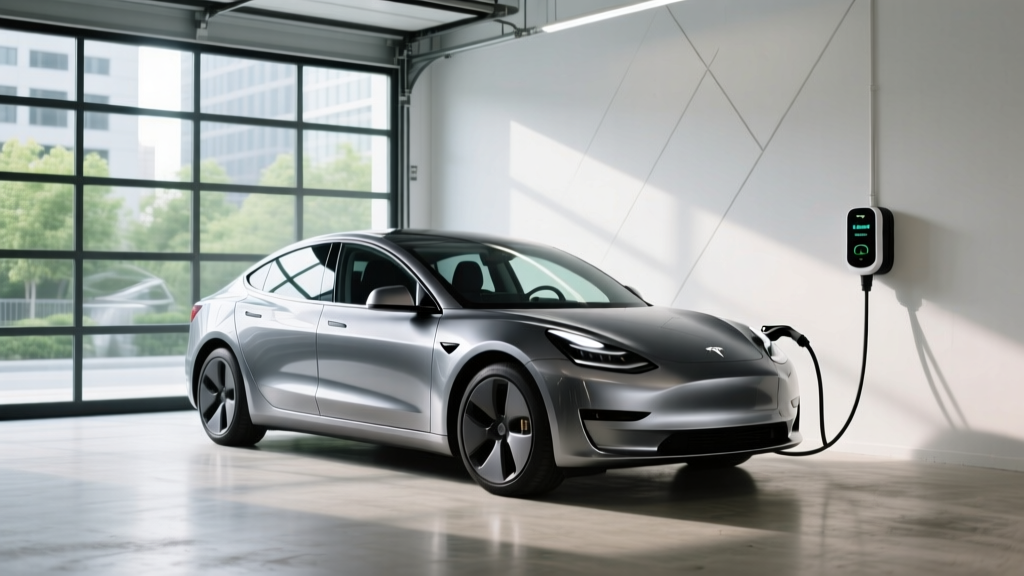
For home charging, a 48-amp Level 2 wall connector on a 60-amp circuit is the sweet spot. Expect to pay $500-$800 for the Tesla Wall Connector hardware and $800-$2,000 for professional installation depending on your panel capacity and run length (source: Tesla Home Charging). Most owners wake up to a full car every morning, making public charging an occasional road-trip affair rather than a daily chore.
Tech, Interior, and Driver Assistance
The 2026 Model 3 carries forward the Highland interior refresh: ventilated front seats, ambient lighting, rear-seat touchscreen, acoustic glass all around, and a substantially quieter cabin at highway speeds compared to pre-2024 cars. The 15.4-inch center display handles all infotainment, climate, and vehicle controls — there is still no dedicated instrument cluster, and turn signals are now on the steering wheel rim rather than a stalk (a learning curve for new drivers).
Autopilot and FSD (Supervised): Every Model 3 ships with Basic Autopilot (lane centering + adaptive cruise). The $8,000 Full Self-Driving (Supervised) upgrade adds city-street navigation, traffic-light recognition, and automatic turns. However, this remains an SAE Level 2 system — you must keep your hands on the wheel and eyes on the road at all times. It is not autonomous driving.
Tesla Autopilot and FSD (Supervised) require continuous driver supervision. The vehicle can steer, accelerate, and brake in many scenarios, but the driver is legally and practically responsible for all driving decisions. Hands-on-wheel monitoring and attention alerts are enforced. Only Level 4 systems like Waymo's robotaxi service operate without a human driver.
Cargo and Passenger Space
- Front legroom: 42.7 inches
- Rear legroom: 35.2 inches (tighter than a Hyundai Ioniq 6 or BMW i4)
- Trunk (rear): 21.0 cu ft
- Frunk (front trunk): 3.1 cu ft
- Total cargo: 24.1 cu ft — adequate for a week's groceries or two carry-ons + backpacks, but not SUV territory
Pricing, Tax Credits, and Total Lease Cost
| Item | Model 3 RWD | Long Range AWD | Performance |
|---|---|---|---|
| Base MSRP (2026) | $38,990 | $45,990 | $52,990 |
| Destination Fee | $1,390 | $1,390 | $1,390 |
| Federal §30D Credit (if eligible) | -$7,500 | -$7,500 | -$7,500 |
| Effective Price (purchase equivalent) | $32,880 | $39,880 | $46,880 |
Federal tax credit eligibility (IRS §30D — 2026 rules): The Model 3 qualifies for up to $7,500 in federal tax credits when purchased, provided you meet all of the following criteria (source: IRS Clean Vehicle Credits):
- MSRP cap: Vehicle MSRP must not exceed $55,000 for sedans (all Model 3 trims currently qualify)
- Buyer income cap: Modified AGI ≤ $150,000 (single), $225,000 (head of household), $300,000 (joint)
- Battery sourcing: Critical minerals and battery components must meet phased-in domestic-content thresholds (Tesla's US-built cells from Panasonic in Nevada generally satisfy 2026 thresholds, but verify via the IRS VIN-lookup tool at fueleconomy.gov)
- Point-of-sale transfer: You can elect to transfer the credit to the dealer at purchase for an immediate price reduction — or, in a lease, the lessor receives it and should pass it through
Lease-specific warning: If you lease rather than buy, you personally cannot claim the §30D credit on your tax return. The credit belongs to the vehicle's legal owner (the leasing company). The only way you benefit is if the lessor applies it as a capitalized-cost reduction. Get this in writing before signing.
Warranty Coverage
- Basic vehicle: 4 years / 50,000 miles
- Battery & drive unit (RWD): 8 years / 100,000 miles
- Battery & drive unit (Long Range / Performance): 8 years / 120,000 miles
- Battery retention threshold: Tesla warrants a minimum of 70% capacity retention during the warranty period
For a 36-month lease, you'll be fully under warranty for the entire term — and typical 3-year degradation on Tesla's NMC and LFP packs is in the 5-8% range based on fleet data, well above the 70% threshold.
Pros and Cons of Leasing a Model 3 in 2026
- Lowest monthly entry into a Tesla with Supercharger network access
- Industry-leading efficiency (25-28 kWh/100 mi) means low "fuel" costs
- Over-the-air updates keep the car current throughout the lease
- Strong residual values protect against excessive lease-end charges
- LFP battery on RWD allows daily 100% charging without degradation worry
- Highland refresh fixed cabin noise, ride quality, and seat comfort
- Tesla's direct lease terms may include no purchase option at lease-end (varies by program)
- Mileage penalties (typically $0.20-$0.25/mile over) can sting for high-mileage commuters
- No physical instrument cluster; turn signals on steering wheel rim take adjustment
- Rear seat space is tighter than key competitors (Ioniq 6, BMW i4)
- Service center availability varies widely by region — mobile service handles many issues but not all
- FSD ($8,000) is not worth adding on a lease — you won't recoup the cost
Who Should Lease the Model 3 — And Who Shouldn't?
- You drive 8,000-12,000 miles/year and have home Level 2 charging
- You want Tesla's software, Supercharger access, and efficiency without a 5-7 year ownership commitment
- You're testing EV ownership for the first time and want an exit strategy
- You prefer a sedan footprint and don't need SUV cargo space
- You drive 15,000+ miles/year — mileage overages will erode the lease value proposition
- You need regular rear-seat adult passengers — the Ioniq 6 or BMW i4 offer more legroom
- You want lease-end purchase flexibility — verify Tesla's current program includes a buyout option
- You live in a region with limited Tesla Service Center coverage and no mobile service
Frequently Asked Questions
What is the real-world range of the Tesla Model 3?
The Long Range AWD carries an EPA rating of 341 miles. In mixed real-world driving at moderate temperatures, expect 290-320 miles. In winter highway conditions (30°F or below), plan for 235-260 miles of usable range. The RWD model is EPA-rated at 272 miles, with real-world highway driving yielding roughly 230-250 miles.
How fast does the Model 3 charge at home and on the road?
On a DC fast charger, the Long Range peaks at 250 kW and charges from 10-80% in roughly 18-20 minutes. The RWD peaks at 170 kW with a 10-80% time of about 25 minutes. At home on a 48-amp Level 2 charger (11.5 kW), the Long Range adds about 44 miles of range per hour; the RWD adds about 30 miles per hour.
Does the Tesla Model 3 qualify for the $7,500 federal tax credit?
Yes, all 2026 Model 3 trims currently qualify for up to $7,500 under IRS §30D, provided the buyer meets income caps ($150K single / $300K joint) and the vehicle's battery sourcing meets current-year domestic-content thresholds. On a lease, the credit goes to the lessor — confirm it's applied as a cap-cost reduction on your lease quote.
Is leasing a Model 3 better than buying in 2026?
Leasing makes sense if you drive under 12,000 miles/year, want lower monthly payments, and value the ability to upgrade in 3 years. Buying makes more sense if you drive high mileage, want to keep the car 5+ years, or want to claim the $7,500 credit directly on your tax return. Run both scenarios with your local Tesla advisor — the math shifts based on your mileage, credit score, and state incentives.
Can I buy the Model 3 at the end of the lease?
This varies by Tesla's current leasing program. Some Tesla lease programs have included a purchase option at lease-end; others have not. This is a critical detail to confirm before signing — if purchase flexibility matters to you, ask for the buyout terms in writing or consider financing instead.
How does the Model 3 compare to competitors for leasing?
Against the Hyundai Ioniq 6 (EPA 361 mi, ~$42,500), the Model 3 Long Range offers similar range with faster DC charging and Supercharger access but less rear-seat space. The BMW i4 eDrive40 (EPA 307 mi, ~$52,200) offers a more traditional luxury interior and instrument cluster at a higher price. The Polestar 2 (EPA 276 mi, ~$49,950) trails on range and efficiency. For pure efficiency and charging infrastructure, the Model 3 still leads — but if interior space or traditional controls matter, test the alternatives.