If you have ever sat at a Supercharger watching your Tesla's battery climb from 20% to 80%, you have probably wished for something more entertaining than scrolling your phone. Tesla apparently agreed. The in-car Karaoke app — accessible while parked — turns the cabin into a rolling karaoke booth, complete with on-screen lyrics, a microphone input, and the ability to record and play back your performance. It is a small feature, but it encapsulates what Tesla does better than almost anyone: make the software experience feel alive.
But a party trick does not pay the lease or get you from Denver to Moab. This review breaks down the 2026 Tesla Model 3 Long Range AWD — the variant most buyers cross-shop — covering its EPA range, real-world efficiency, charging speeds, pricing after federal tax credits, and whether the Karaoke feature and broader tech suite justify the premium over rivals like the Hyundai Ioniq 6 and BMW i4.
Quick Verdict: The 2026 Tesla Model 3 at a Glance
| Spec | 2026 Tesla Model 3 Long Range AWD |
|---|---|
| EPA Range | 341 miles |
| Battery (usable) | ~75 kWh, NMC (nickel manganese cobalt) |
| Max DC Fast Charge | 250 kW peak |
| 10–80% DC Charge Time | ~25 minutes |
| Level 2 Home Charge Rate | 11.5 kW (~44 mi/hr) |
| 0–60 mph | 4.2 seconds |
| Horsepower | 346 hp (dual-motor AWD) |
| EPA Efficiency | 131 MPGe combined / 26 kWh/100 mi |
| Cargo Volume | 23 cu ft (rear trunk + frunk) |
| Rear Legroom | 35.3 inches |
| Base MSRP | $47,740 (before incentives) |
| Battery Warranty | 8 years / 120,000 miles |
The Model 3 Long Range remains one of the most efficient sedans in the EV market. Its combination of range, Supercharger network access, and software depth — Karaoke included — is hard to match at this price point. But efficiency on paper is only half the story.
Real-World Range: What 341 EPA Miles Actually Means
EPA Sticker: 341 miles
Real-World Highway (70–75 mph, mild weather): ~280–305 miles
Real-World Highway (cold weather, below 30°F): ~230–260 miles
City/Commuter (stop-and-go with regen): ~310–335 miles
The EPA's 341-mile estimate for the Model 3 Long Range AWD is one of the more achievable stickers in the segment, thanks to Tesla's heat pump and strong regenerative braking. On a 250-mile highway loop at 72 mph in 65°F weather, independent testers and owner logs consistently show consumption around 26–28 kWh/100 mi, which translates to roughly 280–305 miles of usable range before you need to stop.
Cold weather is the equalizer. Lithium-ion cells lose efficiency in low temperatures, and cabin heating draws significant power even with a heat pump. Expect a 20–30% range reduction in sustained sub-freezing driving. If you are planning a winter road trip through the Rockies, budget for 230–260 real miles and plan charging stops accordingly.
For daily commuting, the story flips. City driving with frequent regenerative braking opportunities lets the Model 3 recapture energy that gas cars waste as brake heat. Many owners report hitting or approaching the EPA sticker on mixed suburban commutes. According to fueleconomy.gov, the combined MPGe rating of 131 places the Model 3 Long Range among the most efficient AWD electric sedans available.
Charging Speed: Supercharger Access Is the Real Advantage
Tesla's Supercharger network remains the most reliable DC fast-charging ecosystem in North America. The Model 3 Long Range peaks at 250 kW on V3 and V4 Superchargers, though — as with all EVs — that peak is not sustained across the entire session.
| Charging Level | Power | Speed (Approx.) | Use Case |
|---|---|---|---|
| Level 1 (120V household) | ~1.4 kW | ~5 mi/hr | Emergency / overnight trickle |
| Level 2 (240V home wall connector) | 11.5 kW | ~44 mi/hr | Daily home charging |
| DC Fast (Supercharger V3/V4) | Up to 250 kW peak | 10–80% in ~25 min | Road trips |
| DC Fast (third-party CCS via adapter) | Up to 150–250 kW | Varies by station | Non-Tesla networks |
The charge curve matters more than the peak number. The Model 3 sustains roughly 200+ kW from 10% to about 40% state of charge, then gradually tapers. From 80% to 100%, charging slows dramatically — a characteristic of NMC chemistry designed to protect long-term battery health. Tesla's navigation system automatically preconditions the battery when you route to a Supercharger, warming the pack to optimize charge acceptance. Skip preconditioning (for example, arriving at a charger without using navigation) and your peak rate may drop to 150 kW or lower, especially in cold weather.
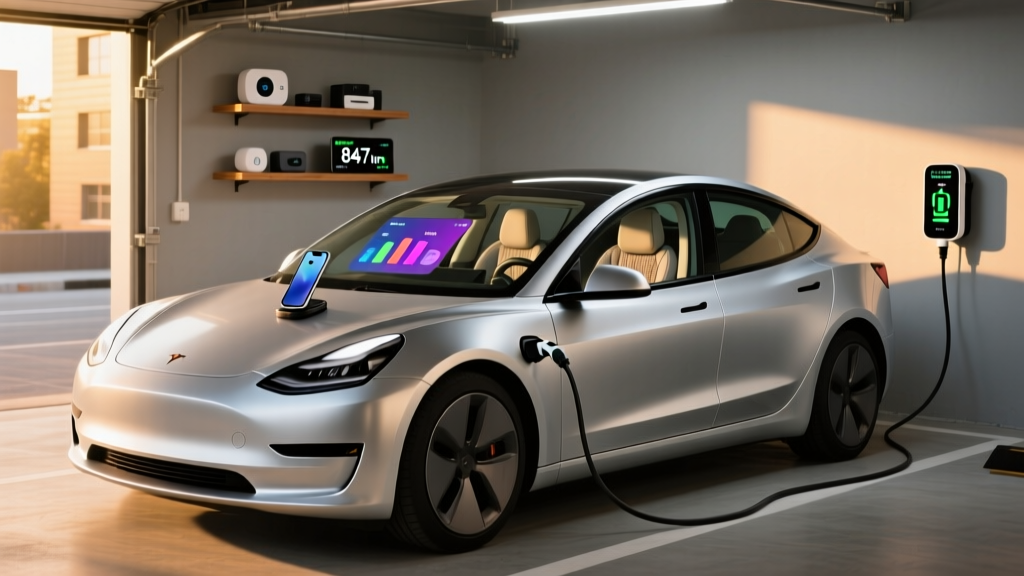
At home on a Tesla Wall Connector wired to a 60-amp circuit, the Model 3 adds roughly 44 miles of range per hour. A full overnight charge from 20% to 80% takes about 5–6 hours — more than enough for any daily routine. Note: you will need a NACS (North American Charging Standard) connector at home, which is now the Tesla-native plug. If you want to use Electrify America or EVgo stations, Tesla sells a CCS adapter, and an increasing number of third-party networks are adding NACS cables as the industry standardizes around Tesla's connector.
Performance and Drivetrain: Quick, Composed, and Efficient
The Long Range AWD pairs dual permanent-magnet motors producing a combined 346 horsepower. The 0–60 mph sprint takes 4.2 seconds — quick enough to merge onto any freeway with confidence and genuinely fun on a winding road. The instant torque delivery means there is no waiting for a transmission to downshift; you press the pedal and the car responds.
Ride quality improved significantly with the "Highland" refresh and has carried forward. The cabin is noticeably quieter at highway speeds than pre-2024 models, with acoustic glass and revised suspension bushings absorbing road imperfections. Handling is flat and composed, though the steering — while precise — remains somewhat numb, a common Tesla trait.
The AWD system is fully electronic, with no mechanical linkage between axles. It provides confident traction in rain and light snow, though ground clearance (5.5 inches) limits any serious winter back-road ambitions. For towing, the Model 3 is not rated for trailer use — if you need to tow, look at the Model Y or a truck-platform EV.
Interior, Tech, and the Karaoke Experience
The Model 3 interior follows Tesla's minimalist philosophy: a single 15.4-inch center touchscreen handles everything from climate controls to navigation to media. There is no instrument cluster — speed and range info appears in the top-left corner of the main display. The 2026 model continues with ventilated front seats, a rear-seat touchscreen for passengers, ambient lighting, and a 17-speaker audio system that punches well above its price class.
The Karaoke app lives under the "Theater" or "Toybox" section of the touchscreen and is only accessible while the vehicle is in Park. You can select from a library of songs with on-screen lyrics, sing along using the cabin microphone or a USB microphone, and even record sessions to replay later. Audio quality through the premium sound system is surprisingly good — the subwoofer and surround processing make it feel like a private karaoke room. It is a genuinely fun feature for campgrounds, tailgates, or killing time at a charging stop with friends. The song library is not as deep as a dedicated karaoke machine, and you cannot use it while driving (a safety and legal restriction), but for what it is, it works well.
Beyond Karaoke, the infotainment system supports Netflix, YouTube, arcade games, and Spotify — all usable while parked. The navigation system remains best-in-class for EV route planning, automatically calculating charging stops, estimating arrival state of charge, and preconditioning the battery.
On the driver-assistance front, the Model 3 comes with Autopilot (adaptive cruise + lane centering) standard. Tesla's Full Self-Driving (Supervised) is available as an add-on or subscription. It is critical to understand: FSD is an SAE Level 2 system. Despite the name, it requires continuous driver supervision — hands on or near the wheel, eyes on the road. It is not autonomous driving. Only Level 4 services like Waymo operate without a human driver engaged.
ADAS Reality Check: Tesla Autopilot and FSD (Supervised) are SAE Level 2 driver-assistance systems. You are the driver. You must remain alert, keep your eyes on the road, and be prepared to take over at any moment. These systems do not make the vehicle self-driving.
Pricing, Tax Credits, and Total Cost
| Trim | MSRP | Est. Federal Credit (§30D) | Effective Price |
|---|---|---|---|
| Model 3 RWD | $38,990 | Up to $7,500* | ~$31,490 |
| Model 3 Long Range AWD | $47,740 | Up to $7,500* | ~$40,240 |
| Model 3 Performance | $54,990 | Up to $7,500* | ~$47,490 |
*Federal tax credit eligibility under IRS §30D depends on multiple factors that change frequently:
- MSRP Cap: Sedans must have an MSRP at or below $55,000. The Model 3 RWD and Long Range qualify; the Performance trim may or may not depending on options.
- Buyer Income Cap: Modified adjusted gross income must not exceed $150,000 (single), $225,000 (head of household), or $300,000 (joint filing).
- Battery Sourcing: The credit is split into two halves ($3,750 each) — one for critical minerals and one for battery component manufacturing. Sourcing requirements tighten annually, and eligibility can shift mid-year. Always verify current status on the IRS website or with a tax professional before purchasing.
- Point-of-Sale Transfer: As of 2024, you can transfer the credit to the dealer at purchase, reducing your out-of-pocket cost immediately rather than waiting to claim it on your tax return.
The Model 3 RWD at ~$31,490 after the full credit is arguably the best value in the entire EV market — a 272-mile, tech-loaded sedan for compact-gas-car money. The Long Range AWD at ~$40,240 is the sweet spot for buyers who want AWD, extra range, and dual-motor performance.
Ownership Costs and Warranty
Tesla's basic vehicle warranty covers 4 years / 50,000 miles. The battery and drive unit warranty extends to 8 years / 120,000 miles for the Long Range AWD, with a capacity retention threshold of 70%. If the battery degrades below 70% of its original capacity within that window, Tesla replaces or refurbishes it at no cost.
Real-world degradation data from owner fleets suggests the Model 3's NMC pack loses roughly 5–8% capacity over the first 100,000 miles, with the curve flattening significantly afterward. Many high-mileage Tesla taxis and fleet vehicles have exceeded 200,000 miles on the original pack. To maximize longevity, Tesla recommends daily charging to 80% for NMC batteries (not 100%) and only charging to full for road trips.
Insurance costs tend to run 15–25% higher than comparable gas sedans, driven by repair costs for aluminum body panels and sensor recalibration after collisions. Get quotes before buying — your mileage will vary by state, age, and driving record.
Maintenance is minimal: no oil changes, no spark plugs, no transmission fluid. Expect to replace cabin air filters, wiper fluid, brake fluid checks, and tires (EVs wear tires faster due to instant torque and heavier curb weight). Budget roughly $600–$900/year for tires if you drive 12,000–15,000 miles annually.
How It Compares: Model 3 vs. Key Rivals
| Spec | 2026 Tesla Model 3 LR AWD | 2026 Hyundai Ioniq 6 SEL AWD | 2026 BMW i4 xDrive40 |
|---|---|---|---|
| EPA Range | 341 mi | 316 mi | 282 mi |
| Battery | ~75 kWh NMC | 77.4 kWh NMC | 83.9 kWh NMC |
| Max DC Charge | 250 kW | 235 kW | 205 kW |
| 10–80% Time | ~25 min | ~18 min | ~31 min |
| 0–60 mph | 4.2 sec | 5.1 sec | 4.5 sec |
| Base MSRP | $47,740 | $46,700 | $57,975 |
| Charging Network | Supercharger (native NACS) | NACS adapter / third-party | NACS adapter / third-party |
| Karaoke App | Yes (built-in) | No | No |
Best Range & Efficiency: Tesla Model 3 — 341 miles with the lowest kWh/100mi consumption in the group.
Fastest 10–80% Charging: Hyundai Ioniq 6 — its 800V architecture sustains higher power longer, hitting 80% in ~18 minutes vs. Tesla's ~25.
Best Charging Network: Tesla Model 3 — native Supercharger access with no adapter needed, the most reliable network in North America.
Best Build Quality & Materials: BMW i4 — premium materials, physical buttons, and traditional luxury craftsmanship that Tesla does not attempt to match.
The Ioniq 6 charges faster (its 800-volt architecture is a genuine advantage on long road trips), and the BMW i4 delivers a more luxurious cabin. But the Model 3's combination of range, Supercharger access, software depth, and price after tax credits makes it the default recommendation for most buyers.
Pros, Cons, and Who Should Buy
Pros
- Class-leading 341-mile EPA range with outstanding real-world efficiency
- Native Supercharger network — no adapters, highest reliability
- Best-in-class software: Karaoke, route planning, OTA updates
- Strong performance (4.2s 0–60) with composed ride quality
- Competitive pricing, especially RWD trim after §30D credit
- Excellent 17-speaker audio system
Cons
- No physical buttons — all climate/media controls are touchscreen-only
- Rear legroom (35.3 in) is tighter than midsize competitors
- FSD (Supervised) subscription adds cost without true autonomy
- Insurance premiums run higher than gas sedan averages
- No towing capacity
- Minimalist interior is polarizing — some find it cheap for the price
Choose the Tesla Model 3 if: You want maximum range per dollar, rely on road-trip charging infrastructure, value software features (Karaoke, streaming, OTA updates), and prefer a minimalist tech-forward cabin.
Look elsewhere if: You need maximum rear-seat space (consider the Model Y or Ioniq 5), want physical buttons and traditional luxury (BMW i4), or need towing capability (Model Y, Rivian R1S, F-150 Lightning).
Frequently Asked Questions
Can I use Tesla Karaoke while driving?
No. Tesla's Karaoke app is only available when the vehicle is in Park. This is a deliberate safety restriction. You can use it at Supercharger stops, campgrounds, parking lots, or in your garage — but not while the car is in motion.
What is the real-world range of the 2026 Tesla Model 3 Long Range?
The EPA rates it at 341 miles. In real-world highway driving at 70–75 mph in mild weather, expect 280–305 miles. In cold weather (below 30°F), plan for 230–260 miles. City commuters using regenerative braking frequently see 310+ miles.
How fast does the Model 3 charge at home and on the road?
At home on a Level 2 Tesla Wall Connector (11.5 kW), the Model 3 adds about 44 miles of range per hour — a full overnight charge covers any daily need. On a V3/V4 Supercharger, it peaks at 250 kW and charges from 10% to 80% in approximately 25 minutes, with the rate tapering above 80% to protect the NMC battery.
Does the 2026 Tesla Model 3 qualify for the $7,500 federal tax credit?
It can, but eligibility depends on your income, the vehicle's MSRP (must be ≤$55,000 for sedans), and battery component/critical mineral sourcing requirements that tighten annually. The RWD and Long Range trims meet the MSRP cap. Verify your personal eligibility on irs.gov or with a tax professional before purchasing. The credit can be transferred at point of sale to reduce your upfront cost.
Is the Tesla Model 3 worth buying over the Hyundai Ioniq 6 or BMW i4?
For most buyers, yes — the Model 3 Long Range offers the best combination of range, efficiency, charging network access, and software features at its price point. The Ioniq 6 charges faster (10–80% in ~18 min) and has a more distinctive design. The BMW i4 offers superior interior materials and a more traditional driving experience. If Supercharger reliability and software depth matter to you, the Model 3 wins. If you prioritize fast DC charging or luxury feel, test-drive the alternatives.
How long will the Model 3 battery last?
Tesla warranties the Long Range battery for 8 years / 120,000 miles with at least 70% capacity retention. Real-world fleet data shows typical degradation of 5–8% over 100,000 miles, with many packs lasting well beyond 200,000 miles. To maximize lifespan, charge to 80% daily and reserve 100% charges for road trips.