The Tesla Model 3 Interior in 2026: Still the Benchmark for EV Minimalism
The Tesla Model 3 Highland refresh transformed what was once a spartan cabin into one of the most refined interiors in the compact electric sedan segment. For 2026, the Model 3 continues to anchor Tesla's lineup as the entry point into the brand's ecosystem — combining a reworked cabin with class-leading efficiency and access to the Supercharger network. But the headline question for buyers remains: does the Tesla Model 3 interior deliver enough comfort and tech to justify its premium positioning against rivals like the Hyundai Ioniq 6, BMW i4, and Polestar 2?
We've spent extensive time in both the Long Range AWD and Performance trims to break down every surface, screen, and software quirk. Here's the full picture — specs, real-world range, charging behavior, and whether the minimalist philosophy works for daily life.
2026 Tesla Model 3 Key Specifications at a Glance
| Spec | RWD (Base) | Long Range AWD | Performance |
|---|---|---|---|
| EPA Range | 272 mi | 363 mi | 315 mi |
| Battery (usable) | ~57.5 kWh (LFP) | ~75 kWh (NMC) | ~75 kWh (NMC) |
| Drivetrain | Rear-Wheel Drive | Dual-Motor AWD | Dual-Motor AWD |
| Horsepower | 271 hp | 346 hp | 510 hp |
| 0–60 mph | 5.8 sec | 4.2 sec | 2.9 sec |
| Top Speed | 125 mph | 125 mph | 163 mph |
| Max DC Fast Charge | 170 kW | 250 kW | 250 kW |
| 10–80% DCFC Time | ~25 min | ~22 min | ~22 min |
| Level 2 Home Charging | 11.5 kW (~44 mi/hr) | 11.5 kW (~44 mi/hr) | 11.5 kW (~44 mi/hr) |
| EPA Efficiency | 132 MPGe (25 kWh/100mi) | 134 MPGe (25 kWh/100mi) | 118 MPGe (29 kWh/100mi) |
| Cargo (trunk + frunk) | 23 cu ft total | 23 cu ft total | 23 cu ft total |
| Rear Legroom | 35.3 in | 35.3 in | 35.3 in |
| Base MSRP | $38,990 | $44,990 | $52,990 |
| Battery/Drive Unit Warranty | 8 yr / 100,000 mi | 8 yr / 120,000 mi | 8 yr / 120,000 mi |
Sources: fueleconomy.gov, Tesla.com official specifications. Pricing reflects base MSRP before destination fees; specs subject to mid-year updates.
Inside the Cabin: Materials, Layout, and the 15.4-Inch Centerpiece
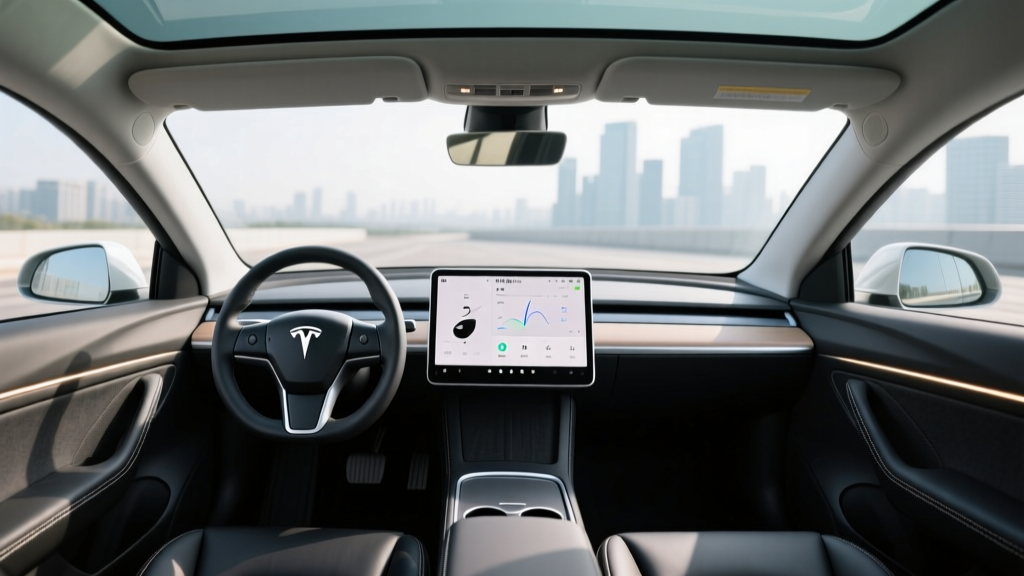
The Tesla Model 3 interior philosophy hasn't changed — there are no physical buttons, no instrument cluster, and no traditional stalks. Everything routes through the 15.4-inch center touchscreen, which now runs a faster Ryzen-based processor with noticeably reduced input lag compared to pre-Highland models. The digital speedometer and vital driving information live in a slim strip at the top-left of the display, which requires a brief glance-down adaptation period but becomes second nature within a week of driving.
Material quality received a substantial upgrade with the Highland refresh. Soft-touch surfaces now cover the dashboard top, door uppers, and center console — replacing the hard plastics that drew criticism in earlier Model 3 generations. The available textile-and-vegan-leather upholstery (standard on Long Range) feels durable and premium, while ambient lighting strips along the dash and doors add visual warmth at night.
Ventilated Seats and Acoustic Glass: The Comfort Upgrades That Matter
Two Highland-era additions make the biggest daily difference: ventilated front seats and acoustic laminated glass on all windows. The ventilated seats are a genuine improvement for hot-climate owners — a feature conspicuously absent from the pre-2024 Model 3. The acoustic glass drops cabin noise significantly at highway speed; Tesla claims roughly 20% less wind and road noise, and real-world driving confirms the cabin is noticeably quieter than an Ioniq 6 or BMW i4 at 70 mph.
Rear-seat comfort remains the Model 3's relative weakness. At 35.3 inches of legroom, it's adequate for adults under six feet but tight for taller passengers on longer trips. The seat cushion is relatively flat and low-mounted, and the panoramic glass roof — while visually expansive — radiates heat in summer despite Tesla's UV-rejection coating. A manual retractable sunshade is not included; owners often purchase aftermarket solutions.
Rear Touchscreen and Infotainment
An 8-inch rear touchscreen mounted behind the center console allows rear passengers to control climate settings, view navigation, and stream entertainment (Netflix, YouTube, Disney+) when parked. It's a welcome addition for families, though the screen's viewing angle washes out in direct sunlight. The 17-speaker premium audio system (standard on Long Range and Performance) delivers rich, well-balanced sound that rivals premium branded systems costing thousands more in competitor vehicles.
Real-World Range vs. EPA Estimates
EPA Sticker: 363 miles (Long Range AWD) / 272 miles (RWD)
Real-World Expectation: In mixed driving at 70 mph with moderate climate use, expect 290–320 miles from the Long Range and 230–250 miles from the RWD. In cold weather (below 32°F), plan for a 15–25% range reduction, bringing the Long Range to roughly 260–290 miles. The Model 3's heat pump (standard on all trims) mitigates winter losses better than many competitors, but highway-speed cold-weather driving remains the worst-case scenario for any EV.
Key Insight: The Model 3 Long Range's 25 kWh/100mi efficiency rating is among the best in its class — meaning you get more miles per kilowatt-hour than nearly any rival. This efficiency advantage matters more than raw battery size for road-trip practicality.
Charging Speed and Infrastructure: Supercharger Access Is the Differentiator
Charging speed separates a usable EV from a genuinely practical road-trip vehicle. The Model 3 Long Range and Performance trims peak at 250 kW on DC fast chargers, reaching 10–80% state of charge in approximately 22 minutes under optimal conditions (battery preconditioned, ambient temperature above 60°F).
| Charging Level | Power / Rate | Miles Added per Hour | Notes |
|---|---|---|---|
| Level 1 (120V household) | ~1.4 kW | ~5 mi/hr | Emergency/trickle only |
| Level 2 (240V home, 48A) | 11.5 kW | ~44 mi/hr | Full charge in ~7–8 hours |
| DC Fast Charge (RWD) | Peak 170 kW | ~650 mi/hr (peak) | 10–80% in ~25 min |
| DC Fast Charge (LR/Perf) | Peak 250 kW | ~1,000 mi/hr (peak) | 10–80% in ~22 min |
Charging curve reality: The 250 kW peak rate is sustained only between roughly 10–35% SoC. Above 50%, the rate tapers progressively — dropping to ~100 kW around 60% and ~50 kW near 80%. This is normal lithium-ion behavior, but it means the "10–80% in 22 minutes" claim only holds with proper battery preconditioning (the car does this automatically when a Supercharger is entered in the navigation).
For home charging, Tesla's Wall Connector at 48 amps delivers 11.5 kW — enough to fully replenish the Long Range battery overnight. A typical 240V/60A circuit installation runs $800–$2,000 depending on panel proximity and local permitting, though homes with older 100A electrical panels may need a $1,500–$3,000 panel upgrade.
The Model 3's native NACS (North American Charging Standard) port provides direct access to Tesla's Supercharger network — over 20,000 stalls in North America. With CCS adapters no longer needed and rival OEMs adopting NACS, Tesla's charging ecosystem remains its strongest competitive moat. For non-Tesla CCS chargers (Electrify America, EVgo), a NACS-to-CCS adapter is available but increasingly unnecessary as networks add NACS connectors.
Pricing, Tax Credits, and Total Cost
The 2026 Model 3 lineup starts at $38,990 for the RWD (including destination) and reaches $52,990 for the Performance before options. Here's how federal incentives apply:
IRS §30D Federal EV Tax Credit — 2026 Eligibility Rules
- Maximum credit: Up to $7,500 for new qualifying EVs
- MSRP cap: Sedans must be priced at or below $55,000 (all Model 3 trims qualify)
- Buyer income cap: AGI must not exceed $150,000 (single), $225,000 (head of household), or $300,000 (married filing jointly)
- Battery sourcing: Critical minerals and battery components must meet escalating domestic-content thresholds — Tesla's Austin-built Model 3 currently qualifies, but verify at fueleconomy.gov before purchasing, as sourcing rules update periodically
- Point-of-sale transfer: Eligible buyers can apply the credit as an upfront discount at the dealership rather than waiting for a tax refund
- Tax liability: The credit is non-refundable — you must owe at least $7,500 in federal taxes to capture the full amount (or use point-of-sale transfer)
Always confirm current eligibility at IRS.gov and consult a tax professional. Rules and qualifying VIN lists change frequently.
| Trim | MSRP | Est. §30D Credit | Effective Price* |
|---|---|---|---|
| RWD | $38,990 | $7,500 | ~$31,490 |
| Long Range AWD | $44,990 | $7,500 | ~$37,490 |
| Performance | $52,990 | $7,500 | ~$45,490 |
*Effective price assumes full $7,500 credit eligibility. Actual credit may be reduced based on battery-sourcing compliance at time of delivery. State incentives (e.g., California, Colorado, New York) may stack on top.
Driver Assistance: Autopilot and FSD Supervised
SAE Automation Level: Level 2
Tesla's Autopilot and Full Self-Driving (Supervised) are SAE Level 2 driver-assistance systems — meaning the driver must remain fully engaged, hands on or near the wheel, and eyes on the road at all times. These are not self-driving systems. Only Level 4 robotaxi services like Waymo operate without a human driver in geofenced areas.
The standard Autopilot package includes Traffic-Aware Cruise Control and Autosteer (lane-centering on divided highways). It works reliably on well-marked interstates but can struggle with construction zones, faded lane markings, and complex merges.
The optional FSD (Supervised) package — currently $8,000 or $99/month — adds automatic lane changes, Navigate on Autopilot (on-ramp to off-ramp highway driving), traffic light and stop sign recognition, and enhanced city-street driving. In 2026, FSD Supervised has improved significantly in urban environments, but it still requires active supervision and occasionally makes conservative or unexpected decisions at unprotected left turns and complex intersections. The camera-only Tesla Vision approach (no lidar or radar) remains a philosophical bet that software can outperform sensor fusion — and while it's come far, it's not a replacement for an attentive driver.
⚠️ What Autopilot/FSD Does NOT Do
- Does not eliminate the need for driver attention — NHTSA requires continuous supervision
- Does not handle all weather conditions — heavy rain, fog, and snow degrade camera performance
- Does not guarantee compliance with all traffic laws — driver is legally responsible
- Is not a Level 3 or Level 4 autonomous system — you cannot read a phone or nap
Who the Model 3 Suits Best — and Who Should Look Elsewhere
Choose the Tesla Model 3 If:
- You prioritize charging infrastructure access — the Supercharger network remains the most reliable public charging option in North America
- You want class-leading efficiency — 25 kWh/100mi means lower electricity costs per mile than nearly any competitor
- You value over-the-air updates that continuously add features and refinements
- You're a tech-forward commuter who enjoys a screen-centric interface and minimal physical controls
- You want a sport sedan experience — the Performance trim's 2.9-second 0–60 time is supercar territory
Look Elsewhere If:
- You need maximum rear-seat space — the Hyundai Ioniq 6 and BMW i4 offer comparable comfort, and SUVs like the Model Y provide far more room
- You prefer physical buttons and a traditional instrument cluster — the all-screen interface isn't for everyone
- You need towing capability — the Model 3 is not rated for towing
- You want Apple CarPlay or Android Auto — Tesla's proprietary infotainment does not support either
Model 3 vs. Key Competitors: Where It Stands
Against the Hyundai Ioniq 6 SE Long Range (EPA 361 mi, ~$42,000), the Model 3 Long Range matches on range but wins on Supercharger access and efficiency. The Ioniq 6 offers a more conventional interior with physical climate controls and standard CarPlay.
Against the BMW i4 eDrive40 (EPA 307 mi, ~$57,000), the Model 3 undercuts on price significantly while offering more range, though the i4 delivers a more traditional luxury experience with superior build consistency.
The Polestar 2 Long Range Dual Motor (EPA 276 mi, ~$49,900) offers a Scandinavian interior and Google-based infotainment but can't match the Model 3's range or charging speed.
✅ Pros
- Class-leading energy efficiency (25 kWh/100mi)
- Native NACS port + Supercharger network access
- Upgraded Highland cabin materials and acoustic glass
- Ventilated front seats standard on Long Range/Performance
- 250 kW DC fast charging with battery preconditioning
- Strong OTA update pipeline adds features over time
- 5-star NHTSA safety rating across all test categories
❌ Cons
- No Apple CarPlay or Android Auto
- Rear-seat space tight for tall adults (35.3 in legroom)
- All-screen interface demands adaptation; no physical backup controls
- Glass roof radiates heat in summer without aftermarket shade
- FSD (Supervised) costs $8,000 extra and requires full driver attention
- Panel gap consistency still lags German competitors
- No towing capacity
Frequently Asked Questions
What is the real-world range of the Tesla Model 3?
The Long Range AWD carries an EPA rating of 363 miles, but real-world highway driving at 70 mph typically yields 290–320 miles. In cold weather (below freezing), expect 260–290 miles. The RWD model's 272-mile EPA rating translates to roughly 230–250 miles in mixed real-world use. These figures assume moderate climate control use; aggressive heating or A/C will reduce range further.
How fast does the Model 3 charge at home and on the road?
At home on a Level 2 (240V/48A) Tesla Wall Connector, the Model 3 charges at 11.5 kW — adding roughly 44 miles of range per hour and achieving a full charge in 7–8 hours. On DC fast chargers, the Long Range and Performance trims peak at 250 kW, completing a 10–80% session in about 22 minutes with a preconditioned battery. The RWD model peaks at 170 kW, taking roughly 25 minutes for the same 10–80% session.
Does the 2026 Tesla Model 3 qualify for the federal EV tax credit?
All Model 3 trims fall under the $55,000 MSRP cap for sedans under IRS §30D rules, making them potentially eligible for up to $7,500 in federal tax credits. However, eligibility depends on the buyer's adjusted gross income (capped at $150K/$225K/$300K depending on filing status), battery component and critical mineral sourcing compliance at time of delivery, and sufficient federal tax liability. The point-of-sale transfer option allows qualified buyers to apply the credit as an upfront price reduction. Always verify current eligibility at fueleconomy.gov before purchasing.
Is the Tesla Model 3 worth buying over competitors in 2026?
For buyers who prioritize charging infrastructure, efficiency, and software-driven features, the Model 3 Long Range remains the segment benchmark. Its Supercharger access, 25 kWh/100mi efficiency, and strong resale value are difficult to match. However, if you prefer physical controls, need Apple CarPlay, or want a more traditional luxury feel, the Hyundai Ioniq 6, BMW i4, or Polestar 2 are compelling alternatives. The decision often comes down to whether Tesla's ecosystem and screen-centric approach align with your preferences.
What battery chemistry does the Model 3 use, and how long will it last?
The RWD trim uses an LFP (lithium iron phosphate) battery — approximately 57.5 kWh usable — which offers superior cycle life and can be regularly charged to 100% without accelerated degradation. The Long Range and Performance trims use NMC (nickel manganese cobalt) chemistry at approximately 75 kWh usable, which provides higher energy density but benefits from daily charging limits of 80–90%. Tesla warranties the battery and drive unit for 8 years/100,000 miles (RWD) or 8 years/120,000 miles (Long Range/Performance), guaranteeing at least 70% capacity retention over that period. Real-world degradation data from Tesla's fleet reports suggests most Model 3 batteries retain roughly 85–90% capacity at 100,000 miles.
Does the Model 3 have Apple CarPlay or Android Auto?
No. Tesla uses a proprietary infotainment system and does not support Apple CarPlay or Android Auto on any model. The system includes native navigation, Spotify, Apple Music, and streaming apps (Netflix, YouTube, Disney+ when parked), along with a built-in web browser. For many owners, the native system is sufficient, but smartphone-projection loyalists will find this a significant omission.
Data sourced from fueleconomy.gov, Tesla.com, and NHTSA.gov. Specifications and pricing reflect 2026 model year at time of publication and are subject to change. Tax credit eligibility should be independently verified with the IRS and a qualified tax professional.