The Tesla Model 3 received its most significant cabin overhaul with the "Highland" refresh, and the changes carry forward into the 2026 model year. For buyers researching the Model 3 interior, the headline is clear: Tesla finally addressed the most common criticisms of its entry-level sedan — road noise, material quality, and ride comfort — while preserving the minimalist, screen-centric layout that defines the brand. But does the execution match the ambition? After spending time with the current Model 3 lineup, here is a spec-driven look at what you actually get inside, paired with the range, charging, and pricing data you need to make a purchase decision.
What Changed Inside the Refreshed Model 3
The pre-2024 Model 3 interior was functional but spartan: hard plastics on the lower dash, noticeable wind and tire noise at highway speeds, and a ride that transmitted every road imperfection. The refreshed Model 3 (introduced for 2024 and continuing into 2026) brought a comprehensive rework:
- Acoustic glass on all windows (front and rear), reducing cabin noise by a measurable margin at 65-80 mph
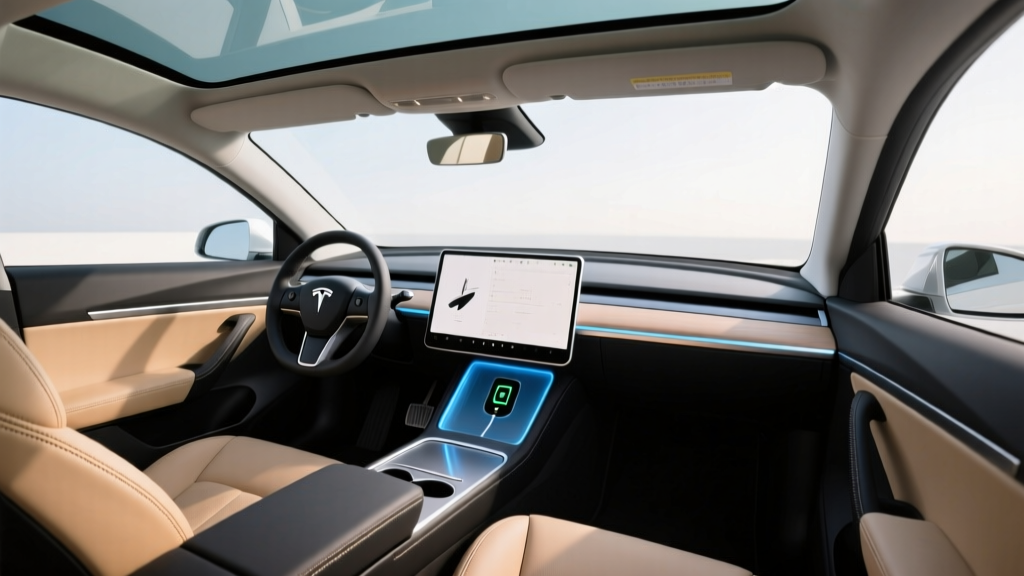
- Upgraded materials: ventilated front seats, textile dash inserts replacing bare plastic, ambient lighting strips across the dashboard and doors, and higher-grade seat upholstery
- Revised suspension tuning with new frequency-selective dampers that absorb sharp impacts without sacrificing handling
- Rear-seat improvements: a dedicated 8-inch touchscreen for rear passengers controlling climate, media, and seat heating, plus improved cushion padding
- Ventilated front seats (a first for Model 3), with multi-directional airflow and three intensity levels
The result is a cabin that now competes more credibly with the BMW i4 and Hyundai Ioniq 6 on perceived quality, though Tesla's design philosophy remains polarizing: there are still no physical buttons for climate, mirrors, or glovebox — everything routes through the 15.4-inch central touchscreen.
Model 3 Interior Dimensions: Space and Cargo
The Model 3 is a midsize sedan by EPA classification, but its low-slung battery pack and sloping roofline create some packaging trade-offs buyers should understand before signing a purchase agreement.
| Dimension | Model 3 (2026) | Hyundai Ioniq 6 | BMW i4 |
|---|---|---|---|
| Front headroom | 40.3 in | 40.3 in | 39.0 in |
| Rear headroom | 36.6 in | 37.1 in | 36.6 in |
| Front legroom | 42.7 in | 41.7 in | 42.8 in |
| Rear legroom | 35.2 in | 35.7 in | 33.7 in |
| Trunk (rear cargo) | 21.0 cu ft | 11.5 cu ft | 16.6 cu ft |
| Frunk (front trunk) | 3.1 cu ft | 0.5 cu ft | None |
| Total cargo | 24.1 cu ft | 12.0 cu ft | 16.6 cu ft |
Real-world takeaway: The Model 3's 21-cubic-foot trunk is class-leading for electric sedans, aided by a wide hatchback-style opening (technically a sedan lid, but the load floor is deep). The 3.1-cubic-foot frunk handles charging cables and a small bag. Rear headroom is tight for passengers over 6 feet — the sloping roofline cuts into space, and the fixed glass roof offers no shade beyond a factory tint. If you regularly carry tall adults in back, sit in the rear seat during a test drive before committing.
Infotainment and Technology
The Model 3 interior revolves around a single 15.4-inch central touchscreen (1920 x 1080 resolution) running Tesla's proprietary infotainment OS. There is no traditional instrument cluster — speed, range, navigation prompts, and Autopilot visualizations appear in the upper-left corner of the main display. A secondary 8-inch rear touchscreen allows back-seat passengers to control climate, seat heaters, and media independently.
Key technology features include:
- Navigation with real-time Supercharger routing: the system automatically calculates charging stops, preconditions the battery, and estimates arrival state of charge
- Over-the-air (OTA) updates: Tesla regularly pushes software improvements — recent additions include adaptive headlights customization, new ambient lighting patterns, and enhanced voice commands
- Gaming and streaming: Steam-compatible gaming (with a connected controller), Netflix, YouTube, and Arcade while parked
- Phone-as-key: Bluetooth-based passive entry with no fob required; key card backup included
- Dashcam and Sentry Mode: records from four cameras (front, rear, left, right) with USB-C storage
- No Apple CarPlay or Android Auto: Tesla's ecosystem is closed. If phone projection is a must-have, this is a dealbreaker
The absence of physical controls remains the most divisive element. Adjusting mirrors, opening the glovebox, and changing wiper speed all require navigating the touchscreen or using voice commands. Most owners adapt within a week, but the learning curve is real — especially for passengers unfamiliar with the car.
Range, Battery, and Efficiency
Model 3 Long Range AWD: EPA-estimated 363 miles | Expect ~310-330 miles highway (70-75 mph), ~260-290 miles in cold weather (below 32°F)
Model 3 RWD: EPA-estimated 341 miles | Expect ~290-310 miles highway, ~240-270 miles in cold weather
Source: fueleconomy.gov
| Spec | Model 3 RWD | Model 3 Long Range AWD | Model 3 Performance |
|---|---|---|---|
| EPA range | 341 mi | 363 mi | 315 mi |
| Battery (usable) | ~60 kWh (LFP) | ~75 kWh (NMC) | ~75 kWh (NMC) |
| Efficiency | 25 kWh/100 mi (134 MPGe) | 25 kWh/100 mi (134 MPGe) | 28 kWh/100 mi (119 MPGe) |
| Drivetrain | Rear-wheel drive | Dual-motor AWD | Dual-motor AWD |
| Horsepower | 271 hp | 384 hp | 510 hp |
| 0-60 mph | 5.8 sec | 4.2 sec | 2.9 sec |
Chemistry matters: The RWD trim uses a lithium iron phosphate (LFP) battery, which Tesla and the manufacturer recommend charging to 100% regularly — ideal for daily commuters with home charging. LFP is more durable over thousands of cycles but has lower energy density and slower cold-weather charging. The Long Range and Performance trims use nickel manganese cobalt (NMC) chemistry, which offers greater range and better cold-weather performance but is best kept between 20-80% state of charge for daily use to minimize long-term degradation.
Highway efficiency in the Model 3 is among the best in the EV segment. Its low drag coefficient (0.219 Cd), heat pump (standard on all trims), and efficient drive unit contribute to real-world highway consumption of roughly 250-270 Wh/mile at 70 mph — meaning a Long Range Model 3 realistically delivers about 310-330 highway miles on a full charge in moderate temperatures. In winter conditions (20-32°F), expect a 15-25% range reduction due to cabin heating demands and battery resistance, even with the heat pump.
Charging Speed: DC Fast and Home Level 2
| Charging Level | Rate | Model 3 RWD (LFP) | Model 3 LR / Performance (NMC) |
|---|---|---|---|
| Level 1 (120V) | ~1.2 kW | ~3 mi/hr | ~3 mi/hr |
| Level 2 (240V, 48A) | ~11.5 kW | ~33 mi/hr (full in ~6 hr) | ~44 mi/hr (full in ~8 hr) |
| DC Fast Charge (peak) | Up to 170 kW (RWD) / 250 kW (LR/Perf) | 10-80% in ~25 min | 10-80% in ~18 min |
| Supercharger V4 access | Yes (NACS native) | Peak rate limited by LFP curve | Sustains higher kW longer |
Charging curve reality: The Long Range Model 3 peaks at 250 kW on a V3 or V4 Supercharger, but that peak is brief — typically sustained from roughly 10-25% state of charge before tapering. From 25-60%, expect ~150-180 kW; from 60-80%, it drops to ~75-100 kW. The 10-80% time of approximately 18 minutes assumes battery preconditioning (which the car does automatically when you navigate to a Supercharger). Without preconditioning — such as arriving at a third-party DC charger cold — add 5-10 minutes.
The RWD's LFP battery peaks at roughly 170 kW and has a flatter charge curve, meaning it doesn't taper as dramatically at higher states of charge but also doesn't hit the same peak. Plan for 10-80% in about 25 minutes.
For home charging, the onboard charger accepts up to 11.5 kW (48 amps) on a 240V circuit. A typical installation with a Tesla Wall Connector on a 60-amp breaker adds roughly 33-44 miles of range per hour of charging — enough to fully replenish any Model 3 overnight. Installation costs vary widely: expect $800-$2,000 if your electrical panel has capacity, or $2,500-$5,000+ if a panel upgrade (100A to 200A) is needed. Always consult a licensed electrician for a site-specific quote.
Pricing, Trims, and Federal Tax Credit
| Trim | Base MSRP | Est. After §30D Credit* |
|---|---|---|
| Model 3 RWD | $38,990 | ~$31,490 |
| Model 3 Long Range AWD | $45,990 | ~$38,490 |
| Model 3 Performance | $52,990 | ~$45,490 |
*Pricing as of early 2026. Destination fee ($1,390) not included. Tax credit estimates assume full $7,500 eligibility under IRS §30D. Actual credit depends on buyer income, battery sourcing, and point-of-sale transfer availability.
- MSRP cap: Sedans must be ≤ $55,000 — all Model 3 trims qualify
- Buyer income cap: AGI ≤ $150,000 (single) / $300,000 (joint) / $225,000 (head of household)
- Battery sourcing: Critical minerals and battery components must meet escalating domestic-sourcing thresholds (verify current-year percentages with dealer)
- Point-of-sale transfer: Eligible buyers can apply the credit as an upfront price reduction at purchase, rather than waiting for a tax refund
- Final assembly: Must be in North America (Model 3 is assembled in Fremont, CA and Austin, TX)
As-tested pricing will vary. A Long Range AWD with Ultra Red paint ($1,000), 19-inch Nova wheels ($1,500), and Enhanced Autopilot ($6,000) pushes the sticker to approximately $54,490 before destination — still under the $55,000 MSRP cap. The Performance trim, at $52,990 base, leaves minimal room for options before exceeding the cap and losing credit eligibility. If the tax credit is important to your budget, configure carefully.
Driver Assistance: Autopilot and FSD (Supervised)
Tesla Autopilot and Full Self-Driving (Supervised) are SAE Level 2 driver-assistance systems. The driver must remain fully engaged, hands on or near the wheel, eyes on the road, and prepared to take over instantly. These systems do not make the vehicle autonomous. Only SAE Level 4 services (e.g., Waymo in designated zones) operate without a human driver.
All Model 3 trims include Basic Autopilot (Traffic-Aware Cruise Control and Autosteer lane-keeping). Enhanced Autopilot ($6,000) adds Navigate on Autopilot (highway on-ramp to off-ramp lane changes), Auto Lane Change, Autopark, and Summon. Full Self-Driving (Supervised) ($8,000 or $99/month subscription) adds traffic light and stop sign recognition, and city-street autosteer with varying reliability depending on your metro area.
FSD (Supervised) has improved substantially in 2025-2026 with Tesla's v13 neural-network-based stack, but it remains a supervisory system — not a chauffeur. Expect occasional hard braking, hesitation at unprotected left turns, and phantom slowdowns. It is most useful on long highway drives where it reduces fatigue, but it does not eliminate the need for attention. NHTSA continues to monitor Level 2 system incidents, and Tesla's own safety report data should be interpreted with the understanding that Autopilot is primarily used in highway conditions with lower baseline crash rates.
Warranty and Long-Term Ownership
| Coverage | Term |
|---|---|
| Basic vehicle warranty | 4 years / 50,000 miles |
| Battery & drive unit (RWD) | 8 years / 100,000 miles (70% minimum capacity retention) |
| Battery & drive unit (LR/Perf) | 8 years / 120,000 miles (70% minimum capacity retention) |
| Roadside assistance | 4 years / 50,000 miles |
Tesla's battery warranty guarantees that the pack will retain at least 70% of its original capacity during the warranty period. Real-world degradation data from fleet sources suggests most Model 3 NMC batteries retain approximately 88-92% capacity at 100,000 miles with typical charging habits (20-80% daily, occasional 100% for trips). LFP batteries in the RWD trim show similarly low degradation and tolerate 100% daily charging better.
Out-of-warranty battery replacement for a Model 3 currently ranges from $12,000 to $16,000 depending on trim and labor, based on Tesla service center quotes and third-party EV repair shops. This is a worst-case scenario — the vast majority of Model 3 batteries do not require replacement within the first 150,000-200,000 miles.
Who the Model 3 Suits Best
- You want class-leading efficiency (25 kWh/100 mi) and access to the Supercharger network
- You primarily commute solo or with one passenger and value low running costs
- You want OTA software updates that add features over time
- Minimalist design and screen-first controls appeal to you
- You regularly carry tall adults in the rear seat (rear headroom is tight)
- You need Apple CarPlay / Android Auto
- You prefer physical buttons for climate and mirrors
- You need a hatchback or SUV cargo configuration for bulky items
Pros and Cons
- Best-in-class efficiency (25 kWh/100 mi)
- Supercharger network access (17,000+ stalls in North America)
- Significantly improved cabin quietness post-refresh
- 21 cu ft trunk + 3.1 cu ft frunk
- LFP battery (RWD) allows daily 100% charging
- OTA updates continuously add features
- Low total cost of ownership vs. gas competitors
- No Apple CarPlay or Android Auto
- All controls through touchscreen — no physical buttons
- Rear headroom tight for passengers over 6 ft
- FSD (Supervised) remains Level 2 — not autonomous
- RWD LFC battery charges slower on DC fast chargers
- Insurance premiums tend to run 15-25% above segment average
- Minimal dealer-style service network (mobile rangers + service centers)
Frequently Asked Questions
What is the real-world range of the Tesla Model 3?
The Long Range AWD is EPA-rated at 363 miles, but expect approximately 310-330 miles on highway road trips at 70-75 mph in moderate weather. In cold conditions (below freezing), plan for 260-290 miles due to battery resistance and cabin heating demands. The RWD trim delivers about 290-310 highway miles in practice.
How fast does the Model 3 charge at home and on the road?
On a home Level 2 charger (240V, 48A), the Model 3 adds 33-44 miles of range per hour and fully charges overnight in 6-8 hours depending on trim. On a Tesla Supercharger, the Long Range and Performance models peak at 250 kW and charge from 10-80% in approximately 18 minutes with preconditioning. The RWD peaks at 170 kW with a 10-80% time of roughly 25 minutes.
How much does the Model 3 cost after the federal tax credit?
If you qualify for the full $7,500 §30D credit (income under $150K single / $300K joint, and the vehicle meets battery-sourcing requirements), the RWD drops to approximately $31,490, the Long Range to ~$38,490, and the Performance to ~$45,490. The credit can be applied as a point-of-sale price reduction. Verify eligibility with the IRS and your tax professional, as sourcing rules tighten annually.
Is the Model 3 worth buying over the Hyundai Ioniq 6 or BMW i4?
The Model 3 wins on efficiency, Supercharger network access, cargo volume (24.1 cu ft total vs. 12.0 for Ioniq 6), and software. The Ioniq 6 offers Apple CarPlay, more rear headroom, and a competitive 361-mile range. The BMW i4 provides a more traditional luxury interior with physical controls but less range (307 mi for eDrive40) and no frunk. If Supercharger access and efficiency are priorities, the Model 3 remains the segment benchmark.
Does the Model 3 qualify for the federal EV tax credit in 2026?
All Model 3 trims are under the $55,000 MSRP sedan cap and are assembled in the US, meeting the basic §30D requirements. However, eligibility also depends on your adjusted gross income and the battery's critical-mineral and component sourcing percentages, which change each year. As of early 2026, Tesla indicates the Model 3 qualifies for the full $7,500, but confirm with the IRS Clean Vehicle Credit page at the time of purchase.
Is the Tesla Model 3 interior actually quiet now?
Yes — the acoustic glass and added sound deadening make a substantial difference. At 70 mph, cabin noise levels are noticeably lower than pre-2024 Model 3s and competitive with the BMW i4. You will hear some tire noise on coarse pavement, but wind noise is well-suppressed, and the overall experience is far more refined than the pre-refresh car.