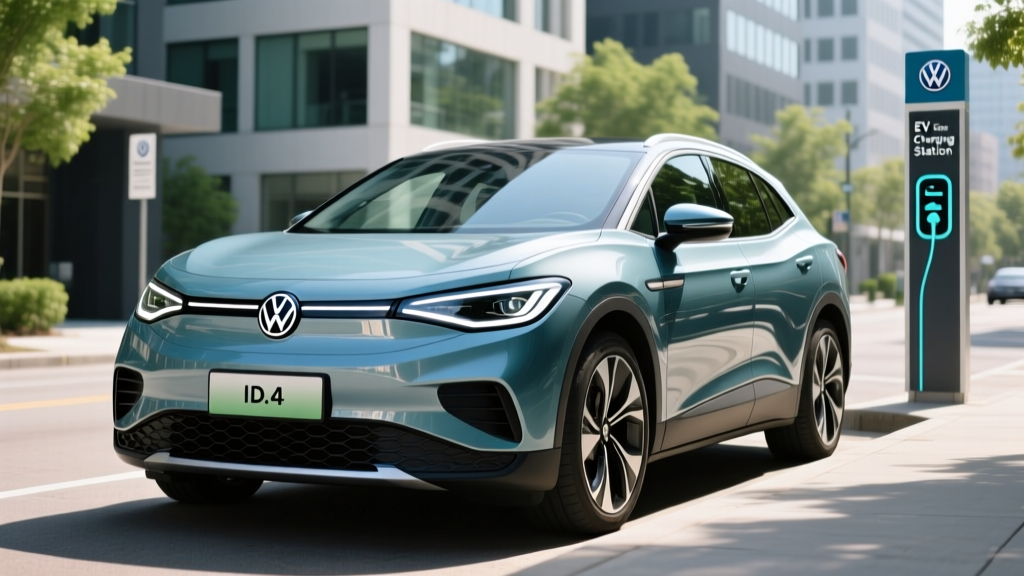
Bottom Line: The 2026 Volkswagen ID.4 is VW's primary electric car for US buyers, starting around $39,735 with an EPA-estimated range of up to 291 miles (RWD Standard). It qualifies for partial or full §30D federal tax credit depending on battery sourcing and buyer income. Real-world highway range drops to roughly 230–250 miles; cold climates knock off another 15–25%. It's a practical, roomy compact SUV for daily commuting and moderate road trips — but DC fast charging at 170 kW (peak) is slower than rivals like the Hyundai Ioniq 5.
Why the VW ID.4 Anchors VW's Electric Car Strategy
Volkswagen has bet its electrification future on the ID.4, a compact electric SUV built on the MEB platform. As of the 2026 model year, it remains the only VW electric car widely available in the United States, following the limited-run ID. Buzz minivan's niche positioning. The ID.4 competes directly with the Tesla Model Y, Hyundai Ioniq 5, Kia EV6, and Ford Mustang Mach-E in the most competitive EV segment in America.
VW positions the ID.4 as the accessible, family-friendly electric car — less performance-focused than a Tesla, more conventionally styled than a Hyundai. For buyers searching for an electric car VW option, the ID.4 is the vehicle to evaluate. The ID.7 sedan, initially announced for the US market, was shelved, leaving the ID.4 as the sole mainstream offering.
VW also offers the ID.4 in both rear-wheel-drive (RWD) and all-wheel-drive (AWD Pro S) configurations, with two battery pack sizes: a 62 kWh (usable) standard pack and an 82 kWh (usable) extended pack using NMC (nickel manganese cobalt) chemistry.
Range, Efficiency, and Real-World Expectations
The EPA range sticker tells only part of the story. Here's what the 2026 ID.4 lineup delivers on paper — and what you can actually expect on the road.
| Trim / Config | Battery (usable kWh) | EPA Range (mi) | MPGe (combined) | Real-World Highway | Cold-Weather Est. |
|---|---|---|---|---|---|
| Standard RWD | 62 kWh (NMC) | 206 | 104 MPGe | ~170–185 mi | ~145–160 mi |
| Pro RWD | 82 kWh (NMC) | 291 | 107 MPGe | ~235–260 mi | ~195–220 mi |
| AWD Pro S | 82 kWh (NMC) | 263 | 98 MPGe | ~215–235 mi | ~175–200 mi |
Real-World Range Reality: The EPA rates the ID.4 Pro RWD at 291 miles. In practice, sustained highway driving at 70–75 mph yields roughly 235–260 miles in moderate temperatures. In sub-30°F conditions without preconditioning, expect 195–220 miles. The ID.4's heat pump (standard on Pro trims) mitigates some cold-weather loss but won't eliminate it. If your commute is under 60 miles round-trip, even the Standard pack covers it easily with margin.
According to fueleconomy.gov, the ID.4 Pro RWD achieves 107 MPGe combined — competitive with the segment but trailing the Hyundai Ioniq 5's 114 MPGe. Efficiency matters because it directly determines how far each kWh of electricity takes you, and how much you'll spend charging.
Charging Speed: Where VW Falls Behind — and Where It Doesn't
Charging speed is where the ID.4 draws the most criticism from EV enthusiasts. Here's the full picture across all charging levels:
| Charging Level | Power (kW) | Connector | Speed (mi/hr added) | Notes |
|---|---|---|---|---|
| Level 1 (120V) | ~1.4 kW | J1772 / NACS | ~3–4 mi/hr | Emergency/trickle only |
| Level 2 (240V, 48A) | 11.5 kW | J1772 / NACS | ~33 mi/hr | Home/workplace standard |
| DC Fast Charge | 170 kW peak | CCS1 / NACS* | 10–80% in ~28 min | Tapers significantly above 80% |
*VW has announced NACS adoption for future model years. Current 2026 ID.4 models use CCS1 with a NACS adapter available for Tesla Supercharger access.
Charging curve reality: The ID.4 peaks at 170 kW but only sustains that rate between roughly 10–35% state of charge (SoC). By 60% SoC, the rate drops to ~100 kW, and above 80% it slows to under 50 kW. A 10–80% session takes approximately 28 minutes at a capable 175+ kW charger — roughly 8–10 minutes slower than an Ioniq 5 or EV6, which peak at 240+ kW on 800V architectures.
For home charging, the 11.5 kW onboard charger is adequate. A full 0–100% charge on Level 2 takes roughly 7.5 hours for the 82 kWh pack — easily handled overnight. Most EV owners with Level 2 home charging rarely use more than 30–40% of battery per day, making overnight replenishment effortless.
Pricing, Trims, and the Federal Tax Credit Question
The 2026 ID.4 lineup spans several trims. Here's the current MSRP structure (destination included):
- Standard: ~$39,735
- Pro: ~$43,735
- Pro S: ~$47,235
- AWD Pro S: ~$50,235
All trims fall under the $80,000 MSRP cap for SUVs under IRS §30D rules. However, the full $7,500 federal tax credit is not guaranteed for every buyer or every ID.4 configuration.
§30D Tax Credit Eligibility Checklist (2026 rules, per IRS.gov):
- Buyer AGI must not exceed $150K (single) / $300K (joint)
- Vehicle MSRP must be under $80,000 (SUVs) — ID.4 qualifies
- Battery critical minerals and component sourcing thresholds apply — VW has worked to localize supply, but verify current-year eligibility at purchase
- Credit can be transferred to the dealer at point of sale as a purchase-price reduction
- Vehicle must be assembled in North America — the US-built ID.4 (Chattanooga, TN) meets this requirement
Because battery-sourcing requirements tighten annually, the credit amount can shift mid-year. Always confirm the exact credit at the dealership and cross-reference with the IRS clean vehicle credit lookup tool before signing.
5-Year Ownership Cost: ID.4 vs a Gas Compact SUV
Numbers beat narratives. Here's how a 2026 ID.4 Pro RWD stacks up against a comparably priced gas compact SUV (e.g., Toyota RAV4 AWD) over 5 years and 75,000 miles:
| Cost Category | VW ID.4 Pro RWD | Gas Compact SUV (AWD) |
|---|---|---|
| Purchase Price (MSRP) | $43,735 | $36,500 |
| Federal Tax Credit | −$7,500 (if eligible) | $0 |
| Effective Purchase Price | $36,235 | $36,500 |
| Fuel/Energy (75K mi) | $3,750 (home L2 @ $0.14/kWh) | $8,400 (@ $3.50/gal, 28 MPG) |
| Maintenance (5 yr) | ~$1,200 | ~$3,500 |
| Insurance (5 yr avg) | ~$9,500 | ~$7,800 |
| Estimated Depreciation | ~$16,000 | ~$13,000 |
| 5-Year Total Cost | ~$66,685 | ~$69,200 |
Key takeaways: the ID.4 saves substantially on fuel and maintenance — no oil changes, fewer brake replacements (regen braking preserves pads), and no transmission fluid. Insurance is typically 15–25% higher for EVs due to repair costs and battery replacement risk. Depreciation on EVs remains higher than gas equivalents, though the gap is narrowing as the used-EV market matures.
If you charge primarily at home on a standard residential rate, the energy savings are significant. If you rely on public DC fast charging exclusively ($0.40–$0.60/kWh), your 75,000-mile energy cost jumps to roughly $6,500–$9,000, erasing much of the fuel-cost advantage.
EV vs Gas vs Hybrid: Which Powertrain Fits Your Life?
Not every buyer is best served by a full EV. Here's a decision framework based on real ownership patterns:
Choose the VW ID.4 (BEV) if:
- You have reliable home Level 2 charging (garage or driveway with 240V access)
- Your daily driving is under 100 miles round-trip
- You take road trips 2–4 times per year and can plan DC fast-charging stops
- You want minimal maintenance and maximum fuel savings
- You qualify for the §30D tax credit, closing the upfront price gap
Choose a PHEV (e.g., Toyota RAV4 Prime) if:
- You lack reliable home charging or live in an apartment
- You frequently drive 300+ miles in a day through charging deserts
- You want electric commuting (42 mi EV range) with gas flexibility for long trips
- Extreme cold (below 0°F) is common and range loss is unacceptable
Choose a gas vehicle if:
- Upfront cost is the primary constraint and you don't qualify for tax credits
- You drive over 25,000 miles/year mostly on highways with no charging access
- You tow frequently (the ID.4 is rated for only 2,700 lbs with the factory tow package)
Common Misconceptions About the VW ID.4 — and the Facts
| Myth | Fact |
|---|---|
| "The battery will need replacing in 5 years" | VW warranties the ID.4 battery for 8 years / 100,000 miles against degradation below 70% capacity. Real-world data from earlier MEB vehicles shows ~5–8% degradation at 60K miles. Full replacement (rare) costs $15,000–$20,000. |
| "It charges as fast as a Tesla" | The ID.4 peaks at 170 kW on a 400V architecture. Tesla Model Y on V3 Superchargers sustains ~250 kW. Expect ~28 min (10–80%) for the ID.4 vs ~18 min for a Model Y. |
| "EVs are worse in the cold" | Range drops 15–25% in sub-30°F weather — a real limitation. But the ID.4's heat pump and preconditioning feature (set via the app while plugged in) mitigate cabin heating energy draw. Traction and AWD performance are excellent. |
| "I can't take road trips" | With 291 miles EPA range and DC fast charging on Electrify America, EVgo, and (via adapter) Tesla Superchargers, road trips are viable — they just require 25–30 minute stops every 200–230 highway miles. |
| "The tax credit is gone" | As of 2026, the §30D credit remains available for qualifying buyers and vehicles. The Chattanooga-built ID.4 meets North American assembly rules, but battery-sourcing thresholds must be verified per the current IRS guidance. |
What First-Time EV Buyers Should Know Before Choosing VW
Home charging is non-negotiable for satisfaction. The vast majority of EV owners do 85–95% of their charging at home. Budget $500–$1,500 for a quality Level 2 charger (e.g., ChargePoint Home Flex, Emporia Vue) and $800–$2,500 for electrician installation, depending on whether your panel needs an upgrade to support a 50–60A circuit.
VW's software has improved but isn't Tesla-tier. The ID.4's infotainment system (updated for 2025–2026 with VW's 4.0 software) is faster and more intuitive than early ID models, which drew widespread criticism. Wireless CarPlay and Android Auto are standard. Over-the-air updates continue to refine the experience.
Maintenance is genuinely minimal. Expect cabin air filter replacement (~$50–$80 every 2 years), tire rotation, windshield washer fluid, and brake fluid checks. That's it. No oil, spark plugs, timing belts, or transmission service. VW's scheduled maintenance plan covers some items for the first two years.
Insurance costs more. Get quotes before buying. EV insurance premiums run 15–25% higher on average due to specialized repair requirements and battery replacement exposure. Shop multiple carriers — some offer EV-specific discounts.
The ID.4 drives like a Volkswagen. That means composed, comfortable, and quiet — not sporty. The RWD model delivers 201 hp and a 0–60 time of roughly 7.7 seconds. The AWD bumps output to 295 hp and drops 0–60 to about 5.4 seconds. Neither will thrill, but both are smooth, torque-rich, and confidence-inspiring in daily driving.
Frequently Asked Questions
Does the VW ID.4 qualify for the full $7,500 federal tax credit?
It can, but eligibility depends on your income (under $150K single / $300K joint AGI), the vehicle's battery-sourcing compliance for the current year, and MSRP (all ID.4 trims fall under the $80K SUV cap). The ID.4 is assembled in Chattanooga, TN, meeting North American assembly requirements. Confirm exact credit status with your dealer and the IRS clean vehicle credit page before purchase. The credit can be applied at point of sale as an immediate price reduction.
How long does it take to charge a VW ID.4 at home?
On a Level 2 home charger (240V, 48A, 11.5 kW), a full 0–100% charge of the 82 kWh Pro pack takes roughly 7.5 hours. Most owners plug in each evening and wake to a full battery. On a standard 120V outlet (Level 1), expect about 3–4 miles of range per hour of charging — sufficient only for very low-mileage days or emergency top-ups.
Can I use Tesla Superchargers with the VW ID.4?
VW has provided a CCS-to-NACS adapter for Supercharger access on current ID.4 models. Availability and compatibility vary by Supercharger generation and site. VW is expected to adopt the native NACS port in upcoming model years. Always verify adapter compatibility and check the Tesla app for site access before relying on Superchargers for a trip.
What is the real-world highway range of the ID.4?
The EPA rates the ID.4 Pro RWD at 291 miles. In real-world highway driving at 70–75 mph in moderate temperatures, expect 235–260 miles. In cold weather (below 30°F), that drops to roughly 195–220 miles. The AWD Pro S sacrifices some range for traction, delivering about 215–235 highway miles in fair conditions.
How does the ID.4 compare to the Tesla Model Y?
The Model Y offers more range (up to 320 mi EPA), faster DC charging (~250 kW peak), a more extensive proprietary Supercharger network, and stronger performance. The ID.4 counters with a lower starting price, a more conventional interior layout, competitive cabin space, and a more car-like ride quality. Both are strong choices — the Model Y favors tech-savvy road-trippers; the ID.4 suits buyers wanting a straightforward, comfortable electric SUV without the Tesla ecosystem.
What's the battery warranty on the VW ID.4?
VW covers the high-voltage battery for 8 years or 100,000 miles, whichever comes first, against capacity loss below 70% of original. This is the industry-standard warranty shared by most automakers. NMC chemistry in the ID.4 has shown moderate degradation rates of approximately 1–2% per year under normal use patterns.