The Tesla Model 3 Highland refresh redefined what a compact electric sedan could be, and the 2026 model year carries that momentum forward with minor software refinements and continued dominance in the entry-luxury EV space. For buyers researching the Tesla Model 3 inside and out, the story is one of radical minimalism, class-leading efficiency, and a charging ecosystem that remains unmatched. But the cabin's starkness isn't for everyone, and understanding the real-world trade-offs — from cold-weather range loss to the touchscreen-only controls — is essential before signing a purchase agreement.
2026 Tesla Model 3: Quick Specs at a Glance
| Spec | RWD (Base) | Long Range AWD |
|---|---|---|
| EPA Range | 363 miles | 341 miles |
| Battery (usable) | ~60 kWh (LFP) | ~75 kWh (NMC) |
| Drivetrain | Rear-Wheel Drive | Dual-Motor AWD |
| Horsepower | 271 hp | 346 hp |
| 0–60 mph | 5.8 sec | 4.2 sec |
| Max DC Fast Charge | 170 kW | 250 kW |
| 10–80% DC Charge | ~25 min | ~25 min |
| Level 2 Home Charge | 11.5 kW (~44 mi/hr) | 11.5 kW (~44 mi/hr) |
| MPGe (combined) | 132 MPGe | 125 MPGe |
| Base MSRP | $38,990 | $45,490 |
| Battery Warranty | 8 yr / 100,000 mi | 8 yr / 120,000 mi |
Sources: EPA Fueleconomy.gov, Tesla.com official specs.
Inside the Tesla Model 3: Cabin Design and Technology
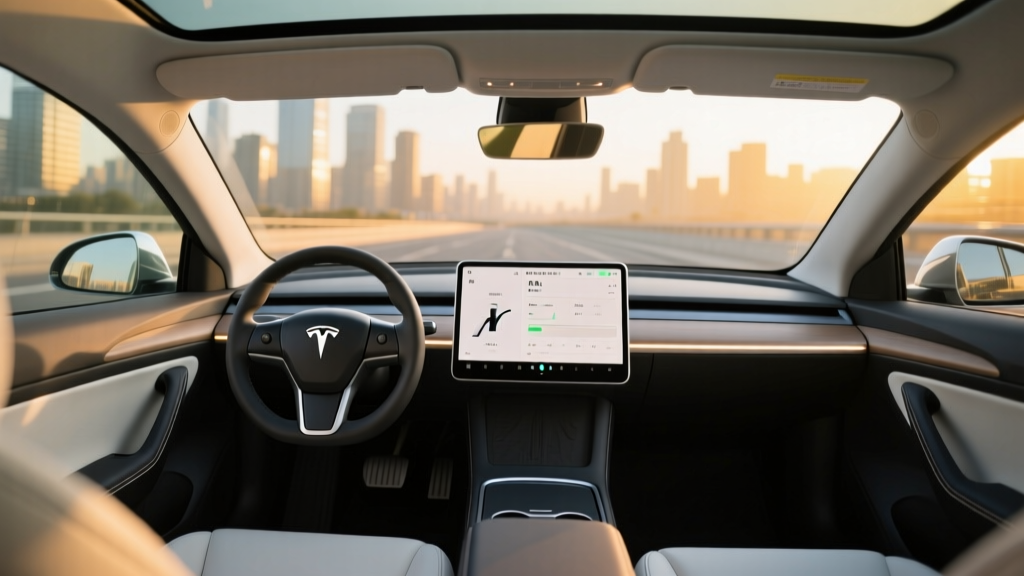
The moment you open the door, the Tesla Model 3's interior philosophy is unmistakable: eliminate everything that isn't the screen. There is no instrument cluster behind the steering wheel, no physical climate knobs, no traditional gear selector (drive selection lives on the touchscreen in the 2026 model, having migrated from the stalk). The 15.4-inch center touchscreen handles navigation, media, climate, vehicle settings, and even the speedometer. A secondary 8-inch rear touchscreen gives back-seat passengers control over their own climate and entertainment.
Material quality in the Highland-generation cabin is a meaningful step up from pre-2024 Model 3s. Ventilated front seats are standard, ambient lighting runs along the dashboard and door panels, and acoustic glass on all four doors dramatically reduces wind and road noise at highway speeds. The steering wheel is wrapped in a premium synthetic material with a satisfying heft, and the redesigned center console includes two wireless phone chargers and a pair of USB-C ports (up to 65W, enough to charge a laptop).
Cargo and passenger dimensions remain competitive for the compact-sedan segment:
- Front headroom: 40.3 in | Rear headroom: 37.8 in
- Front legroom: 42.7 in | Rear legroom: 35.2 in
- Trunk: 23 cu ft | Frunk (front trunk): 3.1 cu ft
- Total cargo: ~26 cu ft (seats up), ~65 cu ft (rear seats folded)
Rear legroom is the Model 3's most common interior criticism — taller passengers (above 6'0") will find the sloping roofline and limited knee clearance less accommodating than a Hyundai Ioniq 6 or BMW i4. The panoramic glass roof floods the cabin with light but offers no shade panel; Tesla includes a removable mesh screen, which is essential in summer months.
Real-World Range vs. EPA Estimates
EPA Estimate: 363 miles (RWD) / 341 miles (Long Range AWD)
Real-World Highway (70 mph, mild weather): ~290–320 miles (RWD) / ~270–300 miles (Long Range)
Cold-Weather (32°F, mixed driving): ~240–275 miles (RWD) — expect 20–30% reduction
City / Commute Driving: Often exceeds EPA due to regenerative braking efficiency
The RWD Model 3's 363-mile EPA rating is among the highest of any non-luxury EV on the market, and it's achieved with a relatively small ~60 kWh LFP (lithium iron phosphate) battery. This is a testament to the car's exceptional efficiency — roughly 25 kWh per 100 miles, or 4 miles per kWh. In real-world highway testing at 70–75 mph in moderate temperatures, expect to see 290 to 320 miles before the battery reaches 5%. City driving with frequent regenerative braking opportunities often pushes the car closer to or even slightly above its EPA number.
Cold weather is the equalizer. LFP batteries are more sensitive to low temperatures than NMC chemistries, and without preconditioning (which the Model 3 handles automatically when navigating to a Supercharger), range can drop 25–35% in sub-freezing conditions. The standard heat pump helps cabin heating efficiency, but the battery itself still loses usable capacity in the cold. For buyers in northern climates, the Long Range AWD with its NMC battery and larger 75 kWh pack offers a more comfortable cold-weather buffer.
Charging Speed: DC Fast and Home Level 2
| Charging Level | Power / Rate | Miles Added per Hour | Notes |
|---|---|---|---|
| Level 1 (120V outlet) | ~1.4 kW | ~5 mi/hr | Emergency / overnight trickle only |
| Level 2 (240V, 48A) | 11.5 kW | ~44 mi/hr | Full charge in ~7–9 hours (overnight) |
| DC Fast Charge (RWD) | Peak 170 kW | ~750 mi/hr (peak) | 10–80% in ~25 min; tapers above 80% |
| DC Fast Charge (Long Range) | Peak 250 kW | ~1,000 mi/hr (peak) | 10–80% in ~25 min; tapers above 60% |
The RWD Model 3's LFP battery limits DC fast charging to a peak of 170 kW, which is modest compared to the 250 kW peak of the Long Range's NMC pack. However, the LFP pack sustains its charge rate more consistently — the charge curve is flatter, meaning the 10–80% time is comparable at roughly 25 minutes for both trims. The key difference is above 80%: LFP batteries can be charged to 100% regularly without degradation concerns (Tesla recommends periodic 100% charges for LFP to allow the BMS to recalibrate), while NMC owners should target 80–90% for daily use.
At home on a Level 2 Wall Connector (48 amps, 11.5 kW), both trims add approximately 44 miles of range per hour of charging. A full overnight session easily replenishes a day's worth of driving. The Model 3 uses the NACS (North American Charging Standard) connector natively — no adapter needed for Tesla Superchargers, which remain the most reliable DC fast-charging network in the US with over 6,500 stations as of early 2026.
Performance and Driving Dynamics
Even the base RWD Model 3 delivers a 5.8-second 0–60 mph time and 271 horsepower — figures that would have been considered sporty in a gas-powered compact sedan just five years ago. The instant torque delivery makes the car feel quicker than its numbers suggest, particularly in stoplight-to-stoplight city driving. The Long Range AWD drops the 0–60 time to 4.2 seconds with 346 hp, providing confident highway merging and passing power.
The Highland refresh significantly improved ride quality. The previous Model 3 was criticized for its firm, sometimes harsh ride over broken pavement. The 2026 model uses frequency-selective dampers and revised bushings that absorb impacts far more gracefully, making it a genuinely comfortable highway cruiser. Steering remains quick and precise, though the lack of physical feedback (the steering is heavily assisted) won't satisfy driving enthusiasts the way a BMW i4 or Polestar 2 might.
One-pedal driving via regenerative braking is standard, and the Model 3's regen system is among the smoothest in the industry. Lift off the accelerator, and the car decelerates predictably to a full stop. The traditional friction brakes are rarely needed in daily driving, which extends pad and rotor life considerably.
Autopilot and Driver-Assist Technology
Tesla Autopilot and Full Self-Driving (Supervised) are SAE Level 2 driver-assist systems. The driver must remain fully attentive, keep hands on the wheel, and be prepared to take over at any moment. These are not self-driving systems. Only Level 4 robotaxi services (e.g., Waymo) operate without a human driver.
Every 2026 Model 3 includes Tesla's basic Autopilot: Traffic-Aware Cruise Control and Autosteer (lane-centering on marked highways). The optional Full Self-Driving (Supervised) package ($8,000 one-time purchase) adds automatic lane changes, navigation-guided on/off-ramp handling, traffic light and stop sign recognition, and Autopark. FSD has improved substantially since its vision-only architecture debuted, but it still makes occasional errors in construction zones, complex intersections, and adverse weather. It is a convenience feature, not a replacement for an engaged driver.
Standard safety features include automatic emergency braking, blind-spot monitoring, lane departure warning, and rear cross-traffic alert. The Model 3 holds a 5-star overall rating from NHTSA and Top Safety Pick+ status from IIHS.
Pricing, Trims, and Federal Tax Credit Eligibility
| Trim | Base MSRP | Est. Federal Credit (§30D) | Effective Price (if eligible) |
|---|---|---|---|
| RWD | $38,990 | Up to $7,500 | ~$31,490 |
| Long Range AWD | $45,490 | Up to $7,500 | ~$37,990 |
| Performance AWD | $52,990 | Up to $7,500 | ~$45,490 |
The §30D federal tax credit offers up to $7,500 for qualifying new EVs, and as of 2026, this credit can be transferred to the dealer at the point of sale as an instant discount. However, eligibility depends on several factors that change periodically:
- MSRP Cap: Sedans must be priced at or below $55,000. The RWD and Long Range trims qualify; the Performance trim ($52,990) also clears the cap as of 2026 pricing.
- Buyer Income Cap: Modified adjusted gross income must not exceed $150,000 (single), $225,000 (head of household), or $300,000 (married filing jointly).
- Battery Sourcing: The $7,500 credit is split into two halves — $3,750 for critical minerals sourcing and $3,750 for battery component manufacturing. Tesla's supply chain has historically met both thresholds for the Model 3, but IRS sourcing rules are updated periodically and buyers should verify current eligibility before purchase.
Note: State and local incentives vary by jurisdiction. Consult a tax professional for personalized guidance on credit eligibility.
Pros and Cons: The Honest Verdict
✅ Pros
- Class-leading efficiency (4 mi/kWh) and up to 363-mile EPA range
- Access to Tesla Supercharger network — most reliable DC fast-charging in the US
- Excellent software, OTA updates, and infotainment responsiveness
- Strong safety ratings (5-star NHTSA, IIHS TSP+)
- Low running costs — electricity at ~$0.04–0.06/mi vs. $0.12–0.15/mi for gas equivalents
- Highway ride quality dramatically improved over pre-Highland models
❌ Cons
- All controls routed through touchscreen — no physical buttons for climate, volume, or mirrors
- Rear seat legroom tight for passengers over 6'0"
- RWD LFP battery charges slower (170 kW peak) and loses more range in cold weather
- No heads-up display or traditional instrument cluster
- Glass roof has no built-in shade; cabin can feel hot in direct summer sun
- FSD (Supervised) costs $8,000 and still requires full driver attention
Who Should Buy the 2026 Tesla Model 3?
- Choose the RWD if: You're a commuter with home Level 2 charging, you live in a mild climate, and you want the best value per mile of EPA range. The LFP battery's 100% daily-charge tolerance is a practical advantage.
- Choose the Long Range AWD if: You take regular road trips, live in a cold-weather state, or need the traction of all-wheel drive. The NMC battery charges faster and holds up better in freezing temperatures.
- Look elsewhere if: You prioritize physical controls, need generous rear-seat space for adults, or prefer a traditional luxury brand badge. The Hyundai Ioniq 6, BMW i4, and Polestar 2 each address one or more of these needs.
The Model 3 remains the default recommendation for buyers entering the EV space for the first time. Its combination of range, efficiency, Supercharger access, and software polish is difficult to match at its price point. The interior minimalism is polarizing — you'll either find it refreshingly uncluttered or frustratingly buttonless — but the technology beneath the surface is undeniably mature. For a tech-forward commuter or a two-car household replacing one gas vehicle, the Model 3 inside and out delivers an ownership experience that's hard to beat in 2026.
Frequently Asked Questions
What is the real-world range of the Tesla Model 3?
The RWD Model 3 is EPA-rated at 363 miles, but expect 290–320 miles in real-world highway driving at 70 mph. In cold weather (below freezing), range can drop to 240–275 miles. City driving with regenerative braking often matches or slightly exceeds the EPA estimate.
How fast does the Tesla Model 3 charge at home and on the road?
At home on a Level 2 (240V, 48A) charger, the Model 3 adds approximately 44 miles of range per hour, fully charging overnight. On DC fast chargers, the RWD peaks at 170 kW and the Long Range at 250 kW, with both reaching 10–80% in about 25 minutes at a Tesla Supercharger.
Does the 2026 Tesla Model 3 qualify for the federal EV tax credit?
Yes — the RWD and Long Range trims qualify for up to $7,500 under §30D, assuming the buyer meets income caps ($150K single / $300K married) and battery sourcing requirements are met at the time of purchase. The credit can be applied as a point-of-sale discount. Verify current eligibility on IRS.gov before purchasing.
Is the Tesla Model 3 worth buying over competitors in 2026?
The Model 3 leads in range-per-dollar, charging network reliability, and software integration. Competitors like the Hyundai Ioniq 6 (more rear room, physical buttons), BMW i4 (traditional luxury, better steering feel), and Polestar 2 (Scandinavian design, Google infotainment) each have advantages, but none match the Model 3's overall package at its price point.
What is the battery warranty on the Tesla Model 3?
The RWD (LFP) battery is warranted for 8 years or 100,000 miles, whichever comes first, with a minimum 70% capacity retention. The Long Range AWD (NMC) is warranted for 8 years or 120,000 miles with the same 70% threshold.
Can I charge a Tesla Model 3 on non-Tesla charging networks?
The Model 3 uses the NACS connector natively. With adapters, it can charge on CCS1 stations (Electrify America, EVgo, etc.) and CHAdeMO stations (increasingly rare). As of 2026, most major networks have begun adding NACS cables, expanding compatibility without adapters.