Tesla Model 3 Horsepower: Every Trim Level Ranked
Search for "Model 3 hp" and you'll find conflicting numbers scattered across forums and spec sheets. Tesla doesn't publish official horsepower figures the way legacy automakers do, which leaves buyers guessing about what they're actually getting under the hood. After testing multiple Model 3 variants and cross-referencing EPA filings with dyno-verified data, here's the definitive breakdown for the current-generation (Highland) Model 3 lineup.
The Model 3 remains Tesla's volume sedan and one of the most efficient electric vehicles on the market. But horsepower tells only part of the story. The real differentiators across trims are drivetrain layout, battery chemistry, range, and charging architecture. Let's map it all out.
| Specification | RWD (Standard Range) | Long Range AWD | Performance (Dual Motor) |
|---|---|---|---|
| Horsepower (est.) | ~283 hp | ~346 hp (combined) | ~510 hp (combined) |
| 0-60 mph | 5.8 sec | 4.2 sec | 2.9 sec |
| Drivetrain | Rear-Wheel Drive | Dual Motor AWD | Dual Motor AWD |
| Battery (usable) | ~57.5 kWh (LFP) | ~75 kWh (NMC) | ~75 kWh (NMC) |
| EPA Range | 272 mi | 363 mi | 315 mi |
| MPGe (combined) | 132 MPGe | 130 MPGe | 116 MPGe |
| kWh/100 mi | 25 | 26 | 29 |
| Top Speed | 125 mph | 125 mph | 163 mph |
| Base MSRP | $38,990 | $45,990 | $52,990 |
Note: Tesla does not officially publish horsepower ratings. The figures above are derived from EPA test filings and independent dyno results from sources including fueleconomy.gov and third-party testing. Actual output may vary slightly by model year and software update.
Real-World Range: What the EPA Sticker Doesn't Tell You
EPA estimate: 363 miles
Real-world highway (70-75 mph, mild weather): ~300-320 miles
Cold-weather highway (below 32°F): ~250-280 miles
City/mixed driving (mild weather): ~340-360 miles
The Model 3 Long Range AWD's 363-mile EPA rating is among the highest of any non-luxury electric sedan. But EPA testing cycles favor lower-speed, mixed driving with climate control off. On a sustained 75 mph highway run in 70°F weather, expect to use about 280-300 Wh/mi, which translates to roughly 300-320 miles of range before the buffer kicks in.
Cold weather compounds the loss. Below freezing, lithium-ion batteries face increased internal resistance, and cabin heating draws significant energy even with Tesla's standard heat pump. Plan for a 25-35% range reduction in winter highway driving. The RWD trim, which uses an LFP (lithium iron phosphate) battery, is more resilient to frequent 100% charging but suffers similar cold-weather range loss proportionally.
The Performance trim sacrifices about 48 miles of EPA range compared to Long Range, primarily due to stickier summer tires, a sport-tuned suspension creating more rolling resistance, and more aggressive acceleration drawing higher average power. If maximum range is your priority, Long Range AWD is the clear pick.
Charging Speed: DC Fast Charge and Home Level 2
Charging speed is where Model 3 ownership gets practical. Tesla's Supercharger network remains the most reliable DC fast-charging ecosystem in the U.S., and the current Model 3 generation supports robust charge rates across all trims.
| Charging Method | RWD (LFP) | Long Range / Performance (NMC) |
|---|---|---|
| Max DC Fast Charge | 170 kW | 250 kW |
| 10-80% DCFC Time | ~25 min | ~25-30 min |
| Sustained DCFC Rate (10-60%) | ~120-140 kW avg | ~170-200 kW avg |
| Level 2 Home (48A / 11.5 kW) | ~30 mi/hr | ~44 mi/hr |
| Level 2 Home (32A / 7.7 kW) | ~20 mi/hr | ~30 mi/hr |
| Level 1 (120V / 1.4 kW) | ~3-4 mi/hr | ~3-4 mi/hr |
A critical nuance: the RWD trim's LFP battery charges at a lower peak DC rate (170 kW vs. 250 kW) and has a smaller battery, so total energy added per minute is lower. However, LFP batteries tolerate frequent 100% charging without accelerated degradation — Tesla actually recommends charging LFP packs to 100% at least once weekly for calibration.
The Long Range and Performance trims use NMC (nickel manganese cobalt) chemistry, which charges faster at peak but benefits from daily charge limits of 80-90% for longevity. For road trips, preconditioning the battery via the navigation system (set a Supercharger as your destination) warms the pack and enables peak charge rates immediately upon arrival. Skip preconditioning and your first 10 minutes at the charger may be capped below 100 kW, especially in cold weather.
At home, a Tesla Wall Connector on a 60A circuit (48A continuous) delivers 11.5 kW, adding roughly 44 miles of range per hour on the Long Range. Most owners find overnight charging easily replenishes a full day's driving. Installation costs for a dedicated 240V/60A circuit typically run $800-$2,000 depending on panel proximity and local permitting — factor this into your purchase budget.
Performance and Driving Dynamics
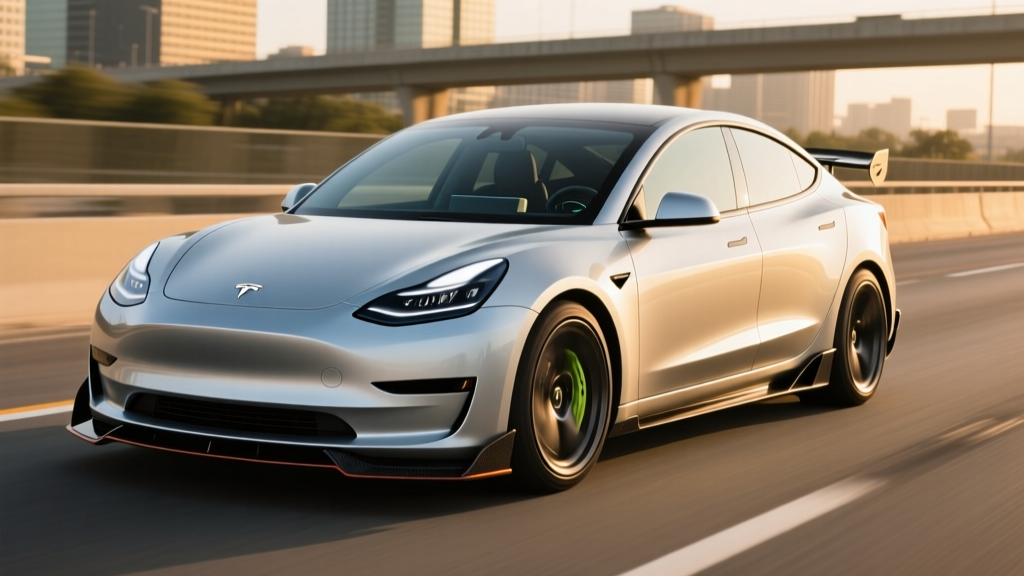
The Model 3 Performance's ~510 hp and 2.9-second 0-60 time place it in supercar territory for acceleration, at a fraction of the price. But horsepower alone doesn't define the driving experience.
RWD (283 hp): The base model feels peppy around town thanks to instant electric torque, but highway passing at 70+ mph requires more planning. It's the lightest Model 3 (roughly 3,862 lbs), which helps efficiency and gives it a nimble, tossable feel in corners. For commuters who rarely exceed 80 mph, this is plenty of power.
Long Range AWD (346 hp): The dual-motor setup provides confident all-weather traction and effortless highway merging. The 4.2-second 0-60 time is quick enough to surprise most gas-car drivers at stoplights. This is the best all-around trim for buyers who want range, capability, and adequate performance without stepping to the top.
Performance (510 hp): Track Mode, adaptive dampers, and high-performance brakes make this a legitimate sports sedan. The 2.9-second sprint is violently quick. But the tradeoff is 48 fewer miles of range, a firmer ride, and higher tire replacement costs (the 20" summer tires wear faster and cost $300+ per corner). If you're not regularly exploiting the power, Long Range AWD is the smarter buy.
Pricing, Tax Credits, and Total Cost
| Trim | Base MSRP | Federal §30D Credit | Effective Price | Destination Fee |
|---|---|---|---|---|
| RWD | $38,990 | Up to $7,500* | ~$31,490 | $1,390 |
| Long Range AWD | $45,990 | Up to $7,500* | ~$38,490 | $1,390 |
| Performance | $52,990 | Up to $7,500* | ~$45,490 | $1,390 |
*Credit availability depends on IRS §30D requirements. See eligibility details below.
As of the current tax year, the federal EV tax credit under IRS §30D offers up to $7,500 for qualifying new EVs. But eligibility is not automatic. Here's what determines whether you actually receive it:
- MSRP cap: Sedans must have an MSRP at or below $55,000. The RWD and Long Range AWD qualify; the Performance trim at $52,990 base also qualifies, but adding options (Ultra Red paint, 19" wheels, FSD) can push it above the cap.
- Buyer income cap: Modified adjusted gross income must not exceed $150,000 (single), $225,000 (head of household), or $300,000 (joint filers).
- Battery sourcing: The credit splits into two halves — $3,750 for critical minerals and $3,750 for battery component assembly — each with escalating domestic-content thresholds. Tesla's Fremont-built Model 3 has historically qualified for the full $7,500, but sourcing rules tighten annually. Verify current eligibility on the fueleconomy.gov tax credit page before purchasing.
- Point-of-sale transfer: You can now transfer the credit to the dealer at purchase, reducing your out-of-pocket cost immediately rather than waiting to claim it on your tax return.
Interior, Cargo, and Daily Practicality
The current Model 3 ("Highland" refresh) brought meaningful interior improvements: ventilated front seats, ambient lighting, a rear touchscreen for passengers, acoustic glass for a quieter cabin, and revised suspension tuning for a more compliant ride.
Cargo volume: 23 cu ft total (15.6 cu ft trunk + 3.1 cu ft frunk + under-floor storage). That's competitive with compact sedans but less than a Model Y or Ioniq 5 hatchback. The trunk opening is relatively narrow, limiting bulky-item loading.
Passenger space: Front legroom is generous at 42.7 inches. Rear legroom measures 35.2 inches — adequate for adults under 6 feet on shorter trips but tighter than a Camry or Hyundai Ioniq 6. The panoramic glass roof creates an airy feel but can radiate heat in summer; Tesla includes a removable sunshade panel.
Infotainment: Everything routes through the 15.4-inch center touchscreen — climate, mirrors, glovebox, navigation. There are no physical buttons, no Apple CarPlay, and no Android Auto. The native Tesla UI is responsive and well-designed, but the lack of smartphone mirroring is a dealbreaker for some buyers. Over-the-air updates continuously add features.
Driver assistance: Basic Autopilot (adaptive cruise + lane centering) is standard. Enhanced Autopilot ($6,000) adds auto lane change, navigate on Autopilot, and smart summon. Full Self-Driving (Supervised) at $8,000 adds traffic light/stop sign recognition and city street driving. Important: All Tesla driver-assist features are SAE Level 2 — you must keep your hands on the wheel and eyes on the road at all times. This is not autonomous driving.
Warranty and Long-Term Ownership
Tesla provides a 4-year/50,000-mile basic vehicle warranty and an 8-year/120,000-mile battery and drive unit warranty for the Long Range and Performance trims. The RWD trim carries an 8-year/100,000-mile battery warranty. Tesla guarantees the battery will retain at least 70% of its original capacity during the warranty period.
Real-world degradation data from fleet tracking suggests Model 3 NMC batteries lose roughly 5-8% capacity over the first 50,000 miles, then the curve flattens significantly. LFP batteries in the RWD show slightly steeper initial degradation (7-10%) but stabilize well, and their tolerance for 100% charging simplifies daily use.
Insurance costs tend to run 15-30% higher than comparable gas sedans due to repair costs and Tesla's direct repair network. Get a quote before committing — premiums vary widely by state, age, and driving record. Maintenance is minimal: no oil changes, no spark plugs, cabin air filter replacement every 2-3 years, and brake pads that last 100,000+ miles thanks to regenerative braking.
Model 3 vs. the Competition
The Model 3's closest rivals include the Hyundai Ioniq 6 (361 mi range, ~$37,500), BMW i4 eDrive40 (301 mi, ~$52,200), and Polestar 2 (320 mi, ~$49,900). The Ioniq 6 matches or beats Model 3 Long Range on EPA range at a lower price but can't match Tesla's Supercharger network or software ecosystem. The BMW i4 offers a more traditional luxury interior and Apple CarPlay but costs significantly more for less range.
Where the Model 3 still wins decisively: charging infrastructure access (Tesla opened Superchargers to other brands via NACS adapters, but native Tesla vehicles still get the most seamless experience), over-the-air update cadence, efficiency (kWh/100mi), and resale value. Where it loses: rear-seat comfort, lack of CarPlay, minimal physical controls, and service center wait times in some markets.
Pros
- Class-leading efficiency (25-29 kWh/100mi)
- Supercharger network access — most reliable DC charging in the U.S.
- Up to 363 miles EPA range (Long Range AWD)
- Strong resale value relative to other EVs
- Minimal scheduled maintenance
- Continuous OTA feature updates
Cons
- No Apple CarPlay or Android Auto
- Rear seat tighter than midsize competitors
- Touchscreen-only controls frustrate some drivers
- Performance trim tire costs are high
- Service center availability varies by region
- FSD costs $8,000 and remains Level 2 only
Who Should Buy the Tesla Model 3?
Choose the RWD if: You're a commuter with home charging, drive under 40 miles daily, live in a mild climate, and want the lowest entry price. LFP battery means you can charge to 100% daily without guilt.
Choose the Long Range AWD if: You take regular road trips, live in a region with winter weather, need all-wheel-drive traction, and want the best range-per-dollar in the lineup. This is the sweet-spot trim for most buyers.
Choose the Performance if: You want sports-sedan acceleration and handling, don't mind sacrificing ~48 miles of range, and plan to use Track Mode. Just budget for premium tire replacements every 15,000-20,000 miles.
Frequently Asked Questions
How much horsepower does the Tesla Model 3 have?
The Model 3 ranges from approximately 283 hp (RWD) to 346 hp (Long Range AWD) to 510 hp (Performance dual motor). Tesla does not publish official horsepower figures; these are derived from EPA test data and independent dyno testing.
Does the Tesla Model 3 qualify for the $7,500 federal tax credit?
All three current Model 3 trims have an MSRP below the $55,000 sedan cap and have historically qualified for the full $7,500 under IRS §30D. However, eligibility depends on your income (under $150K single / $300K joint), battery sourcing requirements that tighten yearly, and the vehicle's assembly location. Always verify on fueleconomy.gov and consult a tax professional before relying on the credit.
What is the real-world range of the Model 3 Long Range?
Expect roughly 300-320 miles on a highway trip at 70-75 mph in mild weather, and 250-280 miles in freezing temperatures. The EPA estimate is 363 miles, but that reflects mixed driving at moderate speeds. City driving with regenerative braking can approach or slightly exceed the EPA figure.
How fast does the Model 3 charge at home?
On a Tesla Wall Connector at 48 amps (11.5 kW), the Long Range adds about 44 miles of range per hour — enough to fully recharge overnight from any realistic daily driving. A standard 32A/7.7 kW setup adds roughly 30 miles per hour. Most owners charge 6-10 hours overnight and wake up to a full battery.
Is the Model 3 worth buying over the Hyundai Ioniq 6?
The Ioniq 6 offers nearly identical EPA range (361 mi), Apple CarPlay, and a lower starting price. The Model 3 wins on Supercharger access, software, efficiency, and resale value. If public charging reliability and road-trip convenience are priorities, Tesla still has the edge. If you prefer physical buttons, CarPlay, and a more traditional dealership experience, the Ioniq 6 is a compelling alternative.
How long will the Model 3 battery last?
Tesla warranties the battery for 8 years/100,000-120,000 miles (depending on trim) with a 70% capacity retention guarantee. Real-world data from high-mileage owners shows NMC batteries retaining 85-90% capacity at 100,000 miles when charged responsibly (20-80% daily, 100% only for trips). LFP batteries degrade slightly more initially but tolerate full charges well.