If you've spent any time scrolling Tesla forums or TikTok, you've probably encountered the legendary Tesla fart sounds. What started as a quirky in-car joke has become one of the most recognizable Easter eggs in the EV world. But beyond the whoopee-cushion theatrics, Tesla's software is packed with hidden features that blend humor, utility, and personalization — and they come wrapped in some of the most capable electric vehicles on the market.
This guide covers everything you need to know about Tesla's Easter eggs and entertainment features in the 2026 Model 3 and 2026 Model Y — and then delivers the full, spec-driven review that buyers actually need: real-world range, charging speeds, pricing after tax credits, and whether these cars still hold up against a rapidly expanding field of competitors.
How to Trigger Tesla Fart Sounds and Easter Eggs
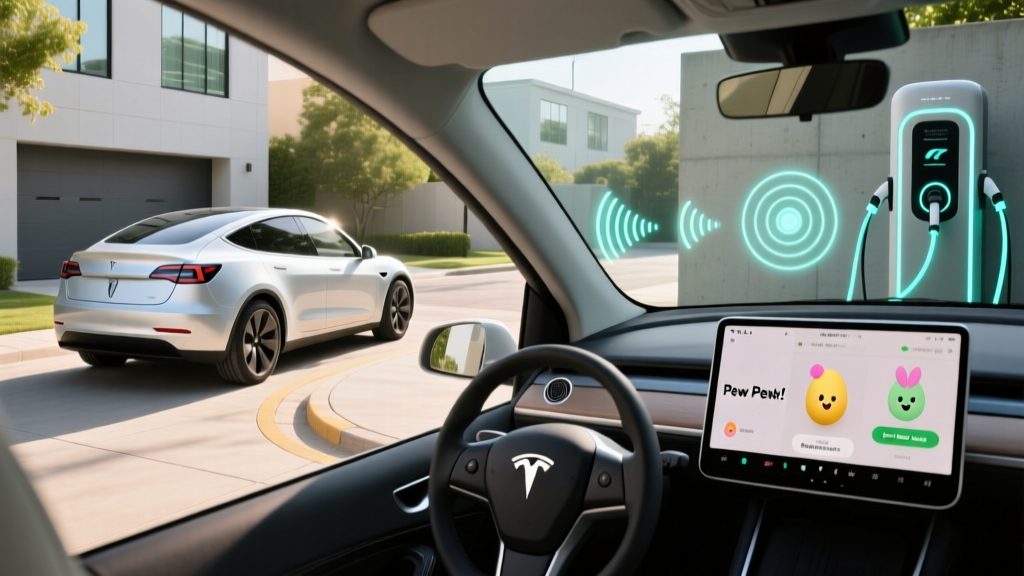
Tesla's fart sound feature lives inside the car's Toybox menu, accessible from the main touchscreen. Here's how to find it and what it does:
- Fart Sounds: Navigate to Controls > Toybox > Fart. You can select from a library of fart sound effects (names like "Rippin' Cotton," "Not My Fault," and "Pucker Factor") and assign them to trigger on demand via the touchscreen or automatically when the turn signal is activated. You can also send a fart sound to a specific seat — perfect for pranking a passenger.
- Boombox: Replace your car's external pedestrian warning speaker with custom sounds, including fart noises, when parked. (Note: Tesla restricted Boombox's use while driving in early 2022 following NHTSA scrutiny.)
- Emissions Test Mode: A related Easter egg that pairs the fart sounds with a fake "emissions test" animation on the screen — activated by holding the Tesla logo on the About screen.
Other notable Tesla Easter eggs in 2026:
- Romance Mode: Displays a crackling fireplace on screen with ambient sounds.
- Light Show: Synchronizes headlights, turn signals, and mirrors to music (Model 3 Highland and refreshed Model Y).
- Sketchpad: A drawing app accessible while parked.
- Chill Mode: Tones down acceleration for valet or new drivers.
- Dog Mode / Sentry Mode: Not hidden, but frequently underused — keeps climate on for pets or records incidents near the car.
Fun as these features are, they're the garnish — not the meal. Let's get into the specs that matter when you're spending $40,000+ on a vehicle.
2026 Tesla Model 3: Full Specs and Real-World Performance
The refreshed Model 3 (introduced for 2024 and carried into 2026 with minor updates) remains Tesla's entry-level sedan and one of the most efficient EVs ever sold. Here's the complete spec breakdown:
| Spec | Model 3 RWD | Model 3 Long Range AWD | Model 3 Performance |
|---|---|---|---|
| EPA Range | 363 miles | 341 miles | 315 miles |
| Battery (usable, est.) | ~57 kWh (LFP) | ~75 kWh (NMC) | ~75 kWh (NMC) |
| Drivetrain | Rear-Wheel Drive | Dual-Motor AWD | Dual-Motor AWD |
| Horsepower | 271 hp | 346 hp | 510 hp |
| 0–60 mph | 5.8 sec | 4.2 sec | 2.9 sec |
| MPGe (combined) | 132 MPGe | 125 MPGe | 113 MPGe |
| kWh / 100 mi | 25 | 27 | 30 |
| Max DC Fast Charge | 170 kW | 250 kW | 250 kW |
| 10–80% DCFC Time | ~28 min | ~18 min | ~18 min |
| Level 2 Home Charging | 11.5 kW (~44 mi/hr) | 11.5 kW (~44 mi/hr) | 11.5 kW (~44 mi/hr) |
| Cargo Volume | 23 cu ft (trunk) + 3.1 cu ft (frunk) | ||
| Rear Legroom | 35.2 in | ||
| Base MSRP | $38,990 | $45,990 | $52,990 |
🔋 Real-World Range Reality Check: The EPA estimates above assume a mix of city and highway driving at moderate temperatures. In real-world highway driving at 70–75 mph, expect the Model 3 RWD to deliver approximately 300–320 miles and the Long Range AWD around 280–300 miles. In cold weather (below 32°F / 0°C), range can drop 20–30% — meaning a 363-mile RWD Model 3 might return 250–270 miles on a frigid winter road trip. Preconditioning the battery while plugged in helps mitigate this loss.
2026 Tesla Model Y: Full Specs and Real-World Performance
The Model Y received a significant refresh (codenamed "Juniper") that rolled out in 2025, bringing a redesigned interior, ambient lighting, ventilated rear seats, a rear touchscreen, and improved ride quality. Here are the 2026 specs:
| Spec | Model Y RWD | Model Y Long Range AWD | Model Y Performance |
|---|---|---|---|
| EPA Range | 320 miles | 320 miles | 285 miles |
| Battery (usable, est.) | ~60 kWh (LFP) | ~75 kWh (NMC) | ~75 kWh (NMC) |
| Drivetrain | Rear-Wheel Drive | Dual-Motor AWD | Dual-Motor AWD |
| Horsepower | 295 hp | 384 hp | 456 hp |
| 0–60 mph | 6.0 sec | 4.8 sec | 3.5 sec |
| MPGe (combined) | 123 MPGe | 119 MPGe | 111 MPGe |
| kWh / 100 mi | 27 | 28 | 30 |
| Max DC Fast Charge | 170 kW | 250 kW | 250 kW |
| 10–80% DCFC Time | ~30 min | ~20 min | ~20 min |
| Level 2 Home Charging | 11.5 kW (~37 mi/hr) | 11.5 kW (~37 mi/hr) | 11.5 kW (~37 mi/hr) |
| Cargo Volume | 30 cu ft (rear seats up) + 4.1 cu ft (frunk); 72 cu ft (seats folded) | ||
| Rear Legroom | 40.5 in | ||
| Base MSRP | $44,990 | $49,990 | $55,990 |
🔋 Real-World Range Reality Check: The refreshed Model Y's aerodynamic improvements helped boost efficiency, but the crossover's taller profile still costs it a few miles versus the Model 3 on the highway. Expect 260–280 miles real-world highway range from the Long Range AWD, and 230–250 miles in cold weather. The Performance trim's stickier tires and sport tuning drop real-world range to roughly 220–240 miles on a mixed highway trip.
Charging Deep Dive: How Fast Do the Model 3 and Model Y Actually Charge?
Charging speed is one of the most misunderstood specs in EV ownership. The peak kW number on a spec sheet doesn't tell the full story — the charge curve matters far more.
| Charging Level | Power (kW) | Model 3 (mi/hr) | Model Y (mi/hr) | Notes |
|---|---|---|---|---|
| Level 1 (120V outlet) | ~1.4 kW | ~5 mi/hr | ~4 mi/hr | Emergency/trickle only |
| Level 2 (240V, 48A) | 11.5 kW | ~44 mi/hr | ~37 mi/hr | Standard home install; full charge in ~6–8 hrs |
| DC Fast (RWD trims) | 170 kW peak | — | — | Sustains ~150 kW to 50%, tapers to <50 kW above 80% |
| DC Fast (LR / Perf) | 250 kW peak | — | — | Holds ~230 kW from 10–30%, tapers sharply above 80% |
The taper reality: Both the Model 3 and Model Y hit their peak DC fast-charge rate only in the lower portion of the battery (roughly 10–30% state of charge). By the time you reach 60%, the rate has already dropped significantly, and above 80% it slows to a trickle. This is why the 10–80% time is the most meaningful metric — and why Tesla's navigation system preconditions the battery when routing to a Supercharger, warming it to the optimal temperature for maximum charge speed.
For home charging, a 240V / 48-amp Level 2 wall connector (roughly $400 for the unit, $800–$2,000 for professional installation depending on your electrical panel) is the practical standard. This adds roughly 250–300 miles of range overnight — more than enough for virtually any daily driving pattern.
Pricing, Trims, and Federal Tax Credit Eligibility (2026)
Tesla's pricing has fluctuated frequently, but as of early 2026, here's where the Model 3 and Model Y stand — including the impact of the IRS §30D federal tax credit.
| Model / Trim | Base MSRP | Federal Credit (est.) | Effective Price |
|---|---|---|---|
| Model 3 RWD | $38,990 | Up to $7,500* | ~$31,490 |
| Model 3 Long Range AWD | $45,990 | Up to $7,500* | ~$38,490 |
| Model 3 Performance | $52,990 | Up to $7,500* | ~$45,490 |
| Model Y RWD | $44,990 | Up to $7,500* | ~$37,490 |
| Model Y Long Range AWD | $49,990 | Up to $7,500* | ~$42,490 |
| Model Y Performance | $55,990 | Up to $7,500* | ~$48,490 |
*Critical eligibility caveats for the §30D credit:
- Income caps: Modified adjusted gross income must not exceed $150,000 (single), $225,000 (head of household), or $300,000 (married filing jointly).
- MSRP caps: Sedans (Model 3) must have an MSRP at or below $55,000; SUVs/trucks/vans (Model Y) must be at or below $80,000. All current Model 3 and Model Y trims qualify on MSRP.
- Battery sourcing: The credit is split into two $3,750 halves — one for critical minerals sourcing and one for battery component manufacturing. Tesla's US-built batteries have historically qualified for the full $7,500, but sourcing rules tighten annually. Verify current eligibility on fueleconomy.gov before purchasing.
- Point-of-sale transfer: As of 2024, buyers can transfer the credit to the dealer at the point of sale, receiving the discount upfront rather than waiting for tax filing.
Consult a tax professional to confirm your personal eligibility. Rules can and do change.
Standout Tech: Autopilot, FSD, and the Tesla Software Advantage
Tesla's software ecosystem remains its most distinctive feature — and its most debated.
⚠️ SAE Automation Level Reminder: Tesla Autopilot and Full Self-Driving (Supervised) are SAE Level 2 driver-assistance systems. The driver must remain fully engaged, hands on the wheel (or providing steering torque), and eyes on the road at all times. These systems are not self-driving. Only Level 4 services like Waymo operate without a human driver.
What you get standard:
- Basic Autopilot: Traffic-aware cruise control and lane-centering on highways. Included on all trims.
- 15.4" touchscreen (Model 3) / 15.4" front + 8" rear touchscreen (refreshed Model Y)
- Over-the-air updates that regularly add features
- Tesla mobile app with remote climate, location, Sentry Mode clips, and Summon
- Access to the full Tesla Supercharger network (17,000+ stalls in North America)
Optional upgrades:
- Enhanced Autopilot ($6,000): Adds automatic lane changes, Navigate on Autopilot, Auto Park, and Summon.
- Full Self-Driving (Supervised) ($8,000): Adds traffic light/stop sign recognition and city street autosteer. Still requires active supervision. Performance has improved significantly through neural-net-based updates, but it remains a Level 2 system with occasional disengagement needs.
What FSD (Supervised) does NOT do: It does not make the car autonomous. It will not handle all construction zones, unmapped roads, severe weather, or complex unprotected left turns without intervention. You are legally and physically the driver at all times.
Model 3 vs. Model Y vs. Key Competitors: Which Should You Buy?
The Tesla Model 3 and Model Y no longer compete in a vacuum. Here's how they stack up against their most relevant 2026 rivals:
| Attribute | Tesla Model 3 LR | Hyundai Ioniq 6 SEL | BMW i4 eDrive40 | Tesla Model Y LR | Hyundai Ioniq 5 SEL |
|---|---|---|---|---|---|
| EPA Range | 341 mi | 361 mi | 307 mi | 320 mi | 303 mi |
| Base MSRP | $45,990 | $42,600 | $52,200 | $49,990 | $46,700 |
| DC Fast Charge (peak) | 250 kW | 240 kW | 205 kW | 250 kW | 240 kW |
| 10–80% DCFC | ~18 min | ~18 min | ~22 min | ~20 min | ~18 min |
| NACS Native? | Yes | Yes (2025+) | Yes (2025+) | Yes | Yes (2025+) |
| Charging Network | Tesla Supercharger | EA / 3rd party | EA / 3rd party | Tesla Supercharger | EA / 3rd party |
Choose the Tesla Model 3 if: You prioritize the Supercharger network for road trips, want best-in-class software and OTA updates, and prefer a sport-sedan driving feel with strong efficiency.
Choose the Tesla Model Y if: You need crossover cargo space and rear-seat room for a family, want hatchback versatility, and value the Supercharger network for frequent long-distance travel.
Look at competitors if: You want a more traditional dealership experience (Hyundai, BMW), prefer physical buttons and a more conventional interior layout, or find Tesla's minimalist cabin too sparse.
Battery Chemistry, Warranty, and Long-Term Ownership
Tesla uses two battery chemistries depending on the trim:
| Attribute | LFP (RWD trims) | NMC (Long Range / Performance) |
|---|---|---|
| Full Name | Lithium Iron Phosphate | Nickel Manganese Cobalt |
| Energy Density | Lower (shorter range per kg) | Higher (longer range per kg) |
| Cycle Life | 3,000+ cycles (excellent longevity) | 1,000–2,000 cycles |
| Charging to 100% | Recommended regularly (helps BMS calibration) | Daily charge to 80%; 100% for trips only |
| Cold-Weather Performance | More range loss in extreme cold | Better cold-weather retention |
| Cost | Lower (enables cheaper RWD trims) | Higher |
Warranty coverage:
- Battery & Drive Unit: 8 years / 100,000 miles (RWD) or 8 years / 120,000 miles (Long Range / Performance), whichever comes first. Tesla guarantees the battery will retain at least 70% of original capacity during the warranty period.
- Vehicle Limited Warranty: 4 years / 50,000 miles (bumper-to-bumper).
Real-world data from Tesla's fleet suggests average battery degradation of roughly 12% after 200,000 miles — meaning most batteries will outlast the car itself. Replacement cost, if needed out of warranty, ranges from $12,000 to $16,000 depending on the pack.
Pros, Cons, and Final Verdict
✅ Pros
- Class-leading Supercharger network reliability
- Best-in-class software, OTA updates, and Easter eggs (yes, including fart sounds)
- Excellent efficiency (low kWh/100mi = lower charging costs)
- Strong DC fast-charge speeds across trims
- LFP battery option offers exceptional cycle life
- Refreshing Model Y interior with rear screen and ventilated seats
- Competitive pricing, especially after tax credit
❌ Cons
- Minimalist interior not for everyone (no physical buttons, no instrument cluster)
- Model 3 rear seat is tight for taller passengers
- FSD ($8,000) remains Level 2 despite the name — questionable value
- Ride quality on Model 3 still firm over rough pavement
- Service center availability varies by region
- No Apple CarPlay / Android Auto
- Insurance costs tend to be higher than non-Tesla competitors
The verdict: The 2026 Tesla Model 3 and Model Y remain the defaults for good reason — efficiency, charging infrastructure, software, and value. The fart sounds are just the tip of the iceberg. If the Supercharger network matters to your lifestyle and you're comfortable with a screen-centric interface, these are still the EVs to beat. If you want a more traditional luxury feel or physical controls, the Ioniq 6, BMW i4, and Ioniq 5 are compelling alternatives that have closed the gap significantly.
Frequently Asked Questions
How do I access Tesla fart sounds in the 2026 Model 3 or Model Y?
Go to Controls > Toybox > Fart on the main touchscreen. From there, you can choose from multiple sound effects, trigger them manually, or assign them to the turn signal for maximum comedic effect.
What is the real-world range of the 2026 Tesla Model 3?
The EPA rates the Model 3 RWD at 363 miles and the Long Range AWD at 341 miles. Real-world highway driving at 70–75 mph typically yields 300–320 miles (RWD) or 280–300 miles (Long Range). Cold weather (below freezing) can reduce range by 20–30%.
How fast does the Tesla Model Y charge at home and on the road?
On a Level 2 home charger (240V, 48A), the Model Y adds roughly 37 miles of range per hour, fully charging overnight in 6–8 hours. On a DC fast charger, Long Range and Performance trims peak at 250 kW and charge from 10–80% in about 20 minutes. The RWD trim peaks at 170 kW with a 10–80% time of roughly 30 minutes.
Does the 2026 Tesla Model 3 qualify for the $7,500 federal tax credit?
Most likely, yes — but it depends on your income and the battery sourcing at time of purchase. All Model 3 trims fall under the $55,000 sedan MSRP cap. Your modified AGI must be below $150,000 (single) or $300,000 (married filing jointly). Verify current eligibility on fueleconomy.gov and consult a tax professional. The credit can be transferred at the point of sale for an upfront discount.
Is the Tesla Model Y worth buying over competitors in 2026?
If road-trip charging convenience is a priority, the Model Y's Supercharger access is still a major advantage. It also offers strong cargo space (72 cu ft with seats folded), a refreshed interior, and competitive pricing after tax credits. However, the Hyundai Ioniq 5, Kia EV6, and Ford Mustang Mach-E are all strong alternatives — especially if you prefer physical controls, a traditional dealer experience, or a more plush ride.
What battery chemistry does the Model 3 RWD use, and does it matter?
The Model 3 RWD uses an LFP (lithium iron phosphate) battery. LFP offers a longer cycle life (3,000+ cycles vs. 1,000–2,000 for NMC) and can be charged to 100% regularly without accelerated degradation. The trade-off is slightly lower energy density (hence the smaller battery) and greater cold-weather range loss compared to NMC packs in the Long Range and Performance trims.
Does Tesla's Full Self-Driving make the car self-driving?
No. FSD (Supervised) is an SAE Level 2 driver-assistance system. You must keep your hands on the wheel and eyes on the road at all times. It handles many highway and city driving scenarios but requires active supervision and will disengage in complex situations. Only Level 4 robotaxi services (like Waymo) operate without a human driver.