Tesla Model 3 Horsepower: The Quick Answer
If you're searching for exactly how much horsepower a Tesla Model 3 has, the answer depends on which 2026 trim you choose. The base Rear-Wheel Drive model produces 271 horsepower, the Long Range All-Wheel Drive delivers 346 horsepower, and the Performance variant pushes 510 horsepower. But horsepower only tells part of the story — torque delivery, weight distribution, and thermal management define how these numbers translate to the driver's seat.
This guide breaks down every 2026 Tesla Model 3 trim by powertrain output, real-world range, charging speed, pricing after federal tax credits, and the ownership realities that spec sheets gloss over.
| Spec | RWD (Base) | Long Range AWD | Performance AWD |
|---|---|---|---|
| Horsepower | 271 hp | 346 hp | 510 hp |
| 0–60 mph | 5.8 sec | 4.2 sec | 2.9 sec |
| Drivetrain | Rear-Wheel Drive | Dual-Motor AWD | Dual-Motor AWD |
| Battery (usable) | ~57.5 kWh (LFP) | ~75 kWh (NMC) | ~75 kWh (NMC) |
| EPA Range | 272 mi | 341 mi | 315 mi |
| MPGe (combined) | 132 MPGe | 130 MPGe | 118 MPGe |
| Efficiency | 25 kWh/100mi | 26 kWh/100mi | 29 kWh/100mi |
| Peak DC Charge | 170 kW | 250 kW | 250 kW |
| 10–80% DCFC Time | ~25 min | ~22 min | ~22 min |
| Level 2 Rate | 11.5 kW (~44 mi/hr) | 11.5 kW (~44 mi/hr) | 11.5 kW (~44 mi/hr) |
| Base MSRP | $38,990 | $45,990 | $53,990 |
Real-World Range vs. EPA Estimates
The EPA range sticker on the window is a starting point, not a guarantee. Tesla's efficiency engineering is among the best in the industry — the Model 3's heat pump, low drag coefficient (0.219 Cd), and regenerative braking all contribute to strong real-world numbers. But physics still applies.
- RWD (EPA 272 mi): Expect 240–260 mi in mixed driving; 210–230 mi sustained highway at 75+ mph; 190–210 mi in sub-30°F winter conditions.
- Long Range AWD (EPA 341 mi): Expect 300–320 mi mixed; 270–290 mi highway; 230–260 mi in cold weather.
- Performance AWD (EPA 315 mi): Expect 270–295 mi mixed; 245–265 mi highway; 210–235 mi cold. The stickier tires and sport tuning cost a few miles.
Source: EPA fueleconomy.gov
The LFP battery in the RWD trim handles repeated 100% charging better than the NMC packs in the Long Range and Performance trims. Tesla recommends charging LFP to 100% at least weekly for accurate state-of-charge calibration, while NMC owners should daily-charge to 80% and save 100% for road trips. This is a meaningful ownership difference that affects usable daily range.
Charging Speed: DC Fast Charging and Home Level 2
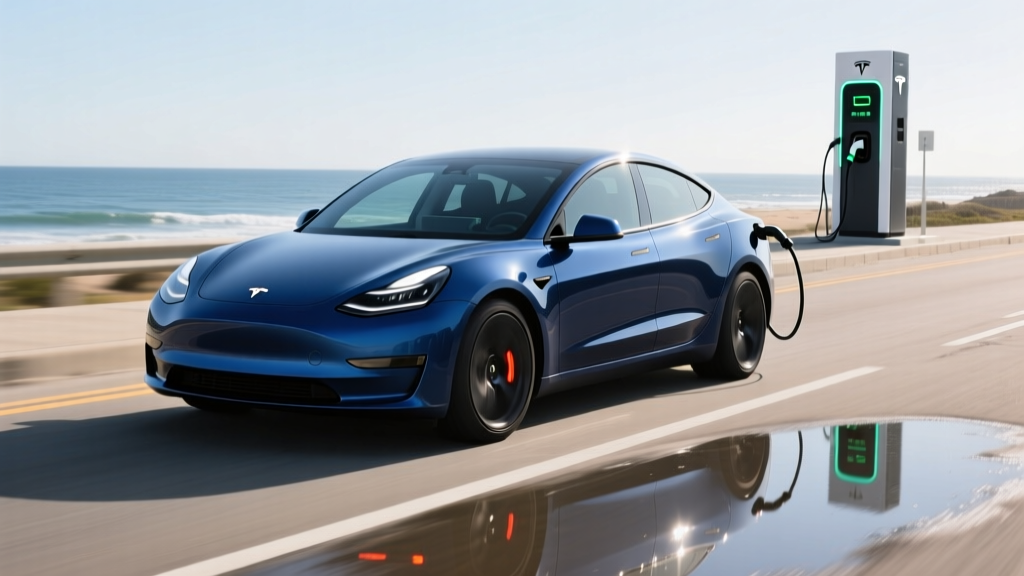
Charging speed is where the trim divergence matters most on road trips. The RWD's LFP battery peaks at roughly 170 kW on a DC fast charger, while the Long Range and Performance models can pull up to 250 kW at a V3 or V4 Supercharger — provided you precondition the battery via navigation routing.
| Charging Level | Power / Rate | Miles Added per Hour | Notes |
|---|---|---|---|
| Level 1 (120V household) | ~1.4 kW | ~5 mi/hr | Emergency/trickle only |
| Level 2 (240V home, 48A) | 11.5 kW | ~44 mi/hr | Full overnight charge in 6–8 hrs |
| DC Fast (RWD peak) | 170 kW | — | 10–80% in ~25 min |
| DC Fast (LR/Perf peak) | 250 kW | — | 10–80% in ~22 min |
Charging curve reality check: The 250 kW peak on Long Range and Performance trims is not sustained. The battery pulls maximum power between roughly 10–35% state of charge, then tapers progressively. From 80–100%, charging slows dramatically — adding the final 20% can take as long as the first 70%. On road trips, plan stops around the 10–80% window for the fastest throughput.
For home charging, a NEMA 14-50 outlet or hardwired Wall Connector on a 60A circuit delivers the full 11.5 kW / 44 miles per hour. Most owners who drive 40–60 miles daily recoup their commute in about 90 minutes of Level 2 charging. Installation typically runs $800–$2,000 depending on panel proximity and local permitting, according to Tesla's home charging guide.
Performance and Powertrain: Beyond the Horsepower Number
Horsepower answers the question of output, but electric motors deliver torque instantly from zero RPM — which is why a 271-hp Model 3 RWD still feels brisker off the line than many 300-hp gas sedans. Here's what each drivetrain actually delivers:
RWD (271 hp, single rear motor): The entry-level Model 3 uses a permanent-magnet synchronous motor on the rear axle. The 5.8-second 0–60 time is genuinely quick for daily driving, and the rear-biased weight distribution gives it confident cornering. This is the efficiency champion of the lineup.
Long Range AWD (346 hp, dual motor): An induction motor up front paired with a permanent-magnet motor in the rear provides all-wheel-drive traction and a meaningful power bump. The 4.2-second 0–60 puts it in sports-sedan territory, and the dual-motor system can disconnect the front motor under light loads to maximize efficiency.
Performance AWD (510 hp, dual motor): Track-tuned with a higher-output rear motor, adaptive dampers, larger brakes, and 20-inch wheels. The 2.9-second 0–60 is supercar-fast. The trade-off is 26 fewer miles of EPA range versus the Long Range and slightly higher tire replacement costs.
Pricing, Tax Credits, and Total Cost
The Model 3 remains one of the most affordable premium electric sedans, especially when federal incentives apply. Under current IRS §30D rules, the base RWD and Long Range trims may qualify for up to $7,500 in federal tax credits, but eligibility is not universal.
| Trim | Base MSRP | §30D Credit (if eligible) | Effective Price |
|---|---|---|---|
| RWD | $38,990 | Up to $7,500 | ~$31,490 |
| Long Range AWD | $45,990 | Up to $7,500 | ~$38,490 |
| Performance AWD | $53,990 | Up to $7,500 | ~$46,490 |
- MSRP cap: Sedans must be under $55,000 — the RWD and Long Range qualify; the Performance at $53,990 also qualifies at base MSRP, but options can push it over.
- Income caps: Modified AGI must not exceed $150,000 (single), $225,000 (head of household), or $300,000 (joint).
- Battery sourcing: Critical minerals and battery component requirements phase in annually. Check the latest IRS clean vehicle credit page for current-year sourcing compliance before purchasing.
- Point-of-sale transfer: Since 2024, buyers can transfer the credit to the dealer for an immediate price reduction at purchase rather than waiting to claim it on their tax return.
Consult a tax professional to confirm your personal eligibility — battery sourcing requirements have tightened annually and can change which vehicles qualify mid-year.
Interior, Cargo, and Daily Practicality
The refreshed Model 3 interior (codenamed "Highland" from the 2024 redesign, carried into 2026) is markedly quieter and better-finished than pre-2024 models. Acoustic glass, ventilated front seats, ambient lighting, and a rear passenger touchscreen bring it closer to the luxury-sedan benchmark.
Dimensions and space:
- Cargo volume: 23 cu ft (rear trunk + frunk combined)
- Front legroom: 42.7 inches
- Rear legroom: 35.2 inches
- Seating: 5 passengers (though the rear middle seat is narrow)
The trunk is deep and wide enough for two large suitcases, and the frunk adds useful space for a charging cable kit or small bag. However, the Model 3 is a sedan — there's no hatchback versatility. If you regularly haul bulky cargo, the Model Y's liftback design offers 30+ cu ft more utility.
Tech highlights:
- 15.4-inch center touchscreen with navigation, media, and vehicle controls (no physical instrument cluster)
- Tesla Autopilot (SAE Level 2) standard — adaptive cruise, lane centering, auto emergency braking
- Full Self-Driving (Supervised) available as a $8,000 add-on or $99/month subscription — still Level 2, requiring active driver supervision at all times
- Over-the-air updates continuously add features and refinements
- Sentry Mode dashcam recording, Dog Mode climate, and theater-mode streaming while parked
Notable drawbacks:
- No Apple CarPlay or Android Auto — Tesla's proprietary infotainment only
- Turn signals are on the steering wheel (no stalk), which frustrates some new owners
- Rear visibility is compromised by the sloping roofline — rely on the backup camera
- Minimal physical buttons — climate and mirror adjustments all go through the touchscreen
Warranty, Battery Longevity, and Ownership Costs
Tesla's warranty coverage is competitive with the EV segment, though not class-leading on the basic bumper-to-bumper term.
- Basic vehicle warranty: 4 years / 50,000 miles
- Battery and drive unit warranty: 8 years / 100,000 miles (RWD) or 8 years / 120,000 miles (Long Range & Performance), with a minimum 70% capacity retention guarantee
Battery degradation data from fleet analyses shows most Model 3 packs retain roughly 90% capacity at 100,000 miles. LFP packs in the RWD trim tend to degrade more slowly in terms of calendar aging, though they are slightly heavier and less energy-dense. NMC packs in the Long Range and Performance offer more range per pound but are more sensitive to sustained 100% state-of-charge storage.
Five-year ownership cost considerations:
- Insurance: Model 3 premiums average 15–25% higher than comparable gas sedans due to repair costs and sensor-dense body panels
- Tires: Performance trim's 20-inch Michelin PS4S tires run ~$300+ each and may need replacement at 20,000–25,000 miles
- Maintenance: Minimal — cabin air filter every 2 years, brake fluid check, tire rotation. No oil changes, no transmission fluid.
- Electricity cost: At $0.14/kWh national average, charging a Long Range from 0–100% costs roughly $10.50 — versus $45–55 to fill a comparable gas sedan
Who Should Buy the 2026 Tesla Model 3?
- You commute under 60 miles round-trip and charge at home nightly
- You want the lowest purchase price and can live with 272 mi EPA range
- You prefer LFP battery chemistry for its longevity and 100% daily charging tolerance
- You take regular road trips of 200+ miles and need the 341-mi buffer
- You live in a region with snow or rain where AWD traction matters
- You want the best balance of performance, range, and price in the lineup
- Sub-3-second 0–60 acceleration is a priority
- You'll use track mode and value adaptive dampers and larger brakes
- You accept the range and efficiency trade-off for maximum power
Pros and Cons at a Glance
- Best-in-class Supercharger network with 60,000+ global stalls
- Class-leading efficiency (25–29 kWh/100mi depending on trim)
- Over-the-air updates keep the car improving post-purchase
- Strong resale value relative to EV segment average
- Highland refresh brought genuine NVH and interior quality improvements
- No CarPlay/Android Auto — a dealbreaker for some buyers
- Steering-wheel turn signals and screen-only controls divide owners
- Insurance premiums remain above segment average
- Sedan trunk limits cargo versatility vs. hatchback competitors
- RWD LFP range drops noticeably in sustained cold weather
Frequently Asked Questions
How much horsepower does the cheapest Tesla Model 3 have?
The 2026 Tesla Model 3 RWD, starting at $38,990, produces 271 horsepower from a single rear-mounted permanent-magnet motor. It hits 0–60 mph in 5.8 seconds.
Is the Tesla Model 3 Performance really 510 horsepower?
Yes. The 2026 Model 3 Performance uses a dual-motor all-wheel-drive setup producing 510 horsepower combined, enabling a 2.9-second 0–60 mph time. This is the most powerful Model 3 Tesla currently offers.
What is the real-world range of the Model 3 Long Range?
The EPA rates the 2026 Model 3 Long Range AWD at 341 miles. In real-world mixed driving, expect 300–320 miles. Sustained highway driving at 75+ mph yields roughly 270–290 miles, and sub-freezing winter conditions can reduce range to 230–260 miles due to battery heating demands and cabin climate use.
Does the 2026 Tesla Model 3 qualify for the $7,500 federal tax credit?
It can, depending on your income, the vehicle's MSRP, and current battery-sourcing rules. The RWD ($38,990) and Long Range ($45,990) are under the $55,000 sedan MSRP cap. Your modified AGI must be under $150K (single) / $300K (joint). Battery critical-mineral and component sourcing requirements must also be met for the model year. Always verify on IRS.gov before purchasing.
How fast does the Model 3 charge at home?
On a 240V Level 2 home charger (48A circuit), all 2026 Model 3 trims charge at up to 11.5 kW, adding approximately 44 miles of range per hour. A full charge from near-empty takes 6–8 hours depending on battery size. Most owners recover a daily commute in 1–2 hours of overnight charging.
How does the Model 3 compare to the Hyundai Ioniq 6 or BMW i4?
The Ioniq 6 offers comparable range (up to 361 mi EPA) and slightly faster 10–80% charging at 350 kW-capable chargers, but lacks Tesla's Supercharger network. The BMW i4 offers a more traditional luxury interior and CarPlay, but costs significantly more and delivers less range per dollar. The Model 3's combination of price, efficiency, and charging infrastructure remains difficult to match.
Is Tesla Autopilot self-driving?
No. Tesla Autopilot and the optional Full Self-Driving (Supervised) package are SAE Level 2 driver-assistance systems. You must keep your hands on the wheel and eyes on the road at all times. True self-driving (Level 4) is currently limited to geofenced robotaxi services like Waymo in select cities.