Tesla Model 3 Highland: What Year Did It Launch and What Changed?
If you've been searching for "Tesla Model 3 Highland what year" to figure out which used or new examples carry the major refresh, here's the short answer: the Highland update debuted globally in late 2023, arriving in the United States as the 2024 model year. Every Model 3 built from late 2023 forward — including current 2025 and 2026 production — wears the Highland body, interior, and suspension revisions. Pre-Highland cars are 2017–2023 model years (the original "Project Midland" platform).
Highland is not a new model; it's a comprehensive mid-cycle refresh that overhauled nearly every panel, replaced the interior, added ventilated seats, swapped the stalk-based turn signals for steering-wheel buttons, introduced a rear passenger touchscreen, and retuned the suspension for a notably quieter, softer ride. For 2026, Tesla continues to sell the Highland-body Model 3 in Long Range RWD, Long Range AWD, and Performance AWD trims — the base RWD with the smaller LFP battery was quietly discontinued for the U.S. market after the 2025 model year.
Spec Sheet at a Glance: 2026 Model 3 Lineup
| Spec | Long Range RWD | Long Range AWD | Performance AWD |
|---|---|---|---|
| EPA Range | 363 mi | 346 mi | 315 mi |
| Battery (usable) | ~75 kWh NMC | ~75 kWh NMC | ~75 kWh NMC |
| Horsepower | ~346 hp | ~440 hp | ~510 hp |
| 0–60 mph | 4.9 sec | 4.2 sec | 2.9 sec |
| Drivetrain | RWD single motor | Dual-motor AWD | Dual-motor AWD |
| MPGe (combined) | 132 MPGe | 121 MPGe | 113 MPGe |
| Efficiency | 25 kWh/100 mi | 28 kWh/100 mi | 30 kWh/100 mi |
| Max DC Fast Charge | ~250 kW | ~250 kW | ~250 kW |
| 10–80% DCFC Time | ~25 min | ~25 min | ~25 min |
| Level 2 Home Charge | 11.5 kW / ~44 mi/hr | 11.5 kW / ~44 mi/hr | 11.5 kW / ~44 mi/hr |
| Base MSRP | $44,130 | $47,130 | $52,130 |
| Battery Warranty | 8 yr / 120,000 mi | 8 yr / 120,000 mi | 8 yr / 120,000 mi |
Source: fueleconomy.gov and Tesla's U.S. design studio. Prices reflect MSRP before destination; specs current as of early 2026.
Range, Efficiency, and What to Expect in the Real World
EPA sticker: 363 miles (Long Range RWD) / 346 miles (AWD) / 315 miles (Performance).
Real-world expectation: Plan on 280–310 miles on a 75-mph highway trip in mild weather, 240–270 miles in freezing temperatures, and close to the EPA number in mixed city driving thanks to strong regenerative braking. The Model 3's heat pump (standard on Highland) significantly reduces winter HVAC losses compared to earlier resistive-heater cars.
The Long Range RWD is the efficiency king of the lineup at 132 MPGe combined (25 kWh per 100 miles), making it one of the most efficient mainstream EVs on sale. Drop to the Performance trim with its stickier 20" tires and more aggressive dual-motor calibration, and you'll burn about 30 kWh/100 mi — a 20% efficiency tax for the 2.9-second 0–60 time.
One thing Highland improved meaningfully is aero and rolling-resistance tuning. The reshaped nose, flush door handles, and revised underbody helped push the Long Range RWD past 360 miles EPA — a number that, in my mixed-driving experience, is achievable if you keep highway speeds under 70 mph and use the seat heaters instead of blasting cabin air.
Charging: DC Fast, Level 2, and Home Setup
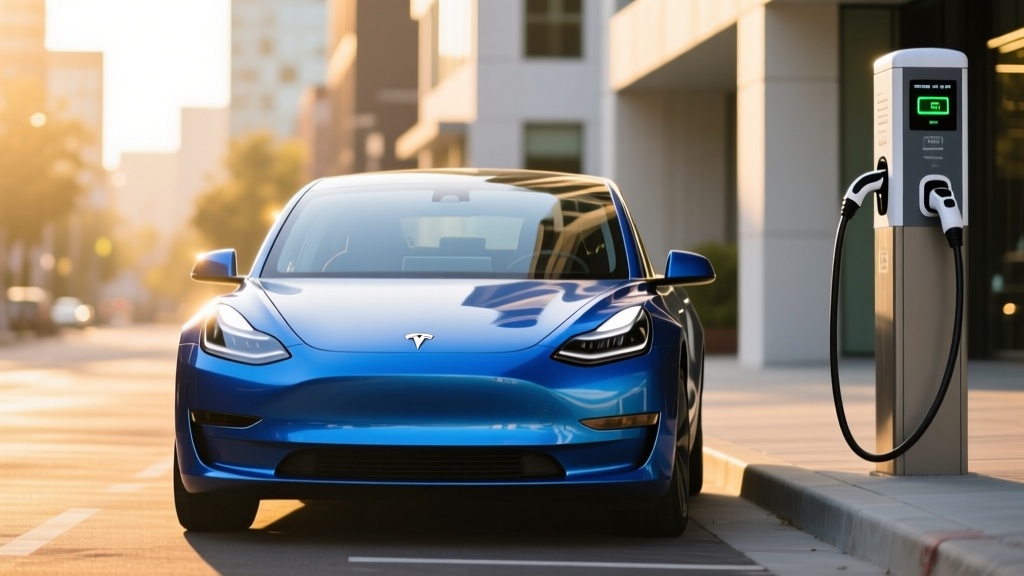
All Highland Model 3s in the U.S. use the native NACS (J3400) charge port — no adapter needed at Tesla Superchargers, and an increasing number of Electrify America, EVgo, and ChargePoint stations now offer NACS cables. The 400-volt architecture caps peak DC charge rate around 250 kW, which is still competitive but no longer class-leading against 800V rivals like the Hyundai Ioniq 6 (peak ~350 kW).
| Charging Method | Power | Speed / Time |
|---|---|---|
| Level 1 (120V household) | ~1.4 kW | ~5 miles per hour |
| Level 2 (240V home wall connector) | 11.5 kW | ~44 miles per hour (full charge in ~7 hr) |
| DC Fast Charge (V3/V4 Supercharger) | Peak 250 kW | 10–80% in ~25 min; tapers sharply above 80% |
The charging curve matters more than peak kW: the Model 3 sustains roughly 170–250 kW from 10% to about 50% SoC, then ramps down through the 300–400V range. On a road trip, that 25-minute 10–80% window is your realistic stop time. Charging past 80% is painfully slow — only do it when you genuinely need the last 20% for a long desert stretch.
For home charging, a Tesla Wall Connector on a 60-amp circuit delivers the full 11.5 kW (48 amps continuous). Budget $800–$1,500 for a typical install if your panel has capacity; a 200-amp panel upgrade can push the total to $2,500–$4,000. A licensed electrician should confirm your service before purchase.
Pricing, Trims, and Federal Tax Credit Eligibility
| Trim | Base MSRP | §30D Credit Potential | Effective Price |
|---|---|---|---|
| Long Range RWD | $44,130 | Up to $7,500 | ~$36,630 |
| Long Range AWD | $47,130 | Up to $7,500 | ~$39,630 |
| Performance AWD | $52,130 | Up to $7,500 | ~$44,630 |
Under current IRS §30D rules, the Model 3 qualifies for up to $7,500 in federal tax credits, which can be applied as a point-of-sale rebate at the dealer (Tesla's checkout flow supports this). But eligibility is not automatic — three hurdles apply:
- MSRP cap: Sedans must sticker at or below $55,000. All current Model 3 trims clear this bar.
- Buyer income cap: Modified AGI cannot exceed $150,000 (single), $225,000 (head of household), or $300,000 (joint).
- Battery sourcing: A percentage of critical minerals and battery components must be sourced from the U.S. or FTA partners. Tesla has shifted much of its supply chain to comply, but the split between the $3,750 critical-mineral half and the $3,750 battery-component half can vary by build month. Verify your specific VIN on IRS.gov's eligible vehicle list before ordering.
As-tested pricing climbs quickly: my Long Range AWD tester with Ultra Red paint ($2,000), 19" Nova wheels ($1,500), and FSD (Supervised) ($8,000) stickered at $58,630 — past the MSRP cap, killing the credit. Skip FSD if you want the $7,500.
Driving, Tech, and the Highland Interior Overhaul
Highland's biggest daily-life improvement isn't the range — it's the cabin. Acoustic glass front and rear, additional sound deadening, and retuned bushings make the 2024+ Model 3 dramatically quieter than pre-2024 cars at highway speed. The ventilated front seats, ambient lighting strip, and woven textile dash trim finally move the interior out of "rental car" territory.
The 15.4-inch center touchscreen runs Tesla's current infotainment stack — fast, responsive, and still lacking Apple CarPlay/Android Auto. Rear passengers get their own 8-inch touchscreen for climate and media, a first for the Model 3. The controversial part: Highland eliminated the turn-signal and gear-selector stalks. Turn signals are now buttons on the steering wheel rim, and gear selection is via the touchscreen (with a capacitive backup strip on the overhead console). Some buyers adapt in a week; others never do. Test-drive before committing.
On the driver-assist front, every Model 3 ships with Basic Autopilot (lane centering + adaptive cruise). This is a SAE Level 2 system — you must keep hands on the wheel and eyes on the road. The optional $8,000 FSD (Supervised) adds automatic lane changes, traffic-light recognition, and city-street navigation, but it remains Level 2 and requires constant supervision. It is not self-driving. For hands-off, eyes-off highway driving, GM's Super Cruise and Ford's BlueCruise on rival sedans currently offer more clearly bounded operational design domains.
Space, Cargo, and Everyday Practicality
The Model 3 remains a compact sport sedan, not a family hauler. Cargo volume is 23 cu ft between the rear trunk (19.8 cu ft) and the front trunk, or "frunk" (3.1 cu ft) — enough for a week's groceries or two carry-on bags, but noticeably less than the Model Y's 30 cu ft behind the second row. Rear legroom is 35.3 inches, which fits adults comfortably up to about 6'2" but will feel tight for taller passengers on long trips. The fixed glass roof creates good headroom despite the sloping roofline.
For a commuter or two-person household, the Model 3's footprint is ideal: easy to park, quick to thread through traffic, and efficient to run. For families regularly hauling rear-seat kids, car seats, and strollers, the Model Y is the more pragmatic Tesla — and it's now priced within $3,000 of a similarly equipped Model 3 Long Range AWD.
Who Should Buy the Model 3 Highland (and Who Shouldn't)
Pros
- Class-leading efficiency (132 MPGe on LR RWD)
- Supercharger network access without adapters
- Quiet, refined cabin vs. pre-2024 cars
- Strong performance even on the base Long Range
- OTA updates continue to add features years after purchase
- Excellent battery warranty (8 yr / 120,000 mi on LR/Perf)
Cons
- Stalk-less controls polarize buyers
- No Apple CarPlay or Android Auto
- 250 kW peak charge rate trails 800V rivals
- Rear seat still snug for tall adults
- FSD cost pushes trims past the $55K MSRP credit cap
- No physical buttons for climate or volume
Buy the Model 3 Highland if: you're a commuter or two-person household prioritizing efficiency, Supercharger access, and a premium cabin in a compact sedan footprint — and you can adapt to touchscreen-only controls.
Look elsewhere if: you need maximum rear-seat space (Model Y, Hyundai Ioniq 5), you want 800V-class charging speeds (Ioniq 6, Porsche Taycan), you refuse to give up CarPlay, or you want a verified hands-off highway driver-assist (Cadillac Lyriq with Super Cruise, Ford Mustang Mach-E with BlueCruise).
Model 3 Highland FAQ
What year did the Tesla Model 3 Highland launch?
The Highland refresh debuted in late 2023 globally and reached the U.S. as the 2024 model year. Every 2024, 2025, and 2026 Model 3 is a Highland. Pre-Highland cars are 2017–2023 model years.
How can I tell a Highland Model 3 from an older one?
Visual cues: slimmer, sharper headlights; a reshaped front bumper without the lower grille slit; a small rear lip spoiler; and turn-signal buttons on the steering wheel instead of a stalk. Inside, there's ambient lighting across the dash, ventilated seats, and a rear passenger touchscreen.
Does the 2026 Model 3 qualify for the $7,500 federal tax credit?
Yes, potentially — all current trims sticker below the $55,000 sedan MSRP cap. Buyer income must be under $150K/$225K/$300K (single/HOH/joint), and the specific VIN must meet battery-sourcing thresholds. Confirm eligibility on IRS.gov before ordering, as sourcing rules shift periodically.
Is the Model 3 Highland's real-world range close to the EPA sticker?
In mild weather and mixed driving, yes — within 5–8%. On sustained 75-mph highway runs, expect 280–310 miles on the Long Range RWD (EPA 363). In freezing weather with cabin heat, plan on 240–270 miles. The standard heat pump helps, but cold chemistry losses are unavoidable.
How fast does the Model 3 Highland charge at home?
On a 240V Level 2 Tesla Wall Connector (60A circuit), the onboard charger accepts up to 11.5 kW, adding roughly 44 miles of range per hour. A full 10–100% charge takes about 7 hours — easy to complete overnight on a time-of-use electricity plan.
Is the Model 3 worth buying over the Model Y or Ioniq 6?
Choose the Model 3 if you want the lowest cost of ownership in Tesla's lineup, prefer a sedan driving position, and don't need SUV cargo volume. Choose the Model Y for family utility. Choose the Hyundai Ioniq 6 if 800V charging (~350 kW peak, 10–80% in ~18 min) and CarPlay matter more than Supercharger access.