The Short Answer: No, the Tesla Model 3 Does Not Drive Itself
If you've searched "does the Tesla Model 3 drive itself," you're not alone — it's one of the most common questions from prospective EV buyers. The direct answer is no. The 2026 Tesla Model 3, even when equipped with Tesla's Full Self-Driving (Supervised) package, remains a SAE Level 2 driver-assistance system. That means the driver must remain fully attentive, keep hands on or near the wheel, and be prepared to take over at any moment.
That clarification out of the way, the 2026 Model 3 remains one of the most capable and efficient electric sedans on the market. Below, we break down its full spec sheet — range, charging, performance, pricing, and whether those driver-assistance features justify the premium.
2026 Tesla Model 3: Full Specifications at a Glance
| Specification | RWD Standard Range | Long Range AWD | Performance AWD |
|---|---|---|---|
| EPA Range | 272 mi | 363 mi | 315 mi |
| Battery (usable) | ~57 kWh (LFP) | ~75 kWh (NMC) | ~75 kWh (NMC) |
| Horsepower | 271 hp | 346 hp | 510 hp |
| 0–60 mph | 5.8 sec | 4.2 sec | 2.9 sec |
| Drivetrain | RWD (single motor) | AWD (dual motor) | AWD (dual motor) |
| Max DC Fast Charge | 170 kW | 250 kW | 250 kW |
| 10–80% DC Charge | ~25 min | ~22 min | ~22 min |
| Efficiency (MPGe) | 132 MPGe | 125 MPGe | 113 MPGe |
| Base MSRP | $38,990 | $44,990 | $52,990 |
Source: fueleconomy.gov, Tesla.com (2026 model year). Prices exclude destination fee ($1,390) and before incentives.
Real-World Range: What the EPA Sticker Doesn't Tell You
Long Range AWD: EPA 363 mi — expect ~310–330 mi in mixed driving, ~270–290 mi sustained highway at 75+ mph, and ~230–260 mi in sub-30°F winter conditions.
RWD Standard Range: EPA 272 mi — expect ~230–250 mi mixed, ~200–220 mi highway, and ~180–200 mi in cold weather.
Performance AWD: EPA 315 mi — expect ~265–285 mi mixed, ~240–260 mi highway.
The Model 3's efficiency is among the best in its class. The RWD trim's LFP battery is lighter, which contributes to its strong 132 MPGe combined rating. However, MPGe (miles per gallon equivalent) measures energy efficiency using a standard conversion (33.7 kWh = 1 gallon of gasoline). For practical trip planning, think in kWh per 100 miles: the Long Range AWD consumes about 25–27 kWh/100mi in real-world conditions, meaning its 75 kWh pack delivers roughly 280–300 miles before you need to stop.
Tesla's heat pump (standard on all trims since the "Highland" refresh) significantly reduces cold-weather range loss compared to resistive heating, but physics still wins: lithium-ion batteries lose 20–30% range in sustained sub-freezing temperatures, especially at highway speeds where aerodynamic drag compounds the loss.
Charging Speed: Home and DC Fast Charging
| Charging Level | Power (kW) | Miles Added per Hour | Best Use Case |
|---|---|---|---|
| Level 1 (120V household outlet) | ~1.4 kW | ~3–5 mi/hr | Emergency / overnight trickle |
| Level 2 (240V, 48A Tesla Wall Connector) | ~11.5 kW | ~37–44 mi/hr | Daily home charging |
| DC Fast Charge (Supercharger V3/V4) | Peak 170–250 kW | ~500–1,000 mi/hr (peak) | Road trips |
The Model 3 uses the NACS (North American Charging Standard) connector natively — the same plug used across the Tesla Supercharger network, now the industry standard adopted by Ford, GM, Rivian, and others. No adapter is needed for Tesla Superchargers.
Charging-curve reality check: The "250 kW peak" figure applies only to the Long Range and Performance trims, and only at low state-of-charge (typically 10–30%). As the battery fills, charge speed tapers significantly. Expect sustained rates of ~100–120 kW between 50–80% SoC. A typical 10–80% session at a V3 Supercharger takes approximately 22 minutes for Long Range/Performance and 25 minutes for the RWD (which peaks at 170 kW due to its smaller LFP pack).
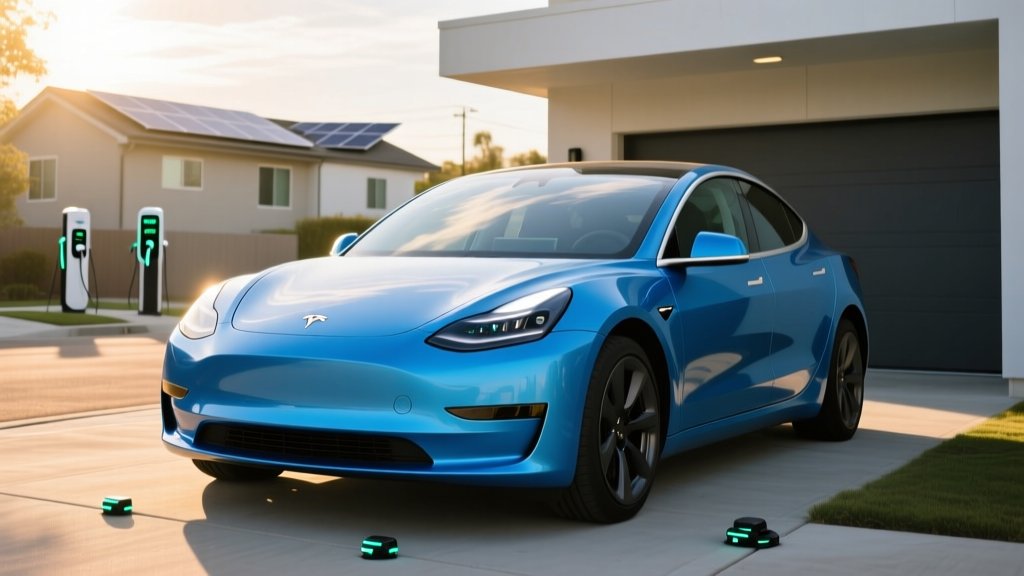
For home charging, Tesla's Wall Connector at 48 amps on a 60A circuit adds roughly 40 miles of range per hour — enough to fully replenish the RWD overnight and the Long Range in about 7–8 hours. Installation typically costs $800–$2,000 depending on panel proximity and local permitting; a 200A panel upgrade can add $1,500–$3,000 if needed.
Autopilot and FSD (Supervised): What They Actually Do
Every 2026 Model 3 comes standard with Basic Autopilot, which includes:
- Traffic-Aware Cruise Control: Maintains set speed and following distance
- Autosteer: Lane-centering on clearly marked highways
Tesla offers the Enhanced Autopilot package ($6,000) adding:
- Navigate on Autopilot (automatic highway interchanges and exits)
- Auto Lane Change
- Autopark (parallel and perpendicular)
- Summon (move the car in/out of tight spaces via the app)
The top-tier Full Self-Driving (Supervised) package ($8,000) adds:
- Traffic Light and Stop Sign Control
- City street Autosteer (handles urban intersections, turns, and roundabouts)
- All Enhanced Autopilot features
- It does NOT make the Model 3 a self-driving car. You are the driver, legally and practically.
- It does NOT eliminate the need for active supervision. The cabin camera monitors your attention and will issue escalating warnings if you look away.
- It does NOT handle all road conditions reliably. Construction zones, faded lane markings, unprotected left turns across traffic, and adverse weather remain challenging.
- It does NOT remove your liability. Any accident while using FSD (Supervised) is the driver's responsibility.
- FSD performance varies significantly by geography and software version — what works well in Phoenix may struggle in Boston's narrow streets.
In our experience, FSD (Supervised) has improved substantially since its vision-only transition. On well-marked suburban arterials and highways, it's smooth and confidence-inspiring. In dense urban environments with complex interactions (double-parked delivery trucks, jaywalking pedestrians, unmarked intersections), it still requires frequent driver interventions. Think of it as a highly capable co-pilot, not a chauffeur.
Pricing, Tax Credits, and Total Cost
| Trim | MSRP (+ dest.) | Est. §30D Credit | Effective Price |
|---|---|---|---|
| RWD Standard Range | $40,380 | Up to $7,500* | ~$32,880* |
| Long Range AWD | $46,380 | Up to $7,500* | ~$38,880* |
| Performance AWD | $54,380 | Up to $7,500* | ~$46,880* |
*Federal tax credit eligibility is NOT guaranteed. See checklist below. Tesla offers a point-of-sale transfer option, reducing the purchase price at delivery if you qualify.
- IRS §30D Federal EV Tax Credit Checklist (2026):
- ✅ Vehicle MSRP must be ≤ $55,000 for sedans (all Model 3 trims qualify)
- ✅ Buyer AGI: ≤ $150,000 (single) / $225,000 (head of household) / $300,000 (joint)
- ⚠️ Battery components must be manufactured/assembled in North America (percentage threshold increases annually)
- ⚠️ Critical minerals must be sourced from the US or FTA-partner countries (threshold increases annually)
- ⚠️ Credit splits into two halves ($3,750 + $3,750) — you may qualify for one, both, or neither depending on sourcing compliance
- ✅ Credit is non-refundable but can be transferred to the dealer at point of sale for an upfront price reduction
Verify current eligibility at IRS.gov before purchasing. Battery sourcing requirements tighten annually and may affect eligibility for specific build dates.
Interior, Cargo, and Daily Practicality
The refreshed Model 3 interior is a significant step up from pre-2024 models. Ventilated front seats, ambient lighting, a rear 8-inch touchscreen for passengers, acoustic glass, and improved materials narrow the gap with luxury competitors.
Dimensions:
- Cargo (trunk): 21.0 cu ft (plus a small front trunk / "frunk" for charging cables)
- Rear legroom: 35.3 inches — adequate for average-height adults, tight for anyone over 6'2"
- Front headroom: 40.3 inches
- Seating: 5 passengers (but the rear middle seat is narrow and firm)
The minimalist interior means virtually all controls — climate, mirrors, glovebox, wiper speed — live inside the 15.4-inch central touchscreen. Some buyers love the clean aesthetic; others find it distracting while driving. There are no physical stalks for turn signals or gear selection; these are handled by steering-wheel buttons and the touchscreen (with a backup gear strip on the overhead console).
Warranty, Ownership Costs, and Longevity
Tesla's warranty coverage for the 2026 Model 3:
- Basic Vehicle: 4 years / 50,000 miles
- Battery & Drive Unit (RWD): 8 years / 100,000 miles
- Battery & Drive Unit (Long Range / Performance): 8 years / 120,000 miles
- Battery retention threshold: 70% of original capacity during the warranty period
Real-world battery degradation data from high-mileage Tesla owners shows NMC packs typically lose 8–12% capacity over the first 100,000 miles, while LFP packs (RWD) demonstrate slower degradation curves, often losing only 5–8% over the same distance. LFP chemistry also tolerates regular 100% charging without accelerated wear — Tesla actually recommends charging LFP packs to 100% at least weekly for accurate SoC calibration.
Insurance costs remain a consideration. Model 3 premiums average 15–25% higher than comparable gas sedans due to repair costs and parts pricing. Get a quote before purchasing — it can meaningfully affect your total cost of ownership.
Pros, Cons, and Who Should Buy the Model 3
✅ Pros
- Class-leading efficiency (132 MPGe combined on RWD)
- Access to Tesla Supercharger network (most reliable public charging in the US)
- Strong real-world range on Long Range (310–330 mi)
- Over-the-air updates continuously add features
- Excellent performance per dollar, especially Performance trim
- LFP battery on RWD offers excellent longevity
- Strong resale value relative to most EVs
❌ Cons
- FSD ($8,000) is expensive and still requires full driver supervision
- No physical controls — turn signals, gear selection all via screen/buttons
- Rear seat is snug for tall passengers
- Ride quality is firm, especially on larger wheels
- Insurance premiums run higher than segment average
- Build quality inconsistencies still reported by some owners
- Repair network limited to Tesla Service Centers and approved body shops
- Choose the RWD Standard Range if: You commute under 50 miles daily, charge at home, and want the lowest entry price with LFP longevity.
- Choose the Long Range AWD if: You take regular road trips, live in a cold climate (AWD + larger battery buffer), or want the most range for the money.
- Choose the Performance if: You prioritize acceleration (2.9 sec 0–60) and track-day capability, and can accept the range and efficiency trade-off.
- Look elsewhere if: You need spacious rear seating for adults, prefer physical controls, want a luxury badge, or require towing (Model 3 is not rated for towing).
Key Competitors: Model 3 vs. the Field
The Model 3 competes directly with the Hyundai Ioniq 6 (EPA 361 mi, ~$38,000), BMW i4 eDrive40 (EPA 301 mi, ~$52,000), and the Polestar 2 (EPA 276 mi, ~$49,000). The Ioniq 6 matches the Model 3 Long Range on EPA range and offers 800V architecture for faster DC charging, but lacks Supercharger access (though it now uses NACS for future compatibility). The BMW i4 wins on interior refinement and driving dynamics but costs significantly more for less range. The Model 3's combination of range, efficiency, Supercharger access, and pricing remains difficult to beat holistically.
Frequently Asked Questions
Does the Tesla Model 3 drive itself?
No. Even with the $8,000 FSD (Supervised) package, the Model 3 is a SAE Level 2 vehicle. The driver must remain attentive, monitor the road, and be ready to take over immediately. Tesla's own documentation and branding ("Supervised") make this explicit.
What is the real-world range of the Tesla Model 3?
The Long Range AWD delivers approximately 310–330 miles in mixed driving, 270–290 miles on sustained highway trips, and 230–260 miles in cold weather. The RWD Standard Range achieves roughly 230–250 miles mixed. These figures assume moderate climate control use and typical driving habits.
How fast does the Model 3 charge at home and on the road?
At home on a Level 2 Tesla Wall Connector (48A/240V), the Model 3 adds approximately 40 miles of range per hour, fully charging overnight. On DC fast charging, the Long Range and Performance peak at 250 kW, reaching 10–80% in roughly 22 minutes at a V3 Supercharger. The RWD peaks at 170 kW, taking about 25 minutes.
Does the Tesla Model 3 qualify for the $7,500 federal EV tax credit?
It can, but eligibility depends on your income (AGI ≤ $150K single / $300K joint), the vehicle's MSRP (all trims fall under the $55K sedan cap), and battery sourcing compliance. The credit splits into two $3,750 halves based on component manufacturing and critical mineral sourcing. Check IRS.gov for current eligibility, as sourcing thresholds tighten annually.
Is the Tesla Model 3 worth buying over competitors?
For most buyers seeking an efficient, long-range electric sedan with reliable public charging access, the Model 3 remains the benchmark. The Supercharger network, strong efficiency, competitive pricing, and continuous software updates are significant advantages. If rear-seat space, physical controls, or luxury branding are priorities, the Ioniq 6 or BMW i4 may be better fits.
Is FSD (Supervised) worth the $8,000 cost?
For most buyers, no. Basic Autopilot (included free) handles highway driving well. Enhanced Autopilot ($6,000) adds useful features like automatic lane changes. FSD (Supervised) at $8,000 is best suited for early adopters who want to experience the latest driver-assist technology and understand its limitations. It does not add resale value commensurate with its cost, and Tesla occasionally adjusts pricing or offers subscription alternatives ($99/month).