The Tesla Model 3 has been the default entry point into the EV world for nearly a decade. But as the used-EV market matures and newer competitors arrive, buyers in 2026 are asking a harder question: what does the Tesla Model 3 depreciation curve actually look like, and does the math still work in your favor? This review covers the current Model 3 lineup end-to-end—range, charging, performance, pricing after federal tax credits, and the depreciation reality that shapes your true cost of ownership.
2026 Tesla Model 3: Quick Verdict
The refreshed Model 3 (codenamed "Highland") carries forward into 2026 with minor updates but the same core formula: class-leading efficiency, access to Tesla's Supercharger network (now with NACS as the industry standard), and aggressive pricing. The Long Range AWD trim remains the sweet spot for most buyers, balancing 341 miles of EPA range with dual-motor traction and strong highway performance. However, the depreciation story is more nuanced than the sticker price suggests—price cuts on new models, increased competition, and battery chemistry all play a role in what a Model 3 will be worth in three to five years.
| Spec | RWD (Base) | Long Range AWD | Performance |
|---|---|---|---|
| EPA Range | 272 mi | 341 mi | 315 mi |
| Battery (usable) | ~57.5 kWh (LFP) | ~75 kWh (NMC) | ~75 kWh (NMC) |
| Peak DC Fast Charge | 170 kW | 250 kW | 250 kW |
| 10–80% DCFC Time | ~25 min | ~20 min | ~20 min |
| Level 2 Home Charge | 11.5 kW (~44 mi/hr) | 11.5 kW (~44 mi/hr) | 11.5 kW (~44 mi/hr) |
| 0–60 mph | 5.8 sec | 4.2 sec | 2.9 sec |
| Horsepower | 271 hp | 346 hp | 510 hp |
| Drivetrain | RWD | Dual-Motor AWD | Dual-Motor AWD |
| Efficiency | 132 MPGe / 25 kWh/100mi | 132 MPGe / 25 kWh/100mi | 121 MPGe / 28 kWh/100mi |
| Base MSRP | $38,990 | $45,990 | $52,990 |
| Warranty (Battery) | 8 yr / 100,000 mi | 8 yr / 120,000 mi | 8 yr / 120,000 mi |
Real-World Range: EPA Sticker vs. What You'll Actually See
Real-World Expectation: 230–250 mi highway (RWD); 290–310 mi highway (Long Range). In cold weather (below 30°F), expect a 20–30% reduction due to battery resistance and cabin heating demands, bringing the Long Range down to roughly 220–260 mi in winter conditions.
The Model 3's efficiency is genuinely best-in-class among sedans its size. Tesla's heat pump and integrated thermal management system minimize energy waste, and the car's aerodynamic drag coefficient (0.219 Cd) helps preserve highway range better than taller crossovers. That said, EPA testing uses moderate-speed mixed cycles. Sustained 75+ mph driving, aggressive acceleration, and cold temperatures all pull real-world numbers below the sticker.
The LFP (lithium iron phosphate) battery in the RWD trim has a key ownership advantage: Tesla recommends charging it to 100% regularly, meaning you get full use of the 272-mile range daily. The NMC (nickel manganese cobalt) packs in the Long Range and Performance trims are best kept at 80–90% for daily driving, reserving 100% for road trips. This means your practical daily range on the Long Range is closer to 270–290 miles at an 80% state of charge—still excellent, but worth understanding before you buy. For detailed EPA data, see fueleconomy.gov.
Charging Speed: DC Fast Charging and Home Setup
Charging speed is where the Model 3's trim differences matter most. The RWD's LFP battery tops out at 170 kW on DC fast chargers, while the Long Range and Performance models can peak at 250 kW at V3/V4 Superchargers or any CCS/NACS station capable of that rate.
| Charging Method | Power (kW) | Miles Added per Hour |
|---|---|---|
| Level 1 (120V household) | ~1.4 kW | ~5 mi/hr |
| Level 2 (240V home, 48A) | 11.5 kW | ~44 mi/hr |
| DC Fast Charge (RWD peak) | 170 kW | ~170 mi in 15 min |
| DC Fast Charge (Long Range/Performance peak) | 250 kW | ~200 mi in 15 min |
A critical detail many buyers miss: peak kW is not sustained kW. The Model 3 Long Range will hit 250 kW only at a low state of charge (roughly 10–25% SoC) and then taper progressively. The 10–80% charge takes approximately 20 minutes at a capable V3 Supercharger, but 80–100% can add another 20+ minutes as the battery management system protects cell health. This taper is normal for all lithium-ion EVs, but it means planning road-trip stops around the 10–80% window is the most time-efficient strategy.
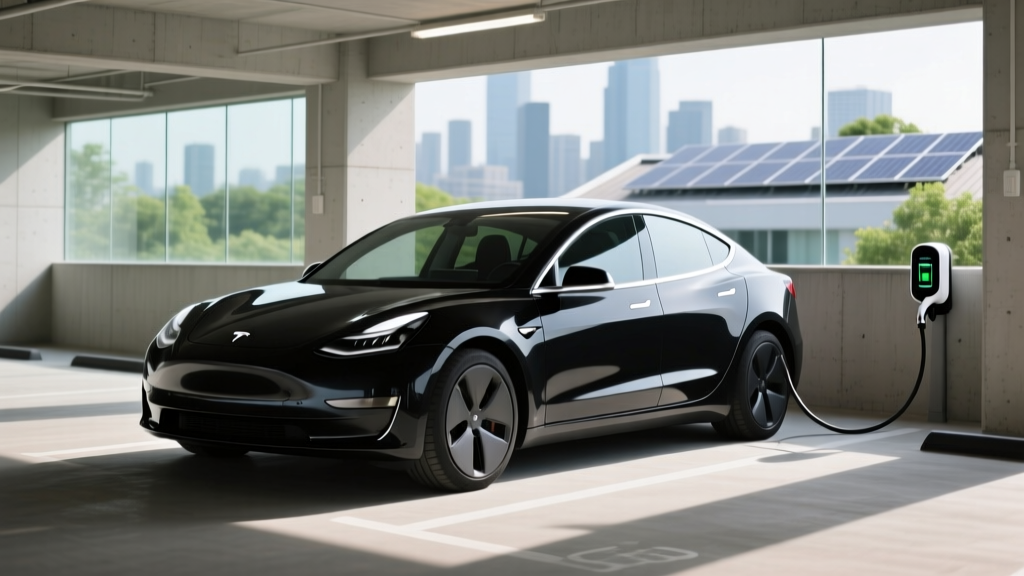
For home charging, a Level 2 wall connector on a 60-amp circuit (48A continuous) delivers 11.5 kW, adding roughly 44 miles of range per hour. Most owners who charge overnight at home will never need public charging for daily driving. Installation costs for a Level 2 home setup typically run $800–$2,000 depending on panel proximity and local permit requirements—always hire a licensed electrician and check whether your utility offers rebates.
Performance, Interior, and Technology
Even the base RWD Model 3 dispatches 0–60 mph in 5.8 seconds—quicker than most gas-powered sport sedans. The Long Range drops that to 4.2 seconds with dual-motor all-wheel drive, and the Performance variant hits 2.9 seconds with track-tuned suspension and a dedicated track mode. All trims feature regenerative braking with one-pedal driving capability, though Tesla removed the user-adjustable regen setting in the Highland refresh; regen strength is now fixed and moderate.
Interior space is competitive for the compact luxury sedan segment: 42.3 inches of front legroom, 35.3 inches rear, and 23 cubic feet of cargo volume (trunk plus a small front trunk/frunk). The minimalist cabin centers on a 15.4-inch touchscreen that handles all vehicle controls, navigation, media, and climate—there are no physical buttons or a traditional instrument cluster. Rear passengers get a small 8-inch screen for climate and entertainment controls.
On the tech front, Tesla's infotainment remains the benchmark for responsiveness and over-the-air update frequency. Autopilot comes standard and includes adaptive cruise control and lane-keeping assist. Full Self-Driving (Supervised) is a $8,000 option (or $99/month subscription) that adds automated lane changes, intersection handling, and parking features—but it is a SAE Level 2 driver-assist system, meaning the driver must remain fully attentive and hands on the wheel at all times. It is not autonomous driving.
Pricing, Tax Credits, and the Depreciation Curve
Understanding the Tesla Model 3 depreciation curve requires looking at three forces: the purchase price after incentives, Tesla's history of price adjustments, and competitive pressure from rivals like the Hyundai Ioniq 6, BMW i4, and Polestar 2.
| Trim | Base MSRP | Est. After §30D Credit | 3-Year Resale Est. (60k mi) | 5-Year Resale Est. (75k mi) |
|---|---|---|---|---|
| RWD | $38,990 | ~$31,490 | ~$22,000–$24,500 | ~$16,000–$19,000 |
| Long Range AWD | $45,990 | ~$38,490 | ~$27,000–$30,000 | ~$20,000–$23,500 |
| Performance | $52,990 | ~$45,490 | ~$30,000–$33,500 | ~$22,000–$26,000 |
How the federal tax credit works: Under IRS §30D rules, the Model 3 qualifies for up to $7,500 in federal tax credits, split between a $3,750 critical-minerals component and a $3,750 battery-components component. Eligibility depends on several factors that change frequently:
- MSRP cap: The vehicle must be under $55,000 (sedans). All current Model 3 trims qualify.
- Buyer income cap: Modified adjusted gross income must not exceed $150,000 (single), $225,000 (head of household), or $300,000 (joint).
- Battery sourcing: Critical minerals and battery components must meet phased-in domestic/FSTA-content thresholds. Tesla's shifting supply chain means eligibility can change mid-year.
- Point-of-sale transfer: As of 2024+, you can transfer the credit to the dealer at purchase for an immediate price reduction, rather than waiting to claim it on your tax return.
Always verify current eligibility on fueleconomy.gov and consult a tax professional before relying on credit amounts.
The Depreciation Reality
The Model 3's depreciation curve has been steeper than legacy luxury sedans for several reasons. Tesla's repeated price cuts on new vehicles (particularly through 2023–2024) immediately compressed used values, since buyers could get a new car for less than a two-year-old one. Increased competition from Hyundai, Kia, BMW, and others has also softened demand for used Model 3s specifically.
Based on current market data and historical trends, expect a Model 3 to retain roughly 55–65% of its purchase price after three years / 60,000 miles, and 40–50% after five years / 75,000 miles. The Long Range AWD trim holds value best due to its range advantage and dual-motor appeal. The RWD trim, while cheapest to buy, depreciates fastest in percentage terms—partly because LFP batteries are perceived (somewhat unfairly) as less premium, and partly because the lower absolute dollar amount makes it more sensitive to new-car price competition.
For context, the Hyundai Ioniq 6 and BMW i4 show slightly better percentage retention in some markets, but start from higher prices. The Model 3's total cost of ownership remains competitive when you factor in lower fuel and maintenance costs versus gas vehicles, plus Supercharger network access, which still leads the industry in reliability and coverage.
Who Should Buy the Model 3 (And Who Shouldn't)
- You want the lowest cost-per-mile of any premium electric sedan
- Supercharger network access matters for your road-trip habits
- You prioritize over-the-air software updates and tech-forward ownership
- You commute 30–80 miles daily and can charge at home
- You need more than 23 cu ft of cargo space (consider Model Y or Ioniq 5)
- You prefer physical buttons and a traditional instrument cluster
- You want a luxury badge and dealer service experience (BMW i4, Mercedes EQB)
- You frequently carry rear-seat adults on long trips (rear seat is snug for tall passengers)
Pros and Cons at a Glance
- Best-in-class efficiency (25 kWh/100mi)
- Supercharger network: 50,000+ global stalls, highest uptime
- Strong 0–60 performance across all trims
- OTA updates keep the car improving post-purchase
- Competitive pricing after tax credits
- LFP battery (RWD) allows daily 100% charging
- Minimalist interior not for everyone; no physical controls
- Rear seat space is tighter than rivals
- FSD (Supervised) is expensive and still requires full driver attention
- Depreciation steeper than some competitors due to Tesla price volatility
- No Apple CarPlay or Android Auto
- Service center availability varies by region
Frequently Asked Questions
What is the real-world range of the Tesla Model 3?
The EPA rates the Long Range AWD at 341 miles, but sustained highway driving at 75 mph typically yields 290–310 miles. In cold weather below 30°F, expect 220–260 miles from the Long Range due to battery chemistry limitations and heating loads. The RWD with its LFP battery delivers around 230–250 miles on the highway in moderate temperatures.
How fast does the Model 3 charge at home and on the road?
At home on a Level 2 (240V, 48A) charger, the Model 3 adds about 44 miles of range per hour—a full overnight charge covers any daily commute. On DC fast chargers, the Long Range and Performance peak at 250 kW (10–80% in ~20 minutes), while the RWD peaks at 170 kW (10–80% in ~25 minutes). Charging slows significantly above 80% SoC to protect battery health.
Does the Tesla Model 3 qualify for the federal EV tax credit?
Yes, the Model 3 currently qualifies for up to $7,500 under IRS §30D, but eligibility depends on your income (under $150K single / $300K joint), the vehicle's MSRP (all trims are under the $55K sedan cap), and battery-sourcing requirements that can shift. The credit can be transferred at point of sale for an immediate price reduction. Always check IRS.gov and consult a tax professional.
Is the Model 3 worth buying over competitors like the Ioniq 6 or BMW i4?
If you value charging network access, software updates, and efficiency per dollar, the Model 3 remains the strongest all-around package. The Hyundai Ioniq 6 offers comparable range and 800V ultra-fast charging but lacks Supercharger access (though NACS adoption is closing this gap). The BMW i4 provides a more traditional luxury experience and better rear-seat comfort at a higher price. The right choice depends on which trade-offs matter most to you.
What is the battery warranty on the Model 3?
Tesla covers the Model 3 battery and drive unit for 8 years / 100,000 miles on the RWD trim and 8 years / 120,000 miles on the Long Range and Performance trims. The warranty guarantees at least 70% battery capacity retention during that period. Real-world data from high-mileage Model 3 owners suggests LFP batteries (RWD) degrade more slowly in early years than NMC packs, though both chemistries are well-managed by Tesla's thermal system.
How does Tesla's depreciation compare to gas sedans?
EVs broadly have experienced higher depreciation than comparable gas vehicles in the 2023–2025 period, driven by rapid technology advancement, new-model competition, and Tesla's own price cuts. A Model 3 may lose 50–60% of its value over five years versus 40–45% for a Toyota Camry or BMW 3 Series. However, the Model 3's lower operating costs (electricity vs. gas, minimal maintenance) partially offset this in total cost of ownership calculations, especially for high-mileage drivers.