The 2026 Tesla Model 3: Still the Benchmark After the Dashcam Update?
The Tesla Model 3 remains the default entry point into the Tesla ecosystem and one of the most scrutinized EVs on the road. For 2026, Tesla rolled out a significant dashcam update via over-the-air software, adding higher-resolution recording, multi-camera clip saving, and improved incident-triggered capture. But beyond the headline software feature, the Model 3 continues to compete on range, charging speed, and price — particularly now that the Long Range RWD variant undercuts several rivals while delivering over 340 miles of EPA range.
This review covers every number that matters: real-world range expectations, DC fast-charge curves, battery chemistry trade-offs, §30D tax credit eligibility, and whether the Model 3 still earns its spot against the Hyundai Ioniq 6, BMW i4, and Polestar 2.
Range, Battery, and Real-World Efficiency
The 2026 Model 3 lineup offers three trims with distinct battery and range profiles. The Standard Range RWD uses a ~60 kWh (usable) lithium iron phosphate (LFP) pack, while the Long Range RWD and Long Range AWD trims step up to an ~82 kWh usable NMC (nickel manganese cobalt) battery supplied primarily by Panasonic's 4680-cell production line.
Standard Range RWD: EPA 272 mi — expect ~230–245 mi on mixed highway driving; ~195–210 mi in sub-30°F winter conditions.
Long Range RWD: EPA 363 mi — expect ~305–325 mi highway at 70 mph; ~260–280 mi in cold weather with cabin heat.
Long Range AWD: EPA 341 mi — expect ~285–305 mi highway; ~245–265 mi in freezing temps.
Real-world range varies with speed, elevation, temperature, and HVAC load. Highway driving at 75+ mph reduces range 12–18% vs. EPA combined figures. Cold weather (below 30°F) can cut range 20–30% due to battery conditioning demands and resistive heating, though the Model 3's heat pump mitigates some of this loss compared to older EVs without one.
| Spec | Standard Range RWD | Long Range RWD | Long Range AWD |
|---|---|---|---|
| EPA Range | 272 mi | 363 mi | 341 mi |
| Battery (usable) | ~60 kWh (LFP) | ~82 kWh (NMC) | ~82 kWh (NMC) |
| Efficiency | 132 MPGe / 25 kWh/100mi | 136 MPGe / 24 kWh/100mi | 128 MPGe / 26 kWh/100mi |
| 0–60 mph | 5.8 sec | 4.9 sec | 4.2 sec |
| Horsepower | 271 hp | 346 hp | 384 hp |
| Drivetrain | RWD (single motor) | RWD (single motor) | AWD (dual motor) |
| Top Speed | 125 mph | 125 mph | 125 mph |
LFP chemistry in the Standard Range trim means slightly lower energy density but superior cycle life and a manufacturer recommendation to charge to 100% daily — a genuine advantage for commuters who want full range every morning without degradation anxiety. NMC packs in the Long Range trims offer more range per kilogram but Tesla recommends an 80–90% daily charge ceiling for longevity.
Charging Speed: DC Fast Charge and Home Level 2
Charging speed is where the Model 3's architecture shows its maturity. The Long Range trims peak at approximately 250 kW on a V3 Supercharger, while the Standard Range RWD tops out around 170 kW. These are peak rates — sustained averages are lower due to the charge curve taper above 50–60% state of charge.
| Charging Level | Standard Range RWD | Long Range RWD/AWD |
|---|---|---|
| DC Fast Charge (peak) | ~170 kW | ~250 kW |
| 10–80% DC Fast Charge | ~28 min | ~25 min |
| Level 2 (240V, 48A) | 11.5 kW (~37 mi/hr) | 11.5 kW (~44 mi/hr) |
| Level 2 (240V, 32A Mobile) | 7.7 kW (~25 mi/hr) | 7.7 kW (~30 mi/hr) |
| Level 1 (120V, 12A) | ~1.4 kW (~4 mi/hr) | ~1.4 kW (~5 mi/hr) |
| Connector | NACS (native) | NACS (native) |
On a road trip, the Long Range Model 3's 10–80% time of roughly 25 minutes at a V3 or V4 Supercharger remains competitive with the best in the segment. The key caveat: charge speed drops sharply above 80% SoC. If you need a full 100%, plan for an additional 15–20 minutes of taper. Preconditioning the battery by navigating to a Supercharger in the Tesla nav system is essential — arriving at a fast charger with a cold battery can double your charge time.
At home, the Model 3's onboard charger accepts up to 11.5 kW (48 amps) on a hardwired Level 2 circuit. A typical installation with a Tesla Wall Connector on a 60-amp breaker adds 37–44 miles of range per hour of charging — enough to fully replenish even the Long Range pack overnight. Installation costs typically run $500–$1,500 if your electrical panel has capacity; a panel upgrade to 200A can add $1,500–$3,000.
2026 Dashcam Update: What Changed and Why It Matters
The 2026 software update (build 2026.8.x and later) brought several meaningful improvements to Tesla's built-in dashcam system, which records footage from the vehicle's Autopilot cameras to a USB drive or the car's internal storage:
- Higher resolution capture: Front camera recording now saves at 1080p (up from 720p), with improved dynamic range for night and high-contrast scenes.
- Multi-camera clip saving: Incident-triggered clips now capture from all available cameras (front, rear, left repeater, right repeater) simultaneously, providing a 360-degree record of events.
- Improved incident detection: The system now triggers automatic saves on hard braking events, airbag deployment, and Sentry Mode alerts — not just manual button presses.
- Clip management UI: A new in-car viewer lets you scrub through footage, tag clips, and export to your phone via the Tesla app without pulling the USB drive.
- Reduced storage overhead: Better H.265 compression means roughly 40% less storage consumption per hour of continuous recording.
This update matters for owners who rely on the built-in system rather than a third-party dashcam. The multi-camera save is particularly valuable for insurance claims and incident documentation. However, Tesla's dashcam still requires a formatted USB drive (or SSD) in the glovebox for continuous recording — it does not use internal storage for the rolling buffer, only for Sentry Mode event clips. Plan to use a high-endurance USB drive rated for continuous write cycles; standard thumb drives fail within months under dashcam duty.
For drivers in regions with high incident rates or those who park in tight urban environments, the Sentry Mode and dashcam combination is a genuine ownership advantage — but it does draw ~300–400W while active, which can cost 5–8 miles of range per day if left on continuously. Most owners set Sentry to activate only when away from home.
Pricing, Trims, and Federal Tax Credit Eligibility
The 2026 Model 3 pricing structure reflects Tesla's ongoing effort to keep its entry-level sedan competitive while navigating evolving federal incentive rules.
| Trim | Base MSRP | As-Tested* | §30D Credit Eligible? | Effective Price (with credit) |
|---|---|---|---|---|
| Standard Range RWD | $38,990 | $40,490 | Yes (up to $7,500) | ~$31,490–$32,990 |
| Long Range RWD | $42,990 | $45,490 | Yes (up to $7,500) | ~$35,490–$37,990 |
| Long Range AWD | $47,490 | $50,990 | Yes (up to $7,500) | ~$39,990–$43,490 |
*As-tested includes common options: premium interior paint ($1,000–$2,000), Full Self-Driving (Supervised) package ($8,000 if equipped), destination fee.
- MSRP cap: Vehicle base price must be under $55,000 for sedans (all Model 3 trims qualify).
- Buyer income cap: AGI must not exceed $150,000 (single), $225,000 (head of household), or $300,000 (married filing jointly).
- Battery sourcing: Critical minerals and battery components must meet phased-in domestic/free-trade sourcing thresholds — Tesla's supply chain has largely met 2026 requirements, but verify at purchase via the dealer/point-of-sale transfer process.
- Point-of-sale transfer: Eligible buyers can transfer the credit to the dealer at purchase, reducing the purchase price directly rather than waiting for a tax refund.
- Assembly: Vehicle must undergo final assembly in North America (all Model 3 vehicles are assembled in Fremont, CA or Austin, TX).
Always verify eligibility at irs.gov and consult a tax professional before relying on the credit.
Interior Space, Tech, and Driver Assistance
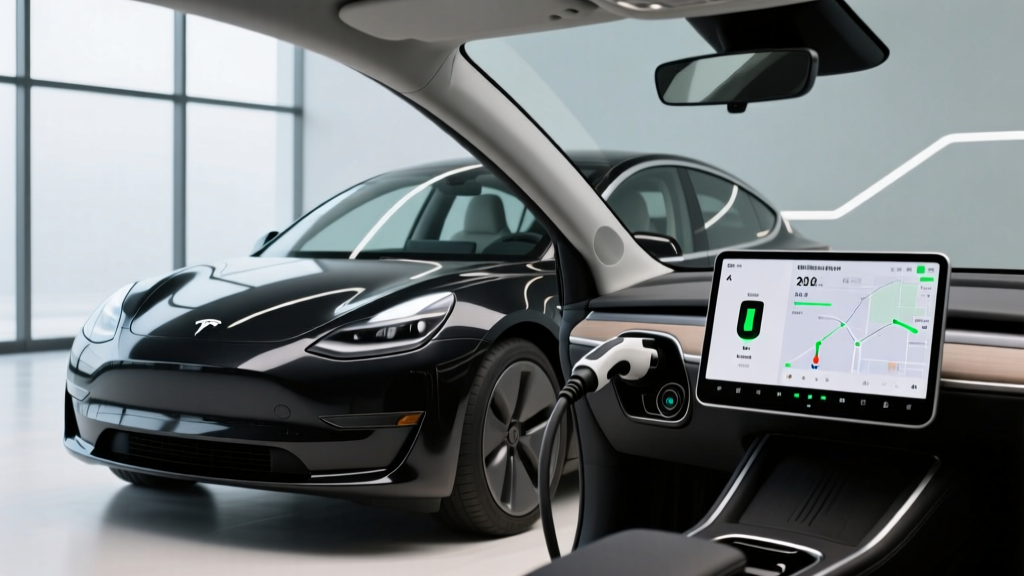
The Model 3's cabin follows Tesla's minimalist philosophy: a single 15.4-inch touchscreen handles all infotainment, climate, and vehicle controls. There is no traditional instrument cluster — speed and navigation appear on the left portion of the center display. Build quality on the 2026 "Highland" refresh has improved noticeably over pre-2024 models, with better panel gaps, ventilated front seats, ambient lighting, and rear-seat ventilation.
Interior dimensions:
- Front headroom: 40.3 in | Legroom: 42.7 in
- Rear headroom: 37.8 in | Legroom: 35.2 in
- Cargo volume (trunk + frunk): 23.0 cu ft (trunk) + 3.1 cu ft (frunk) = 26.1 cu ft total
- Rear seats fold 60/40 for extended cargo capacity
The rear seat remains tighter than a midsize sedan like the Hyundai Ioniq 6 or BMW i4 — tall passengers (6'+) will find headroom snug due to the sloping roofline. The frunk (front trunk) is useful for charging cables and small bags but smaller than the Model Y's.
Driver assistance: Every Model 3 comes with Tesla's Basic Autopilot (adaptive cruise control and lane centering). The optional Full Self-Driving (Supervised) package ($8,000) adds automatic lane changes, navigate-on-autopilot, traffic light and stop sign recognition, and the latest FSD neural-network-based city driving. However, FSD remains an SAE Level 2 system — the driver must remain fully engaged, hands on the wheel (or torque-applied), and eyes on the road at all times. This is not autonomous driving.
Tesla Autopilot and FSD (Supervised) are SAE Level 2 driver-assistance systems. The vehicle can control steering, acceleration, and braking under certain conditions, but the human driver is responsible for monitoring the environment and must be ready to take over immediately. Only Level 4 systems (e.g., Waymo robotaxis) operate without human oversight in defined areas.
Warranty and Long-Term Ownership
| Component | Coverage |
|---|---|
| Basic Vehicle | 4 years / 50,000 miles |
| Battery & Drive Unit | 8 years / 100,000 mi (Standard Range) 8 years / 120,000 mi (Long Range) |
| Battery Capacity Retention | Minimum 70% over warranty period |
Tesla's battery warranty guarantees at least 70% capacity retention over the warranty period. Real-world data from Tesla's fleet suggests most Model 3 batteries retain 85–90% capacity at 100,000 miles, with LFP packs showing even slower degradation curves due to their chemistry advantages. Battery replacement outside warranty is costly — approximately $12,000–$16,000 for a full pack swap — but statistically rare within the first 150,000 miles based on current fleet data.
Insurance costs remain a consideration: the Model 3 typically costs 15–25% more to insure than a comparable gas-powered sedan due to higher repair costs after collision damage (sensor recalibration, aluminum panel work, battery inspection). Tesla Insurance is available in many states and uses real-time driving data to set premiums, which can benefit safe drivers.
Pros, Cons, and the Competition
- Class-leading EPA range (363 mi Long Range RWD)
- Access to Tesla Supercharger network (20,000+ stalls in North America)
- 2026 dashcam update adds genuine safety/documentation value
- LFP option for daily 100% charging without degradation worry
- Over-the-air updates continuously add features
- Strong §30D tax credit eligibility across all trims
- Best-in-class efficiency (24–26 kWh/100mi)
- Rear seat headroom tight for tall passengers
- No physical buttons — all controls via touchscreen
- FSD (Supervised) remains Level 2, not autonomous, at $8,000
- Insurance premiums higher than segment average
- Turn signal stalks removed (steering-wheel buttons instead)
- No Apple CarPlay or Android Auto
- Sentry Mode/dashcam parasitic drain if left on continuously
Choose the Model 3 if: You want maximum range per dollar, rely on fast-charging road trips, value the Supercharger network, commute daily and want LFP's 100%-charge convenience, or want built-in dashcam/Sentry Mode without aftermarket hardware.
Consider competitors if: You need a roomier rear seat (Hyundai Ioniq 6, BMW i4), prefer physical buttons and traditional controls, want Apple CarPlay integration, or need a hatchback cargo opening (Polestar 2, Ioniq 6 liftback).
Frequently Asked Questions
What is the real-world range of the 2026 Tesla Model 3?
The Long Range RWD achieves an EPA-estimated 363 miles, but real-world highway driving at 70–75 mph typically yields 305–325 miles. In cold weather (below 30°F), expect 260–280 miles due to battery thermal management demands and cabin heating. The Standard Range RWD's 272-mile EPA figure drops to roughly 230–245 miles on the highway and 195–210 miles in winter.
How fast does the Model 3 charge at home and on the road?
On DC fast charging, the Long Range trims peak at 250 kW and charge from 10–80% in approximately 25 minutes at a V3/V4 Supercharger. The Standard Range peaks at ~170 kW with a 10–80% time of ~28 minutes. At home on a 48-amp Level 2 charger, the Model 3 adds 37–44 miles of range per hour, fully charging overnight.
How much does the 2026 Model 3 cost after the federal tax credit?
The Standard Range RWD starts at $38,990 MSRP and can drop to approximately $31,490–$32,990 after the full $7,500 §30D credit (if you meet income and sourcing requirements). The Long Range RWD falls to roughly $35,490–$37,990, and the Long Range AWD to $39,990–$43,490. Verify eligibility at irs.gov before purchasing.
Does the Model 3 qualify for the federal EV tax credit?
Yes — all 2026 Model 3 trims are assembled in the US, fall under the $55,000 sedan MSRP cap, and Tesla's battery supply chain meets 2026 critical-mineral and component sourcing thresholds. However, the buyer must also meet AGI income caps ($150K single / $300K married filing jointly) to claim the credit. Point-of-sale transfer is available.
What does the 2026 Tesla dashcam update actually add?
The 2026 update upgrades front-camera recording to 1080p, enables simultaneous multi-camera clip saving during incidents, improves automatic trigger detection (hard braking, airbag deployment), adds an in-car clip viewer with phone export, and reduces storage consumption by ~40% through H.265 compression. You still need a high-endurance USB drive for continuous rolling recording.
Is the Model 3 worth buying over the Ioniq 6 or BMW i4?
The Model 3 wins on range (363 mi vs. Ioniq 6's 361 mi, but with better efficiency), Supercharger network access, and software features like the dashcam update and Sentry Mode. The Ioniq 6 offers a more spacious rear seat and a liftback cargo opening. The BMW i4 provides a more traditional luxury interior with physical controls and Apple CarPlay, but at a higher price point and with less range. Your priority — tech and network vs. comfort and tradition — determines the best pick.
Sources: fueleconomy.gov for EPA range and efficiency data; IRS §30D Clean Vehicle Credit for tax credit rules; Tesla.com official specifications for 2026 Model 3 trims.