Quick Verdict: The Efficiency Benchmark
The 2026 Tesla Model 3 remains the midsize electric sedan to beat when it comes to efficiency and per-mile operating cost. With EPA ratings reaching 132 MPGe on the Long Range AWD trim and a starting price that undercuts most rivals, the Model 3 delivers a cost per mile that gas-powered competitors simply cannot match — provided you can charge at home. Below, we unpack the real numbers: range, charging speed, tax credit eligibility, and the math that determines whether this EV saves you money or costs you more than expected.
Tesla Model 3 Cost Per Mile: The Math That Matters
The headline question for buyers is straightforward: how much does it actually cost to drive a Model 3 per mile? The answer depends on how and where you charge.
| Charging Method | Avg Cost per kWh | kWh/100 mi (LR AWD) | Cost Per Mile |
|---|---|---|---|
| Home Level 2 (national avg $0.16/kWh) | $0.16 | 25 | $0.040 |
| Home Level 2 (California avg $0.27/kWh) | $0.27 | 25 | $0.068 |
| Tesla Supercharger V4 (avg $0.35/kWh) | $0.35 | 25 | $0.088 |
| Public DCFC non-Tesla (avg $0.48/kWh) | $0.48 | 25 | $0.120 |
For comparison, a 30 MPG gas sedan at $3.40/gallon costs roughly $0.113 per mile in fuel alone. A Model 3 charged primarily at home on the national average electricity rate costs roughly one-third of that. Even exclusive Supercharger use undercuts gasoline on a per-mile basis. The caveat: if you rely entirely on expensive public DC fast chargers in high-cost states, your per-mile cost can approach or exceed gasoline.
The Long Range AWD's efficiency of approximately 25 kWh per 100 miles (per fueleconomy.gov) is among the best in its class. The Rear-Wheel Drive trim does slightly better at roughly 24 kWh/100 mi thanks to lower weight and single-motor drivetrain losses.
Range and Efficiency: EPA vs Reality
EPA Estimated Range:
- RWD: 272 miles (60 kWh battery)
- Long Range AWD: 341 miles (79 kWh battery)
- Performance: 315 miles (79 kWh battery)
Real-World Expectation: On highway-heavy trips at 70+ mph, expect 10–15% less than EPA — roughly 230–245 mi (RWD) and 290–305 mi (Long Range). In sub-freezing temperatures, range drops an additional 15–25% due to cabin heating demands and battery chemistry limitations, even with the Model 3's heat pump. Plan for 200–220 mi usable range on a cold-weather RWD road trip.
The RWD trim uses a 60 kWh usable lithium iron phosphate (LFP) battery pack supplied by CATL. LFP chemistry offers slower degradation and tolerates regular 100% charging — Tesla recommends daily charging to full for LFP packs. The Long Range and Performance trims use a 79 kWh usable nickel-manganese-cobalt (NMC) pack from Panasonic, which delivers higher energy density but benefits from daily charge limits of 80–90% for long-term health.
Efficiency ratings per the EPA:
- RWD: 132 MPGe combined (25 kWh/100 mi) — city 138, highway 125
- Long Range AWD: 130 MPGe combined (26 kWh/100 mi) — city 136, highway 123
- Performance: 116 MPGe combined (29 kWh/100 mi)
Charging Speed: Home and DC Fast Charging
| Charging Level | Connector | Max Power | Rate / Time |
|---|---|---|---|
| Level 1 (120V) | NACS (native) | ~1.4 kW | ~3–4 mi/hr |
| Level 2 (240V, 48A) | NACS (native) | 11.5 kW | ~36–44 mi/hr; full charge in 8–9 hr |
| DC Fast Charge | NACS (native) | 250 kW peak (RWD: 170 kW) | 10–80% in ~22 min (LR); ~25 min (RWD) |
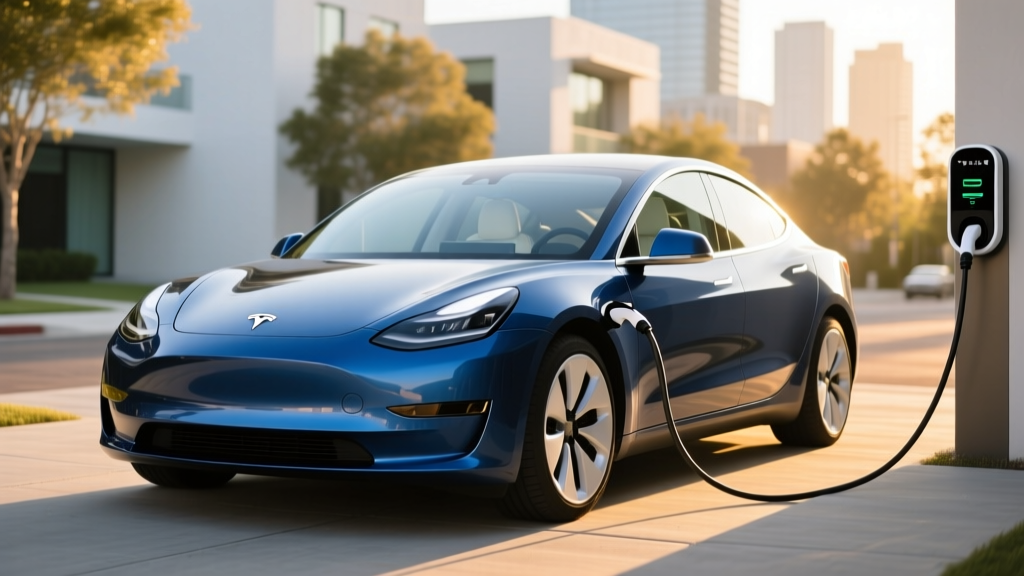
Tesla's NACS connector is now the North American standard, and the 2026 Model 3 ships with it natively — no adapter needed for Tesla Superchargers. For non-Tesla DCFC networks (Electrify America, EVgo), a NACS-to-CCS adapter may be required depending on the station, though network-level NACS adoption has accelerated through 2025–2026.
Charging curve reality check: The Long Range AWD peaks at 250 kW but only sustains that rate between roughly 10–30% state of charge. From 30–60%, power tapers to ~150 kW, and above 80% it drops sharply to protect the battery. A 10–80% session takes approximately 22 minutes at a V4 Supercharger; a 10–90% session stretches to ~35 minutes. The RWD's LFP pack peaks lower at 170 kW but can accept full-rate charging deeper into the curve, making its 10–80% time only marginally longer.
For home charging, a 48-amp Level 2 wall connector on a 60-amp circuit delivers the best experience — roughly 40 miles of range per hour of charging, enough to replenish a full day's driving overnight. Installation costs typically range from $500–$2,000 depending on panel proximity and local permitting, on top of the ~$400 Tesla Wall Connector unit.
Performance, Interior, and Tech
| Spec | RWD | Long Range AWD | Performance |
|---|---|---|---|
| 0–60 mph | 5.8 sec | 4.2 sec | 2.9 sec |
| Horsepower | 271 hp | 346 hp | 510 hp |
| Drivetrain | RWD (single motor) | AWD (dual motor) | AWD (dual motor) |
| Battery (usable) | 60 kWh (LFP) | 79 kWh (NMC) | 79 kWh (NMC) |
| EPA Range | 272 mi | 341 mi | 315 mi |
| Top Speed | 125 mph | 125 mph | 163 mph |
| Cargo Volume | 23 cu ft (trunk + frunk combined) | ||
| Rear Legroom | 34.9 inches | ||
| Curb Weight | 3,862 lbs | 4,034 lbs | 4,065 lbs |
The refreshed Model 3 (introduced for the 2024 model year and carried into 2026 with minor updates) features a quieter cabin with acoustic glass, ventilated front seats, rear-seat ventilation on Long Range and Performance trims, ambient lighting, and a 15.4-inch center touchscreen. A rear 8-inch touchscreen for climate and media controls was added during the refresh. The minimalist interior eliminates nearly all physical controls — even turn signals are on the steering wheel, which divides owners.
Standout tech:
- Tesla Autopilot (SAE Level 2 driver-assist) is standard — adaptive cruise and lane centering. Full Self-Driving (Supervised) is an $8,000 option or $99/month subscription. FSD remains a Level 2 system requiring full driver attention.
- Over-the-air updates continuously add features.
- Sentry Mode dashcam recording, Dog Mode cabin climate for pets.
- Vehicle-to-load (V2L) capability via the 12V system for low-power accessories.
Notable drawbacks: The steering-wheel turn signals and lack of a traditional instrument cluster frustrate some drivers. Rear-seat headroom is tight for passengers over 6 feet. No Apple CarPlay or Android Auto — Tesla's proprietary infotainment only. The ride on 19-inch wheels can be firm over broken pavement.
Pricing, Tax Credits, and Total Cost
| Trim | Base MSRP | Federal §30D Credit | Effective Price |
|---|---|---|---|
| RWD | $38,990 | Up to $7,500 (if eligible) | ~$31,490 |
| Long Range AWD | $45,740 | Up to $7,500 (if eligible) | ~$38,240 |
| Performance | $52,990 | Up to $7,500 (if eligible) | ~$45,490 |
Federal tax credit eligibility under IRS §30D involves several requirements that not every buyer will meet:
- MSRP cap: Sedans must be under $55,000. The RWD and Long Range qualify; the Performance at $52,990 also clears the cap, but adding options that push it above $55,000 disqualifies it.
- Buyer income cap: Modified AGI must not exceed $150,000 (single), $225,000 (head of household), or $300,000 (joint filers).
- Battery sourcing: Critical minerals and battery components must meet phased-in domestic/free-trade-partner sourcing thresholds. As of 2026, the Model 3 Long Range's Panasonic cells assembled in Nevada generally satisfy these requirements, but Tesla's RWD trim with CATL-sourced LFP cells has faced partial credit eligibility in prior years. Confirm current-year eligibility on fueleconomy.gov before purchasing.
- Point-of-sale transfer: Eligible buyers can transfer the credit to the dealer at purchase, reducing the purchase price directly rather than waiting for a tax refund.
5-Year Ownership Cost Snapshot (Long Range AWD, 15,000 mi/yr, home charging at $0.16/kWh):
- Energy cost: ~$1,500 (vs ~$8,500 for a 30 MPG gas sedan at $3.40/gal)
- Maintenance: ~$800 (no oil changes, minimal brake wear from regen; cabin air filter and tire rotation primary costs)
- Insurance: ~$9,000–$11,000 (Tesla insurance premiums run 15–30% above class average per industry data)
- Estimated depreciation: ~$14,000–$17,000 over 5 years
- Total approximate 5-year cost: $25,300–$29,300 (vs $32,000–$38,000 for a comparably priced gas sedan when fuel and maintenance are included)
Warranty Coverage
Tesla's warranty structure is competitive but not class-leading:
- Basic vehicle: 4 years / 50,000 miles
- Battery and drive unit (RWD): 8 years / 100,000 miles
- Battery and drive unit (Long Range/Performance): 8 years / 120,000 miles
- Battery capacity retention threshold: Tesla warrants that the battery will retain at least 70% of original capacity during the warranty period. Real-world data from fleet operators suggests NMC packs typically retain 85–90% after 100,000 miles; LFP packs show even slower degradation due to chemistry advantages.
Pros, Cons, and Who Should Buy
Pros
- Best-in-class efficiency — lowest cost per mile in the segment when charging at home
- Access to Tesla Supercharger network (250 kW V4 stations, highest reliability of any DCFC network)
- Strong real-world range, especially Long Range AWD at 290+ highway miles
- LFP battery on RWD allows daily 100% charging with minimal degradation concern
- OTA updates, strong resale demand, and robust third-party service ecosystem
Cons
- Steering-wheel turn signals and stalkless design polarize drivers
- No Apple CarPlay or Android Auto integration
- Insurance premiums run above segment average
- Rear-seat space is tighter than Hyundai Ioniq 6 or BMW i4
- RWD LFP battery sourcing may affect partial-year tax credit eligibility — verify before purchase
Who This EV Suits Best
Choose the Model 3 RWD if: You commute under 40 miles daily, charge at home, want the lowest entry price, and value LFP's daily-charging convenience.
Choose the Model 3 Long Range AWD if: You road-trip regularly, need dual-motor traction for snow or rain, and want 300+ real-world miles between charges.
Choose the Model 3 Performance if: Track-capable acceleration matters and you're willing to trade some range and ride comfort for 2.9-second 0–60 runs.
Look elsewhere if: You need a spacious rear seat for adults (check the Ioniq 6 or BMW i4), prefer physical controls and CarPlay, or lack reliable home charging access.
Frequently Asked Questions
What is the real-world range of the Tesla Model 3?
The EPA rates the Long Range AWD at 341 miles, but highway driving at 70+ mph typically yields 290–305 miles. In freezing weather, expect 240–270 miles. The RWD's 272-mile EPA rating translates to roughly 230–245 highway miles in mild conditions and 195–215 in cold weather.
How fast does the Model 3 charge at home and on the road?
At home on a 48-amp Level 2 charger, the Model 3 adds roughly 40 miles of range per hour, fully charging overnight. On a Tesla V4 Supercharger, the Long Range peaks at 250 kW and charges from 10–80% in about 22 minutes. The RWD peaks at 170 kW with a 10–80% time of roughly 25 minutes.
How much does the Tesla Model 3 cost after tax credits?
If you qualify for the full $7,500 federal credit under IRS §30D (income within limits, MSRP under $55,000, battery sourcing compliant), the RWD drops to approximately $31,490 and the Long Range to ~$38,240. The credit can be applied as a point-of-sale discount. Verify current-year eligibility on fueleconomy.gov and with a tax professional.
Is the Model 3 worth buying vs the Hyundai Ioniq 6 or BMW i4?
The Model 3 wins on efficiency, Supercharger access, and software. The Ioniq 6 offers more rear-seat room and an 800V architecture for faster DC charging curves. The BMW i4 provides a more traditional luxury interior with physical controls and CarPlay. For lowest cost per mile and best charging network, the Model 3 still leads.
Does the Tesla Model 3 qualify for the federal EV tax credit?
Yes, but with conditions. The RWD, Long Range, and Performance all fall under the $55,000 sedan MSRP cap. However, buyer income limits ($150K single / $300K joint), battery critical-mineral sourcing rules, and final assembly requirements all apply. The Long Range AWD with its Nevada-built Panasonic pack has maintained consistent eligibility; the RWD's CATL LFP cells have faced scrutiny under sourcing rules. Always confirm on the IRS clean vehicle credit page before committing.
What does it cost to maintain a Model 3?
Routine maintenance is minimal: cabin air filter replacement every 2 years (~$100–$150), tire rotation every 6,250 miles, brake fluid check every 2 years, and windshield washer fluid. Regenerative braking means brake pads often last 100,000+ miles. Expect roughly $150–$200 per year in scheduled maintenance — a fraction of a gas sedan's costs.