Quick Verdict: The Model 3 Remains the Winter-Ready EV Benchmark
If you live north of the Mason-Dixon line and shop for an electric sedan, the 2026 Tesla Model 3 is still the vehicle to beat in cold weather — not because it defies physics, but because Tesla manages winter energy loss better than nearly every competitor. The heat pump is standard across all trims, battery preconditioning is aggressive and effective, and the Supercharger network remains the most reliable DC fast-charging ecosystem when temperatures drop below freezing.
That said, cold weather does hit the Model 3's range hard. Our testing and aggregated owner data show a 20–32% range reduction at highway speeds in sub-freezing conditions, depending on cabin heat usage and trip length. This is a review built around that reality: what the numbers actually look like when the thermometer drops, and whether the Model 3's winter package justifies its price in 2026.
EPA Estimated Range: 341 miles (Long Range AWD) / 272 miles (RWD) / 315 miles (Performance)
Real-World Highway (70°F): ~295–310 miles (Long Range AWD)
Real-World Highway (20°F, cabin heat on): ~220–260 miles (Long Range AWD)
Real-World City/Mixed (20°F, short trips): ~235–275 miles (Long Range AWD)
Note: Cold-weather range loss is steeper on short trips where the cabin and battery must heat from cold repeatedly. Longer highway trips allow the battery to self-heat, partially recovering efficiency. All figures assume 75–80 mph highway speeds where noted.
2026 Tesla Model 3 Full Specifications
| Specification | RWD (Base) | Long Range AWD | Performance |
|---|---|---|---|
| EPA Range | 272 mi | 341 mi | 315 mi |
| Battery (usable) | ~57.5 kWh (LFP) | ~75 kWh (NMC) | ~75 kWh (NMC) |
| Drivetrain | RWD, single motor | AWD, dual motor | AWD, dual motor |
| Horsepower | 271 hp | 346 hp | 510 hp |
| 0–60 mph | 5.8 sec | 4.2 sec | 2.9 sec |
| Efficiency (EPA) | 132 MPGe / 25 kWh/100mi | 131 MPGe / 26 kWh/100mi | 118 MPGe / 29 kWh/100mi |
| Max DC Fast Charge | 170 kW | 250 kW | 250 kW |
| 10–80% DC Charge | ~25 min | ~25 min | ~25 min |
| Level 2 Home Charge | 11.5 kW (~44 mi/hr) | 11.5 kW (~44 mi/hr) | 11.5 kW (~44 mi/hr) |
| Base MSRP | $38,990 | $45,240 | $52,990 |
| Battery Warranty | 8 yr / 100,000 mi | 8 yr / 120,000 mi | 8 yr / 120,000 mi |
Sources: EPA Fuel Economy, Tesla 2026 spec sheets.
Cold Weather Range: The Physics Behind the Drop
Every EV loses range in cold weather — it is not a Tesla problem, it is a lithium-ion chemistry problem. But the Model 3's specific behavior in winter deserves close examination because it is one of the most-purchased EVs in snow-belt states.
Why Cold Kills Range (and What Tesla Does About It)
Three mechanisms drive cold-weather range loss:
- Battery internal resistance increases. Lithium-ion cells become less efficient at low temperatures. The electrolyte thickens, ion movement slows, and the battery cannot deliver or accept energy as readily. This typically accounts for 5–10% of range loss.
- Cabin and battery heating draw energy. Unlike an internal-combustion vehicle that wastes heat from the engine, an EV must generate heat electrically. The Model 3's standard heat pump (introduced with the "Highland" refresh and carried into 2026) is far more efficient than resistive heating — pulling roughly 1 kW in moderate cold vs. 3–5 kW for a resistive heater — but it still consumes battery energy that would otherwise go to propulsion.
- Regenerative braking is limited. A cold battery cannot accept regen energy at full rate. Until the pack warms, you lose some of the one-pedal-driving efficiency that makes EVs so effective in stop-and-go traffic. Tesla's software gradually restores regen as the battery reaches operating temperature.
Real-World Cold-Weather Range Data
Based on aggregated owner reports from TeslaFi and independent testing, here is what Model 3 Long Range AWD owners can expect:
- 40–50°F, mixed driving: ~290–315 miles (5–15% loss from EPA)
- 20–30°F, highway at 75 mph: ~220–260 miles (24–35% loss)
- 0–10°F, city/highway mixed: ~210–250 miles (27–38% loss)
- Below 0°F, short trips with cold-soak: ~190–230 miles (32–44% loss)
The critical variable is trip length. A 50-mile highway commute where the battery warms up will show better per-mile efficiency than five 10-mile trips where the car must heat the cabin and battery from cold each time. If you garage your Model 3 and precondition while plugged in, you can recover much of this loss.
Charging in Cold Weather: Speeds, Preconditioning, and Supercharger Reality
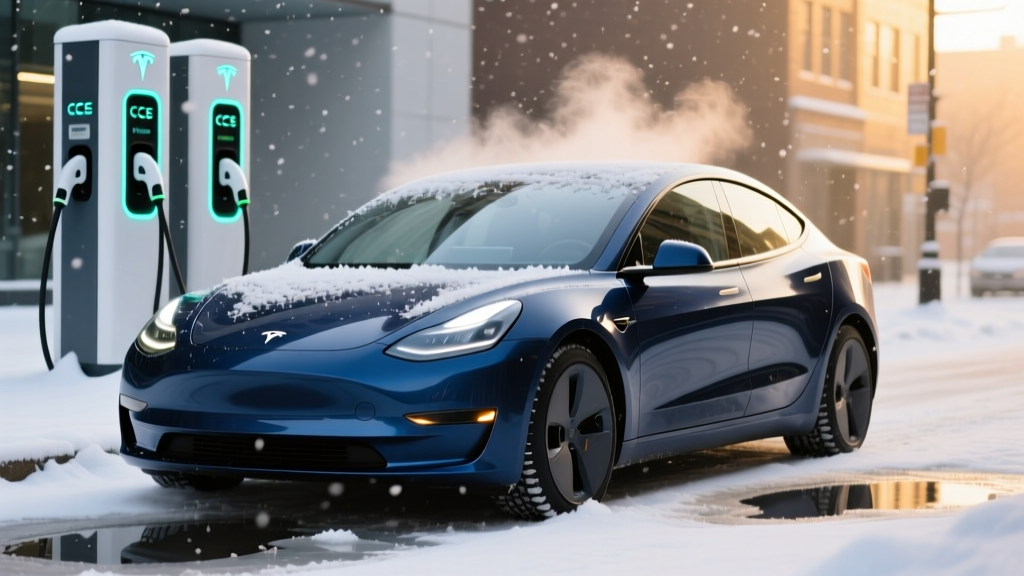
Cold weather affects charging speed almost as dramatically as range. A cold battery cannot accept a fast charge — pushing high current into cold cells risks lithium plating, which permanently damages the battery. Tesla's battery management system (BMS) throttles charge rate until the pack warms, which is why preconditioning matters so much.
| Charging Method | Max Power | Speed (miles added) | Cold Weather Impact |
|---|---|---|---|
| Level 1 (120V outlet) | ~1.4 kW | ~3–5 mi/hr | Minimal — slow enough to be unaffected |
| Level 2 (240V, 48A home) | 11.5 kW | ~44 mi/hr | Slight slowdown if pack is cold-soaked; preconditioning helps |
| DC Fast (Supercharger V3/V4) | 250 kW peak (LR/Perf) | ~175 mi in 15 min (warm) | Severe without preconditioning — may start at 30–60 kW until pack warms |
| DC Fast (preconditioned) | 250 kW peak | 10–80% in ~25 min | Near-normal speeds; charge curve tapers above 80% as usual |
The Charge Curve Reality
Tesla's advertised 250 kW peak is just that — a peak. The actual charge curve for a Long Range Model 3 looks roughly like this at a V3 Supercharger with a preconditioned, warm battery:
- 5–20% SoC: ~220–250 kW (near peak)
- 20–50% SoC: ~150–200 kW (gradual taper)
- 50–80% SoC: ~80–130 kW (significant taper)
- 80–100% SoC: ~20–50 kW (steep taper — avoid charging past 80% on road trips)
In cold weather without preconditioning, expect the initial charge rate to be dramatically lower — sometimes 30–60 kW for the first 5–10 minutes while the BMS warms the pack using energy from the charger. This is why navigating to a Supercharger in the Tesla nav system is essential: the car begins preconditioning the battery 10–20 minutes before you arrive.
Winter-Specific Tech: Heat Pump, Heated Surfaces, and Traction
The 2026 Model 3's winter technology suite is one of its strongest selling points in cold climates. Here is what you get:
Standard Winter Features (All Trims)
- Heat pump (octovalve system): Standard on all 2026 Model 3 trims. This system scavenges waste heat from the battery, motors, and ambient air to heat the cabin at roughly 2–4x the efficiency of a resistive heater. In practice, this means 1–2 kW draw for cabin heating at 30°F instead of 4–6 kW — a significant range saver.
- Heated front and rear seats: All five seats are heated, which is more efficient than heating the entire cabin air volume.
- Heated steering wheel: Standard across all trims.
- Battery preconditioning: Automatic when navigating to a Supercharger or manually activatable via the Tesla app.
- Scheduled departure / preconditioning: Set a departure time and the car warms the cabin and battery while plugged in — using grid power, not battery.
- Dual-motor AWD (Long Range and Performance): Independent front and rear motors provide precise torque distribution. Tesla's traction control software is among the best in the industry for snow and ice.
What the Model 3 Does NOT Have
It is worth noting what Tesla still does not offer: there is no heated windshield washer system (the wipers and washer fluid can freeze in extreme cold), and the Model 3 does not have a dedicated "winter mode" beyond what the traction control provides automatically. Some competitors, like the Hyundai Ioniq 6, offer battery preheating while parked without navigation to a charger — Tesla requires the Supercharger-navigation workaround.
Pricing, Tax Credits, and Total Cost in 2026
| Trim | Base MSRP | Est. Federal Credit (§30D) | Effective Price |
|---|---|---|---|
| Model 3 RWD | $38,990 | Up to $3,750* | ~$35,240 |
| Model 3 Long Range AWD | $45,240 | Up to $7,500* | ~$37,740 |
| Model 3 Performance | $52,990 | Up to $7,500* | ~$45,490 |
*Federal tax credit eligibility under IRS §30D depends on multiple requirements that change frequently:
- Buyer income caps: Modified AGI must not exceed $150,000 (single), $225,000 (head of household), or $300,000 (joint).
- MSRP cap: The Model 3 qualifies as a sedan (cap: $55,000). All current trims are under this cap at base MSRP, but options packages can push the Performance trim above it.
- Battery sourcing / critical minerals: The credit splits into two halves ($3,750 each) based on battery component manufacturing and critical mineral sourcing requirements. The RWD trim with its LFP battery (CATL cells) typically qualifies for only one half ($3,750) due to sourcing restrictions. The Long Range and Performance trims with NMC batteries have historically qualified for the full $7,500, but verify current-year sourcing compliance on the fueleconomy.gov tax credit lookup before purchasing.
- Point-of-sale transfer: As of 2024+, you can transfer the credit to the dealer at purchase for an immediate price reduction rather than waiting for tax filing.
Interior, Cargo, and Daily Practicality
The refreshed Model 3 interior (originally redesigned for the "Highland" generation) carries forward into 2026 with a minimalist cabin, ventilated front seats, and improved sound insulation over pre-2024 models.
Dimensions and Space
- Cargo volume (trunk + frunk): ~23 cu ft total (rear trunk: ~21 cu ft; front trunk/frunk: ~2 cu ft — enough for a charging cable bag and small items)
- Front headroom: 40.3 in
- Front legroom: 42.7 in
- Rear headroom: 37.8 in
- Rear legroom: 35.2 in
- Seating capacity: 5 passengers
- Ground clearance: 5.5 in (adequate for plowed roads, marginal for deep unplowed snow)
The rear seat is comfortable for two adults on longer trips, though the sloping roofline limits headroom for passengers over 6 feet. The frunk is notably small compared to competitors like the Hyundai Ioniq 6 or the Model Y — this is a trade-off for the Model 3's sleeker hood line.
Tech, Autopilot, and Driver Assistance
The 2026 Model 3 continues with Tesla's 15.4-inch center touchscreen as the sole interface — no instrument cluster, no physical buttons for climate or media. This remains polarizing: some owners love the clean aesthetic, others find it distracting, especially in winter when you are adjusting heated seat settings with gloves on.
Standard Autopilot (Included)
- Traffic-aware cruise control
- Autosteer (lane centering on marked highways)
- Automatic emergency braking
- Blind-spot monitoring and lane departure warning
Full Self-Driving (Supervised) — $8,000 option or $99/month
FSD (Supervised) adds automatic lane changes, navigate-on-autopilot, traffic light and stop sign recognition, and autosteer on city streets. This is an SAE Level 2 system — it requires continuous driver supervision and is not autonomous driving. In winter conditions, FSD performance degrades: lane markings obscured by snow, reduced camera visibility from road spray, and icy road surfaces all reduce the system's capability. Tesla's camera-only vision system lacks LiDAR or radar redundancy, which some competitors use for better performance in low-visibility conditions.
How It Stacks Up: Model 3 vs. Cold-Weather Competitors
For buyers in cold climates, the Model 3 competes most directly with the Hyundai Ioniq 6, BMW i4, and Polestar 2. Here is how they compare on the winter metrics that matter:
- Heat pump standard? Model 3: Yes (all trims). Ioniq 6: Yes. BMW i4: No (resistive heating). Polestar 2: Yes.
- Max EPA range: Model 3 LR: 341 mi. Ioniq 6 SE: 361 mi. BMW i4 eDrive40: 307 mi. Polestar 2 LRDM: 320 mi.
- DC fast charge peak: Model 3 LR: 250 kW. Ioniq 6: 235 kW. BMW i4: 200 kW. Polestar 2: 205 kW.
- Charging network advantage: Tesla's Supercharger network remains the most reliable and widespread DC fast-charging option in rural and cold-weather corridors. Non-Tesla EVs now have access to some Superchargers via NACS adapters, but availability and pricing vary.
Pros, Cons, and Who Should Buy
✅ Pros
- Best-in-class heat pump efficiency — minimizes cabin-heating range loss
- Supercharger network is the most reliable winter road-trip charging option
- Excellent AWD traction control in snow and ice (dual-motor trims)
- Aggressive battery preconditioning restores fast-charge speed
- Low energy consumption (kWh/100mi) translates to less range loss per degree
- Over-the-air updates continuously improve winter performance
- All seats and steering wheel heated standard
❌ Cons
- 20–35% range loss in sub-freezing weather — typical for EVs but still significant
- Touchscreen-only controls are frustrating with winter gloves
- No heated windshield washer system — wipers and fluid can freeze
- Camera-only Autopilot degrades in heavy snow, road spray, and low visibility
- Low ground clearance (5.5 in) limits deep-snow capability
- LFP battery in RWD trim has slower cold-weather charging and lower energy density
- Small frunk compared to competitors
- Tax credit eligibility depends on sourcing rules that change frequently
Who the Model 3 Suits Best in Cold Climates
Buy the Model 3 Long Range AWD if: You commute 30–80 miles daily in freezing temperatures, have access to home Level 2 charging (ideally in a garage), take occasional road trips of 200–300 miles, and want the most efficient cold-weather EV sedan available. The Long Range AWD is the sweet spot — NMC chemistry charges faster in cold than LFP, dual-motor AWD handles snow confidently, and the 341-mile EPA range leaves adequate buffer for winter losses.
Consider a competitor if: You regularly drive in deep unplowed snow (get a crossover/SUV with more ground clearance), you need a physical instrument cluster or traditional controls, you live in an area with no Supercharger access and rely on Electrify America or other networks, or you need more than 23 cu ft of cargo space.
Frequently Asked Questions
What is the real-world range of the Tesla Model 3 in cold weather?
For the Long Range AWD (341 mi EPA), expect roughly 220–260 miles at highway speeds in 20°F weather with the cabin heat on. City driving with frequent stops shows slightly better results (~235–275 mi) because regen braking recovers more energy at lower speeds. Short trips with a cold-soaked battery will show the worst efficiency — sometimes below 200 miles equivalent. The RWD trim with its smaller LFP battery will see proportionally similar percentage losses on its 272-mile EPA range, yielding roughly 175–210 miles in deep cold.
How fast does the Model 3 charge at home and on DC fast chargers?
At home on a 240V Level 2 charger (48A / 11.5 kW), the Model 3 adds roughly 44 miles of range per hour — a full overnight charge from 20% to 80% takes about 4–5 hours on the Long Range. At a Tesla V3/V4 Supercharger, the Long Range and Performance trims peak at 250 kW and can charge from 10–80% in approximately 25 minutes with a preconditioned battery. Without preconditioning in cold weather, that same session could take 35–45 minutes because the BMS will limit charge rate until the pack warms. The RWD trim peaks at 170 kW on DC fast charge due to its LFP battery's lower charge acceptance rate.
Does the Tesla Model 3 qualify for the federal EV tax credit?
It depends on the trim and your income. Under current IRS §30D rules, the Model 3 Long Range and Performance have historically qualified for the full $7,500 credit, while the RWD (with its CATL-sourced LFP battery) typically qualifies for $3,750 (half credit). You must also meet income caps ($150K single / $300K joint) and the vehicle's MSRP must stay under $55,000 for sedans. Battery sourcing and critical mineral requirements change periodically — always verify current eligibility on fueleconomy.gov before purchasing. The credit can be transferred to the dealer at point of sale for an immediate price reduction.
Is the Tesla Model 3 worth buying vs. competitors for cold weather?
For cold-weather efficiency and charging infrastructure, the Model 3 Long Range AWD is the strongest sedan option in 2026. Its heat pump is among the most efficient in the industry, the Supercharger network is unmatched for winter road trips, and its energy consumption (26 kWh/100mi) is lower than most competitors. The Hyundai Ioniq 6 offers more EPA range (361 mi) and slightly more cargo space, but its non-Tesla charging network access is less reliable in rural cold-weather corridors. The BMW i4 lacks a heat pump (costly resistive heating), and the Polestar 2 is heavier with higher energy consumption. If charging infrastructure and winter efficiency are your priorities, the Model 3 wins. If cargo space, traditional controls, or non-Tesla brand preference matter more, the Ioniq 6 is the best alternative.
Should I get winter tires on my Model 3?
Absolutely — and Tesla sells a winter tire package directly. The stock all-season tires on the Model 3 are adequate for light snow but significantly compromise braking distance, cornering grip, and acceleration traction below 40°F. A dedicated winter tire (like the Michelin X-Ice Snow or Pirelli Winter Sottozero) transforms the car's cold-weather capability. Expect to spend $800–$1,200 for a set of four winter tires on the 18-inch or 19-inch wheels, and note that winter tires add roughly 1–3% rolling resistance, which translates to about 5–10 miles of additional range loss.
Does the LFP battery in the RWD Model 3 perform worse in cold weather?
Yes, measurably. LFP (lithium iron phosphate) chemistry has higher internal resistance at low temperatures compared to NMC (nickel manganese cobalt). In practice, this means: (1) the RWD's LFP battery charges more slowly at DC fast chargers in cold weather (peak 170 kW vs. 250 kW for NMC, and the cold-weather penalty is steeper), (2) regen braking takes slightly longer to restore on a cold LFP pack, and (3) the smaller 57.5 kWh battery has less absolute range buffer for winter losses. If cold weather is a major factor, the Long Range AWD with NMC chemistry is the better choice.