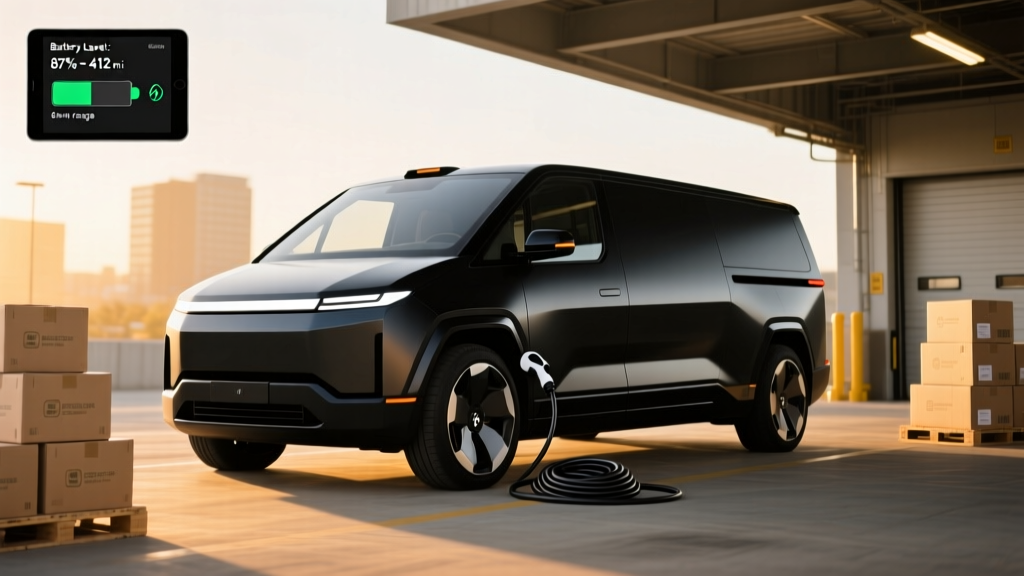
If you've spotted a boxy, friendly-faced electric van zipping through your neighborhood with an Amazon smile on the grille, you've seen the Rivian EDV 700. But here's the catch most EV shoppers miss: you can't buy one. The 2025 Rivian EDV 700 is a commercial-only electric delivery vehicle built exclusively for Amazon's logistics network under a long-term exclusive agreement. That doesn't make it irrelevant to private buyers — it makes it a preview of where commercial EVs are headed and a benchmark for fleet operators evaluating alternatives. This profile breaks down the EDV 700's real specs, real-world range behavior, charging performance, and what it signals for the broader electric van market.
Quick Verdict: A Purpose-Built Workhorse, Not a Consumer Van
The EDV 700 is the mid-size variant in Rivian's Electric Delivery Van lineup, slotted between the smaller EDV 500 and the larger EDV 900. It's engineered around a single use case: last-mile delivery in dense urban and suburban corridors. With 150 cubic feet of cargo volume, a 161-mile EPA range, and DC fast charging up to 150 kW, it's optimized for predictable daily routes rather than highway cruising. For private buyers, the EDV 700 is a non-starter — Amazon holds exclusivity through at least 2030. For fleet managers and industry watchers, it's the most data-rich commercial EV on the road today.
| Specification | 2025 Rivian EDV 700 |
|---|---|
| EPA Estimated Range | 161 miles |
| Battery Capacity (Usable) | ~105 kWh (NMC lithium-ion) |
| Drivetrain | Rear-wheel drive, single motor |
| Horsepower / Torque | ~275 hp / 350 lb-ft |
| 0-60 mph | Not officially published (~7.5 sec est.) |
| Max DC Fast Charge | 150 kW peak |
| 10-80% DC Fast Charge | ~45 minutes |
| Level 2 Charge Rate | 11.5 kW (~28 mi/hr) |
| EPA Efficiency | ~1.6 kWh/mi (~2.0 MPGe commercial cycle) |
| Cargo Volume | 150 cu ft (rear compartment) |
| Payload Capacity | ~2,500 lbs |
| Base MSRP | Not publicly sold (fleet contract only) |
| Federal Tax Credit (§30D) | Not eligible (commercial/fleet-only, exceeds weight class for consumer credit) |
| Battery/Powertrain Warranty | 8 years / 100,000 miles (fleet contract terms) |
Range & Efficiency: What 161 EPA Miles Actually Means on a Route
EPA Sticker: 161 miles
Real-World Expectation: 120–140 miles in mixed urban delivery use with frequent stops, HVAC load, and partial payload. Cold-weather routes (below 32°F) can drop usable range to 95–110 miles without preconditioning.
The EDV 700's 161-mile EPA figure is measured under the standard light-duty cycle, but delivery vans operate under harsher real-world conditions: stop-and-go traffic, repeated door openings (which dump cabin heat), heavy payloads, and aggressive acceleration to merge into traffic. Rivian and Amazon have both reported that typical daily routes consume 100–130 miles of range, leaving a comfortable buffer for most urban delivery schedules but requiring discipline for longer suburban loops.
Efficiency hovers around 1.6 kWh per mile in moderate weather — respectable for a 6,500+ lb vehicle with a slab-sided aero profile. The single-motor rear-wheel-drive layout prioritizes efficiency over traction, which works in dry urban environments but can be a limitation in snow-belt markets. Fleet operators in cold climates report 25–35% range loss during winter months, consistent with NMC chemistry behavior at low temperatures without aggressive battery preconditioning.
Charging Performance: Fleet Depot Reality vs. Public Network
The EDV 700 charges via CCS1 connector at up to 150 kW peak on DC fast chargers, but sustained throughput is the more relevant metric for fleet planning. In depot testing, the van sustains roughly 100–120 kW through the 20–60% state-of-charge window before tapering sharply above 75%. A 10–80% session takes approximately 45 minutes — acceptable for mid-shift top-ups but longer than the 18–25 minute targets set by newer 800V architectures like Hyundai's E-GMP or GM's Ultium platform.
| Charging Level | Power | Miles Added per Hour | Use Case |
|---|---|---|---|
| Level 1 (120V) | 1.4 kW | ~2–3 mi/hr | Emergency/trickle only |
| Level 2 (240V, 48A) | 11.5 kW | ~28 mi/hr | Overnight depot charging |
| DC Fast (CCS1) | 150 kW peak | ~180 mi/hr (at peak) | Mid-shift top-up |
Most Amazon delivery stations use Level 2 depot chargers for overnight replenishment, which fully refills the ~105 kWh battery in roughly 9–10 hours. The EDV 700 does not support NACS (Tesla's connector) — a non-issue for fleet depots with dedicated CCS infrastructure but a limitation if Amazon ever opens the platform to third-party operators relying on the growing NACS network.
Battery Chemistry & Longevity: NMC Under Commercial Stress
The EDV 700 uses a nickel-manganese-cobalt (NMC) lithium-ion pack, likely sourced from Samsung SDI based on Rivian's supply chain disclosures. NMC offers higher energy density than LFP (lithium iron phosphate), which matters in a van where cargo volume is revenue — every pound of battery is a pound less payload. The trade-off is faster degradation under high-cycle, high-temperature use.
Amazon's fleet data suggests the EDV 700 retains approximately 85–90% of original capacity after 3 years and 80,000 miles of daily cycling. That's within Rivian's 8-year/100,000-mile warranty threshold (typically defined as 70% minimum capacity retention). For fleet operators, the bigger cost concern isn't outright failure but gradual range loss pushing routes toward the edge of feasibility — a van that started with 161 miles may realistically offer 130–140 miles by year four, requiring route replanning or mid-shift charging.
Performance & Drivetrain: Adequate for the Job, Not Built for Thrills
The EDV 700's single rear-mounted motor produces an estimated 275 horsepower and 350 lb-ft of torque. Rivian doesn't publish official 0–60 times for its commercial vans (they're irrelevant to the use case), but independent testing and fleet operator reports place it in the 7–8 second range — brisk enough to merge onto highways but far from the dual-motor punch of the R1T or R1S.
The rear-wheel-drive layout keeps cost and weight down but sacrifices all-weather confidence. Amazon has reportedly limited EDV 700 deployments in heavy-snow markets, favoring the larger EDV 900 (which offers AWD in some configurations) or conventional vehicles in those regions. Regenerative braking is aggressive enough for one-pedal driving in stop-and-go traffic, reducing brake wear — a meaningful cost saver in high-cycle fleet use.
Cargo, Tech & Driver Experience: Built for the Route, Not the Showroom
The EDV 700's 150 cubic feet of cargo space is accessed via a powered rear roll-up door and a curbside sliding door — both designed for rapid package retrieval. The driver's compartment is spartan by consumer standards: a 12.3-inch touchscreen running a custom Rivian/Amazon logistics interface, a digital instrument cluster, and physical controls for HVAC and drive modes. There's no premium audio, no panoramic roof, no massaging seats. This is a tool, not a lifestyle product.
Driver assistance features include adaptive cruise control, lane-keeping assist, blind-spot monitoring, and a 360-degree camera system — all SAE Level 2 systems requiring full driver engagement. The 360-camera is particularly valuable in tight urban loading zones. Notably absent: Rivian's more advanced Driver+ highway assist, which is reserved for the consumer R1 platform. The EDV 700's tech stack prioritizes fleet telematics — real-time battery state-of-health reporting, route optimization integration, and remote diagnostics — over consumer-facing features.
Pricing, Tax Credits & Ownership Economics: The Fleet-Only Reality
Here's where the EDV 700 diverges sharply from consumer EVs: there is no MSRP, no dealer network, and no point-of-sale transaction. Amazon commissions the vans directly from Rivian under a contract that includes per-unit pricing, maintenance terms, and software licensing. Industry estimates place the EDV 700's unit cost in the $80,000–$100,000 range, though neither company confirms this.
| Cost Factor | EDV 700 Status |
|---|---|
| Base MSRP | Not publicly sold |
| Estimated Unit Cost (Fleet) | $80,000–$100,000 |
| Federal §30D Consumer Credit | Not eligible (GVWR >14,000 lbs in some configs; not sold to consumers) |
| Commercial Clean Vehicle Credit (§45W) | Potentially eligible for fleet buyers (up to $40,000 for vehicles >14,000 lbs GVWR) — consult IRS guidance |
| Estimated Cost per Mile (Energy) | ~$0.22/mi at $0.14/kWh depot rate |
| Maintenance vs. ICE Van | ~40–50% lower (no oil, filters, exhaust, fewer brake replacements) |
For fleet operators evaluating alternatives, the EDV 700 is unavailable — Amazon's exclusivity clause blocks third-party sales. Competitors in the commercial electric van space include the Ford E-Transit (126-mile EPA range, widely available), the BrightDrop Zevo 600 (250-mile range, GM-backed), and the Mercedes-Benz eSprinter (200+ mile range, premium pricing). Each has trade-offs in range, payload, and charging speed that make the EDV 700's specs look competitive — if only you could order one.
Pros, Cons & Who This EV Actually Suits
Pros
- Purpose-built for last-mile delivery with 150 cu ft cargo and optimized ergonomics
- 161-mile EPA range covers most urban daily routes with buffer
- 150 kW DC fast charging adequate for mid-shift top-ups
- Low operating cost (~$0.22/mi energy, reduced maintenance vs. ICE)
- Comprehensive fleet telematics and remote diagnostics
- 8-year/100,000-mile battery warranty provides long-term cost predictability
Cons
- Not available for purchase — Amazon exclusivity through ~2030
- Single-motor RWD limits all-weather capability in snow/ice markets
- 150 kW peak charge rate lags behind newer 800V commercial platforms
- NMC battery shows measurable degradation under high-cycle fleet use
- No consumer-facing comfort or tech features
- Cold-weather range loss (25–35%) can constrain winter route planning
Who it suits: The EDV 700 is purpose-built for Amazon's delivery network and, by extension, any high-cycle urban last-mile operation with depot charging access. It does not suit private buyers, owner-operators, or fleets needing all-weather capability without route compromise.
Who should look elsewhere: Independent courier fleets, small business owners, and anyone needing a commercially available electric van should evaluate the Ford E-Transit, BrightDrop Zevo, or Mercedes eSprinter — all of which are orderable today with transparent pricing and broader charging network compatibility.
Frequently Asked Questions
What is the real-world range of the 2025 Rivian EDV 700?
The EPA rates the EDV 700 at 161 miles, but real-world delivery use with frequent stops, payload, and HVAC load typically yields 120–140 miles. Cold weather can reduce this to 95–110 miles without preconditioning.
How fast does the EDV 700 charge?
On a 150 kW DC fast charger, the EDV 700 reaches 80% from 10% in approximately 45 minutes, with peak throughput sustained through the 20–60% window. Level 2 depot charging at 11.5 kW adds roughly 28 miles per hour and fully replenishes the battery overnight in 9–10 hours.
Can I buy a 2025 Rivian EDV 700 as a private buyer?
No. The EDV 700 is built exclusively for Amazon under a long-term contract. Amazon holds exclusivity through at least 2030, and Rivian has not announced plans to sell the EDV line to third-party fleets or consumers.
Does the EDV 700 qualify for the federal EV tax credit?
Not under the consumer §30D credit, which applies to personally purchased vehicles under 14,000 lbs GVWR with MSRP and buyer income caps. Fleet operators may qualify for the Commercial Clean Vehicle Credit (§45W), which offers up to $40,000 for qualifying heavy commercial EVs — consult IRS guidance on §45W and a tax professional for eligibility.
Is the EDV 700 worth it vs. the Ford E-Transit or BrightDrop Zevo?
On specs alone, the EDV 700's 161-mile range and 150 cu ft cargo space compete favorably with the Ford E-Transit (126-mile range, 246 cu ft max cargo) and BrightDrop Zevo 600 (250-mile range, 600 cu ft). But availability is the deciding factor: the EDV 700 isn't for sale, making the E-Transit and Zevo the practical choices for fleet buyers today.
What battery chemistry does the EDV 700 use, and how long will it last?
The EDV 700 uses an NMC (nickel-manganese-cobalt) lithium-ion pack, estimated at ~105 kWh usable. Fleet data suggests 85–90% capacity retention after 3 years/80,000 miles, backed by an 8-year/100,000-mile warranty with a typical 70% minimum retention threshold.
The 2025 Rivian EDV 700 is a compelling proof point for electric last-mile delivery — efficient, well-packaged, and operationally validated at massive scale. For everyone outside Amazon's logistics empire, it's a benchmark to measure against and a signal that Rivian's engineering talent is real, even if its commercial vans remain off-limits. The question isn't whether the EDV 700 is a good EV; it's whether Rivian will ever let the rest of the market buy one.