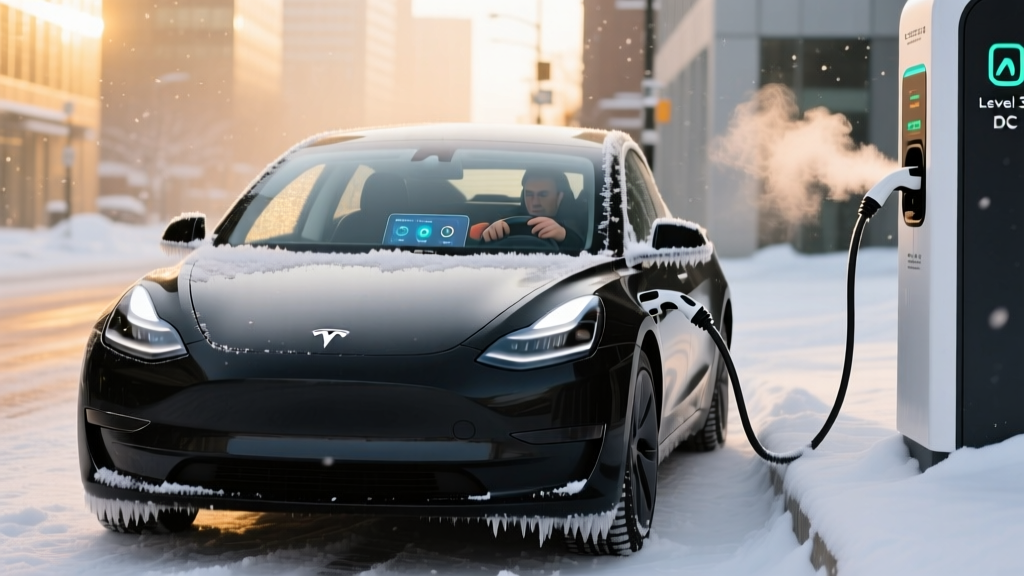
If you live north of the 40th parallel, you already know that every EV loses range when the thermometer drops. The question isn't whether the Tesla Model 3 suffers in winter — it does, like every lithium-ion vehicle on the road — but how well its cold-weather engineering mitigates the hit. For 2026, the refreshed Model 3 (internally called "Highland" and its subsequent updates) bundles a heat pump, battery preconditioning, heated seats across all positions, and a heated steering wheel into a package that remains one of the most winter-capable sedans in the EV segment.
This review focuses on the Model 3's cold-weather feature set alongside the full ownership picture: real-world range, charging speeds, pricing after federal tax credits, and how it stacks up against rivals like the Hyundai Ioniq 6 and BMW i4 when temperatures plunge below freezing.
2026 Tesla Model 3: Full Spec Sheet at a Glance
| Specification | Model 3 RWD | Model 3 Long Range AWD | Model 3 Performance |
|---|---|---|---|
| EPA Range | 272 mi | 341 mi | 315 mi |
| Battery (usable) | ~57.5 kWh (LFP) | ~75 kWh (NMC) | ~75 kWh (NMC) |
| Drivetrain | Rear-Wheel Drive | Dual-Motor AWD | Dual-Motor AWD |
| Horsepower | 271 hp | 346 hp | 510 hp |
| 0–60 mph | 5.8 sec | 4.2 sec | 2.9 sec |
| Peak DC Fast Charge | 170 kW | 250 kW | 250 kW |
| 10–80% DCFC Time | ~25 min | ~22 min | ~22 min |
| Level 2 Home Charge | 11.5 kW (~37 mi/hr) | 11.5 kW (~44 mi/hr) | 11.5 kW (~44 mi/hr) |
| MPGe (combined) | 132 MPGe | 132 MPGe | 119 MPGe |
| Efficiency | 25 kWh/100 mi | 25 kWh/100 mi | 28 kWh/100 mi |
| Base MSRP | $38,990 | $44,990 | $52,990 |
| Battery Warranty | 8 yr / 100,000 mi | 8 yr / 120,000 mi | 8 yr / 120,000 mi |
Source: EPA / fueleconomy.gov and Tesla specifications. Pricing reflects 2026 MSRP before destination fees.
Cold Weather Features That Actually Matter
Tesla doesn't offer a standalone "winter package" — cold-weather hardware is standard on every 2026 Model 3 trim. Here's what's baked in and why each component matters when you're commuting at 15°F:
Heat Pump (Standard on All Trims)
The Model 3 uses a heat pump rather than a resistive PTC heater for cabin climate. A heat pump moves thermal energy rather than generating it from scratch, pulling heat from the ambient air, the battery, and even the drive motors. In practice, this means cabin heating at 30°F might draw 2–3 kW instead of the 5–7 kW a resistive system would consume. That's a meaningful range saver on a 40-mile round-trip commute in January. Tesla's "octovalve" thermal management system routes waste heat from the battery and powertrain into the cabin loop, squeezing extra efficiency from components that would otherwise vent heat to the atmosphere.
Battery Preconditioning
When you navigate to a Supercharger in the Tesla app or in-car navigation, the Model 3 begins warming the battery pack to its optimal charging temperature — typically around 95°F (35°C) — even while you're still driving. This preconditioning process is critical in winter because a cold battery can't accept high charge rates. Without it, you'd arrive at a 250 kW Supercharger and be capped at perhaps 60–80 kW until the pack warmed up organically. With preconditioning active, the Model 3 Long Range can hit its peak ~250 kW rate within the first few minutes of plugging in, even at 20°F ambient.
Heated Seats, Steering Wheel, and Wiper De-Ice
Every 2026 Model 3 includes heated front and rear seats, a heated steering wheel, and heated side mirrors. The wiper area has an embedded heating element to prevent ice buildup. These features let you use seat heating as a primary warmth source — drawing roughly 50–100 watts per seat — while setting the cabin air temperature lower. That strategy alone can reclaim 10–15 miles of range on a cold day compared to blasting the HVAC to 72°F.
Sentry Mode & Cabin Overheat Protection (Winter Use)
While marketed for warm-weather safety, Tesla's climate-keeping features are equally useful in winter. You can leave the climate system running while parked to keep the cabin warm for passengers or prevent the interior from dropping below freezing, which protects electronics and makes the next drive more comfortable.
Real-World Winter Range: What the EPA Sticker Doesn't Tell You
EPA sticker: 341 miles
Real-world highway (70°F, 70 mph): ~290–310 miles
Real-world winter highway (25°F, 70 mph, heat pump active): ~220–255 miles
Worst-case (10°F, short trips, cabin at 72°F): ~190–210 miles
Cold reduces lithium-ion chemical reaction speed, increases cabin heating demand, and thickens lubricants. Expect a 20–35% range reduction in sustained sub-freezing conditions versus the EPA combined figure.
The Model 3's LFP-equipped RWD trim is slightly more vulnerable in extreme cold. LFP (lithium iron phosphate) chemistry has a higher internal resistance at low temperatures than NMC, which can further reduce regenerative braking effectiveness and slightly increase energy consumption. Tesla's thermal management offsets much of this, but LFP owners in Minnesota or Maine should plan for a 30–40% winter range reduction on short-trip, cold-soak commutes where the battery never fully warms up.
For context, the Hyundai Ioniq 6 Long Range AWD (EPA 316 miles) exhibits similar winter losses — roughly 25–35% — while the BMW i4 eDrive40 (EPA 301 miles) tends to fare slightly better thanks to its larger 83.9 kWh battery providing a bigger absolute buffer, even with comparable percentage losses.
Charging in Winter: Speeds, Preconditioning, and Home Setup
| Charging Level | Power | Speed (Long Range AWD) | Notes |
|---|---|---|---|
| Level 1 (120V) | ~1.4 kW | ~4 mi/hr | Emergency/trickle only; virtually useless in winter for daily needs |
| Level 2 (240V, 48A) | 11.5 kW | ~44 mi/hr | Full overnight recharge in ~7 hours; standard home setup |
| DC Fast (Supercharger V3/V4) | Peak 250 kW | 10–80% in ~22 min | Preconditioning required for peak speed in cold; tapers sharply above 80% |
| DC Fast (non-Tesla, CCS via adapter) | Up to 250 kW | Varies by station | NACS native; CCS adapter included with newer vehicles |
The critical winter charging insight: always navigate to a Supercharger using the car's built-in navigation, even if you know the route. This triggers battery preconditioning, which can shave 5–10 minutes off your charging session in freezing weather. Drivers who pull up to a Supercharger without preconditioning in sub-30°F temperatures often see charge rates stuck at 40–70 kW for the first 8–12 minutes as the pack warms.
At home, a Level 2 wall connector on a 60-amp circuit delivers 11.5 kW — enough to add roughly 300 miles overnight. Installation costs typically range from $800–$2,000 depending on panel capacity and conduit run. If your home's electrical panel is maxed out, a panel upgrade to 200A can add $1,500–$3,000.
Pricing, Trims, and Federal Tax Credit Eligibility
| Trim | Base MSRP | Est. After §30D Credit | Credit Eligibility |
|---|---|---|---|
| Model 3 RWD | $38,990 | ~$31,490 | Eligible for up to $7,500 (verify sourcing) |
| Model 3 Long Range AWD | $44,990 | ~$37,490 | Eligible for up to $7,500 (verify sourcing) |
| Model 3 Performance | $52,990 | ~$45,490 | Eligible for up to $7,500 (verify sourcing) |
The Model 3 qualifies for the IRS §30D Clean Vehicle Credit — up to $7,500 — but eligibility hinges on three moving targets that change annually:
- MSRP cap: Sedans must be under $55,000. The RWD and Long Range trims clear this; the Performance at $52,990 also qualifies, but adding high-cost options can push it over.
- Buyer income cap: Modified adjusted gross income must not exceed $150,000 (single), $225,000 (head of household), or $300,000 (joint filing).
- Battery sourcing: The credit splits into two halves — $3,750 for critical-minerals sourcing and $3,750 for battery-component manufacturing. Tesla's North American supply chain has historically qualified for the full $7,500, but the IRS updates its eligible vehicle list periodically. Always verify before purchase.
As of 2026, the credit can be transferred to the dealer at the point of sale, reducing your out-of-pocket cost at delivery rather than waiting for a tax refund. Consult a tax professional for your specific situation.
Interior, Tech, and Daily Livability
The refreshed Model 3 interior is a significant step up from the pre-2024 cabin. Materials are softer, road noise is reduced by acoustic glass, and the 15.4-inch center touchscreen runs Tesla's latest software with a ventilated seat control bar, customizable ambient lighting, and rear-seat ventilation (a welcome addition for passengers bundled in winter coats).
Dimensions and Cargo
- Front legroom: 42.7 inches
- Rear legroom: 35.2 inches
- Cargo (trunk): 21.0 cu ft
- Frunk (front trunk): 3.1 cu ft
- Total cargo: 24.1 cu ft
The trunk is deep and wide enough for two large suitcases plus a week's groceries. The frunk is small — useful for charging cables and an emergency kit, not much else. For families needing more cargo volume, the Model Y offers 30.2 cu ft behind the rear seats.
Driver Assistance
Tesla Autopilot and Full Self-Driving (Supervised) are Level 2 driver-assistance systems, not autonomous driving. You must keep your hands on the wheel and eyes on the road at all times. The system handles lane centering, adaptive cruise, and traffic-light recognition, but it does not replace the driver. True Level 4 autonomy (no driver needed) currently exists only in geofenced robotaxi services like Waymo.
In winter, Autopilot's camera-only vision system can be degraded by heavy snow, slush-covered lane markings, and salt spray on the camera housings. Tesla recommends clearing all cameras before driving. Expect more frequent disengagements and manual takeovers in active snowfall compared to clear conditions.
Infotainment and Connectivity
The Model 3 ditches physical gauges entirely — speed, range, and navigation all live on the center screen. There's no Apple CarPlay or Android Auto; instead, Tesla's native system handles Spotify, YouTube (while parked), and a surprisingly capable web browser. Bluetooth audio and USB-C ports (up to 65W for laptop charging) round out the connectivity.
Pros and Cons: The Honest Summary
Pros
- Heat pump + octovalve thermal management delivers best-in-class winter efficiency
- Battery preconditioning enables fast DC charging even below freezing
- Standard heated seats (front and rear), heated steering wheel, heated mirrors
- Supercharger network remains the most reliable public DC fast-charging ecosystem
- Class-leading efficiency: 25 kWh/100 mi means fewer stops and lower electricity cost
- Over-the-air updates continuously add features and improve performance
- Strong safety ratings: NHTSA 5-Star, IIHS Top Safety Pick+
Cons
- LFP battery (RWD trim) charges slower and is more cold-sensitive than NMC
- No physical instrument cluster or climate buttons — everything is screen-based
- Camera-only Autopilot struggles in heavy snow and slush-covered roads
- Rear seat headroom is tight for passengers over 6'1"
- No Apple CarPlay / Android Auto support
- Build quality inconsistencies still appear (panel gaps, trim alignment)
- FSD (Supervised) costs $8,000 extra and remains Level 2 — not autonomous
How It Compares: Model 3 vs. Ioniq 6 vs. BMW i4 in Winter
If you're cross-shopping winter-capable EV sedans, three competitors deserve a hard look:
- Hyundai Ioniq 6 Long Range AWD — EPA 316 mi, ~$46,500. Also has a heat pump and battery preconditioning. Slightly less efficient than the Model 3 (27 kWh/100 mi vs. 25) but offers physical buttons, CarPlay, and an 800V architecture enabling 10–80% charges in ~18 minutes on 350 kW chargers.
- BMW i4 eDrive40 — EPA 301 mi, ~$57,000. RWD only (no AWD option on this trim), which matters in snow unless you invest in winter tires. Excellent build quality and a more traditional cockpit layout. Larger 83.9 kWh battery provides a bigger absolute winter buffer.
- Polestar 2 Long Range Dual Motor — EPA 276 mi, ~$54,000. Solid heat pump and AWD, but higher consumption and slower DC charging (~200 kW peak) make it less compelling for winter road trippers.
The Model 3 Long Range AWD wins on efficiency and charging infrastructure. The Ioniq 6 wins on charging speed (at compatible stations) and interior ergonomics. The BMW i4 wins on build quality and driving refinement but costs significantly more.
Who Should Buy the Model 3 for Cold-Weather Driving?
The 2026 Model 3 Long Range AWD is the trim to choose if winter performance is a priority. The dual-motor AWD system provides confident traction on snow and ice, the NMC battery handles cold better than LFP, and the 341-mile EPA range gives you a realistic 220–255 miles in deep winter — enough for most commutes and manageable for road trips with one Supercharger stop per 200 miles.
Choose the Model 3 RWD if you live in a milder winter climate (think North Carolina or Virginia, not Minnesota) and want to minimize cost. The LFP battery is more durable long-term (higher cycle life, less degradation) and the $38,990 price before credits is compelling — but plan for reduced winter range and slower DC charging.
Skip the Model 3 and look at the Model Y if you need more cargo space, easier child-seat installation, or the higher seating position that makes ingress easier in puffy winter coats.
Frequently Asked Questions
What is the real-world range of the Tesla Model 3 in winter?
For the Long Range AWD, expect 220–255 miles in sustained sub-freezing highway driving, down from the 341-mile EPA sticker. The RWD with its LFP battery may drop to 170–200 miles in similar conditions. Short-trip, cold-soak commutes (where the battery never warms up) produce the worst efficiency.
How fast does the Model 3 charge in cold weather?
With battery preconditioning active (triggered by navigating to a Supercharger), the Long Range and Performance trims can still hit ~250 kW peak and charge 10–80% in about 22–25 minutes, even below freezing. Without preconditioning, expect 5–10 extra minutes as the pack warms on the charger. At home on Level 2 (11.5 kW), cold weather has negligible impact on charge speed.
Does the Tesla Model 3 qualify for the $7,500 federal tax credit?
All three trims currently qualify for up to $7,500 under IRS §30D, subject to buyer income caps ($150K single / $300K joint), the $55,000 sedan MSRP cap, and battery critical-mineral/component sourcing requirements. The credit can be applied at the point of sale. Always check the IRS eligible vehicle list before purchasing, as sourcing rules change.
Is the Model 3 worth buying over the Hyundai Ioniq 6 for winter?
The Model 3 Long Range AWD offers more EPA range (341 vs. 316 mi), better efficiency (25 vs. 27 kWh/100 mi), and access to Tesla's Supercharger network. The Ioniq 6 charges faster on 350 kW stations (18 min vs. 22 min, 10–80%) and has physical buttons plus CarPlay. If your priority is winter range and charging reliability, the Model 3 edges ahead. If you value interior ergonomics and ultra-fast charging, the Ioniq 6 is a strong alternative.
Does the Model 3 have a heat pump?
Yes. Every 2026 Model 3 trim includes Tesla's heat pump with the octovalve thermal management system as standard equipment. This is one of the most efficient cabin-heating solutions in the EV market and significantly reduces winter range loss compared to older resistive-heater EVs.
How cold is too cold for the Tesla Model 3?
The Model 3 operates in temperatures down to -40°F (-40°C) — Tesla tests in Arctic conditions. The real limitation isn't the car's ability to function but range reduction and charging speed. Below 0°F, expect 35–45% range loss and plan for longer charging sessions. Garaging the car and preconditioning before departure make a substantial difference.
Should I get winter tires for the Model 3?
Absolutely, if you drive in sustained snow and ice. The Model 3's AWD system provides excellent traction for acceleration, but braking and cornering grip depend entirely on your tires. Tesla sells a winter tire package through its service centers, or you can fit dedicated winter tires (e.g., Michelin X-Ice Snow, Bridgestone Blizzak) on aftermarket or Tesla OEM wheels. Expect to spend $800–$1,400 for a set of four mounted and balanced.