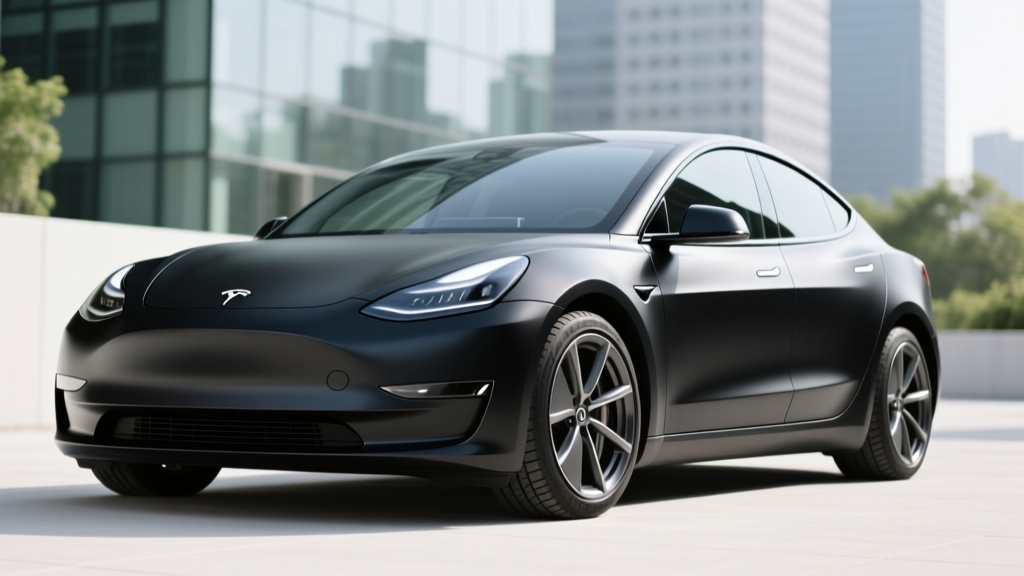
If you've spent any time in Tesla forums or Instagram reels, you've seen the phrase Tesla chrome delete — the aftermarket vinyl wrap that blacks out the shiny window trim, badges, and mirror caps that used to define the Model 3's exterior. But with the refreshed Model 3 (internally called "Highland" and continuing into the 2026 model year), Tesla largely eliminated the need for this modification at the factory. The chrome is mostly gone. What remains is one of the most efficient, best-charging, and most tech-dense electric sedans on the market. Here's the full data-driven breakdown.
The Chrome Delete Story: Why It Mattered and What Changed
Pre-2024 Model 3 vehicles shipped with chrome window surrounds, door-handle accents, and bright badging that clashed with the otherwise minimalist design. Owners spent $300–$800 on PPF or vinyl chrome-delete kits to achieve a murdered-out, monochrome look. The 2024 Highland refresh — carried forward into 2026 — replaced most of that chrome with satin-black or body-color trim from the factory. The Long Range AWD and Performance trims now ship with darkened window surrounds and black badges as standard. The base RWD still has some bright trim on lower-spec builds, so a partial chrome delete may still appeal to RWD buyers chasing a uniform aesthetic. But for most 2026 Model 3 shoppers, the chrome-delete tax is effectively gone.
2026 Tesla Model 3: Trim Lineup and Pricing
| Trim | MSRP | Drivetrain | 0–60 mph | EPA Range | Battery (usable) |
|---|---|---|---|---|---|
| RWD (Standard Range) | $38,990 | Rear-Wheel Drive | 5.8 sec | 272 mi | ~60 kWh (LFP) |
| Long Range AWD | $44,990 | Dual-Motor AWD | 4.2 sec | 363 mi | ~79 kWh (NMC) |
| Performance AWD | $52,990 | Dual-Motor AWD | 2.9 sec | 341 mi | ~79 kWh (NMC) |
All prices reflect the destination-inclusive MSRP before any incentives. The Long Range AWD at $44,990 remains the sweet spot for range, power, and value. The Performance trim adds adaptive dampers, a lowered sport suspension, 20-inch wheels, and track-ready brake cooling — at the cost of roughly 22 miles of EPA range versus the Long Range.
Range and Efficiency: EPA vs. Real World
Long Range AWD: EPA-rated 363 miles. Expect ~310–330 miles in mixed highway driving at 70–75 mph. In freezing temperatures (below 32°F), plan for 240–280 miles due to battery resistance and cabin-heating load. The Model 3's heat pump mitigates some of this loss compared to resistive-heater EVs, but cold still bites.
RWD: EPA 272 miles. Real-world highway: ~230–250 miles. Cold weather: ~190–220 miles.
Performance AWD: EPA 341 miles. Real-world highway: ~290–310 miles. The stickier 20-inch summer tires and sport tuning increase rolling resistance slightly.
Efficiency remains a Tesla strong point. The Long Range AWD posts an EPA-rated 132 MPGe combined (25 kWh/100 mi), which translates to roughly 4 miles per kWh — among the best in its class. The RWD LFP variant achieves up to 142 MPGe combined thanks to lighter weight and lower drivetrain losses. For context, a comparable BMW i4 eDrive40 returns 109 MPGe combined, and the Hyundai Ioniq 6 SE Long Range hits 140 MPGe. Tesla's efficiency edge comes from its SiC inverter, integrated heat-pump system, and aggressive aero (0.219 Cd on the Long Range).
Charging: DC Fast, Level 2, and the NACS Advantage
| Charging Level | Power / Rate | Estimated Speed | Notes |
|---|---|---|---|
| Level 1 (120V) | ~1.4 kW | ~3–5 mi/hr | Emergency / overnight trickle only |
| Level 2 (240V / 48A) | 11.5 kW | ~44 mi/hr | Full charge in ~7–8 hours (Long Range) |
| DC Fast Charge (peak) | 250 kW (LR/Perf) 170 kW (RWD) | 10–80% in ~25 min (LR) 10–80% in ~30 min (RWD) | Peak rate not sustained; tapers sharply above 60% SoC |
The Model 3 Long Range and Performance peak at 250 kW on V3 Superchargers, though that rate is sustained only between roughly 10–30% SoC. The charge curve tapers to ~150 kW by 50% and drops below 100 kW past 70%. This is normal lithium-ion behavior — peak kW is a headline number, not a sustained average. A realistic 10–80% session takes about 25 minutes in ideal (preconditioned) conditions, or 30–35 minutes if you arrive cold.
The RWD with its LFP battery tops out at 170 kW DC but has a flatter charge curve, meaning it holds closer to peak rate for a longer portion of the session. LFP batteries also tolerate regular 100% charging without degradation concerns — Tesla actually recommends charging LFP to 100% at least weekly to keep the BMS calibrated.
Home Level 2 charging at 48 amps / 11.5 kW adds roughly 44 miles of range per hour. A Wall Connector installation typically runs $500–$1,200 for the unit plus $800–$2,500 for electrician labor depending on panel proximity and local permit costs. The Model 3 uses the native NACS connector — the same port now adopted by Ford, GM, Rivian, Volvo, and most major automakers for 2025+. This gives Model 3 owners seamless access to the entire Supercharger network (20,000+ stalls in North America) without adapters.
Performance and Drivetrain
The Model 3 lineup covers a wide performance envelope:
- RWD: ~271 hp, single rear motor, 5.8-second 0–60. Adequate for commuting, but not thrilling.
- Long Range AWD: ~346 hp, dual-motor, 4.2-second 0–60. Quick enough for confident highway merging and genuinely fun on back roads.
- Performance AWD: ~510 hp, dual-motor, 2.9-second 0–60. Supercar territory. The 2026 Performance also includes a new Track Mode V3 with adjustable torque split, regenerative-braking tuning, and adaptive damper profiles.
All trims feature standard regenerative braking with one-pedal-driving capability (now adjustable in software after Tesla briefly removed the setting in 2023). The steering is quick-ratio and precise, though feedback remains somewhat synthetic compared to a Porsche Taycan or BMW i4.
Interior, Cargo, and Technology
The 2026 Model 3 interior received significant noise, vibration, and harshness (NVH) upgrades over the pre-Highland generation: acoustic glass front and rear, redesigned door seals, and additional sound deadening. The result is a noticeably quieter cabin at highway speed — roughly 3–4 dB lower than the 2023 model by independent measurement.
Dimensions and cargo:
- Front legroom: 42.7 inches
- Rear legroom: 35.2 inches (tight for tall passengers on long trips)
- Trunk: 21 cu ft (plus 3.1 cu ft front trunk/frunk)
- Total cargo: 24.1 cu ft — competitive with a BMW 3 Series sedan but less than a Hyundai Ioniq 5 hatchback's 27.2 cu ft
Standout tech features:
- 15.4-inch center touchscreen (all controls route through it — no physical stalks for turn signals or gear selection; those moved to the steering wheel and screen in the Highland refresh)
- 8-inch rear passenger touchscreen with climate, media, and navigation controls
- Ambient lighting with customizable color zones
- Ventilated front seats (new for the refresh)
- Standard Autopilot (SAE Level 2) with adaptive cruise and lane-centering; optional FSD (Supervised) at $8,000 or $99/month — still requires full driver attention at all times
Tesla Autopilot and FSD (Supervised) are SAE Level 2 driver-assistance systems. You must keep your hands on the wheel and eyes on the road. These are not self-driving systems. The driver is legally and operationally responsible at all times. True driverless (Level 4) service is currently limited to geofenced robotaxi operations like Waymo in select cities.
Notable drawbacks: The stalkless design (turn signals on the steering wheel, gear selection via screen) draws polarized reactions and takes genuine adaptation time. Rear-seat space remains snug for a $45K+ sedan. No Apple CarPlay or Android Auto — Tesla's proprietary infotainment only. Visibility out the rear is compromised by the sloping roofline and small rear window.
Federal Tax Credit and Ownership Costs
| Trim | MSRP | Est. §30D Credit | Effective Price |
|---|---|---|---|
| RWD | $38,990 | Up to $7,500* | ~$31,490 |
| Long Range AWD | $44,990 | Up to $7,500* | ~$37,490 |
| Performance AWD | $52,990 | Up to $7,500* | ~$45,490 |
*Critical eligibility caveats under IRS §30D (2026 rules):
- MSRP cap: Sedans must be under $55,000. The RWD and Long Range qualify; the Performance at $52,990 also qualifies, but any added options pushing the invoice above $55,000 will disqualify it.
- Buyer income cap: Modified AGI must not exceed $150,000 (single), $225,000 (head of household), or $300,000 (joint).
- Battery sourcing: The $7,500 credit splits into two halves — $3,750 for critical-mineral sourcing and $3,750 for battery-component manufacturing. Tesla's shifting supply chain means the exact credit amount varies by production batch. Check the latest fueleconomy.gov listing for your specific VIN's eligibility.
- Point-of-sale transfer: Since 2024, buyers can transfer the credit to the dealer at purchase, reducing the upfront cost rather than waiting for a tax refund. Confirm with your Tesla advisor at delivery.
For full IRS rules, reference IRS.gov clean vehicle credits. Consult a tax professional — eligibility depends on your individual tax situation and the specific vehicle's battery-component sourcing at time of manufacture.
Warranty Coverage
Tesla provides the following warranty structure for the 2026 Model 3:
- Basic vehicle: 4 years / 50,000 miles
- Battery & drive unit (RWD): 8 years / 100,000 miles
- Battery & drive unit (Long Range / Performance): 8 years / 120,000 miles
- Battery capacity retention: Minimum 70% over the warranty period
The 70% retention floor is industry-standard (Hyundai offers 70% over 10 years/100,000 miles; BMW offers 70% over 8 years/100,000 miles). Real-world data from Tesla's fleet suggests most Model 3 NMC batteries retain 88–92% capacity at 100,000 miles, while LFP packs show even slower degradation due to their more robust chemistry — though they sacrifice some energy density.
Pros, Cons, and Who Should Buy
- Class-leading efficiency (132–142 MPGe combined)
- Access to the Supercharger network — still the most reliable DC fast-charging ecosystem in North America
- Strong real-world range (310+ highway miles on Long Range)
- Over-the-air updates continuously add features
- Factory dark trim eliminates chrome-delete cost for most buyers
- Low running costs: ~$0.04–$0.06 per mile on home electricity vs. ~$0.12–$0.15 for a comparable gas sedan
- Stalkless steering wheel and screen-based gear selection require adaptation
- Rear seat is tight for taller adults on long trips
- No Apple CarPlay / Android Auto
- Build quality improved but still inconsistent panel gaps vs. German competitors
- FSD (Supervised) remains an expensive add-on with no full-autonomy payoff yet
- Insurance premiums run 15–25% higher than comparable gas sedans in most states
Who this EV suits best: The Model 3 Long Range AWD is ideal for tech-forward commuters and road-trippers who prioritize range, charging infrastructure, and performance per dollar. It's a strong pick for two-adult households (or families with young children) who don't need SUV cargo space. The RWD variant is the budget-conscious commuter's choice, especially in mild climates where LFP's cold-weather limitations are less pronounced. The Performance trim targets driving enthusiasts who want supercar acceleration in a daily-drivable, four-door package. If you need maximum rear-seat room or hatchback cargo flexibility, the Hyundai Ioniq 6 or a Model Y may serve better.
Frequently Asked Questions
Do I still need a chrome delete on a 2026 Tesla Model 3?
Mostly no. The Long Range and Performance trims ship with factory-blackened window trim and dark badges. The RWD may still have some chrome accents depending on production batch, so a partial vinyl delete ($200–$400) may still be desired for a fully monochrome look. Check your specific build at delivery.
What is the real-world highway range of the Model 3 Long Range?
Expect approximately 310–330 miles at 70–75 mph in moderate temperatures. In winter (below 32°F), plan for 240–280 miles. Preconditioning the battery via the Tesla app before departure helps recover some of this loss.
How fast does the Model 3 charge on a Supercharger?
The Long Range and Performance peak at 250 kW, achieving a 10–80% charge in roughly 25 minutes when the battery is preconditioned. The RWD LFP peaks at 170 kW with a 10–80% time of about 30 minutes. Expect slower rates at non-V3 chargers or if the battery is cold.
Does the 2026 Model 3 qualify for the $7,500 federal tax credit?
The RWD ($38,990) and Long Range ($44,990) fall under the $55,000 sedan MSRP cap. The Performance ($52,990) also qualifies, but options pushing total MSRP above $55,000 will disqualify it. Buyer income must not exceed $150K single / $300K joint. Battery-sourcing requirements may reduce the credit to $3,750 for some production batches. Verify at fueleconomy.gov and consult a tax professional.
Is the Model 3 worth buying over the Hyundai Ioniq 6 or BMW i4?
The Model 3 Long Range wins on range (363 vs. 361 mi for Ioniq 6, 307 mi for i4), charging-network access, and efficiency. The Ioniq 6 offers 800V architecture (faster peak charging at 350 kW-capable stations) and a more traditional interior layout. The BMW i4 provides superior build quality and driving dynamics but at a higher price ($57K+ base) with lower range. Choose the Model 3 if Supercharger access and software integration are priorities; choose the Ioniq 6 for ultra-fast charging capability; choose the i4 for traditional luxury and handling feel.
How does the LFP battery in the RWD compare to NMC?
LFP (lithium iron phosphate) offers longer cycle life, better thermal stability, and tolerance for regular 100% charging — but at the cost of lower energy density (hence the RWD's 272-mile range vs. the Long Range's 363 miles). LFP also performs worse in extreme cold. If you live in a mild climate and commute under 100 miles daily, LFP is an excellent, long-lasting choice. For cold climates or frequent road trips, the NMC Long Range is the stronger pick.