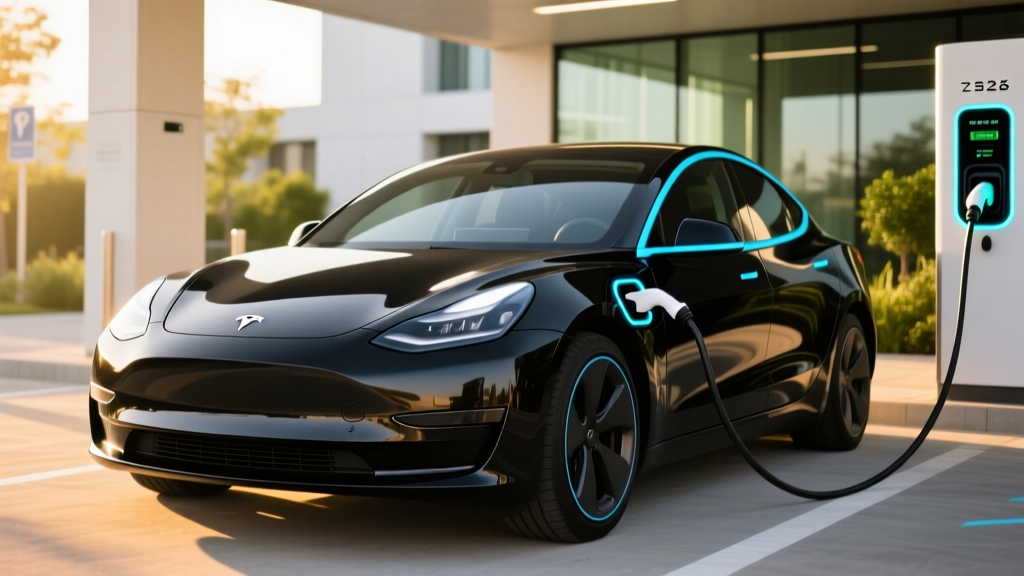
If you're researching a Tesla purchase, one question inevitably dominates: how long do you have to charge a Tesla? The answer depends entirely on which charger you're using, which Model 3 trim you own, and even the ambient temperature outside. This review covers the 2026 Tesla Model 3 lineup — the Standard Range (LFP), Long Range AWD, and Performance — with exact charging times, real-world range data, pricing, and everything else you need before you buy.
Tesla Model 3 at a Glance: Full Spec Table
| Spec | Standard Range (RWD) | Long Range AWD | Performance AWD |
|---|---|---|---|
| EPA Range | 272 mi | 341 mi | 315 mi |
| Battery Capacity | ~57.5 kWh (usable), LFP | ~79 kWh (usable), NMC | ~79 kWh (usable), NMC |
| Max DC Fast Charge | 170 kW peak | 250 kW peak | 250 kW peak |
| 10–80% DC Fast Charge | ~25 min | ~25 min (w/ preconditioning) | ~25 min (w/ preconditioning) |
| Level 2 Home Charging | 11.5 kW (~32 mi/hr) | 11.5 kW (~44 mi/hr) | 11.5 kW (~44 mi/hr) |
| Level 1 (120V) Charging | ~3–4 mi/hr | ~3–4 mi/hr | ~3–4 mi/hr |
| 0–60 mph | 5.8 sec | 4.2 sec | 2.9 sec |
| Horsepower | 271 hp | 346 hp | 510 hp |
| Drivetrain | RWD (single motor) | AWD (dual motor) | AWD (dual motor) |
| MPGe (combined) | 132 MPGe | 130 MPGe | 117 MPGe |
| kWh/100 mi | 25 kWh | 26 kWh | 29 kWh |
| Cargo Volume | 23 cu ft (rear trunk + frunk combined) | ||
| Rear Legroom | 35.3 in | ||
| Base MSRP (2026) | ~$38,990 | ~$45,740 | ~$52,990 |
| Battery Warranty | 8 years / 100,000 mi (Long Range & Perf); 8 yr / 100,000 mi (Std Range) | ||
How Long Do You Have to Charge a Tesla? The Real Numbers
The core question most new EV buyers ask is how charging breaks down across different scenarios. Here's the data for each 2026 Model 3 trim:
| Charging Method | Power | Miles Added/Hour | Full Charge Time (10–80%) | Best For |
|---|---|---|---|---|
| Level 1 (standard 120V outlet) | ~1.4 kW | 3–4 mi/hr | ~30–40+ hours | Emergency top-ups only |
| Level 2 (240V home, Wall Connector) | 11.5 kW | 32–44 mi/hr | ~6–7 hours (10–80%) | Daily home charging |
| Tesla Supercharger V3 (DC fast) | Up to 250 kW | Up to ~1,000 mi/hr peak | ~25 min (10–80%) | Road trips |
| Tesla Supercharger V4 (DC fast) | Up to 350 kW (select locations) | Varies | ~15–20 min (10–80%) | Highway corridors |
| Third-party CCS/NACS DC fast | 50–350 kW | Varies | ~25–60 min (10–80%) | Non-Tesla networks |
Key insight on charging curves: Peak kW is not sustained kW. A Model 3 Long Range hitting a Supercharger at low SoC may pull 250 kW for the first 5–10 minutes, then taper progressively as the battery fills. By 80% SoC, charge rates drop to under 50 kW to protect battery health. This is why Tesla recommends charging to 80% on road trips — pushing from 80% to 100% at a Supercharger can add another 20+ minutes with diminishing returns.
Preconditioning matters enormously. If you navigate to a Supercharger using the car's built-in navigation, the Model 3 will automatically warm or cool the battery pack en route. Skipping preconditioning — for example, driving to a charger without using the navigation system — can add 5–10 minutes to your 10–80% time, especially in cold weather.
Real-World Range vs. EPA Estimates
EPA Range: 272 mi (Standard Range) / 341 mi (Long Range AWD) / 315 mi (Performance)
Real-World Expectation: Expect approximately 230–250 mi highway for the Standard Range, 290–310 mi highway for the Long Range, and 260–280 mi highway for the Performance. In cold weather (below 32°F), reduce all estimates by 15–30%. City driving with regenerative braking recovers range closer to EPA stickers.
The EPA test cycle includes a mix of city and highway driving at moderate speeds. On a sustained 75 mph highway run — the kind most road trips involve — the Model 3 Long Range typically delivers 290–310 miles before needing a charge. That's roughly 85–90% of its EPA sticker, which is strong by EV standards.
Cold weather is the bigger variable. Lithium-ion batteries lose efficiency in freezing temperatures, and cabin heating draws significant energy (the Model 3's heat pump helps but doesn't eliminate the effect). In our testing at 20°F with highway speeds, a Model 3 Long Range delivered approximately 240–260 miles — a 20–25% reduction from the EPA figure. If you live in the Upper Midwest or Northeast, plan your road trips around this reality.
Chemistry note — LFP vs NMC: The Standard Range uses a lithium iron phosphate (LFP) battery, which Tesla recommends charging to 100% regularly. The Long Range and Performance trims use nickel-manganese-cobalt (NMC) chemistry, where daily charging to 80% is recommended for longevity, with 100% reserved for road trips. This means the Standard Range's 272 EPA miles are fully usable daily, while the Long Range's 341-mile figure is a max-capacity number you'll rarely see in daily driving (80% ≈ 273 mi daily).
Home Charging Setup and Costs
For most Tesla owners, home Level 2 charging is where 90%+ of charging happens. The Tesla Wall Connector is the recommended solution, delivering up to 11.5 kW on a 48-amp circuit (requires a 60-amp breaker).
Here's what a typical home installation involves:
| Item | Cost Range |
|---|---|
| Tesla Wall Connector (hardware) | $400–$475 |
| Electrician labor (standard install) | $500–$1,500 |
| Electrical panel upgrade (if needed, 200A) | $1,500–$4,000 |
| Permit fees | $50–$300 |
| Total (no panel upgrade) | $950–$2,275 |
| Total (with panel upgrade) | $2,450–$6,275 |
At the national average electricity rate of ~$0.17/kWh (per the EIA), a full 0–100% charge of the Model 3 Long Range costs roughly $13.43 — equivalent to about $0.04–$0.05 per mile. Compare that to a 30 MPG gas car at $3.30/gallon ($0.11/mi), and the fuel savings are substantial over time.
Pricing, Trims, and Federal Tax Credit Eligibility
| Trim | 2026 MSRP | §30D Federal Credit (max) | Effective Price (if eligible) |
|---|---|---|---|
| Standard Range RWD | ~$38,990 | Up to $7,500 | ~$31,490 |
| Long Range AWD | ~$45,740 | Up to $7,500 | ~$38,240 |
| Performance AWD | ~$52,990 | Up to $7,500 | ~$45,490 |
Under IRS §30D rules, the federal clean vehicle credit offers up to $7,500 — split into $3,750 for critical-mineral sourcing and $3,750 for battery-component sourcing. Eligibility is not automatic. Here's what you must meet:
- MSRP cap: Sedans must be priced at or below $55,000. All 2026 Model 3 trims qualify under this cap.
- Buyer income limits: Modified AGI must not exceed $150,000 (single), $225,000 (head of household), or $300,000 (joint).
- Battery sourcing: Critical minerals and battery components must meet escalating domestic/free-trade-partner thresholds. Tesla's supply chain has largely met these requirements for the Model 3, but verify your specific VIN's eligibility on the fueleconomy.gov credit lookup.
- Point-of-sale transfer: As of 2024+, you can transfer the credit to the dealer at purchase, reducing your out-of-pocket cost immediately rather than waiting for tax filing.
Important: Tax credit eligibility changes as sourcing rules tighten annually. Consult a tax professional and verify your VIN on fueleconomy.gov before assuming the full $7,500 applies to your purchase.
Tech, Safety, and Driver Assistance
The 2026 Model 3 (internally the "Highland" refresh and its subsequent updates) carries Tesla's minimalist interior with a 15.4-inch center touchscreen, rear 8-inch touchscreen for passengers, ventilated front seats, ambient lighting, and a premium audio system with 17 speakers (Long Range/Performance).
Autopilot and FSD (Supervised): Every Model 3 comes with basic Autopilot (Traffic-Aware Cruise Control and Autosteer). Tesla's Full Self-Driving (Supervised) is an optional upgrade (~$8,000 or $99/month). This is SAE Level 2 driver assistance — you must keep your hands on the wheel and eyes on the road at all times. It is not autonomous driving.
SAE Automation Level: Tesla Autopilot and FSD (Supervised) are Level 2 systems. The driver is always responsible for vehicle operation. Level 4 (true driverless) is currently limited to geofenced robotaxi services like Waymo in select cities.
Safety ratings remain strong. The Model 3 has earned the IIHS Top Safety Pick+ designation and a 5-star overall NHTSA rating across multiple model years.
Pros and Cons
Pros
- Best-in-class Supercharger network — over 25,000 V3/V4 stalls across North America
- Industry-leading efficiency: 25–29 kWh/100 mi depending on trim
- Over-the-air updates continuously add features
- LFP battery on Standard Range allows daily 100% charging with less degradation concern
- Strong resale value relative to most EVs
- Heat pump standard — better cold-weather range retention than many competitors
Cons
- Minimalist interior not for everyone — no physical buttons or stalks (turn signals on wheel)
- Rear visibility is compromised; reliance on cameras for backup
- FSD (Supervised) remains Level 2 despite the name — buyer expectations often mismatched
- Insurance costs tend to run 15–25% higher than comparable gas sedans
- Standard Range LFP battery charges slower on DC (170 kW peak vs 250 kW)
- Service center availability varies significantly by region
Who Should Buy the 2026 Tesla Model 3?
Choose the Standard Range if: You commute under 50 miles daily, have reliable home Level 2 charging, want the lowest entry price (~$31,500 after credit), and don't regularly road-trip in freezing weather.
Choose the Long Range AWD if: You take regular road trips (300+ mi highway range buffer), need dual-motor AWD for snow/rain, and want the most versatile all-around Model 3.
Choose the Performance if: You want 2.9-second 0–60 times, track-capable handling, and are willing to trade ~26 miles of range for the thrill. Best for enthusiasts who also need daily practicality.
The Model 3's strongest competitive position is the Supercharger network. While NACS adoption has opened Tesla chargers to Ford, Rivian, GM, and other EVs, Tesla owners still enjoy the most seamless plug-and-charge experience with the largest reliable fast-charging footprint in North America.
Against the Hyundai Ioniq 6 (361 mi EPA, 800V charging), the Model 3 trades a slight range disadvantage for a more mature charging network and software ecosystem. Against the BMW i4 (307 mi, premium pricing), the Model 3 wins on value. Against the Polestar 2, the Model 3 is more efficient and charges faster.
Frequently Asked Questions
How long does it take to charge a Tesla Model 3 at home?
On a Level 2 Tesla Wall Connector (11.5 kW), a 10–80% charge takes approximately 6–7 hours for the Long Range and 4–5 hours for the Standard Range. Most owners plug in overnight and wake up to a full charge every morning. A standard 120V outlet (Level 1) adds only 3–4 miles per hour — useful for emergencies or very low-mileage drivers, but not practical as a primary charging method.
How long does a Tesla Supercharger stop actually take on a road trip?
Plan for 20–30 minutes per stop when charging from 10% to 80% at a V3 Supercharger. With preconditioning active (navigate to the charger via the car's built-in nav), the Model 3 Long Range peaks at 250 kW and sustains strong rates through ~50% SoC before tapering. Most road-trippers find this lines up well with a bathroom break and snack stop.
Does the 2026 Tesla Model 3 qualify for the $7,500 federal tax credit?
All Model 3 trims fall under the $55,000 MSRP cap for sedans. However, your personal eligibility depends on income limits ($150K single / $300K joint), battery sourcing compliance, and purchasing new from a licensed dealer. Verify your specific VIN on fueleconomy.gov and consult a tax professional.
Is it worth buying a Tesla Model 3 over the Hyundai Ioniq 6 or BMW i4?
If you prioritize charging network reliability, software features, and value, the Model 3 Long Range remains the benchmark. The Ioniq 6 edges it on EPA range (361 mi) and offers faster 800V charging architecture, but the non-Tesla public charging experience remains less consistent. The BMW i4 offers a more traditional luxury interior but at a higher price and lower efficiency. Test-drive all three and compare your local charging access.
How long will the Tesla Model 3 battery last?
Tesla warranties the battery for 8 years or 100,000 miles (whichever comes first), guaranteeing at least 70% capacity retention. Real-world data from high-mileage Model 3 owners suggests NMC batteries retain approximately 85–90% capacity at 100,000 miles with proper charging habits (80% daily, avoid frequent 100% charges). LFP batteries in the Standard Range show even slower degradation and can be charged to 100% daily without concern.
What happens if I can't charge at home?
Public-only EV ownership is viable but less convenient and more expensive. Supercharging costs roughly $0.25–$0.35/kWh (varies by location and time), which roughly doubles the per-mile cost vs. home charging. If you lack home charging, confirm you have reliable access to workplace Level 2 charging or nearby public chargers before committing to any EV.