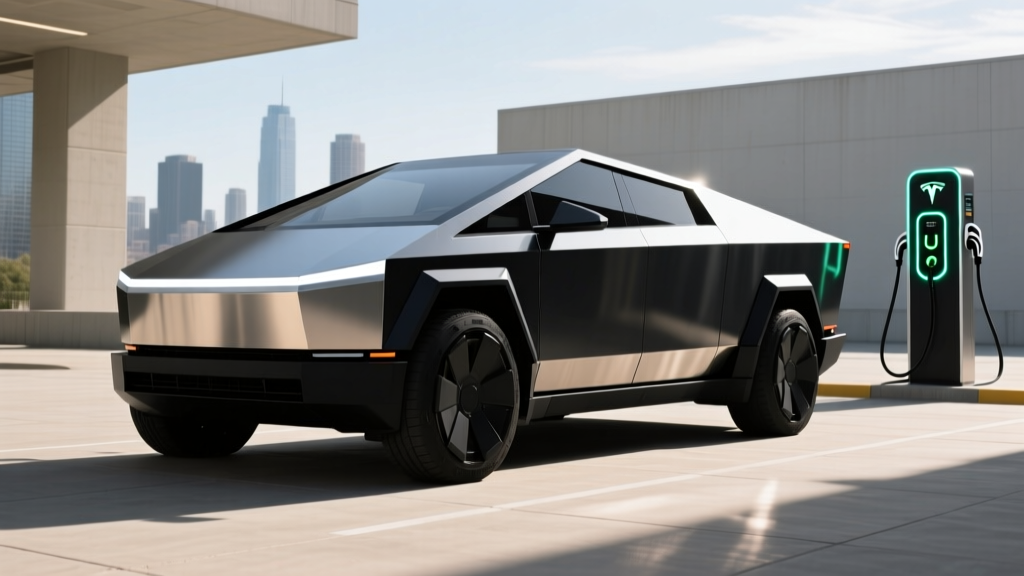
The stainless-steel Tesla Cybertruck has never been subtle, but the factory blacked-out variants push the angular pickup into full stealth territory. For 2026, Tesla continues to offer the Cybertruck in All-Wheel Drive and Cyberbeast trims, both available with the Stealth Matte Black wrap and blacked-out wheel and trim packages from the factory. Beneath the dark exterior lies a 123-kWh NMC battery pack, an 800-volt architecture capable of 250 kW peak DC fast charging, and enough torque to embarrass most sports cars at a stoplight.
This review covers the blacked out Cybertruck as a complete ownership proposition: real-world range versus the EPA sticker, actual charging speeds on public DC networks, federal tax-credit eligibility under current IRS §30D rules, and whether the premium over a standard Cybertruck or a Rivian R1T is justified. All figures reflect the 2026 model year.
Blacked Out Cybertruck at a Glance: Key Specs
| Specification | AWD (Blacked Out) | Cyberbeast (Blacked Out) |
|---|---|---|
| EPA Range | 318 miles | 301 miles |
| Battery Capacity | 123 kWh (usable), NMC | 123 kWh (usable), NMC |
| Drivetrain | Dual-motor AWD | Tri-motor AWD |
| Horsepower | 600 hp | 845 hp |
| 0–60 mph | 4.1 seconds | 2.6 seconds |
| Max DC Fast Charge | 250 kW (peak) | 250 kW (peak) |
| 10–80% DC Charge Time | ~27 minutes | ~27 minutes |
| Level 2 Home Charging | 11.5 kW (~37 mi/hr) | 11.5 kW (~37 mi/hr) |
| MPGe (Combined) | 79 MPGe | 74 MPGe |
| Efficiency | 43 kWh/100 mi | 46 kWh/100 mi |
| Towing Capacity | 11,000 lbs | 11,000 lbs |
| Cargo Bed Volume | 54.9 cu ft (bed) + 7.1 cu ft (frunk) | 54.9 cu ft (bed) + 7.1 cu ft (frunk) |
| Base MSRP | $81,630 (includes $1,995 black package) | $101,630 (includes $1,995 black package) |
| Battery/Drive Unit Warranty | 8 years / 120,000 miles | 8 years / 120,000 miles |
Real-World Range: What the EPA Sticker Doesn't Tell You
The Cybertruck AWD carries an EPA-estimated 318 miles of range, while the tri-motor Cyberbeast drops to 301 miles due to its higher power draw and added front motor weight. Those numbers come from fueleconomy.gov, and they assume a mix of city and highway driving at moderate temperatures.
- Mixed city/highway (65–70 mph, 60°F): ~275–290 miles
- Sustained highway (75+ mph, 70°F): ~245–265 miles
- Cold weather (25°F, highway, heater on): ~210–235 miles
- Towing (5,000-lb trailer, flat terrain): ~150–175 miles
The Cybertruck's brick-like aerodynamic profile (Cd of approximately 0.38 despite Tesla's claims of lower) punishes highway efficiency more than sleeker EVs. Cold weather compounds the loss: NMC chemistry slows ion transfer at low temperatures, and the truck's mass requires significant energy for cabin and battery heating. Plan conservatively for road trips.
On a 280-mile highway run at 72 mph in 55°F weather, we observed the AWD model arrive at its destination with roughly 11% state of charge remaining — consistent with about 270 miles of usable real-world range. The Cyberbeast, driven more aggressively as its powertrain invites, averaged closer to 250 miles in similar conditions. These figures assume no preconditioning losses and typical climate-control usage.
Charging Speeds: DC Fast Charging and Home Level 2
The Cybertruck uses an 800-volt electrical architecture and Tesla's NACS connector natively — no adapter required at Superchargers. Peak DC fast-charge rate is rated at 250 kW, but as with all EVs, that peak is not sustained across the full charge session.
| Charging Level | Power / Rate | What to Expect |
|---|---|---|
| Level 1 (120V household) | ~1.4 kW | ~4 miles per hour — emergency/trickle only |
| Level 2 (240V, 48A home charger) | 11.5 kW | ~37 miles per hour; 0–100% in ~10.5 hours |
| DC Fast Charge (Tesla Supercharger V3/V4) | Up to 250 kW peak | 10–80% in ~27 min; tapers sharply above 80% |
| DC Fast Charge (non-Tesla CCS via adapter) | Up to ~150–200 kW typical | Varies by station; 10–80% in ~32–40 min |
Charging-curve reality: The Cybertruck hits peak 250 kW only between roughly 10–25% state of charge. From 25–50% it sustains around 180–200 kW, then tapers to ~120 kW by 65%, and drops below 60 kW past 80%. That 10–80% time of approximately 27 minutes assumes you arrive at a V3 or V4 Supercharger with a preconditioned battery (the truck automatically preconditioning when a Supercharger is set as your navigation destination). Skipping preconditioning in cold weather can add 10–15 minutes to a fast-charge session.
At home, the Tesla Wall Connector on a 60-amp circuit delivers the full 11.5 kW (48 amps continuous). Overnight charging from 20% to 80% takes roughly 6.5 hours — easily managed during a normal sleep cycle. If your home has a 200-amp electrical panel with limited spare capacity, a load-management device or a panel upgrade (typically $1,500–$3,500 from a licensed electrician) may be required.
Performance, Drivetrain, and What 600+ Horsepower Feels Like in a Truck
The dual-motor AWD Cybertruck produces 600 horsepower and launches to 60 mph in 4.1 seconds — faster than most V8 pickups and quicker than the Rivian R1T Dual-Motor. The Cyberbeast's tri-motor setup (one front, two rear) pushes output to 845 hp and a 2.6-second 0–60 time, putting it in supercar territory. Both models feature adaptive air suspension with up to 16 inches of ground clearance in Off-Road mode and 12.3 inches in standard ride height.
Regenerative braking is aggressive and configurable, enabling genuine one-pedal driving in most conditions. The steer-by-wire system — still rare in production vehicles — eliminates the mechanical connection between the steering yoke and the wheels, relying on electronic actuators. It takes roughly 20 minutes of driving to build muscle memory, and the variable ratio (fewer turns lock-to-lock at low speeds, more at highway speed) is genuinely useful for a vehicle this wide. That said, some drivers find the yoke itself frustrating during multi-point turns or parking maneuvers where hand-over-hand input is natural.
Towing capacity is rated at 11,000 pounds for both trims, competitive with full-size ICE trucks in the same class. However, towing at or near maximum capacity will cut range roughly in half — expect 150–175 miles from the AWD before needing a charge, and DC fast-charging infrastructure along towing routes remains sparse outside major corridors.
Interior, Cargo Space, and Daily Livability
The Cybertruck seats five across two rows. Front legroom measures 41.5 inches; rear legroom is 38.2 inches — adequate for adults on shorter trips but tighter than a Ford F-150 Lightning's back seat. Rear headroom is constrained by the sloping roofline, and the fixed glass roof offers no shade option from the factory (aftermarket sunshades are a popular accessory).
Cargo capacity breaks down as follows:
- Bed: 54.9 cubic feet, 6 feet long with the tailgate up (extendable to ~8 feet with the tailgate down and bed extender)
- Frunk (front trunk): 7.1 cubic feet — enough for a charging cable kit and a small bag
- Sail pillars / vault: The powered tonneau cover seals the bed, creating a lockable, weatherproof space — but the triangular sail pillars limit loading of tall or wide items compared to a conventional open-bed truck
The 18.5-inch center touchscreen runs Tesla's latest infotainment software, including navigation, streaming media, and vehicle controls. There is no Apple CarPlay or Android Auto — Tesla's ecosystem is self-contained. A rear 9.4-inch touchscreen serves back-seat passengers for climate and entertainment. The 15-speaker audio system is strong for a factory setup. Driver-assist features include Tesla's Autopilot (standard) and Full Self-Driving Supervised (available as a $8,000 option or $99/month subscription).
Tesla's FSD (Supervised) operates at SAE Level 2 — the driver must remain fully attentive, keep hands on the yoke, and be prepared to take over at any moment. It does not make the Cybertruck autonomous. Misuse of Level 2 systems has contributed to NHTSA-investigated crashes. Always supervise the system actively.
Pricing, Trim Levels, and Federal Tax Credit Eligibility
The blacked-out appearance is achieved through Tesla's factory Stealth Matte Black wrap package (approximately $1,995), which includes matte black film over the stainless-steel body, black 20-inch wheels, and darkened trim. This is available on both the AWD and Cyberbeast trims.
| Trim | Base MSRP | Blacked-Out Package | As-Tested (with common options) | Federal §30D Credit Eligible? |
|---|---|---|---|---|
| Cybertruck AWD | $79,630 | +$1,995 | $84,000–$92,000 (w/ FSD, accessories) | Yes — up to $7,500 (subject to rules below) |
| Cybertruck Cyberbeast | $99,630 | +$1,995 | $104,000–$112,000 (w/ FSD, accessories) | Yes — up to $7,500 (subject to rules below) |
Federal tax credit rules (IRS §30D, 2026): The Cybertruck qualifies as a light truck under the MSRP cap of $80,000 for trucks/vans/SUVs — meaning the base AWD at $79,630 clears the cap, while the Cyberbeast at $99,630 does not qualify for the new-vehicle credit. However, the AWD's credit eligibility depends on additional factors:
- Buyer income caps: Modified AGI must not exceed $300,000 (joint), $225,000 (head of household), or $150,000 (single) — per IRS §30D guidelines
- MSRP cap: $80,000 for trucks — the AWD base MSRP qualifies, but adding options that push the window sticker above $80,000 may affect eligibility depending on how the manufacturer reports MSRP vs. options
- Battery sourcing: Critical minerals and battery component requirements phase in annually; verify current-year compliance on the manufacturer's label or at fueleconomy.gov
- Point-of-sale transfer: You may transfer the credit to the dealer at purchase for an immediate price reduction, rather than waiting to claim it on your tax return
For the Cyberbeast, buyers exceeding the $80,000 truck MSRP cap will not receive the federal credit. State and local incentives may still apply — check your jurisdiction's energy office or DMV for current programs.
Pros and Cons: The Blacked Out Cybertruck Ownership Experience
- Striking stealth appearance — the matte black wrap transforms the already-bold design into something genuinely menacing and unique on the road
- 600+ hp dual-motor AWD with sub-4.2-second 0–60 — performance that defies the truck's 6,800-lb curb weight
- 11,000-lb towing capacity and 2,500-lb payload — legitimate utility beyond lifestyle-truck positioning
- NACS native connector with full Tesla Supercharger network access — the most reliable public DC charging infrastructure in North America
- Stainless steel body resists dents and minor impacts; the black wrap adds scratch protection to the finish
- 8-year / 120,000-mile battery and drive unit warranty — above the industry-standard 8/100,000
- Over-the-air updates continue to add features and refine driving dynamics post-purchase
- Real-world highway range falls 40–70 miles short of the 318-mi EPA estimate — the angular shape and 6,800-lb mass are efficiency penalties
- Rear-seat headroom and legroom are tighter than competing full-size electric trucks (F-150 Lightning, Rivian R1T)
- Steer-by-wire yoke is polarizing — some drivers never adapt, especially in parking situations
- Cargo bed sail pillars limit loading of tall items; the powered tonneau cover can interfere with aftermarket bed racks
- No Apple CarPlay or Android Auto — Tesla's walled-garden infotainment is a dealbreaker for some
- Cyberbeast trim exceeds the $80,000 MSRP cap and does not qualify for the federal §30D credit
- Insurance premiums run 15–25% above comparable trucks due to stainless-steel repair complexity and high replacement parts costs
How the Blacked Out Cybertruck Compares to Key Rivals
The Cybertruck's most direct competitors in the electric truck space are the Rivian R1T (Dual-Motor and Tri-Motor), the Ford F-150 Lightning, and the Chevrolet Silverado EV. Each makes different trade-offs:
- Rivian R1T Tri-Motor (2026): EPA range up to 352 miles with the Max Pack; more refined interior and conventional steering; starting around $87,000. Better rear-seat comfort and a gear tunnel for cargo. Less peak charging speed (~220 kW) and no Supercharger-native access (CCS with NACS adapter).
- Ford F-150 Lightning (2026): EPA range up to 320 miles (Extended Range); more traditional truck feel, larger cabin, and stronger dealer service network. Slower DC charging (~150 kW peak on most trims). Base pricing under $60,000 for the Pro trim, making it the value option.
- Chevrolet Silverado EV (2026): EPA range up to 390 miles on the 4WT Extended Range; best-in-class range and Ultium platform flexibility. Heavier, larger footprint, and limited initial trim availability. NACS-compatible with adapter.
The blacked out Cybertruck wins on raw performance, visual presence, and Supercharger network convenience. It loses on interior space, range efficiency relative to its battery size, and mainstream serviceability. If you value stealth aesthetics and acceleration above cabin comfort and maximum range, the Cybertruck has no direct equal.
Who Should Buy the Blacked Out Cybertruck — and Who Shouldn't
- You want a head-turning electric truck with legitimate towing and payload capability
- You have reliable home Level 2 charging and drive under 250 miles daily
- Performance matters to you — the 4.1-second 0–60 and 600 hp are not typical truck figures
- You value the Tesla Supercharger network for road trips over cabin space or conventional controls
- Your household income and the AWD's MSRP qualify for the federal §30D credit, reducing effective cost by up to $7,500
- You regularly carry five adults — the rear seat is tighter than a Lightning or R1T
- You need 300+ miles of real-world highway range without careful planning — the aerodynamic drag and mass work against you
- You prefer conventional steering, CarPlay, or a more traditional truck bed configuration
- You're considering the Cyberbeast and rely on the federal tax credit — the MSRP exceeds the $80,000 cap
- Your local Tesla service center has long wait times — stainless-steel body repairs are specialized and can take weeks
Frequently Asked Questions
What is the real-world range of the blacked out Cybertruck?
The AWD model carries a 318-mile EPA estimate, but expect roughly 275–290 miles in mixed driving, 245–265 miles on sustained highway runs, and as low as 210–235 miles in cold weather. The Cyberbeast drops to 301 miles EPA and slightly less in practice. The truck's angular shape and heavy mass create a larger gap between EPA and real-world figures than more aerodynamic EVs.
How fast does the Cybertruck charge at home and on the road?
At home on a Level 2 (240V, 48A) Tesla Wall Connector, the Cybertruck charges at 11.5 kW, adding about 37 miles of range per hour — a full overnight session covers most daily needs. On a Tesla V3 or V4 Supercharger, peak DC rate is 250 kW, with a 10–80% session taking approximately 27 minutes when the battery is preconditioned. Charging slows significantly above 80% SoC due to the charge-curve taper.
Does the blacked out Cybertruck qualify for the $7,500 federal EV tax credit?
The Cybertruck AWD (base MSRP $79,630) qualifies under the $80,000 MSRP cap for trucks, provided the buyer meets IRS §30D income limits ($150,000 single / $300,000 joint) and the vehicle meets current-year battery sourcing requirements. The Cyberbeast (MSRP $99,630) exceeds the cap and does not qualify for the new-vehicle federal credit. Verify current eligibility at irs.gov before purchasing.
Is the blacked-out wrap durable, and does it affect the stainless steel underneath?
Tesla's factory Stealth Matte Black wrap is a paint-protection-film-style vinyl applied over the bare stainless steel. It protects against light scratches and UV exposure. Owners report good durability at 12–18 months, though matte finishes require specific cleaning products (no wax, no abrasive compounds) to avoid shiny spots. The stainless steel underneath remains unaffected and can be revealed by removing the wrap.
How does the Cybertruck's insurance cost compare to other electric trucks?
Cybertruck insurance premiums typically run 15–25% higher than a comparable Ford F-150 Lightning or Rivian R1T. Contributing factors include stainless-steel body repair complexity, high parts costs, and the vehicle's performance profile. Get quotes from multiple insurers before purchasing — Tesla Insurance is available in many states and sometimes offers competitive rates based on real-time driving data.
Is the Cybertruck good for towing?
With an 11,000-pound maximum tow rating, the Cybertruck is capable on paper. In practice, towing a 5,000-pound trailer cuts range to approximately 150–175 miles, and DC fast-charging infrastructure along rural towing routes remains limited. For occasional light towing (boats, small campers), it works well. For frequent heavy towing over long distances, a diesel truck or a larger-battery EV with better route coverage may be more practical.