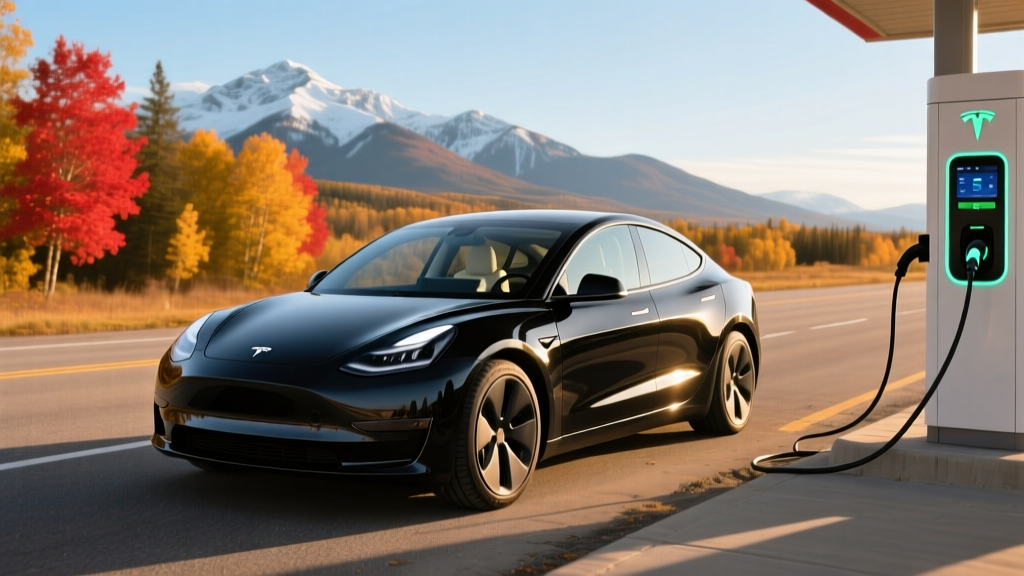
Shopping for a Tesla Model 3 in Canada means navigating a different set of variables than American buyers face. You're dealing with NRCan range ratings instead of EPA estimates, Transport Canada incentive programs instead of IRS §30D credits, and winter conditions that can slash your range by 30% or more. The 2026 Model 3 Highland refresh has matured into a more refined, better-insulated sedan — but the fundamentals of battery chemistry, charging infrastructure, and cross-border pricing still demand a close look before you sign the order sheet.
This review breaks down every number that matters for Canadian buyers: real range in sub-zero temperatures, Supercharger and home charging speeds, exact CAD pricing by trim, federal and provincial incentives, and how the Model 3 stacks up against the Hyundai Ioniq 6 and BMW i4 on Canadian roads.
2026 Tesla Model 3 Canadian Pricing & Trims
Tesla prices in Canada fluctuate more frequently than legacy automakers, but as of early 2026, the Model 3 lineup is structured across three trims. All prices below are in CAD before destination fees, taxes, or incentives.
| Trim | MSRP (CAD) | Drivetrain | NRCan Range | Federal iZEV Eligible |
|---|---|---|---|---|
| Model 3 RWD | $54,990 | Rear-Wheel Drive | 500 km | Yes (≤$55k base) |
| Model 3 Long Range AWD | $62,990 | Dual Motor AWD | 584 km | Eligibility varies by trim cap |
| Model 3 Performance | $69,990 | Dual Motor AWD | 528 km | No (above price cap) |
Federal iZEV program: Canada's Transport Canada iZEV rebate provides up to $5,000 CAD for eligible vehicles with a base MSRP under $55,000 (sedans). The RWD trim qualifies at the threshold; Long Range and Performance trims may not, depending on how Tesla structures option packages. Provincial rebates stack on top — Quebec's Roulez vert program offers up to $7,000 CAD, and British Columbia's CleanBC Go Electric provides up to $4,000 CAD based on income.
U.S. IRS §30D note for cross-border shoppers: The U.S. federal tax credit of up to $7,500 USD applies only to vehicles purchased and titled in the United States. Canadian residents buying a Model 3 in Canada do not qualify for §30D. The credit has MSRP caps ($55,000 USD for sedans), buyer income limits, and battery critical-mineral sourcing requirements per IRS guidelines.
Range & Efficiency: NRCan vs. Real World
Canada uses Natural Resources Canada (NRCan) range ratings, which tend to be slightly more conservative than U.S. EPA estimates but still represent ideal conditions. Here's what the 2026 Model 3 lineup delivers on paper — and what you should actually expect.
NRCan vs. Real-World Range — Model 3 Long Range AWD:
📋 NRCan Rating: 584 km (363 mi)
🛣️ Real-World Highway (summer, 110 km/h): ~470–500 km (292–310 mi)
❄️ Real-World Highway (winter, -10°C / 14°F): ~370–410 km (230–255 mi)
🏙️ City/Mixed (summer): ~520–550 km (323–342 mi)
Cold weather reduces range due to cabin heating demands, battery resistance, and reduced regenerative braking efficiency. The Model 3's heat pump (standard on all trims) recovers significant energy compared to resistive heating, but physics still wins in deep cold.
| Specification | RWD | Long Range AWD | Performance |
|---|---|---|---|
| Battery Capacity (usable) | ~60 kWh (LFP) | ~79 kWh (NMC) | ~79 kWh (NMC) |
| Battery Chemistry | LFP (Lithium Iron Phosphate) | NMC (Nickel Manganese Cobalt) | NMC (Nickel Manganese Cobalt) |
| NRCan Range | 500 km (311 mi) | 584 km (363 mi) | 528 km (328 mi) |
| Energy Consumption (Le/100 km) | ~14.5 Le/100 km | ~15.1 Le/100 km | ~16.8 Le/100 km |
| MPGe Equivalent | ~130 MPGe | ~125 MPGe | ~112 MPGe |
| 0–100 km/h (0–60 mph) | 6.1 s (5.8 s) | 4.4 s (4.2 s) | 3.1 s (2.9 s) |
| Horsepower | 283 hp | 346 hp | 510 hp |
| Drivetrain | RWD | Dual Motor AWD | Dual Motor AWD |
LFP vs. NMC in Canadian winters: The RWD trim's LFP battery is more durable over time (higher cycle life, can be charged to 100% daily without degradation concerns), but it has lower energy density and slower charging in cold weather. If you live in the Prairies or Northern Ontario where temperatures regularly drop below -20°C, the Long Range's NMC battery with preconditioning is a better choice for reliable DC fast charging in winter.
Charging Speeds: Supercharger, Home & Destination
Charging speed is where the Model 3 Highland generation shows meaningful improvement. The 2026 refresh supports faster peak DC charging and improved thermal management for sustained rates.
| Charging Level | Power / Rate | Speed (km added per hour) | Notes |
|---|---|---|---|
| Level 1 (120V household) | ~1.4 kW | ~7–9 km/hr | Emergency/trickle only; not practical for daily use |
| Level 2 (240V home, Wall Connector) | 11.5 kW (48A) | ~64–72 km/hr | Full charge overnight in ~8–10 hours |
| DC Fast (Tesla Supercharger V3) | Peak 250 kW | ~1,000+ km/hr (peak) | 10–80% in ~25 min (LR); ~30 min (RWD/LFP) |
| DC Fast (Supercharger V4) | Peak 250 kW (capped) | Similar to V3 | V4 stalls support higher power but Model 3 caps at 250 kW |
Real-world charging curve reality: The 250 kW peak is only sustained between roughly 10–30% State of Charge (SoC). Above 50%, the rate tapers to ~100 kW, and above 80%, it drops below 50 kW. A realistic Supercharger stop from 10–80% takes about 25 minutes for the Long Range and roughly 30 minutes for the RWD (LFP chemistry charges slower at the top end). In cold weather without preconditioning, add 5–10 minutes as the battery warms.
Supercharger network in Canada: Tesla operates over 1,900 Supercharger stalls across Canada as of 2026, concentrated along the Trans-Canada Highway corridor, major metro areas, and popular routes in Quebec and BC. Coverage thins significantly in Northern Ontario, rural Saskatchewan, and the territories. The Supercharger network has opened to non-Tesla EVs at select Canadian locations via the NACS adapter, but Tesla owners still benefit from automatic plug-and-charge integration and lower per-kWh pricing.
Home charging installation: A Tesla Wall Connector installed on a 60A circuit (48A continuous) delivers the full 11.5 kW. Expect to pay $1,200–$2,500 CAD for a professional installation including the $650 CAD Wall Connector hardware, assuming your electrical panel has capacity. Older homes may need a panel upgrade ($2,000–$5,000 CAD additional). Always get a quote from a licensed electrician before ordering.
Winter Performance & Canadian Driving Realities
Canada is the ultimate EV stress test. The Model 3 Highland addresses several cold-weather pain points from previous generations, but winter ownership still requires planning.
What's improved for 2026:
- Heat pump (standard): All trims now include Tesla's octovalve heat pump system, which pulls heat from the drivetrain and outside air rather than relying solely on resistive heating. This reduces winter range loss by roughly 10–15% compared to older resistive-heater Model 3s.
- Battery preconditioning: When you navigate to a Supercharger, the car automatically warms the battery to optimal charging temperature. In -15°C weather, this can cut your charging session from 40+ minutes down to 25 minutes.
- Improved cabin insulation: The Highland redesign added acoustic glass and better door seals, which also helps thermal retention. Cabin heating demands drop measurably on highway drives.
- Heated seats and steering wheel (all seats): Front and rear heated seats plus a heated steering wheel are standard, allowing you to lower cabin air temperature and save energy.
What still bites in winter:
- Expect 25–35% range reduction in sustained sub-zero highway driving, even with the heat pump.
- LFP batteries (RWD trim) charge noticeably slower when cold — always precondition before DC fast charging.
- Regenerative braking is limited when the battery is cold and near full charge, requiring more friction brake use in the first 15–20 minutes of a winter drive.
- Snow and ice on the flush door handles can be stubborn — a silicone spray on the seals helps.
Interior, Cargo & Daily Practicality
The Model 3 Highland interior is a significant step up in materials and comfort from pre-2024 models. The minimalist approach remains, but execution is sharper.
Dimensions & space:
- Trunk: 682 litres (24.1 cu ft) with rear seats up; 1,274 litres (45.0 cu ft) with seats folded
- Frunk (front trunk): 88 litres (3.1 cu ft) — fits a small bag or charging cables
- Front legroom: 1,078 mm (42.4 in)
- Rear legroom: 894 mm (35.2 in) — tight for tall passengers on long trips
- Ground clearance: 138 mm (5.4 in) — low; watch for snow berms and steep driveways
Standout tech features:
- 15.4-inch center touchscreen with ventilated-seat controls and ambient lighting adjustment
- Rear 8-inch touchscreen for passengers (climate, media, navigation)
- Tesla Autopilot (SAE Level 2) standard — includes Traffic-Aware Cruise Control and Autosteer
- Full Self-Driving (Supervised) available as a $9,000 CAD add-on — still SAE Level 2 requiring full driver attention
- Dashcam and Sentry Mode with all-around cameras
- Over-the-air updates continuously add features
⚠️ Driver-Assist Limitation Notice: Tesla Autopilot and FSD (Supervised) are SAE Level 2 systems. They are NOT self-driving. You must keep your hands on the wheel and eyes on the road at all times. These systems assist with steering and speed on marked roads but cannot handle construction zones, unmapped routes, severe weather, or unexpected obstacles without driver intervention. Autonomy responsibility remains entirely with the driver.
Notable drawbacks:
- No physical stalks — turn signals and gear selection are via steering-wheel buttons and touchscreen, which draws polarized reactions
- No Apple CarPlay or Android Auto — Tesla's native infotainment only
- Rear visibility is compromised by the sloping roofline; rely on the backup camera
- Low ground clearance makes deep snow and steep icy driveways challenging
Warranty & Long-Term Ownership
Tesla's warranty structure is competitive with the segment, though not class-leading on bumper-to-bumper coverage.
- Basic vehicle warranty: 4 years / 80,000 km
- Battery & drive unit warranty (RWD / LFP): 8 years / 192,000 km, with ≥70% capacity retention
- Battery & drive unit warranty (Long Range & Performance / NMC): 8 years / 192,000 km, with ≥70% capacity retention
The 70% retention threshold is the industry standard (matching Hyundai, Ford, and others). Real-world data from Tesla's fleet suggests most Model 3 batteries retain 85–90% capacity at 160,000 km, with LFP packs showing particularly strong longevity due to their higher cycle-life chemistry. Battery replacement out of warranty runs approximately $16,000–$22,000 CAD depending on the pack, though failures before 200,000 km remain statistically rare based on fleet data.
Canadian ownership costs: Electricity rates vary dramatically by province. Quebec's hydro rates (~$0.07/kWh) make the Model 3 extraordinarily cheap to fuel — roughly $2.50 CAD per 100 km. Ontario (~$0.14/kWh off-peak) brings that to ~$5.00 per 100 km. Compare that to a gas sedan at 8 L/100 km with fuel at $1.55/L: ~$12.40 per 100 km. Insurance premiums for the Model 3 in Canada tend to run 10–25% higher than comparable gas sedans due to repair-cost data; get quotes before purchasing.
Tesla Model 3 vs. Canadian Competitors
The Model 3 doesn't exist in a vacuum. Here's how it compares to key rivals available in Canada for 2026.
| Spec | Tesla Model 3 LR AWD | Hyundai Ioniq 6 Preferred AWD | BMW i4 xDrive40 |
|---|---|---|---|
| MSRP (CAD) | $62,990 | $58,499 | $72,500 |
| NRCan Range | 584 km | 519 km | 430 km |
| Battery (kWh) | ~79 (NMC) | 77.4 (NMC) | 81.5 (NMC) |
| Peak DC Charge (kW) | 250 | 240 | 205 |
| 10–80% DC Time | ~25 min | ~18 min | ~31 min |
| 0–100 km/h | 4.4 s | 5.1 s | 4.6 s |
| Charging Port | NACS (native) | CCS (NACS adapter available) | CCS (NACS adapter available) |
| iZEV Eligible | Varies by trim | Yes | No (above cap) |
Choose the Tesla Model 3 if:
- You want the longest range in the segment for highway road trips across provinces
- Supercharger network reliability is a priority for rural/trans-Canada travel
- You value OTA updates and Tesla's software ecosystem
- You prefer NACS-native charging without adapters
Choose the Hyundai Ioniq 6 if:
- You want faster 10–80% DC charging (18 min on 800V architecture)
- Physical buttons, CarPlay, and a more conventional interior matter to you
- Lower MSRP and guaranteed iZEV eligibility are important
- You prefer a traditional dealership service experience
Choose the BMW i4 if:
- Build quality, ride refinement, and brand prestige are top priorities
- You prefer a Gran Coupe hatchback body style with more cargo flexibility
- Budget is less of a constraint (significantly higher MSRP, no iZEV)
Pros, Cons & Verdict
✅ Pros
- Class-leading NRCan range (584 km LR AWD) among sedans at this price
- Supercharger network — still the most reliable DC fast-charging network in Canada
- Excellent efficiency (Le/100 km) with heat pump standard across all trims
- Strong acceleration and low center of gravity make it genuinely fun to drive
- OTA updates continuously improve the vehicle post-purchase
- LFP battery option (RWD) offers exceptional long-term durability
- Low operating costs, especially in provinces with cheap hydro
❌ Cons
- Turn-signal buttons and screen-based gear selector frustrate some drivers
- No Apple CarPlay or Android Auto support
- Rear seat legroom is tight for adults on longer trips
- Low ground clearance (138 mm) is a liability in deep snow
- Insurance premiums run higher than segment average in most provinces
- FSD (Supervised) costs $9,000 CAD and remains SAE Level 2
- Supercharger-only DC charging limits flexibility in areas with third-party networks (though NACS adoption is expanding)
Verdict: The 2026 Tesla Model 3 remains the default recommendation for Canadian EV sedan buyers who prioritize range, charging-network reliability, and software sophistication. The Long Range AWD at $62,990 CAD hits the sweet spot for most buyers outside Quebec's incentive sweet spot. If you need guaranteed iZEV eligibility and the lowest entry price, the RWD at $54,990 CAD is compelling — but know that LFP cold-weather charging trade-offs are real. For those who value conventional controls, faster peak charging, or CarPlay, the Ioniq 6 is a worthy alternative.
Frequently Asked Questions
What is the real-world range of the Tesla Model 3 in Canadian winters?
For the Long Range AWD, expect 370–410 km of real highway range at -10°C with the heat pump running. In extreme cold (-25°C or below, common in the Prairies), plan for 320–360 km. The RWD with LFP will see slightly more range loss due to the battery's lower cold-temperature performance.
How fast does the Model 3 charge at home and on the road?
At home on a Tesla Wall Connector (11.5 kW Level 2), you'll add roughly 64–72 km of range per hour, fully recharging overnight. On a Supercharger (250 kW DC), the Long Range goes from 10–80% in about 25 minutes in moderate temperatures. Add 5–10 minutes in deep cold if the battery hasn't preconditioned.
How much does the Tesla Model 3 cost after Canadian incentives?
The RWD at $54,990 CAD qualifies for the $5,000 federal iZEV rebate, bringing it to ~$49,990 before provincial rebates. In Quebec, add up to $7,000 (Roulez vert), dropping the effective price to ~$42,990 CAD. In BC, add up to $4,000 (CleanBC), making it ~$45,990 CAD. Long Range and Performance trims may not qualify for iZEV depending on MSRP cap rules — check Transport Canada's eligible list before ordering.
Does the Tesla Model 3 qualify for the U.S. federal EV tax credit?
No. The IRS §30D credit applies only to vehicles purchased and registered in the United States. Canadian buyers use the federal iZEV program and provincial rebates instead. U.S. buyers purchasing a Model 3 may qualify for up to $7,500 USD, subject to MSRP caps ($55,000 USD for sedans), income limits, and battery-sourcing requirements.
Is the Tesla Model 3 worth buying over the Hyundai Ioniq 6 in Canada?
It depends on your priorities. The Model 3 wins on range (584 km vs. 519 km), Supercharger network access, and software. The Ioniq 6 wins on 10–80% charge speed (18 min vs. 25 min thanks to 800V architecture), lower price, CarPlay support, and guaranteed iZEV eligibility. Both are excellent; test-drive both in winter conditions if possible.
Can I use non-Tesla chargers with the Model 3 in Canada?
Tesla's NACS connector is becoming the North American standard, and many networks (Electrify America Canada, Petro-Canada, Flo) are adding NACS cables. For CCS-only stations, Tesla sells a CCS adapter (~$350 CAD). As of 2026, NACS coverage is expanding rapidly, but CCS adapters remain useful for rural areas with legacy chargers.
How does Tesla's Autopilot handle Canadian winter roads?
Autopilot (SAE Level 2) works in winter but has limitations: lane markings obscured by snow, heavy precipitation, and icy roads reduce system confidence. Expect more frequent disengagements and take-overs in winter conditions. Always maintain full attention — Autopilot is a driver-assist system, not a self-driving system.