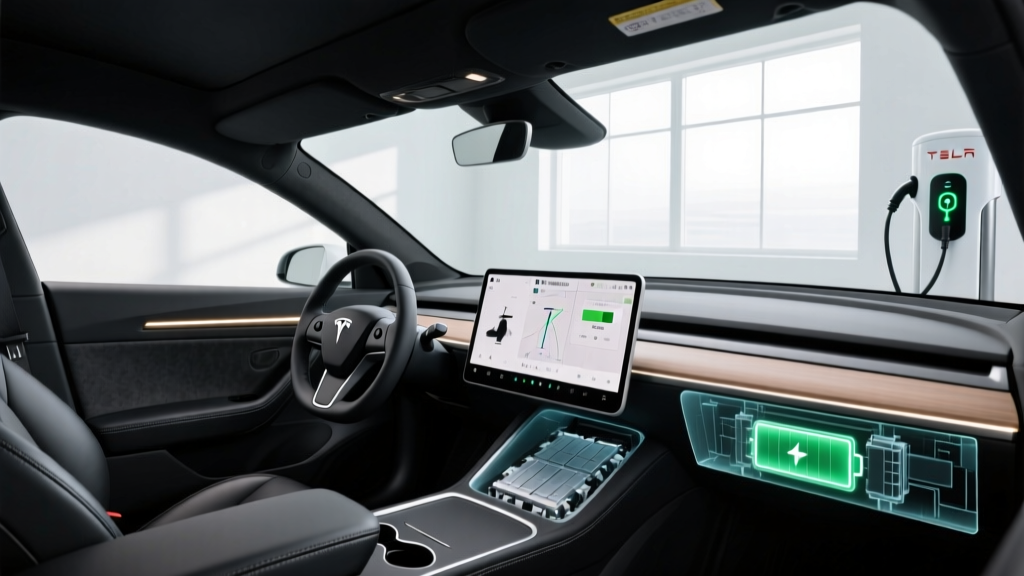
The Tesla Model 3 Highland refresh brought a wave of interior and exterior changes, but one detail continues to dominate owner forums and configurator debates: the Tesla Model 3 black headliner. While the refreshed Model 3 defaults to a light, off-white headliner in many configurations, buyers who spec the All-Black premium interior get a darker, more cohesive cabin that dramatically changes the car's feel. This review covers the 2026 Tesla Model 3 Long Range AWD — the trim most commonly paired with the black headliner — with exact range, charging, pricing, and ownership data you need before configuring your own.
EPA Estimated: 363 miles (Long Range AWD, 19" wheels)
Real-World Highway (70 mph, moderate climate): ~290–320 miles
Real-World Cold Weather (below 32°F, mixed driving): ~240–275 miles
Highway speeds above 70 mph and cold temperatures reduce range 15–30% due to aerodynamic drag and battery heating demands. The Model 3's heat pump helps mitigate cold-weather loss compared to resistive heating systems.
2026 Tesla Model 3 Long Range: Spec Sheet at a Glance
| Specification | 2026 Model 3 Long Range AWD |
|---|---|
| EPA Range | 363 miles (19" wheels) / 346 miles (18" Aero) |
| Battery Capacity | ~79 kWh usable (NMC lithium-ion) |
| Drivetrain | Dual Motor AWD |
| Horsepower | ~384 hp (combined) |
| 0–60 mph | 4.2 seconds |
| Top Speed | 125 mph |
| Max DC Fast Charge | 250 kW peak |
| 10–80% DC Charge Time | ~25 minutes |
| Level 2 Home Charge Rate | 11.5 kW (~44 mi/hr) |
| Efficiency | 132 MPGe combined / 25 kWh/100 mi |
| Cargo Volume | 23 cu ft (trunk + frunk combined) |
| Rear Legroom | 35.3 inches |
| Battery Warranty | 8 years / 120,000 miles (min 70% retention) |
| Base MSRP | $47,740 (before incentives) |
Sources: EPA Fueleconomy.gov, Tesla Model 3 Design Studio. Specs reflect 2026 model year Long Range AWD with 19" Sport Wheels. 18" Aero wheel option yields slightly higher range.
The Black Headliner Interior: What You Actually Get
The black headliner is not a standalone option — it's bundled within the All-Black Premium Interior, which is a $1,000 upgrade on the Long Range trim (the base Rear-Wheel Drive Model 3 includes a black interior as standard). Here's what that package includes:
- Black headliner — replaces the default light gray/off-white fabric with a dark, charcoal-toned material that reduces glare and creates a more premium, enclosed cockpit feel
- Black vegan leather seats — front and rear, with contrast stitching
- Black dashboard and door panel trim — paired with the textile dash accent introduced in the Highland refresh
- Premium audio — 17-speaker system with dual subwoofers and immersive sound (standard on Long Range regardless of interior color)
From an ownership standpoint, the black headliner is practical: it resists visible staining from hair products, sunlight discoloration, and general wear far better than the light headliner. However, it does make the cabin feel noticeably smaller and darker, especially on overcast days. Owners who frequently drive in hot, sunny climates also report that the black interior absorbs more radiant heat when parked — though the Model 3's cabin overheat protection and ventilated front seats (introduced in the Highland refresh) mitigate this substantially.
Charging Speed: DC Fast, Level 2, and the Charge Curve Reality
Tesla's Supercharger network remains the gold standard for public charging reliability, and the 2026 Model 3 Long Range takes full advantage of it. Here's the breakdown by charging level:
| Charging Level | Power | Speed (Miles Added) | Notes |
|---|---|---|---|
| Level 1 (120V household) | ~1.4 kW | ~3–5 mi/hr | Emergency/trickle only |
| Level 2 (240V home, 48A) | 11.5 kW | ~44 mi/hr | Full charge in ~7–8 hours |
| Level 2 (240V public, lower amperage) | 7.2–9.6 kW | ~28–37 mi/hr | Varies by station |
| DC Fast (Tesla Supercharger V3/V4) | 250 kW peak | ~175 mi in 15 min | 10–80% in ~25 min |
| DC Fast (CCS adapter, non-Tesla) | ~150–200 kW typical | Varies by station | CCS adapter included since 2024 |
Charge curve reality check: The 250 kW peak only sustains between roughly 10–30% state of charge. Above 50%, the rate tapers to ~100 kW, and above 80%, it drops further to protect battery longevity. On a road trip, plan your stops around the 10–80% window for maximum efficiency — charging from 80–100% can add 20+ minutes for only ~70 miles of range. Preconditioning the battery (automatic when you navigate to a Supercharger) is essential for achieving peak charge rates, especially in cold weather.
For home charging, a Tesla Wall Connector on a 60-amp circuit delivers the full 11.5 kW (48 amps continuous). Most owners report a full overnight charge from 20% to 100% in roughly 7 hours. Installation costs for a dedicated 240V/60A circuit typically range from $500–$2,000 depending on panel proximity and local permit requirements — budget for a potential panel upgrade if your home has a 100-amp main service.
Performance and Driving Dynamics
The 2026 Model 3 Long Range AWD produces approximately 384 combined horsepower from its dual-motor setup, delivering a 4.2-second 0–60 mph time. That's quick enough for confident highway merging and passing, though it's a step below the Performance trim's 3.1-second sprint.
The Highland refresh significantly improved ride quality. Tesla reworked the suspension tuning, added frequency-selective dampers, and improved sound insulation. The result is a noticeably quieter, more compliant ride than pre-2024 Model 3s — road noise on coarse pavement drops by roughly 3–5 dB by Tesla's own measurements. The steering remains precise and quick, though some enthusiasts find it overly assisted and numb compared to a BMW i4 or Porsche Taycan.
Regenerative braking in the Model 3 is strong and consistent, though Tesla removed the user-adjustable regen setting several years ago. The default regen level enables near-one-pedal driving in most conditions, but you'll still need the friction brakes for final stops and low-speed maneuvering. The Model 3 does not offer a dedicated "creep" or "low regen" mode as of the 2026 model year.
Pricing, Trims, and Federal Tax Credit Eligibility
Here's how the 2026 Model 3 lineup breaks down, with the Long Range AWD (the trim most associated with the black headliner option) highlighted:
| Trim | MSRP | All-Black Interior | Federal Credit (§30D) | Est. After Credit |
|---|---|---|---|---|
| Rear-Wheel Drive | $38,990 | Standard | Up to $7,500* | ~$31,490* |
| Long Range AWD | $47,740 | +$1,000 option | Up to $7,500* | ~$41,240* |
| Long Range AWD (All-Black Interior) | $48,740 | Included | Up to $7,500* | ~$41,240* |
| Performance AWD | $54,990 | Standard | Up to $7,500* | ~$47,490* |
*Federal tax credit eligibility under IRS §30D depends on multiple factors:
- Buyer income cap: Modified AGI must not exceed $150,000 (single), $225,000 (head of household), or $300,000 (joint filing)
- MSRP cap: Sedans must have an MSRP at or below $55,000 (all Model 3 trims qualify)
- Battery sourcing: The $7,500 credit splits into two halves — $3,750 for critical minerals sourcing and $3,750 for battery component manufacturing. Eligible percentages shift annually under the Inflation Reduction Act. Check Fueleconomy.gov for the current eligibility status of the specific Model 3 trim you're configuring
- Point-of-sale transfer: As of 2024, eligible buyers can transfer the credit to the dealer at purchase, reducing the upfront price rather than waiting for a tax refund
Always verify your personal eligibility with a tax professional. State incentives (California's CVRP, Colorado's state credit, etc.) may stack on top of the federal credit — check your local DMV or energy office for current programs.
Tech, Safety, and Driver Assistance
The 2026 Model 3's tech stack remains one of the most integrated in the EV market, though it comes with some polarizing choices:
- 15.4-inch center touchscreen — controls virtually all vehicle functions, including climate, mirrors, and glovebox. No physical instrument cluster; speed and navigation are displayed on the center screen
- 8-inch rear touchscreen — added in the Highland refresh, allows rear passengers to control climate and entertainment
- Autopilot (standard) — SAE Level 2 driver assistance including adaptive cruise, lane centering, and automatic emergency braking. This is not self-driving — you must keep hands on the wheel and eyes on the road at all times
- Full Self-Driving Supervised ($8,000 option or $99/month) — adds automatic lane changes, intersection handling, and parking assist. Still SAE Level 2 — full driver supervision required
- Ventilated front seats — introduced in Highland, a welcome addition for warm climates
- Ambient lighting — customizable RGB strips along the dash and doors, new with the refresh
Safety ratings remain strong: the Model 3 holds a 5-star overall rating from NHTSA and a Top Safety Pick+ designation from IIHS (testing on structurally equivalent Highland-generation models).
Who Should Buy the Model 3 with the Black Headliner?
- You commute 30–80 miles daily and want to charge exclusively at home
- You take 2–4 road trips per year and value Supercharger network reliability
- You prefer a darker, lower-maintenance interior that hides wear
- You want a sport sedan experience with 363 miles of range and sub-4.5-second acceleration
- You need substantial rear-seat space or cargo room (the Hyundai Ioniq 5 and BMW i4 offer more rear headroom/cargo flexibility)
- You want physical buttons, a head-up display, or Apple CarPlay/Android Auto (none are available in the Model 3)
- You frequently carry rear-seat adults on long trips — the sloping roofline limits headroom
- You live in an area with limited charging infrastructure and no home charging option
Pros and Cons
- Class-leading efficiency (25 kWh/100 mi) stretches every kWh further than rivals
- Supercharger network offers the most reliable public charging in the US
- Black headliner/interior resists staining and reduces cabin glare
- Highland suspension and NVH improvements make it a genuinely comfortable daily driver
- Strong resale value relative to non-Tesla EVs
- Over-the-air updates continuously add features
- No physical controls — everything runs through the touchscreen, including mirror adjustment
- No Apple CarPlay or Android Auto integration
- Rear seat headroom is tight for passengers over 6'0" due to the sloping roofline
- FSD remains an expensive ($8,000) SAE Level 2 system with no timeline to true autonomy
- Turn signal stalks removed in Highland — signals are now on the steering wheel rim, which divides owners
- Black interior absorbs more heat when parked in direct sunlight
Frequently Asked Questions
What is the real-world range of the 2026 Tesla Model 3 Long Range?
The EPA rates it at 363 miles with 19" wheels. In real-world highway driving at 70–75 mph, expect 290–320 miles. In cold weather (below freezing), range drops to approximately 240–275 miles depending on cabin heating use and driving style. The heat pump helps, but battery chemistry and aerodynamic drag at speed are the dominant range factors.
How fast does the Model 3 charge at home and on the road?
At home on a Level 2 Tesla Wall Connector (240V, 48A), it charges at 11.5 kW, adding roughly 44 miles of range per hour — a full charge takes about 7–8 hours. On a Tesla V3/V4 Supercharger, it peaks at 250 kW, achieving a 10–80% charge in approximately 25 minutes. Remember: peak rate only sustains at low state of charge and tapers significantly above 50%.
Does the 2026 Tesla Model 3 qualify for the $7,500 federal tax credit?
It can, but eligibility depends on your income (under $150K single / $300K joint), the MSRP cap (sedans must be under $55,000 — all Model 3 trims qualify), and battery sourcing requirements that tighten annually. The credit can be transferred at point of sale to reduce your upfront cost. Verify current eligibility on Fueleconomy.gov and consult a tax professional.
Is the Model 3 worth buying over the Hyundai Ioniq 6 or BMW i4?
The Model 3 Long Range wins on efficiency (25 kWh/100 mi vs. Ioniq 6's ~27) and charging network access (Superchargers). The Ioniq 6 offers more rear-seat space and physical buttons. The BMW i4 provides a more traditional luxury interior and Apple CarPlay but sacrifices range (EPA ~307 mi) and charges at a lower peak rate. If Supercharger access and software integration matter most, the Model 3 remains the benchmark.
Is the black headliner worth the $1,000 All-Black interior upgrade?
If you prioritize practicality and a sportier cabin aesthetic, yes — the black headliner hides wear, reduces glare, and pairs well with the Highland's ambient lighting. If you prefer an airy, spacious feeling cabin or live in a hot climate where black interiors absorb more heat, the standard light interior may be preferable. The $1,000 cost is modest relative to the overall vehicle price and has minimal impact on resale.
What is the battery warranty on the 2026 Model 3?
Tesla covers the Long Range battery and drive unit for 8 years or 120,000 miles, whichever comes first, with a minimum 70% capacity retention guarantee. If the battery degrades below 70% of its original capacity within that period, Tesla will repair or replace it. The basic vehicle limited warranty is 4 years / 50,000 miles.