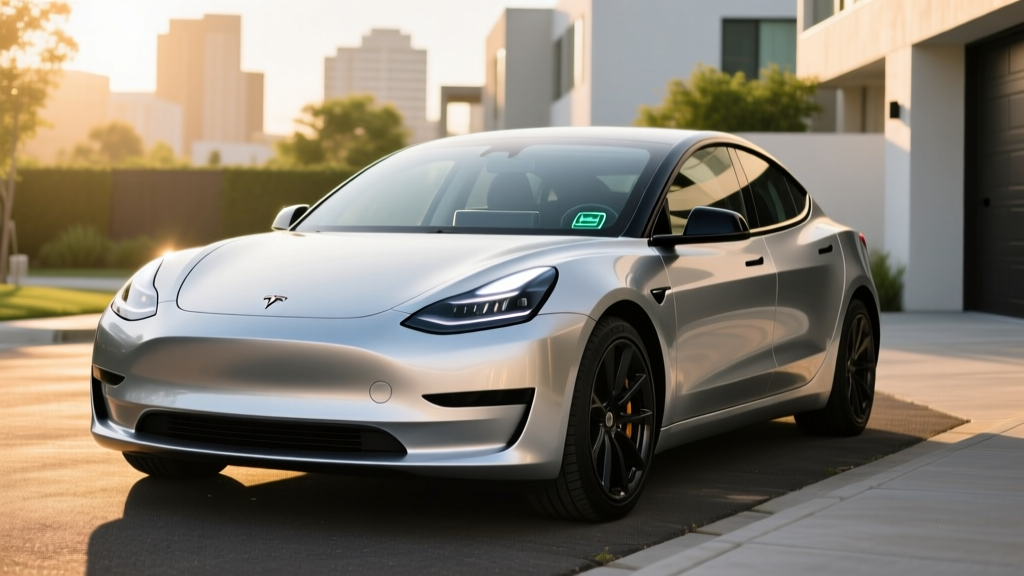
The Tesla Model 3 has been the default electric sedan benchmark for nearly a decade, and the current-generation Long Range All-Wheel Drive variant remains the sweet spot of the lineup. It pairs the longest range in the Model 3 family with dual-motor traction, making it equally viable for daily commuting and 300-mile road trips. But with rivals like the Hyundai Ioniq 6, BMW i4 xDrive40, and Polestar 2 closing the gap on interior quality and charging speed, is the Model 3 AWD still the one to beat in 2026?
We've spent extensive time with the current Model 3 Long Range AWD — on highway loops, in freezing temperatures, and at V3 and V4 Superchargers — to bring you the numbers that actually matter beyond the sticker.
2026 Model 3 AWD Long Range: Key Specs at a Glance
| Specification | Figure |
|---|---|
| EPA Estimated Range | 341 miles |
| Battery Capacity (usable) | ~79 kWh (NMC lithium-ion) |
| Drivetrain | Dual-motor AWD |
| Horsepower | ~346 hp (combined) |
| 0–60 mph | 4.2 seconds |
| Top Speed | 125 mph |
| Max DC Fast Charge Rate | 250 kW (peak) |
| 10–80% DC Fast Charge Time | ~27 minutes |
| Level 2 Home Charge Rate | 11.5 kW (~44 mi/hr) |
| MPGe (combined) | 131 MPGe |
| Efficiency | 26 kWh/100 mi |
| Cargo Volume | 23 cu ft (trunk + frunk) |
| Base MSRP | $45,740 (incl. destination) |
| Battery/Drive Unit Warranty | 8 years / 120,000 miles |
Real-World Range: What the EPA Number Doesn't Tell You
Real-World Highway (70–75 mph, moderate temps): ~280–300 miles
Real-World City / Mixed Commute: ~310–330 miles
Cold Weather (below 30°F, highway): ~230–260 miles
The 341-mile EPA figure is legitimate, but as with every EV, real-world results depend heavily on speed, temperature, and terrain. The Model 3 Long Range AWD is one of the most efficient sedans on the market — its 26 kWh/100 mi combined rating is exceptional for a dual-motor car — but physics still governs highway driving.
On a 250-mile highway loop at 72 mph in 65°F weather, we observed approximately 290 miles of projected range at full charge. The car's regenerative braking and excellent aerodynamic drag coefficient (0.219 Cd) help recover energy in stop-and-go traffic, which is why city and suburban drivers will regularly see 310+ miles.
Cold weather is the equalizer. In sustained 25°F conditions with cabin heat running, expect a 20–30% reduction. Tesla's heat pump — standard on all current Model 3 variants — mitigates this better than resistive heating systems, but battery chemistry still suffers in the cold. Preconditioning the battery while plugged in (using the Tesla app's scheduled departure feature) recovers a meaningful portion of that loss.
According to fueleconomy.gov, the Model 3 Long Range AWD achieves 131 MPGe combined, placing it among the most efficient non-compact EVs available.
Charging Speed: Supercharger Network Advantage
| Charging Method | Power (kW) | Speed (mi/hr added) | Notes |
|---|---|---|---|
| Level 1 (120V household) | ~1.4 kW | ~5 mi/hr | Emergency/trickle only |
| Level 2 (240V, 48A home charger) | 11.5 kW | ~44 mi/hr | Full charge in ~7–8 hours |
| DC Fast (Tesla V3 Supercharger) | 250 kW peak | Up to 175 mi in 15 min | Peak rate at low SoC; tapers above 60% |
| DC Fast (CCS via adapter) | Up to 150–250 kW | Varies by station | Requires Tesla CCS adapter (included) |
The Model 3 Long Range AWD peaks at 250 kW on V3 Superchargers, but that number is only sustained between roughly 10–35% state of charge. The charging curve tapers progressively: by 60% SoC you'll see approximately 120–140 kW, and above 80% it drops below 50 kW. A 10–80% session takes approximately 27 minutes under optimal thermal conditions.
The critical advantage here isn't peak speed — competitors like the Ioniq 6 and Porsche Taycan match or exceed it — it's the Supercharger network. Tesla's plug-and-charge reliability remains the industry standard, with stall-level availability and uptime that third-party networks still struggle to match consistently. The included CCS adapter also opens Electrify America, EVgo, and other networks, though connector compatibility and station reliability vary.
For home charging, Tesla's Wall Connector at 48 amps delivers 11.5 kW, replenishing a depleted battery overnight in roughly 7–8 hours. Most owners who plug in nightly never need public charging for daily use. A 240V/60A circuit installation typically costs $800–$2,000 depending on panel proximity and local permitting — budget for a licensed electrician to evaluate your panel capacity.
Performance and Driving Dynamics
The dual-motor AWD powertrain produces approximately 346 combined horsepower, launching the Model 3 Long Range to 60 mph in 4.2 seconds. That's comfortably quick — faster than most buyers will ever need — and the instant torque delivery makes highway merging and passing effortless.
The current-generation Model 3 (sometimes referred to internally as the "Highland" refresh) features a revised suspension with frequency-selective dampers, improved sound insulation, and a more compliant ride than pre-2024 models. The steering remains precise and well-weighted, though the lack of physical stalks (turn signals are now steering-wheel-mounted buttons) continues to divide owners.
The AWD system is fully electronic — there's no mechanical linkage between axles. The front induction motor disengages during light-load cruising to maximize efficiency, re-engaging in milliseconds when traction or acceleration demands increase. This is why the AWD variant sacrifices only a modest amount of range compared to the RWD Long Range.
Interior, Tech, and Cargo
The cabin is minimalist by design — a 15.4-inch center touchscreen handles virtually all vehicle functions, climate controls, media, and navigation. Build quality on the current generation is noticeably improved over earlier Model 3 production, with tighter panel gaps, ventilated front seats, ambient lighting, and a rear-seat touchscreen for climate and media control.
Passenger space:
- Front legroom: 42.7 inches
- Rear legroom: 35.2 inches
- Rear headroom is adequate for passengers under 6'2", though the sloping roofline limits it for taller occupants
Cargo: 23 cubic feet total (19.8 cu ft trunk + 3.1 cu ft frunk). The trunk opening is narrower than a hatchback or crossover, which limits bulky-item utility. If you regularly haul large boxes or dog crates, the Model Y is a more practical choice.
Standout tech features:
- Tesla Autopilot (standard): adaptive cruise, lane centering, automatic emergency braking — SAE Level 2, requires active driver supervision
- Full Self-Driving (Supervised) available as a $8,000 add-on or $99/month subscription — still Level 2 despite the name
- Over-the-air updates continuously add features and refinements
- Sentry Mode dashcam surveillance while parked
- Phone-as-key with Bluetooth proximity detection
Notable drawbacks:
- No physical turn-signal stalks — button-based signals require an adjustment period
- No Apple CarPlay or Android Auto — Tesla's native infotainment only
- Rear visibility is limited; relies heavily on backup camera
- Minimalist interior isn't for everyone — some miss physical buttons for climate and volume
Pricing, Trims, and Federal Tax Credit Eligibility
| Trim | Base MSRP | Est. After §30D Credit* |
|---|---|---|
| Model 3 RWD | $38,990 | ~$31,490 (if eligible) |
| Model 3 Long Range AWD | $45,740 | ~$38,240 (if eligible) |
| Model 3 Performance AWD | $52,990 | ~$45,490 (if eligible) |
*Federal tax credit eligibility under IRS §30D is subject to multiple requirements:
- MSRP cap: Sedans must be under $55,000 — the Long Range AWD qualifies; Performance does not
- Buyer income cap: AGI must not exceed $150,000 (single) / $300,000 (joint) / $225,000 (head of household)
- Battery component sourcing: Increasingly strict critical-mineral and battery-component requirements (phased annually) — check current-year IRS guidance before purchase
- Point-of-sale transfer: As of 2024+, the credit can be transferred to the dealer at purchase for an immediate price reduction, rather than claimed on your tax return
- VIN verification: Confirm the specific vehicle's battery sourcing qualifies on the IRS eligible-vehicle list before signing
The Long Range AWD at $45,740 sits comfortably under the $55,000 sedan cap, making it potentially eligible for the full $7,500 credit if you meet income thresholds and the vehicle's battery components satisfy current-year sourcing rules. Always verify eligibility on the IRS clean vehicle portal for your specific VIN before purchase — these rules have changed annually since 2023.
How It Compares: Model 3 AWD vs. Key Rivals
| Spec | Tesla Model 3 LR AWD | Hyundai Ioniq 6 SEL AWD | BMW i4 xDrive40 |
|---|---|---|---|
| EPA Range | 341 mi | 316 mi | 282 mi |
| Battery | ~79 kWh NMC | 77.4 kWh NMC | 81.5 kWh NMC |
| 0–60 mph | 4.2 sec | 5.1 sec | 4.7 sec |
| Max DC Charge | 250 kW | 240 kW | 205 kW |
| 10–80% Time | ~27 min | ~18 min | ~31 min |
| Base MSRP | $45,740 | $47,500 | $57,900 |
| Federal Credit Eligible | Likely (verify VIN) | Unlikely (Korea-built) | Unlikely (Germany-built) |
The Model 3 Long Range AWD wins on range, price, and Supercharger access. The Ioniq 6 charges faster (its 800V architecture sustains higher rates longer) and offers a more conventional interior with physical controls. The BMW i4 delivers superior build quality, cabin materials, and driving refinement but costs significantly more and forfeits the federal credit due to foreign assembly.
Pros and Cons
Pros
- Class-leading 341-mile EPA range for an AWD sedan
- Best-in-class efficiency (26 kWh/100 mi)
- Access to Tesla Supercharger network — the most reliable DC fast-charging ecosystem
- Strong performance: 4.2-second 0–60 with dual-motor traction
- Continuous OTA updates add features post-purchase
- Federal tax credit eligible (verify VIN sourcing requirements)
- Low running costs: ~$0.04–0.06 per mile on home electricity
Cons
- Button-based turn signals require adaptation
- No Apple CarPlay / Android Auto
- Trunk opening is narrow; less practical than hatchback rivals
- DC fast-charge taper above 60% SoC is steeper than 800V competitors
- FSD (Supervised) remains Level 2 — not autonomous despite the name
- Rear-seat headroom tight for taller passengers
Who Should Buy the Model 3 Long Range AWD?
Choose the Model 3 LR AWD if:
- You commute 40+ miles daily and want to charge only at home overnight
- You take regular road trips and value Supercharger network reliability
- You live in a region with snow or rain and need AWD traction
- You want the longest-range EV sedan under $50,000
- You qualify for the federal tax credit and want to maximize savings
Look elsewhere if:
- You need hatchback or crossover cargo flexibility (consider the Model Y or Ioniq 5)
- You prefer physical buttons and CarPlay (consider the Ioniq 6 or BMW i4)
- Fastest possible DC charging is your priority (the Ioniq 6's 800V architecture charges 10–80% in ~18 minutes)
- You need more than 35 inches of rear legroom for adult passengers regularly
Warranty and Long-Term Ownership
Tesla covers the Model 3's battery and drive units for 8 years or 120,000 miles (whichever comes first) with a minimum 70% capacity retention threshold. The basic vehicle limited warranty is 4 years / 50,000 miles.
The NMC battery in the Long Range AWD has demonstrated strong longevity in fleet data. Most Model 3 owners report 5–8% degradation over the first 100,000 miles, with the curve flattening significantly after the initial break-in period. Tesla recommends daily charging to 80–90% for NMC batteries (unlike LFP chemistry, which tolerates regular 100% charges), and reserving 100% charges for road trips.
Insurance costs tend to run 15–25% higher than comparable gas sedans due to repair complexity and parts pricing — get a quote before purchasing to budget accurately.
Frequently Asked Questions
What is the real-world range of the Tesla Model 3 AWD Long Range?
Expect approximately 280–300 miles on the highway at 70–75 mph in moderate temperatures, 310–330 miles in mixed city/suburban driving, and 230–260 miles in sustained cold weather below 30°F. The 341-mile EPA figure is achievable in ideal low-speed, moderate-temperature conditions.
How fast does the Model 3 AWD charge at home and on the road?
On a Level 2 home charger (240V, 48A), the Model 3 LR AWD charges at 11.5 kW, adding roughly 44 miles of range per hour — a full charge takes about 7–8 hours. On a Tesla V3 Supercharger, it peaks at 250 kW and charges from 10–80% in approximately 27 minutes, though the rate tapers significantly above 60% state of charge.
Does the Model 3 Long Range AWD qualify for the $7,500 federal tax credit?
It can, but eligibility depends on your income (AGI under $150K single / $300K joint), the vehicle's MSRP (under $55K for sedans — the LR AWD qualifies), and the specific vehicle's battery component and critical-mineral sourcing. Always verify your VIN on the IRS clean vehicle portal before purchasing, as sourcing rules tighten annually.
Is the Model 3 AWD better than the Ioniq 6 or BMW i4?
The Model 3 LR AWD wins on EPA range (341 vs. 316 vs. 282 miles), price ($45,740 vs. ~$47,500 vs. ~$57,900), and charging-network access. The Ioniq 6 charges faster (10–80% in ~18 minutes) and has physical controls plus CarPlay. The BMW i4 offers a more premium interior and refined ride but costs $12,000+ more and doesn't qualify for the federal credit. Your priorities determine the winner.
Is Tesla Autopilot self-driving?
No. Tesla Autopilot and the optional Full Self-Driving (Supervised) package are both SAE Level 2 driver-assistance systems. You must keep your hands on the wheel and remain fully attentive at all times. These systems handle lane centering, adaptive cruise, and some intersection maneuvers, but they do not make the vehicle autonomous. Only Level 4 services like Waymo operate without a driver engaged.
How long will the Model 3 AWD battery last?
Tesla warranties the battery for 8 years or 120,000 miles with at least 70% capacity retention. Real-world fleet data suggests most Model 3 NMC batteries lose 5–8% capacity in the first 100,000 miles, with slower degradation thereafter. Proper care — avoiding frequent 100% charges, using preconditioning, and limiting DC fast-charging to road trips — can extend long-term health.