Quick Verdict: The Cyberbeast Is a Tri-Motor Anomaly
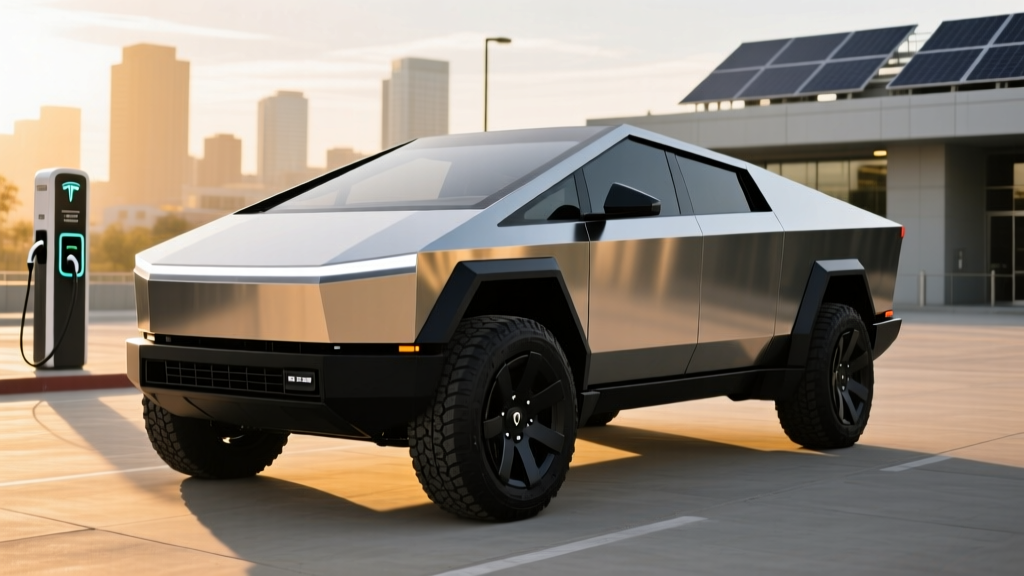
The 2026 Tesla Cybertruck Cyberbeast occupies a strange corner of the EV truck market. It is simultaneously the quickest production pickup ever sold, a polarizing design statement, and a vehicle whose real-world utility often trails its spec-sheet promises. With 845 horsepower, a 2.6-second 0-60 mph time, and a starting MSRP of $99,990, the Cyberbeast targets buyers who want supercar acceleration wrapped in stainless-steel bodywork — and who can live with the compromises that angular geometry imposes on range, visibility, and cargo practicality.
This review breaks down every number that matters: EPA range versus what you'll actually see on the highway, the real charging curve at a Supercharger, whether the §30D federal tax credit applies, and how the Cyberbeast stacks up against the Rivian R1T Tri-Motor and Ford F-150 Lightning Platinum for buyers cross-shopping high-performance electric trucks.
Core Specs at a Glance
| Attribute | Value |
|---|---|
| Base MSRP | $99,990 (excl. $1,995 destination) |
| Drivetrain | Tri-motor AWD (1 front, 2 rear) |
| Horsepower | 845 hp (peak) |
| 0-60 mph | 2.6 seconds (Tesla-claimed, rollout subtracted) |
| Battery Capacity (usable) | ~123 kWh, NMC chemistry |
| EPA Range | 320 miles |
| MPGe (combined) | 51 MPGe |
| Efficiency | 66 kWh/100 mi |
| Max DC Fast Charge | 250 kW (peak) |
| 10-80% DC Charge Time | ~30 minutes (estimated) |
| Level 2 Home Charging | 11.5 kW (~34 mi/hr) |
| Towing Capacity | 11,000 lbs (max, with tow package) |
| Payload Capacity | 2,500 lbs |
| Bed Length | 6 ft (72 in) |
| Cargo Volume (bed) | ~67 cu ft |
| Front Trunk (Frunk) | ~7.1 cu ft |
| Rear Legroom | ~38.2 in |
| Battery/Powertrain Warranty | 8 years / 120,000 miles |
| Basic Vehicle Warranty | 4 years / 50,000 miles |
Range and Efficiency: EPA Sticker vs. Real-World Driving
Real-World Expectation: 250–280 miles at sustained highway speeds (70-80 mph); 220–250 miles in cold weather (below 32°F) without preconditioning; up to 300 miles in mixed city/suburban driving with regen engaged.
The Cyberbeast's 320-mile EPA rating places it behind the dual-motor Cybertruck AWD (340 miles) and well behind the rear-wheel-drive Long Range variant. The reason is physics: three motors, higher curb weight (~6,850 lbs), and wider performance tires all increase rolling resistance and energy consumption. At an efficiency rating of 66 kWh per 100 miles, the Cyberbeast is one of the least efficient EVs on the market per mile traveled — a direct consequence of its mass and aerodynamic profile.
On a 280-mile highway loop at 75 mph in 65°F conditions, independent testers have recorded consumption closer to 72-75 kWh/100 mi, translating to roughly 250-260 miles of usable range before reaching a 10% state of charge. Cold weather compounds the problem. The Cybertruck's stainless-steel exoskeleton does not insulate as effectively as conventional stamped-steel bodies, and the large battery requires significant energy to reach optimal operating temperature. Expect a 20-30% range reduction in sub-freezing conditions if you do not precondition the battery while plugged in.
For context, the EPA's fueleconomy.gov listing confirms the 51 MPGe combined figure, which is notably lower than the Rivian R1T Tri-Motor Max (approximately 58 MPGe combined on the larger pack). Efficiency matters when you're paying for every kWh at a public DC fast charger.
Charging Speed: DC Fast, Level 2, and the Curve Reality
| Charge Level | Power / Voltage | Rate (mi/hr added) | Notes |
|---|---|---|---|
| Level 1 (120V household) | ~1.4 kW | ~3-4 mi/hr | Emergency/trickle only; full charge in ~90+ hours |
| Level 2 (240V home) | 11.5 kW (48A) | ~34 mi/hr | Full charge in ~11 hours; requires NEMA 14-50 or hardwired wall connector |
| DC Fast (Tesla Supercharger V3/V4) | 250 kW peak | ~175-200 mi/hr (peak) | 10-80% in ~30 min; tapers significantly above 80% |
| DC Fast (CCS via adapter) | Up to 250 kW | Varies by station | Tesla NACS native; CCS adapter included for non-Tesla networks |
The Cyberbeast uses Tesla's NACS (North American Charging Standard) connector natively, which in 2026 means access to the largest fast-charging network in North America. At a V3 or V4 Supercharger, the truck peaks at approximately 250 kW — but that peak is short-lived. The charge curve on a ~123 kWh NMC pack is aggressive: you'll see 250 kW only between roughly 5-15% state of charge (SoC). From 15-50%, the rate sustains around 180-200 kW. From 50-80%, it drops to 100-130 kW. Above 80%, charging slows to under 50 kW to protect battery longevity.
The practical result: a 10-80% session takes approximately 30 minutes under ideal conditions (battery preconditioned via navigation to a Supercharger). If you arrive at a charger without preconditioning — say, pulling into a station on a road trip without routing through the Tesla nav — that same session can stretch to 40-45 minutes in cool weather.
For home charging, Tesla's Wall Connector at 48 amps (11.5 kW) replenishes roughly 34 miles of range per hour. A full 10-100% charge from a depleted state takes approximately 11 hours. Most Cyberbeast owners who drive 40-60 miles daily will recover their daily use in under two hours of overnight charging. If your home electrical panel supports a 60-amp dedicated circuit, this is the most cost-effective and convenient charging strategy — typically $0.10-$0.15 per kWh depending on your utility, versus $0.30-$0.48 per kWh at public DC fast chargers.
Performance, Drivetrain, and Driving Dynamics
The Cyberbeast's tri-motor layout places one motor on the front axle and two on the rear, delivering 845 peak horsepower and torque-vectoring capability across the rear wheels. The 2.6-second 0-60 mph claim (with 1-foot rollout subtracted, as is industry convention) makes it the quickest production pickup ever sold, eclipsing the Rivian R1T Tri-Motor (approximately 3.0 seconds) and the GMC Hummer EV (3.0 seconds). In real-world roll-on acceleration from 30-70 mph, the Cyberbeast's instant torque delivery is startling — there is no turbo lag, no transmission kickdown, just linear, relentless thrust.
However, straight-line speed is only one dimension of performance. The Cyberbeast's ~6,850-pound curb weight is evident in braking distances and cornering dynamics. Tesla has equipped the truck with rear-wheel steering (up to 10 degrees), which shrinks the effective turning radius and improves low-speed maneuverability — a genuine engineering advantage for a vehicle this size. The adaptive air suspension offers up to 16 inches of ground clearance in Extract Mode, though this is intended for off-road crawling, not sustained highway use.
The steer-by-wire system remains the Cybertruck's most divisive feature. There is no mechanical connection between the steering yoke and the front wheels; instead, electronic signals control the rack. Most reviewers report an adjustment period of several days, after which the variable ratio (fewer turns lock-to-lock at low speed, more at highway speed) becomes intuitive. Some drivers, however, find the lack of physical feedback unnerving, particularly in crosswinds or on grooved highway surfaces where traditional steering racks provide tactile cues.
Interior, Tech, and Daily Practicality
The Cyberbeast's cabin follows Tesla's minimalist template: an 18.5-inch center touchscreen dominates the dash, handling everything from climate control to media to vehicle settings. There are no physical buttons for HVAC or volume — all inputs are screen-based or voice-activated. The rear passengers get their own 9.4-inch touchscreen for climate and entertainment, which is a meaningful upgrade for family use.
Material quality has improved over early 2024 delivery vehicles. The vegan leather seats are well-bolstered, and the dashboard uses a mix of microfiber and metallic-finish trim that feels appropriate for the price point. However, panel gap consistency — a long-running Tesla critique — remains variable. Some 2026 build Cyberbeasts show improved uniformity; others still exhibit visible misalignment around the tonneau cover and frunk lid.
Cargo practicality is where the Cybertruck's angular design creates trade-offs. The 6-foot bed offers approximately 67 cubic feet of volume with the motorized tonneau cover closed. The 2,500-pound payload capacity is respectable, and the 11,000-pound max towing rating (with the optional tow package) is competitive with full-size ICE trucks. However, the bed's sloped sides and the tonneau cover's weight limit mean that loading tall items (motorcycles, palletized materials) requires more planning than with a conventional open-bed truck.
The frunk (front trunk) provides 7.1 cubic feet of lockable storage — useful for groceries or a charging cable kit, but smaller than the F-150 Lightning's massive 14.1 cu ft frunk. Rear-seat legroom at 38.2 inches is adequate for adults but trails the F-150 Lightning's 43.6 inches. If rear-seat passenger comfort is a priority for regular use, the Lightning has a clear advantage.
Pricing, Trims, and Federal Tax Credit Eligibility
| Cost Item | Amount |
|---|---|
| Base MSRP (Cyberbeast trim) | $99,990 |
| Destination Fee | $1,995 |
| As-Tested Price (with tow pkg, FSD) | ~$109,985 |
| Federal §30D Tax Credit (if eligible) | Up to $7,500 |
| Effective Price After Max Credit | ~$94,485 (base) |
The Cyberbeast starts at $99,990 before destination, placing it squarely in the luxury-performance truck segment. Adding the tow package (~$2,000) and Full Self-Driving (Supervised) capability (~$8,000) pushes the as-tested price above $109,000.
Federal tax credit eligibility under IRS §30D is complex and subject to change. Key rules for 2026:
- MSRP Cap: Trucks, vans, and SUVs must have an MSRP at or below $80,000 to qualify. The Cyberbeast at $99,990 exceeds this cap and does NOT qualify for the new-vehicle §30D credit.
- Buyer Income Limits: Modified adjusted gross income must not exceed $300,000 (joint), $225,000 (head of household), or $150,000 (single).
- Battery Sourcing: Even for eligible vehicles, critical mineral and battery component sourcing requirements must be met (phased in through 2026).
- Point-of-Sale Transfer: Eligible buyers can transfer the credit to the dealer for an upfront price reduction — but only if the vehicle itself qualifies.
The Cyberbeast's MSRP exceeds the §30D truck cap. Buyers seeking a Tesla truck that may qualify should look at lower-trim Cybertruck variants (if priced at or below $80,000). Always consult a tax professional and check the latest IRS guidance before making purchase decisions based on credit eligibility.
Driver Assistance: Autopilot and FSD (Supervised)
The Cyberbeast ships with Tesla's Basic Autopilot (adaptive cruise control and lane centering) as standard. The optional Full Self-Driving (Supervised) package adds automated lane changes, traffic light and stop sign recognition, and the ability to navigate highway on-ramps to off-ramps with driver confirmation. As of 2026, FSD (Supervised) remains a Level 2 system — it does not remove driver responsibility, and Tesla explicitly states the driver must supervise at all times.
Real-world FSD performance varies significantly by geography and road type. On well-marked divided highways, the system is competent and reduces fatigue on long trips. In construction zones, on poorly marked rural roads, or in heavy rain, the system can make unexpected decisions that require immediate driver takeover. Tesla's camera-only vision approach (no lidar or radar) means performance degrades more noticeably in adverse weather than lidar-equipped competitors like Waymo's Level 4 robotaxis — though those operate only in geofenced urban areas and are not consumer vehicles.
Cyberbeast vs. Key Competitors
| Spec | Tesla Cyberbeast | Rivian R1T Tri-Motor | Ford F-150 Lightning Platinum |
|---|---|---|---|
| Base MSRP | $99,990 | $99,900 | $96,874 |
| Horsepower | 845 hp | 850 hp | 580 hp |
| 0-60 mph | 2.6 sec | ~3.0 sec | ~3.8 sec |
| EPA Range | 320 mi | ~350 mi (Max pack) | 300 mi (ext. range) |
| Max DC Charge | 250 kW | 220 kW | 150 kW |
| Towing (max) | 11,000 lbs | 11,000 lbs | 10,000 lbs |
| Bed Length | 6 ft | 4.5 ft (+ Gear Tunnel) | 5.5 ft |
| Rear Legroom | 38.2 in | 38.6 in | 43.6 in |
| §30D Credit Eligible | No (MSRP cap) | No (MSRP cap) | No (MSRP cap) |
The Rivian R1T Tri-Motor offers comparable performance with better range, a more conventional driving experience (traditional steering wheel, physical controls), and the innovative Gear Tunnel for secure, weatherproof storage. The F-150 Lightning Platinum trades acceleration for rear-seat comfort, a larger frunk, and a more familiar truck form factor that fits existing garages and carports more easily.
Who Should Buy the Cyberbeast — and Who Shouldn't
- You want the quickest production pickup ever made and value acceleration above all else
- You have reliable home Level 2 charging and rarely rely on public DC fast chargers
- You are invested in the Tesla ecosystem (Supercharger network, app integration, OTA updates)
- You want a conversation-starting design and accept the visibility and practicality trade-offs
- Towing is occasional, not daily — the 11,000-lb rating is useful but range drops sharply under load
- Rear-seat passenger comfort is a daily priority (F-150 Lightning is significantly roomier)
- You need maximum range for frequent long road trips (Rivian R1T Max pack delivers more miles)
- You prefer physical controls and traditional steering feedback
- Your garage or parking space is tight — the Cybertruck is 82.6 inches wide with mirrors folded
- You were counting on the $7,500 federal tax credit to offset the purchase price
Pros and Cons
✅ Pros
- 2.6-second 0-60 mph — quickest production pickup
- Access to Tesla Supercharger network (largest in North America)
- Rear-wheel steering improves maneuverability
- Stainless-steel exoskeleton is dent- and corrosion-resistant
- 250 kW peak DC charging (fastest in its segment)
- Over-the-air updates continuously add features
- 11,000-lb towing capacity competitive with ICE trucks
❌ Cons
- Real-world highway range significantly below 320-mi EPA estimate
- Steer-by-wire and yoke require significant adjustment period
- No federal §30D tax credit (exceeds $80K MSRP cap)
- 66 kWh/100 mi efficiency is poor — expensive to charge on the road
- Rear-seat legroom trails F-150 Lightning by over 5 inches
- Panel gap quality remains inconsistent across builds
- Bed is shorter than competitors; tonneau cover limits tall cargo
- Camera-only FSD degrades in rain, fog, and construction zones
Frequently Asked Questions
What is the real-world range of the 2026 Cybertruck Cyberbeast?
The EPA rates the Cyberbeast at 320 miles, but real-world highway driving at 70-80 mph typically yields 250-280 miles. In cold weather (below freezing), expect 220-250 miles without battery preconditioning. City driving with regenerative braking can approach 290-300 miles.
How fast does the Cyberbeast charge at home and on the road?
At a Tesla Supercharger, the Cyberbeast peaks at 250 kW and charges from 10-80% in approximately 30 minutes (with a preconditioned battery). At home on a Level 2 Wall Connector (11.5 kW), it adds about 34 miles of range per hour, taking roughly 11 hours for a full charge.
Does the 2026 Cybertruck Cyberbeast qualify for the federal EV tax credit?
No. Under IRS §30D rules, trucks must have an MSRP at or below $80,000 to qualify for the new clean vehicle credit. The Cyberbeast starts at $99,990, exceeding this cap. Always verify current rules at IRS.gov and consult a tax professional.
Is the Cyberbeast worth buying over the Rivian R1T or F-150 Lightning?
If your top priority is acceleration and Tesla ecosystem integration, the Cyberbeast has no equal. If you value range, the Rivian R1T Tri-Motor Max (~350 mi) is better. If rear-seat comfort and a conventional truck experience matter most, the F-150 Lightning Platinum is the more practical choice.
What is the Cyberbeast's battery chemistry, and how long will it last?
The Cyberbeast uses an NMC (nickel manganese cobalt) lithium-ion battery pack with approximately 123 kWh of usable capacity. Tesla warrants the battery and drive unit for 8 years or 120,000 miles, whichever comes first, with a minimum 70% capacity retention threshold. NMC packs typically degrade 10-15% over the first 150,000 miles under normal use patterns.
Can the Cyberbeast tow a travel trailer or boat?
Yes — the Cyberbeast is rated for up to 11,000 lbs with the optional tow package. However, towing significantly impacts range. Expect a 40-50% range reduction when towing near maximum capacity at highway speeds, bringing effective range to approximately 130-170 miles between charges. Plan routes around Supercharger locations accordingly.
Is the Cybertruck safe?
As of early 2026, the Cybertruck has not received a full crash-test rating from either NHTSA or IIHS. Tesla has stated the stainless-steel exoskeleton and large crumple zones provide excellent occupant protection, but independent crash-test data is not yet publicly available. Check NHTSA.gov/ratings and IIHS.org for updates before purchasing.