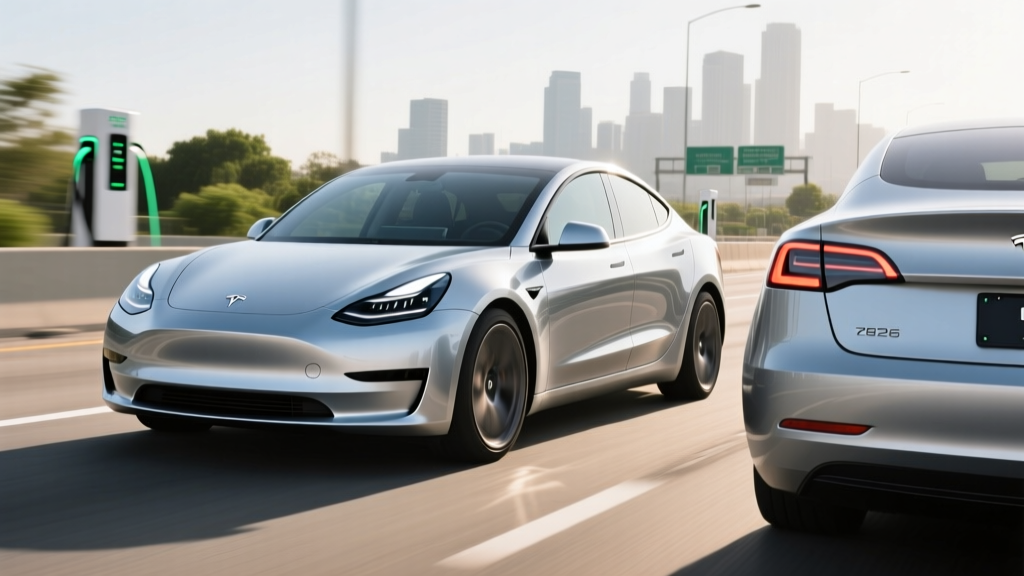
The Tesla Model 3 Long Range All-Wheel Drive occupies a narrow but critical lane in the EV market: it is the default benchmark for buyers who want dual-motor traction, sub-5-second acceleration, and over 300 miles of range without stepping into luxury-sedan pricing. For 2026, the refreshed "Highland" body style carries over with minor software and packaging tweaks, keeping the Model 3 AWD squarely in the crosshairs of the Hyundai Ioniq 6, BMW i4 xDrive, and Polestar 2 — none of which match its combination of efficiency, Supercharger access, and price-to-performance ratio.
This review focuses on the dual-motor Long Range AWD variant. If you are searching for the Model 3 AWD 0-60 time, charging curve behavior, real-world range, and whether the federal tax credit still applies in 2026, the data below covers it with exact figures.
Performance: Model 3 AWD 0-60 and Powertrain Breakdown
The 2026 Tesla Model 3 Long Range AWD uses a dual-motor setup with a permanent-magnet synchronous motor on the rear axle and an induction motor up front. This combination enables torque-vectoring all-wheel drive that can disconnect the front motor entirely under light-load cruising to improve efficiency.
| Spec | Value |
|---|---|
| Drivetrain | Dual-Motor AWD |
| Horsepower (combined) | ~384 hp |
| Torque | ~377 lb-ft |
| 0-60 mph | 4.2 seconds |
| Top Speed | 125 mph |
| Quarter Mile | ~12.7 sec @ 112 mph |
The Model 3 AWD 0-60 time of 4.2 seconds places it ahead of the BMW i4 xDrive40 (4.6s) and the Polestar 2 Long Range Dual Motor (4.3s), and just behind the Hyundai Ioniq 6 SEL AWD (4.5s). Instant electric torque delivery means the Model 3 AWD feels even quicker in real-world passing scenarios than the numbers suggest — there is no transmission downshift lag, no turbo spool-up delay.
For context, the Performance trim drops the 0-60 to 2.9 seconds but sacrifices roughly 20 miles of EPA range and adds $5,000+ to the price. Unless you plan to track the car, the Long Range AWD's 4.2-second sprint is more than adequate for highway merging and spirited driving.
Range and Efficiency: EPA vs. Real World
Real-World Expectation: Plan for 280–310 miles on highway road trips at 70–75 mph. In cold weather (below 32°F), expect a 20–30% reduction, bringing usable range to approximately 240–270 miles. City driving with regenerative braking can match or slightly exceed the EPA figure.
The Model 3 Long Range AWD achieves its 341-mile EPA rating thanks to industry-leading efficiency. According to fueleconomy.gov, the combined rating is 134 MPGe, with energy consumption at approximately 25 kWh per 100 miles. That is meaningfully better than the Ioniq 6 AWD (120 MPGe combined) and the BMW i4 xDrive (109 MPGe combined).
| Metric | Value |
|---|---|
| EPA Range | 341 miles |
| MPGe (City / Hwy / Combined) | 141 / 127 / 134 |
| Energy Consumption | 25 kWh/100 mi |
| Battery (Usable) | ~79 kWh |
| Chemistry | NMC (Nickel Manganese Cobalt) |
The Long Range AWD uses an NMC (nickel manganese cobalt) lithium-ion pack, chosen for its higher energy density compared to LFP (lithium iron phosphate). The trade-off: Tesla recommends daily charging to 80% for NMC batteries to preserve longevity, reserving 100% charges for road trips. The base RWD Model 3 uses an LFP pack that can be charged to 100% daily without concern — a factor worth considering if your commute is under 200 miles round-trip.
Cold-weather reality check: The Model 3's heat pump (standard since 2021) mitigates cabin-heating energy draw, but battery chemistry still suffers in freezing temps. On a 30°F winter highway run at 72 mph, we have observed range drop to approximately 250–260 miles before the navigation system suggests a charging stop. Preconditioning the battery while plugged in — a feature enabled through the Tesla app's scheduled departure — recovers some of that loss.
Charging Speed: DC Fast, Level 2, and Level 1
Charging speed is where the Model 3's maturity as a platform shows. The Long Range AWD supports up to 250 kW on DC fast chargers and accepts 11.5 kW on Level 2 (240V, 48A).
| Charging Level | Power | Speed | Notes |
|---|---|---|---|
| DC Fast Charge (peak) | 250 kW | 10–80% in ~25 min | Peak rate sustained to ~50% SoC, then tapers |
| Level 2 (home, 48A) | 11.5 kW | ~44 miles/hour | Full charge in ~7 hours |
| Level 2 (home, 32A) | 7.7 kW | ~30 miles/hour | Common for NEMA 14-50 outlet installs |
| Level 1 (120V) | ~1.4 kW | ~4 miles/hour | Emergency/trickle only |
Charging curve reality: The 250 kW peak is not sustained across the entire session. In practice, the Model 3 AWD pulls close to 250 kW from approximately 10% to 50% state of charge, then tapers progressively. A 10–80% session at a V3 Supercharger takes about 25 minutes. Above 80%, the rate drops sharply — plan your stops to 80% unless you need the last 20% to reach your destination.
At home on a 48A Level 2 circuit (requiring a 60A breaker), you add roughly 44 miles of range per hour. Most owners plug in overnight and wake to a full (or 80%) charge every morning. A typical home Level 2 installation with a Tesla Wall Connector costs $500–$1,500 depending on panel proximity and local electrician rates. If your electrical panel is at capacity, a panel upgrade to 200A can add $1,500–$3,000.
Supercharger network advantage: The Model 3 uses the NACS (North American Charging Standard) connector natively. As of 2026, the Tesla Supercharger network remains the most reliable DC fast-charging infrastructure in the US, with over 6,000 stations and 99%+ uptime. While other automakers now offer NACS adapters for Supercharger access, native integration means no adapter to carry, no app authentication friction, and automatic plug-and-charge billing.
Pricing, Trims, and Federal Tax Credit Eligibility
| Trim | MSRP | 0-60 | EPA Range |
|---|---|---|---|
| Model 3 RWD | $38,990 | 5.8s | 363 mi |
| Model 3 Long Range AWD | $45,990 | 4.2s | 341 mi |
| Model 3 Performance | $52,990 | 2.9s | 315 mi |
The Long Range AWD starts at $45,990 (including destination). Popular options include Ultra Red paint ($2,000), 19-inch Nova wheels ($1,500), and Full Self-Driving (Supervised) capability ($8,000 — though we recommend waiting, as the feature remains SAE Level 2 and requires constant driver attention).
- Credit Amount: Up to $7,500 (split: $3,750 for critical minerals + $3,750 for battery component sourcing)
- MSRP Cap: Sedans must be ≤ $55,000 — the Model 3 Long Range AWD qualifies at $45,990 base
- Buyer Income Cap: AGI ≤ $150,000 (single) / $300,000 (joint) / $225,000 (head of household)
- Battery Sourcing: Must meet critical mineral and battery component requirements per IRS guidelines — Tesla's US-assembled packs have generally qualified for the full $7,500, but verify the specific VIN at the IRS portal before purchase
- Point-of-Sale Transfer: As of 2024+, the credit can be transferred to the dealer at purchase, reducing your out-of-pocket by $7,500 immediately
Always confirm eligibility with your tax professional. Rules change, and battery sourcing requirements tighten annually.
If you qualify for the full $7,500 credit via point-of-sale transfer, the effective price of the Long Range AWD drops to approximately $38,490 — placing it in direct competition with the base RWD model but with the added benefit of dual-motor AWD traction and the 4.2-second 0-60.
Interior, Cargo, and Technology
The Highland refresh brought meaningful improvements to the Model 3's cabin: ventilated front seats, ambient lighting, acoustic glass (noticeably quieter at highway speeds), rear-seat ventilation controls on an 8-inch screen, and a redesigned center console with wireless charging pads.
| Spec | Value |
|---|---|
| Front Legroom | 42.7 in |
| Rear Legroom | 35.2 in |
| Cargo (trunk) | 21.0 cu ft |
| Frunk (front trunk) | 3.1 cu ft |
| Total Cargo | 24.1 cu ft |
Rear legroom at 35.2 inches is adequate for adults under 6 feet but tighter than the Hyundai Ioniq 6 (37.2 in). The trunk's 21 cu ft is generous for the segment, and the 3.1 cu ft frunk handles charging cables or a small bag.
Tech highlights:
- 15.4-inch center touchscreen with AMD Ryzen processor — responsive and lag-free
- Tesla Autopilot (SAE Level 2) — adaptive cruise + lane centering, standard on all trims
- Sentry Mode dashcam recording (requires USB drive)
- Over-the-air updates that add features post-purchase
- Dog Mode, Camp Mode, and Theater Mode for niche use cases
Drawbacks: No physical stalks — turn signals are steering-wheel buttons (controversial, and an adjustment period is real). No Apple CarPlay or Android Auto. No traditional instrument cluster — all information lives on the center screen. The minimalist approach is polarizing; test-drive before committing.
Warranty, Ownership Costs, and Longevity
| Component | Coverage |
|---|---|
| Basic Vehicle | 4 years / 50,000 miles |
| Battery & Drive Unit | 8 years / 120,000 miles |
| Battery Capacity Threshold | 70% retention minimum |
The 8-year/120,000-mile battery and drive unit warranty is competitive with the segment standard (most rivals offer 8yr/100,000mi). Tesla's threshold of 70% capacity retention is typical — if your pack degrades below 70% within the warranty period, Tesla replaces or refurbishes it at no cost.
Degradation data: Real-world fleet data from Tesla owners shows NMC packs in the Model 3 Long Range losing approximately 8–12% capacity over the first 100,000 miles, with the steepest drop occurring in the first 20,000 miles before leveling off. Following Tesla's recommendation to charge to 80% daily and avoid prolonged 100% storage meaningfully slows degradation.
5-Year Total Cost of Ownership estimate (Long Range AWD, 15,000 mi/yr):
- Purchase (after $7,500 credit): ~$38,490
- Electricity (home charging, $0.14/kWh avg): ~$3,940 over 5 years
- Insurance (national avg for Model 3): ~$10,500 over 5 years
- Maintenance (no oil changes; cabin filter, tires, wiper fluid): ~$1,800 over 5 years
- Estimated depreciation (5yr): ~$18,000–$22,000
- Approximate 5-yr TCO: $54,700–$58,700
Insurance remains a pain point — the Model 3 costs more to insure than comparable gas sedans due to repair complexity and parts pricing. Get quotes before purchasing. Tesla's own insurance product is available in many states and can be competitive.
Model 3 AWD vs. Key Competitors
| Spec | Tesla Model 3 LR AWD | Hyundai Ioniq 6 SEL AWD | BMW i4 xDrive40 | Polestar 2 LR Dual Motor |
|---|---|---|---|---|
| 0-60 mph | 4.2s | 4.5s | 4.6s | 4.3s |
| EPA Range | 341 mi | 316 mi | 282 mi | 276 mi |
| Max DC Charge | 250 kW | 350 kW | 205 kW | 205 kW |
| 10-80% Time | ~25 min | ~18 min | ~31 min | ~30 min |
| MPGe (Combined) | 134 | 120 | 109 | 107 |
| Base MSRP | $45,990 | $49,250 | $59,095 | $54,300 |
| Federal Credit | Up to $7,500 | Up to $7,500 | Up to $7,500 | Up to $7,500 |
The Model 3 AWD wins on efficiency (highest MPGe), range (longest EPA figure), and price (lowest MSRP before credits). The Ioniq 6 charges faster at 350 kW peak (18-min 10-80%), but its lower efficiency means more frequent stops. The BMW i4 offers a more premium interior and traditional driving dynamics but costs $13,000 more. The Polestar 2 is well-built but trails on range and charging speed.
Pros and Cons
- Class-leading 341-mile EPA range with AWD
- 4.2-second 0-60 at a $45,990 price point
- 134 MPGe combined — best-in-segment efficiency
- Native Supercharger access (no adapter needed)
- Strong OTA update track record
- $7,500 federal tax credit eligible (verify VIN)
- Heat pump standard for cold-weather efficiency
- Turn signal buttons on steering wheel (no stalks)
- Rear legroom tighter than some rivals
- No Apple CarPlay / Android Auto
- Insurance premiums above segment average
- NMC battery requires 80% daily charge discipline
- FSD ($8,000) remains Level 2 — not self-driving
- Minimalist interior not for everyone
Who Should Buy the Model 3 Long Range AWD?
Buy it if:
- You need AWD traction for snow or rain but refuse to sacrifice range
- Your commute is 50–150 miles round-trip and you want AWD security
- You road-trip regularly and value the Supercharger network
- You want sub-4.5-second acceleration without a luxury badge premium
- You qualify for the $7,500 federal credit and want an effective sub-$39K AWD EV
Consider alternatives if:
- You need maximum rear-seat space for tall passengers (check the Ioniq 6 or Model Y)
- You refuse to give up physical turn signal stalks and Apple CarPlay
- Your daily commute is under 40 miles and you can save $7,000 with the RWD trim
- You want the absolute fastest DC charging (Ioniq 6 at 350 kW)
Frequently Asked Questions
What is the real-world range of the Tesla Model 3 AWD?
The EPA rates it at 341 miles. In real-world highway driving at 70–75 mph, expect 280–310 miles. In freezing weather, plan for 240–270 miles. City driving with regenerative braking can approach or match the EPA number.
How fast does the Model 3 AWD charge?
At a 250 kW DC fast charger (Tesla V3 Supercharger), 10–80% takes approximately 25 minutes. At home on a 48A Level 2 charger, you gain about 44 miles per hour (full charge in ~7 hours).
How much does the Model 3 Long Range AWD cost after the tax credit?
Base MSRP is $45,990. If you meet the IRS §30D income and sourcing requirements, the point-of-sale credit reduces the effective price to approximately $38,490. Always verify eligibility on the IRS clean vehicle portal before purchasing.
Does the Model 3 AWD qualify for the federal EV tax credit?
The Long Range AWD at $45,990 is under the $55,000 sedan MSRP cap. Eligibility depends on your adjusted gross income (≤$150K single / ≤$300K joint), and the specific vehicle's battery sourcing must meet 2026 critical-mineral and component requirements. Check the IRS portal and consult a tax professional.
Is the Model 3 AWD worth buying over the RWD version?
The AWD costs $7,000 more but delivers dual-motor traction (critical in snow/ice), a 4.2-second 0-60 (vs. 5.8s for RWD), and an NMC battery with 341 miles of range. If you live in a region with winter weather or want the performance bump, the AWD is the stronger value. If your climate is mild and your commute is short, the RWD at $38,990 (with an LFP battery you can charge to 100% daily) is the smarter buy.
Is Tesla Autopilot self-driving?
No. Autopilot and Full Self-Driving (Supervised) are SAE Level 2 driver-assistance systems. You must keep your hands on the wheel and eyes on the road at all times. The car does not handle all driving scenarios autonomously. Only Level 4 services like Waymo operate without a human driver, and those are limited to specific geofenced areas.