Quick Verdict: The Model 3 in 2026 — Leaner Software, Same Dominant Hardware
The 2026 Tesla Model 3 remains the default benchmark for compact electric sedans, but this year's biggest story isn't a new battery or a faster motor — it's software. Tesla's decision to streamline its driver-assistance naming and feature structure (widely discussed as the Autosteer beta removal and consolidation into the core Autopilot and FSD Supervised tiers) has reshaped what buyers actually get at each price point. The car itself? Still excellent: 363 miles of EPA range on the Long Range AWD trim, a mature Supercharger network, and efficiency numbers that competitors still chase.
Below, we break down every spec that matters — range, charging curves, battery chemistry, real-world ownership costs, tax credit eligibility under current IRS §30D rules, and what the Autosteer beta removal actually changes for your daily drive.
Range, Efficiency, and the Real-World Reality Check
The 2026 Model 3 is offered in three trims, each with distinct range and efficiency profiles. Tesla continues to use a mix of NMC (nickel manganese cobalt) chemistry in the Long Range and Performance trims, and LFP (lithium iron phosphate) in the base Rear-Wheel Drive model.
| Trim | EPA Range | Battery (usable) | Chemistry | MPGe (combined) | kWh/100 mi |
|---|---|---|---|---|---|
| RWD | 272 mi | ~57.5 kWh | LFP | 132 MPGe | 25 |
| Long Range AWD | 363 mi | ~75 kWh | NMC | 134 MPGe | 24 |
| Performance AWD | 315 mi | ~75 kWh | NMC | 117 MPGe | 28 |
The LFP vs. NMC distinction matters beyond range. LFP batteries tolerate regular 100% charging without accelerated degradation — Tesla actually recommends periodic full charges for LFP cells. NMC batteries last longest when daily charging is capped at 80–90%. If your commute is short and predictable, the RWD's LFP pack is arguably the more durable long-term choice despite its lower range.
Charging Speed: DC Fast, Level 2, and the Supercharger Advantage
Charging speed remains a Tesla strong suit, aided by the NACS connector native to all Model 3 vehicles and access to the Supercharger network — now exceeding 6,000 stations in North America.
| Charging Level | Power | Speed (approx.) | Notes |
|---|---|---|---|
| Level 1 (120V) | ~1.4 kW | ~5 mi/hr | Emergency/trickle only |
| Level 2 (240V, 48A) | 11.5 kW | ~44 mi/hr | Full charge in ~6.5–8 hrs depending on trim |
| DC Fast (Supercharger V3/V4) | Peak 250 kW | 10–80% in ~25 min | Sustained rate tapers above 60% SoC |
The 250 kW peak figure requires context. Like all EVs, the Model 3 doesn't sustain peak power throughout the session. The charge curve holds near 250 kW from roughly 10–35% state of charge, then steps down to ~180 kW through 55%, and further to ~100 kW by 75%. A 10–80% session takes about 25 minutes at a V3 Supercharger when the battery is preconditioned — a process the car initiates automatically when you navigate to a Supercharger.
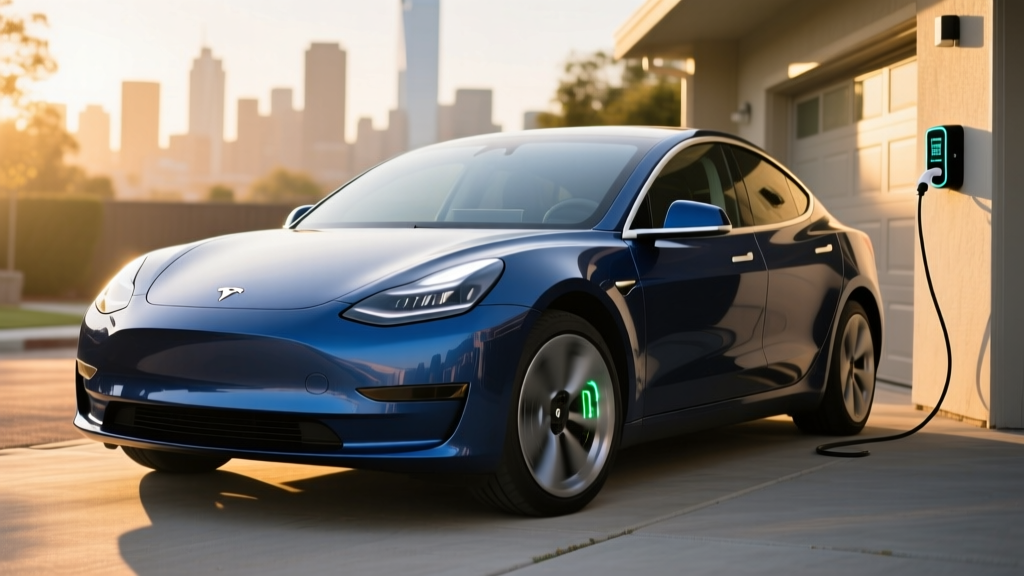
For home charging, the onboard 11.5 kW AC charger means a Wall Connector (or any J1772/NACS Level 2 station) on a 60A circuit will add roughly 44 miles per hour of charging. Most owners charging overnight will wake to a full battery regardless of trim. Note: LFP owners should charge to 100% at least weekly to allow the BMS to recalibrate — skipping this leads to range-display inaccuracy over time.
Performance, Drivetrain, and Dimensions
The Model 3 lineup covers a wide performance envelope:
- RWD: 271 hp, 0–60 mph in 5.8 seconds, single rear motor
- Long Range AWD: 346 hp, 0–60 mph in 4.2 seconds, dual-motor all-wheel drive
- Performance AWD: 510 hp, 0–60 mph in 2.9 seconds, dual-motor with track-oriented tuning
Interior space is adequate for a compact sedan, though rear headroom is tight for taller passengers due to the sloping roofline:
- Cargo volume: 23 cu ft (trunk + frunk combined)
- Rear legroom: 35.3 inches
- Front headroom: 40.3 inches
- Rear headroom: 36.6 inches
The Performance trim adds adaptive dampers, larger brakes, and a lowered ride height. It rides firmly — buyers prioritizing comfort over cornering should test-drive both the Long Range and Performance back to back.
Autosteer Beta Removal: What Changed and What It Means for You
The phrase "Autosteer beta removal" has circulated widely in Tesla communities, and the context matters. Historically, Tesla's Autosteer (the lane-centering component of basic Autopilot) and the more advanced Full Self-Driving (Supervised) capability existed in overlapping, sometimes confusing tiers. Some features were gated behind beta labels, and the software stack evolved rapidly with over-the-air updates that occasionally changed behavior without clear documentation.
In 2026, Tesla has consolidated its driver-assistance offerings into clearer tiers:
- Basic Autopilot (included): Traffic-Aware Cruise Control and Autosteer (lane centering on marked highways). No longer labeled "beta."
- Enhanced Autopilot ($6,000 option): Adds Navigate on Autopilot (highway on/off-ramp guidance), Auto Lane Change, Autopark, and Summon.
- FSD Supervised ($8,000 option): Adds city-street traffic light and stop sign recognition, automatic turns, and broader autonomous-capable routing. Still requires active driver supervision.
The practical effect of the Autosteer beta removal is that Tesla has moved core Autosteer functionality from a perpetually "testing" status to a production-grade feature with more consistent behavior. This doesn't mean the system is infallible — it still struggles with faded lane markings, construction zones, and aggressive cut-ins — but it reduces the frequency of unexpected behavioral changes that beta status implied. For buyers, this means more predictable daily driving on the included Autopilot, and a clearer value proposition for the paid upgrades.
- Drive without your attention — camera-based monitoring will issue warnings and disengage the system
- Navigate unmapped or severely degraded roads reliably
- Handle all weather conditions — heavy rain, fog, and snow can impair camera vision
- Replace your insurance liability — you are the responsible driver at all times
Pricing, Tax Credits, and Ownership Costs
The 2026 Model 3 pricing structure is straightforward, though federal tax credit eligibility under IRS §30D requires careful attention to income caps, MSRP limits, and battery sourcing rules.
| Trim | Base MSRP | As-Tested (typical config) | Federal Credit Potential | Effective Price |
|---|---|---|---|---|
| RWD | $38,990 | $39,990 | Up to $7,500* | ~$32,490 |
| Long Range AWD | $45,740 | $47,740 | Up to $7,500* | ~$40,240 |
| Performance AWD | $52,990 | $54,990 | Up to $7,500* | ~$47,490 |
*Federal tax credit eligibility depends on multiple factors. Verify current rules at irs.gov.
- MSRP cap: Sedans must be ≤$55,000 — all Model 3 trims qualify on base pricing
- Buyer income cap: AGI ≤$150,000 (single) / ≤$300,000 (joint) / ≤$225,000 (head of household)
- Battery sourcing: Critical minerals and battery component requirements phase in annually; Tesla's supply chain has largely met thresholds for full $7,500, but verify at purchase — point-of-sale transfer is available
- Transfer to dealer: You can transfer the credit to Tesla at point of sale, reducing your purchase price directly rather than waiting for a tax refund
Beyond the purchase price, Model 3 ownership costs benefit from low "fuel" expenses. At the U.S. average electricity rate of ~$0.17/kWh, charging the Long Range AWD from empty to full costs roughly $12.75 — versus ~$45+ to fill a comparable gas sedan at $3.50/gallon and 28 MPG combined. Over 15,000 miles annually, that's approximately $1,300 in electricity vs. $1,900 in gasoline.
Insurance is the offset. Model 3 premiums run 15–30% higher than comparable gas sedans due to repair costs and ADAS-equipped body panels. Budget $1,800–$2,800/year depending on your state and driving record.
Warranty and Long-Term Battery Health
Tesla's warranty coverage is competitive with the segment:
- Basic vehicle: 4 years / 50,000 miles
- Battery & drive unit (RWD): 8 years / 100,000 miles, minimum 70% capacity retention
- Battery & drive unit (Long Range / Performance): 8 years / 120,000 miles, minimum 70% capacity retention
The 70% retention threshold is the warranty trigger — if your battery drops below 70% of original capacity within the warranty window, Tesla replaces or remanufactures it. In practice, Tesla's NMC packs have shown roughly 10–12% degradation over 100,000 miles based on fleet data, while LFP packs tend to degrade more slowly but can show BMS-related range-readout drift if not regularly charged to 100%. Out-of-warranty battery replacement currently runs $12,000–$16,000 depending on the pack — a figure worth factoring into 10+ year ownership plans.
Pros, Cons, and Who Should Buy the 2026 Model 3
- Best-in-class efficiency (24–28 kWh/100 mi)
- Supercharger network — the most reliable DC fast-charging ecosystem
- Strong real-world range (290–310 mi highway on Long Range)
- OTA updates continuously add features
- LFP option for buyers wanting maximum battery longevity
- Competitive pricing after $7,500 credit
- Rear seat headroom tight for passengers over 6'0"
- No Apple CarPlay or Android Auto
- FSD Supervised remains Level 2 despite the name and price
- Insurance premiums above segment average
- Turn-signal stalk removed — steering wheel buttons take adjustment
- Service center wait times vary significantly by region
- Choose the RWD if: You commute under 40 miles daily, charge at home, want the lowest entry price, and prefer LFP longevity.
- Choose the Long Range AWD if: You take regular road trips, live in a cold climate, or need all-wheel drive — this is the best all-around Model 3.
- Choose the Performance if: You want sports-sedan acceleration and handling, and accept the 48-mile range trade-off vs. Long Range.
- Look elsewhere if: You need a spacious rear seat for adults, require CarPlay, or want a true hands-free driving system (consider GM Super Cruise on the Cadillac Lyriq or BlueCruise on the Ford Mustang Mach-E).
Frequently Asked Questions
What is the real-world range of the 2026 Tesla Model 3?
The Long Range AWD delivers approximately 290–310 miles on highway trips at 70–80 mph, and 240–270 miles in freezing weather. The RWD trim provides roughly 220 highway miles in moderate conditions. City driving with regenerative braking can approach or slightly exceed EPA estimates.
How fast does the Model 3 charge at home and on the road?
At home on a 240V/48A Level 2 charger, the Model 3 adds about 44 miles of range per hour (11.5 kW). On a V3 Supercharger, it peaks at 250 kW and charges from 10–80% in approximately 25 minutes with battery preconditioning enabled.
Does the 2026 Model 3 qualify for the $7,500 federal EV tax credit?
All trims fall under the $55,000 MSRP sedan cap. Eligibility depends on your adjusted gross income (≤$150K single / ≤$300K joint) and current battery sourcing compliance. Tesla has largely met critical mineral and component thresholds, but confirm at point of purchase. The credit can be transferred at sale for an immediate price reduction per IRS guidelines.
What did the Autosteer beta removal actually change?
Tesla consolidated Autosteer from a beta-labeled feature into the production Autopilot suite, providing more consistent behavior and clearer tier separation between included Autopilot, Enhanced Autopilot ($6,000), and FSD Supervised ($8,000). Core lane-centering and cruise control functions remain standard on every Model 3.
Is the Model 3 worth buying vs. the Hyundai Ioniq 6 or BMW i4?
The Model 3 Long Range undercuts the Ioniq 6 on price and matches its range, while the Supercharger network remains a decisive advantage for road-trippers. The Ioniq 6 offers CarPlay and a more conventional interior. The BMW i4 is a premium alternative with superior build quality but starts ~$10,000 higher. For most buyers prioritizing value and charging infrastructure, the Model 3 Long Range AWD remains the segment benchmark.
How long will the Model 3 battery last?
Tesla warranties the battery for 8 years/100,000–120,000 miles (depending on trim) with a 70% capacity retention floor. Fleet data suggests NMC packs lose roughly 10–12% capacity over 100,000 miles. LFP packs degrade more slowly. Out-of-warranty replacement costs $12,000–$16,000.
Sources: EPA Fuel Economy — Tesla Model 3, IRS §30D Clean Vehicle Credits, Tesla Model 3 Design Studio.