Quick Verdict: The Benchmark Sedan Still Sets the Pace
The 2026 Tesla Model 3 remains the most data-dense decision in the EV sedan segment. With EPA range stretching to 363 miles on the Long Range AWD trim, access to the industry's most reliable DC fast-charging network, and Tesla's continually evolving auto steering and driver-assistance suite, the Model 3 earns its position as the default comparison point for every electric sedan that follows. But default doesn't mean perfect — interior minimalism divides buyers, the ride on the Standard Range trim can feel firm over broken pavement, and the Full Self-Driving (Supervised) option remains a Level 2 system that demands your full attention despite its impressive capability.
This review covers the 2026 Model 3 lineup with exact figures on range, charging speed, battery chemistry, pricing, and the auto steering systems buyers actually want to understand before committing $40,000+.
Range, Battery, and Efficiency: What the Numbers Actually Mean
| Spec | Standard Range RWD | Long Range AWD | Performance AWD |
|---|---|---|---|
| EPA Range | 272 mi | 363 mi | 315 mi |
| Battery (usable) | ~57.5 kWh (LFP) | ~75 kWh (NMC) | ~75 kWh (NMC) |
| Efficiency | 25 kWh/100mi (135 MPGe) | 24 kWh/100mi (141 MPGe) | 26 kWh/100mi (130 MPGe) |
| Drivetrain | RWD, single motor | AWD, dual motor | AWD, dual motor |
| 0–60 mph | 5.8 sec | 4.2 sec | 2.9 sec |
| Horsepower | 271 hp | 346 hp | 510 hp |
The chemistry split matters for long-term ownership. The Standard Range RWD uses a lithium iron phosphate (LFP) battery — heavier and less energy-dense than NMC, but with superior cycle life and the ability to charge to 100% daily without accelerating degradation. Tesla explicitly recommends periodic 100% charges on LFP packs for accurate state-of-charge calibration. The Long Range and Performance trims use nickel manganese cobalt (NMC) chemistry, which delivers higher energy density (hence the 363-mile figure) but benefits from daily charge limits set around 80% to preserve long-term health.
For efficiency context, the Model 3 Long Range's 24 kWh/100mi figure translates to roughly $0.04–$0.05 per mile on residential electricity at $0.13/kWh — compared to approximately $0.12/mile for a 30 mpg gas sedan at $3.50/gallon. Over 15,000 annual miles, that's roughly $1,050 in fuel savings per year, per fueleconomy.gov comparisons.
Charging Speed: DC Fast Charge, Level 2, and the Supercharger Advantage
| Charging Level | Max Rate | Miles Added Per Hour | 10–80% Time |
|---|---|---|---|
| Level 1 (120V household) | ~1.4 kW | ~3–5 mi/hr | N/A (trickle) |
| Level 2 (240V home, 48A) | 11.5 kW | ~44 mi/hr | ~7–8 hours |
| DC Fast Charge (Supercharger V4) | 250 kW peak | ~170 mi in 15 min | ~25–30 min |
The Model 3's peak 250 kW DC fast-charge rate is impressive on paper, but the charge curve tells the real story. The Long Range NMC pack sustains near-peak rates only between roughly 10–35% state of charge. Beyond 50%, the rate tapers significantly — by 80%, you're pulling closer to 60–80 kW. This is why Tesla (and every other manufacturer) quotes 10–80% times rather than 0–100%: the final 20% can take as long as the first 60%.
For home charging, a 48-amp Level 2 wall connector on a 60-amp circuit delivers the full 11.5 kW the Model 3's onboard charger can accept. This adds roughly 44 miles per hour of charging — more than enough to replenish a full day's driving overnight. Installation costs vary widely by market and electrical panel condition: expect $800–$2,000 for a straightforward install near the panel, or $2,500–$5,000+ if a panel upgrade or long conduit run is required. Always get a quote from a licensed electrician before budgeting.
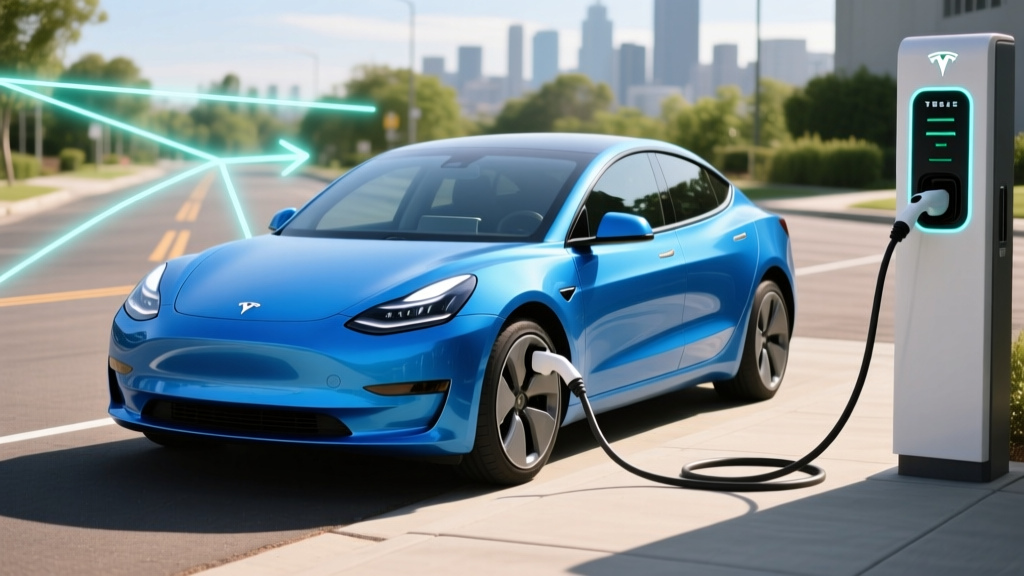
The Tesla Supercharger network remains a significant ownership advantage. With over 6,500 V3/V4 Supercharger stalls across the US and the transition to NACS as the industry standard connector, Model 3 owners enjoy the most seamless plug-and-charge experience available. Non-Tesla EVs now access Superchargers via adapter, but Tesla owners still benefit from native integration — no adapter required, automatic billing, and preconditioning that ramps battery temperature for optimal charge speed as you navigate to a station.
Auto Steering and Driver Assistance: Autopilot vs. FSD Supervised
When buyers search for "auto steering Tesla," they're typically evaluating two systems: basic Autopilot (included standard) and Full Self-Driving Supervised (a $8,000 option or $99/month subscription as of early 2026).
Autopilot (standard) provides Traffic-Aware Cruise Control and Autosteer — lane-centering on marked highways with adaptive speed management. It handles well-marked interstates competently but can struggle with faded lane markings, construction zones, and complex merges. The auto steering inputs are smooth but the system occasionally "hunts" slightly within the lane on curves.
FSD Supervised extends capability to city streets: it can navigate intersections, respond to traffic lights and stop signs, execute turns, and handle roundabouts — all with active driver supervision. In 2026 testing, FSD Supervised has shown marked improvement in urban navigation, but it still makes occasional puzzling decisions: unnecessary lane changes, overly conservative stops at empty intersections, and hesitation during unprotected left turns in heavy traffic. The system is genuinely useful for reducing driver fatigue on long trips and commuting, but it absolutely requires an attentive driver prepared to intervene.
Interior, Cargo, and Daily Livability
The Model 3's interior is a study in reduction. A single 15.4-inch touchscreen handles all infotainment, climate, and vehicle controls. There are no physical buttons, no instrument cluster, and no traditional stalks — turn signals and wipers are activated via steering-wheel buttons (a change that remains polarizing among owners). The 2026 refresh (carried over from the "Highland" update) improved cabin materials, added ventilated front seats, ambient lighting, and a rear passenger touchscreen, addressing the most common complaints about the pre-refresh interior.
Passenger space is adequate for four adults but tight for five. Rear legroom measures 35.2 inches — sufficient for average-height passengers but snug for anyone over 6'2" behind a tall driver. Headroom is generous thanks to the glass roof, though that roof offers no shade option, which some owners find creates cabin heat on sunny days.
Cargo capacity totals 23 cubic feet combined (trunk + frunk). The trunk offers 21 cu ft with a wide, practical opening and 60/40 split-folding rear seats. The frunk adds 2 cu ft — useful for charging cables or a small bag but not a primary cargo area. For comparison, the Hyundai Ioniq 6 offers 12.3 cu ft of trunk space (no frunk), while the BMW i4 provides 16.6 cu ft — the Model 3 leads the segment here.
Pricing, Trims, and Federal Tax Credit Eligibility
| Trim | Base MSRP | Est. After §30D Credit* | Destination |
|---|---|---|---|
| Standard Range RWD | $38,990 | ~$31,490 | $1,390 |
| Long Range AWD | $45,990 | ~$38,490 | $1,390 |
| Performance AWD | $52,990 | ~$45,490 | $1,390 |
*Assumes full $7,500 §30D credit eligibility. Actual credit depends on buyer income, battery sourcing, and MSRP caps — see details below.
The IRS §30D federal tax credit offers up to $7,500 for qualifying new EVs, but eligibility is not automatic. As of 2026, the Model 3 qualifies, but you must meet all of the following:
- Income caps: Modified AGI must not exceed $150,000 (single), $225,000 (head of household), or $300,000 (married filing jointly)
- MSRP cap: The vehicle's MSRP must not exceed $55,000 for sedans (all Model 3 trims currently comply)
- Battery sourcing: A percentage of critical minerals and battery components must be sourced from the US or free-trade-agreement countries — Tesla's supply chain has largely met these thresholds for the full $7,500, but this is subject to annual IRS guidance updates
- Point-of-sale transfer: As of 2024, you can transfer the credit to the dealer at purchase, reducing your out-of-pocket cost immediately rather than waiting for tax filing
Consult a tax professional before relying on credit eligibility — rules can shift with IRS guidance, and your individual tax situation determines whether you can use a non-refundable credit.
Warranty, Ownership Costs, and Long-Term Outlook
Tesla's warranty coverage breaks down as follows:
- Basic vehicle: 4 years / 50,000 miles
- Battery & drive unit (Standard Range): 8 years / 100,000 miles, with minimum 70% capacity retention
- Battery & drive unit (Long Range/Performance): 8 years / 120,000 miles, with minimum 70% capacity retention
The 70% retention threshold is standard across the industry but worth noting: it means Tesla considers a battery that has lost 29% of its original capacity to be within normal spec. Real-world degradation data from owner fleets suggests Model 3 batteries typically lose roughly 5–8% capacity in the first 50,000 miles, then the degradation curve flattens considerably. Most Model 3s on the road with 100,000+ miles still retain 88–92% of original capacity.
Insurance costs remain a consideration. Model 3 premiums average 15–25% higher than comparable gas sedans, driven by repair costs (particularly for collision damage involving the battery pack or sensor suite) and Tesla's direct-repair network pricing. Get quotes from multiple insurers before purchasing — the spread between carriers can be $800–$1,500 annually.
Tesla does not publish scheduled maintenance intervals because there are none in the traditional sense. No oil changes, no spark plugs, no transmission fluid. Cabin air filter replacement (~$50–$100 every 2–3 years), tire rotation, and wiper fluid are the primary recurring costs. Brake pad replacement is rare thanks to regenerative braking — many Model 3 owners report original pads at 80,000+ miles.
Pros, Cons, and Who Should Buy the Model 3
- Class-leading efficiency (24 kWh/100mi) minimizes charging cost
- Supercharger network provides best-in-class road-trip charging
- 363-mile EPA range on Long Range eliminates most range anxiety
- 250 kW DC fast charging adds ~170 miles in 15 minutes
- Strong resale value relative to non-Tesla EVs
- OTA updates continuously add features post-purchase
- LFP battery on Standard Range allows daily 100% charging
- No physical controls — all functions routed through touchscreen
- Steering-wheel turn signals take significant adaptation
- FSD Supervised ($8,000) remains Level 2, not autonomous
- Rear seat tight for tall passengers (35.2" legroom)
- Insurance premiums run 15–25% above segment average
- Glass roof lacks shade — cabin heat in summer sun
- Service center wait times can stretch weeks in some markets
Frequently Asked Questions
What is the real-world range of the 2026 Tesla Model 3?
The EPA rates the Long Range AWD at 363 miles, but sustained 75 mph highway driving yields roughly 290–315 miles. In freezing temperatures, expect a 20–30% reduction, bringing winter highway range to approximately 230–260 miles. The Standard Range RWD delivers roughly 220–240 real-world highway miles in moderate conditions and 170–200 in deep cold.
How fast does the Model 3 charge at home and on the road?
On a 48-amp Level 2 home charger (11.5 kW), the Model 3 adds about 44 miles per hour — a full overnight charge covers virtually any daily commute. On a V3/V4 Supercharger at 250 kW peak, a 10–80% charge takes approximately 25–30 minutes, though sustained rates drop significantly above 50% SoC due to the charge curve taper.
Does the Tesla Model 3 qualify for the $7,500 federal tax credit?
As of 2026, yes — all Model 3 trims fall under the $55,000 sedan MSRP cap and Tesla's battery supply chain meets critical-mineral and component sourcing requirements. However, buyer income must not exceed IRS thresholds ($150K single / $300K joint), and you should verify current-year eligibility on irs.gov before purchasing. The credit can be transferred at point of sale to reduce your purchase price immediately.
Is Tesla's auto steering (Autopilot/FSD) actually self-driving?
No. Both Autopilot and FSD Supervised are SAE Level 2 driver-assistance systems. They can steer, accelerate, and brake within their operational limits, but the driver must remain fully engaged and ready to take over at any moment. FSD Supervised extends capability to city streets and intersections but still makes errors that require human correction. True self-driving (Level 4) is available only in geofenced robotaxi services, not in consumer vehicles.
How does the Model 3 compare to the Hyundai Ioniq 6 and BMW i4?
The Model 3 Long Range beats the Ioniq 6 on range (363 vs. 361 miles — essentially a tie) and charging infrastructure access (Superchargers vs. third-party networks). The Ioniq 6 offers a more conventional interior with physical buttons and slightly faster 10–80% DC charging (~18 minutes at 350 kW capable). The BMW i4 provides a premium interior and traditional driving feel but trails significantly on range (up to 307 miles) and starts above $52,000. For tech-forward buyers who prioritize charging network reliability, the Model 3 wins. For those wanting luxury or physical controls, look at the i4 or Ioniq 6.
What's the biggest long-term ownership risk?
Battery degradation is minimal based on fleet data (typically 8–12% over 100,000 miles), and the 8-year/120,000-mile battery warranty provides a strong backstop. The greater ownership risks are insurance costs (get quotes before buying), potential service-center delays in your market, and the ongoing uncertainty around FSD's long-term value proposition — if you buy the $8,000 FSD package, understand you're paying for a Level 2 system with the hope of future capability, not a guaranteed autonomous vehicle.