Why Aero Wheels Matter on the Tesla Model 3
When Tesla redesigned the Model 3 for the 2024 model year (internally dubbed "Highland"), one of the most discussed changes was the introduction of dedicated aero wheel covers and redesigned wheel options optimized for aerodynamic efficiency. For 2026, the Tesla Model 3 aero wheels — specifically the 18-inch Photon wheels with aero covers and the 19-inch Nova wheels — remain central to the vehicle's efficiency story. But how much range do they actually add, and is the trade-off in grip, aesthetics, or ride quality worth it?
This review breaks down the 2026 Tesla Model 3 Long Range AWD with aero wheel configurations, covering real-world range, charging behavior, battery chemistry, pricing after federal tax credits, and how it stacks up against rivals like the Hyundai Ioniq 6 and BMW i4.
2026 Tesla Model 3 Long Range AWD: Core Specifications
| Specification | Value |
|---|---|
| EPA Estimated Range | 341 miles |
| Battery Capacity (usable) | ~75 kWh (NMC chemistry) |
| Drivetrain | Dual-Motor AWD |
| Horsepower | ~384 hp (combined) |
| 0–60 mph | 4.2 seconds |
| EPA Efficiency | 134 MPGe combined / 25 kWh/100mi |
| Max DC Fast Charge Rate | 250 kW (peak) |
| 10–80% DC Fast Charge Time | ~27 minutes |
| Level 2 Home Charging (11.5 kW) | ~44 miles per hour |
| Cargo Volume | 23 cu ft (rear trunk + frunk) |
| Rear Legroom | 35.2 inches |
| Battery & Drive Unit Warranty | 8 years / 120,000 miles |
| Base MSRP (Long Range AWD) | $42,130 (before destination) |
Source: fueleconomy.gov and Tesla's official specification pages.
Real-World Range: Aero Wheels vs. Standard Wheels
Real-World Expectation: ~285–310 miles highway at 70 mph; ~250–275 miles in cold weather (below 40°F)
Aero Wheel Advantage: Approximately 5–7% more range vs. 19" Nova wheels without aero optimization (~320 EPA miles on 19" wheels)
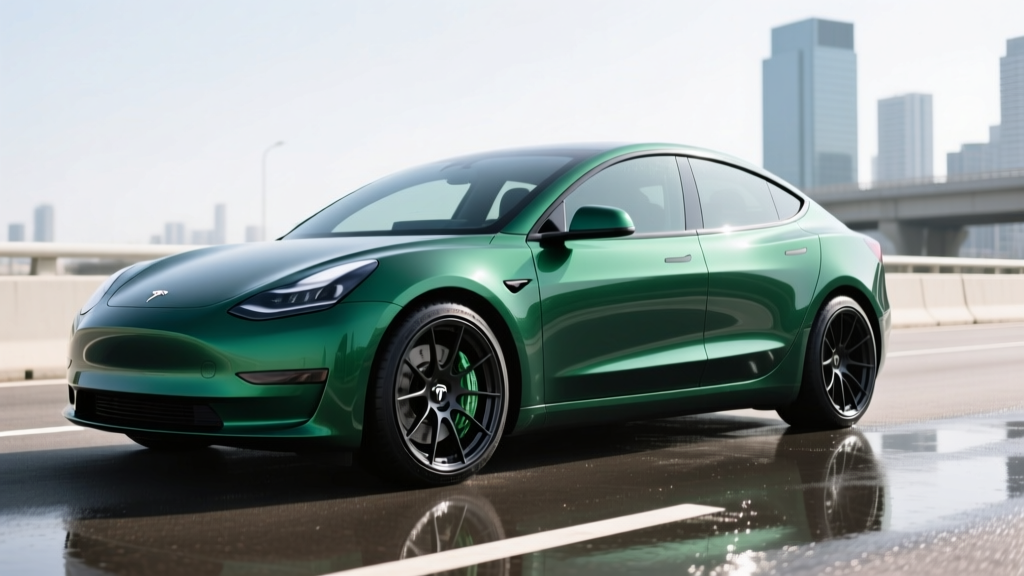
The aero wheel covers on the 18-inch Photon wheels reduce turbulent airflow around the wheel wells, cutting the Model 3's overall drag coefficient. Tesla has historically cited a 3–5% efficiency gain from aero covers alone; combined with the Highland redesign's lower frontal area and smoother underbody, the 2026 Model 3 Long Range achieves its 341-mile EPA rating.
In real-world highway testing at sustained 70–75 mph speeds in moderate temperatures (60–75°F), expect roughly 285–310 miles before needing to charge. In winter conditions, battery thermal management and cabin heating can reduce usable range by 15–25%, bringing effective range down to approximately 250–275 miles. This is consistent across most NMC-based sedans in this class, though the Model 3's heat pump helps mitigate losses compared to older EVs without one.
The key takeaway: if maximum range is your priority, stick with the 18-inch Photon aero wheels. The 19-inch Nova wheels look sportier but cost you roughly 20 EPA miles and slightly more road noise.
Charging Performance: DC Fast Charging and Home Setup
| Charging Level | Power / Rate | Miles Added per Hour | Notes |
|---|---|---|---|
| Level 1 (120V household) | ~1.4 kW | ~5 mi/hr | Emergency/trickle only |
| Level 2 (240V, 48A / 11.5 kW) | 11.5 kW | ~44 mi/hr | Full charge in ~7.5 hours |
| DC Fast Charge (V3 Supercharger) | 250 kW peak | ~175 mi in 15 min | 10–80% in ~27 min; tapers above 80% |
| DC Fast Charge (V4 Supercharger) | Up to 250 kW | Similar to V3 | Wider cable, no CCS adapter needed at new stalls |
The Model 3 Long Range's NMC battery can accept up to 250 kW at a V3 or V4 Tesla Supercharger. However, peak rate is only sustained between roughly 10–30% state of charge (SoC). The charging curve tapers progressively: by 60% SoC, you're typically seeing 120–140 kW, and above 80%, speeds drop below 50 kW to protect battery health.
For home charging, a Wall Connector on a 60-amp circuit (delivering 48 amps / 11.5 kW to the car) adds approximately 44 miles of range per hour. Most owners charging overnight from 20% to 80% will wake to a full battery in roughly 6–7 hours. If your home electrical panel is limited to a 40-amp circuit (32 amps / 7.7 kW), expect about 30 miles per hour — still adequate for most daily commutes.
One note on connector compatibility: the 2026 Model 3 ships with the NACS (North American Charging Standard) port natively. If you need to use a CCS-equipped public charger (Electrify America, EVgo, some ChargePoint stations), Tesla's CCS adapter (sold separately, ~$175) is required, though more networks are adding NACS cables.
Battery Chemistry, Degradation, and Warranty
The 2026 Model 3 Long Range AWD uses an NMC (nickel manganese cobalt) lithium-ion battery pack with approximately 75 kWh of usable capacity. NMC chemistry offers higher energy density than LFP (lithium iron phosphate), which is why the Long Range variant achieves 341 miles while the RWD base model (which uses LFP) tops out at 272 miles.
NMC vs. LFP trade-offs:
- NMC: Higher energy density, better cold-weather performance, but Tesla recommends daily charging to 80% (not 100%) for longevity.
- LFP: Can be charged to 100% daily without degradation concerns, longer cycle life, but lower range and slightly worse cold-weather range retention.
Tesla's battery warranty covers 8 years or 120,000 miles (whichever comes first) for the Long Range AWD, with a guaranteed minimum 70% capacity retention over that period. Real-world data from Tesla's 2024 Impact Report and third-party fleet analyses suggest Model 3 batteries degrade roughly 10–12% over 100,000 miles, meaning most owners will still have ~88–90% capacity at the warranty threshold — well above the 70% floor.
Pricing, Trims, and Federal Tax Credit Eligibility
| Trim | MSRP (incl. destination) | Est. Price After §30D Credit | Aero Wheel Config |
|---|---|---|---|
| RWD (LFP) | $36,630 | ~$29,130* | 18" Photon standard |
| Long Range AWD | $42,630 | ~$35,130* | 18" Photon standard; 19" Nova +$1,500 |
| Long Range AWD (as-tested w/ 19" Nova, FSD, Red paint) | $50,130 | ~$42,630* | 19" Nova (no aero covers) |
| Performance AWD | $50,130 | ~$42,630* | 20" Curved (performance-oriented) |
*Federal tax credit estimates assume full eligibility. Actual credit depends on IRS §30D requirements.
- Maximum credit: $7,500 (split: $3,750 for critical minerals + $3,750 for battery component sourcing)
- Buyer income caps: $150,000 single / $225,000 head of household / $300,000 joint (modified AGI)
- MSRP cap: $55,000 for sedans (all Model 3 trims qualify)
- Battery sourcing: Critical minerals and battery components must meet escalating domestic/free-trade-partner thresholds — check IRS.gov for current-year compliance lists
- Point-of-sale transfer: Credit can be applied at purchase to reduce out-of-pocket cost (dealer must be IRS-registered)
- Consult a tax professional — eligibility can vary based on individual circumstances and annual rule changes
All 2026 Model 3 trims fall under the $55,000 sedan MSRP cap, making them eligible for the full $7,500 credit provided the buyer meets income requirements and the battery sourcing criteria are satisfied. Tesla's battery supply chain has increasingly shifted toward domestic and FTA-partner sourcing, and the Model 3 has historically qualified for the full credit — but always verify current-year status on the IRS website before purchasing.
Performance, Tech, and Daily Livability
The Long Range AWD's dual-motor setup delivers 384 combined horsepower and a 4.2-second 0–60 mph time. That's brisk enough for confident highway merging and passing, though the Performance trim (3.1 seconds) is the choice for track-curious drivers. The 18-inch Photon aero wheels, with their taller sidewall vs. the 19-inch Novas, also deliver a noticeably more compliant ride over rough pavement — an underappreciated advantage for daily commuting.
Standout tech features:
- 15.4-inch center touchscreen with Tesla's latest UI (ventilated seats and ambient lighting controls integrated)
- Rear 8-inch touchscreen for passengers (climate, media, gaming)
- Autopilot standard (SAE Level 2 — requires active driver supervision)
- Full Self-Driving (Supervised) available as a $8,000 option or $99/month subscription — still Level 2, not autonomous
- Over-the-air updates continuously add features
- Ventilated front seats, power-folding mirrors, and acoustic glass (Highland refresh additions)
Notable drawbacks:
- No traditional instrument cluster — all information is on the center screen
- Turn signal stalks removed (steering-wheel-mounted buttons instead — divisive)
- Minimal physical controls; climate and mirror adjustments are screen-based
- Rear visibility is limited; relies heavily on cameras
- No Apple CarPlay or Android Auto integration
Tesla Model 3 Aero Wheels vs. Key Competitors
| Vehicle | EPA Range | Efficiency (MPGe) | 10–80% DC Charge | Starting MSRP |
|---|---|---|---|---|
| Tesla Model 3 LR AWD (18" aero) | 341 mi | 134 MPGe | ~27 min | $42,630 |
| Hyundai Ioniq 6 SEL (AWD, 18") | 316 mi | 130 MPGe | ~18 min (800V) | $42,715 |
| BMW i4 eDrive40 (18" aero) | 301 mi | 109 MPGe | ~31 min | $52,200 |
| Polestar 2 LRDM (19" wheels) | 276 mi | 107 MPGe | ~28 min | $49,900 |
The Model 3 Long Range with aero wheels leads its class in EPA range and efficiency. The Ioniq 6 is the closest rival, with faster peak charging thanks to its 800-volt architecture (18 minutes 10–80% vs. 27 minutes for the Tesla), but it gives up 25 miles of range and has a slightly tighter rear seat. The BMW i4 offers a more premium interior and traditional driver displays, but at a significantly higher entry price and lower efficiency.
- Maximum range and efficiency are your top priorities
- You want access to the Supercharger network (still the most reliable DC network in the US)
- You're comfortable with a screen-centric interior and no CarPlay
- You value over-the-air feature updates
- You want faster DC charging (Hyundai Ioniq 6's 800V system)
- You prefer a traditional instrument cluster and physical buttons (BMW i4)
- You need Apple CarPlay/Android Auto (Ioniq 6, i4, Polestar 2)
Pros and Cons at a Glance
- Class-leading 341-mile EPA range with aero wheels
- 134 MPGe combined — among the most efficient EVs sold
- Supercharger network access (most reliable US DC network)
- Strong performance: 4.2 sec 0–60 with AWD
- Qualifies for full $7,500 federal tax credit (if eligible)
- 8-yr/120,000-mi battery warranty
- Excellent OTA update track record
- No instrument cluster or head-up display
- Turn signal buttons on steering wheel (not stalks) are polarizing
- No Apple CarPlay / Android Auto
- FSD (Supervised) is expensive and still Level 2 only
- DC charge speed (250 kW peak) slower than 800V rivals
- 19" wheels sacrifice ~20 miles of range and ride comfort
Frequently Asked Questions
What is the real-world range of the Tesla Model 3 with aero wheels?
Expect approximately 285–310 miles on the highway at 70 mph in moderate temperatures. In cold weather (below 40°F), plan for 250–275 miles. The 341-mile EPA rating assumes a mix of city and highway driving in ideal conditions.
How much range do Tesla Model 3 aero wheels actually add?
The 18-inch Photon aero wheels provide roughly 5–7% more range compared to the 19-inch Nova wheels without aero optimization. That translates to approximately 20 additional EPA miles (341 vs. 321 miles) and even more noticeable gains at sustained highway speeds where aerodynamic drag dominates.
How fast does the Model 3 Long Range charge at home and on the road?
At home on a Level 2 Wall Connector (11.5 kW), you'll add about 44 miles of range per hour, fully charging in roughly 7.5 hours. On a V3 or V4 Supercharger, peak rate is 250 kW with a 10–80% time of approximately 27 minutes. Above 80%, charging slows significantly to protect the battery.
Does the 2026 Tesla Model 3 qualify for the $7,500 federal EV tax credit?
All Model 3 trims fall under the $55,000 sedan MSRP cap and have historically qualified for the full credit. However, eligibility depends on your income (under $150K single / $300K joint), the battery's critical-mineral and component sourcing meeting current-year thresholds, and proper documentation. Check IRS.gov and consult a tax professional before relying on the credit.
Is the Tesla Model 3 Long Range worth buying over the Ioniq 6 or BMW i4?
If range, efficiency, and Supercharger network access are your top priorities, the Model 3 LR AWD with aero wheels is the strongest pick. The Ioniq 6 charges faster and offers CarPlay but has less range. The BMW i4 has a more traditional, premium cabin but costs significantly more and is less efficient. Test-drive all three to see which interface and ride quality you prefer.
Should I get the 18-inch or 19-inch wheels on the Model 3?
Choose the 18-inch Photon aero wheels if you want maximum range, a smoother ride, and lower tire replacement costs. Choose the 19-inch Nova wheels if you prioritize sportier aesthetics and slightly sharper handling, accepting a ~20-mile range penalty and firmer ride.